
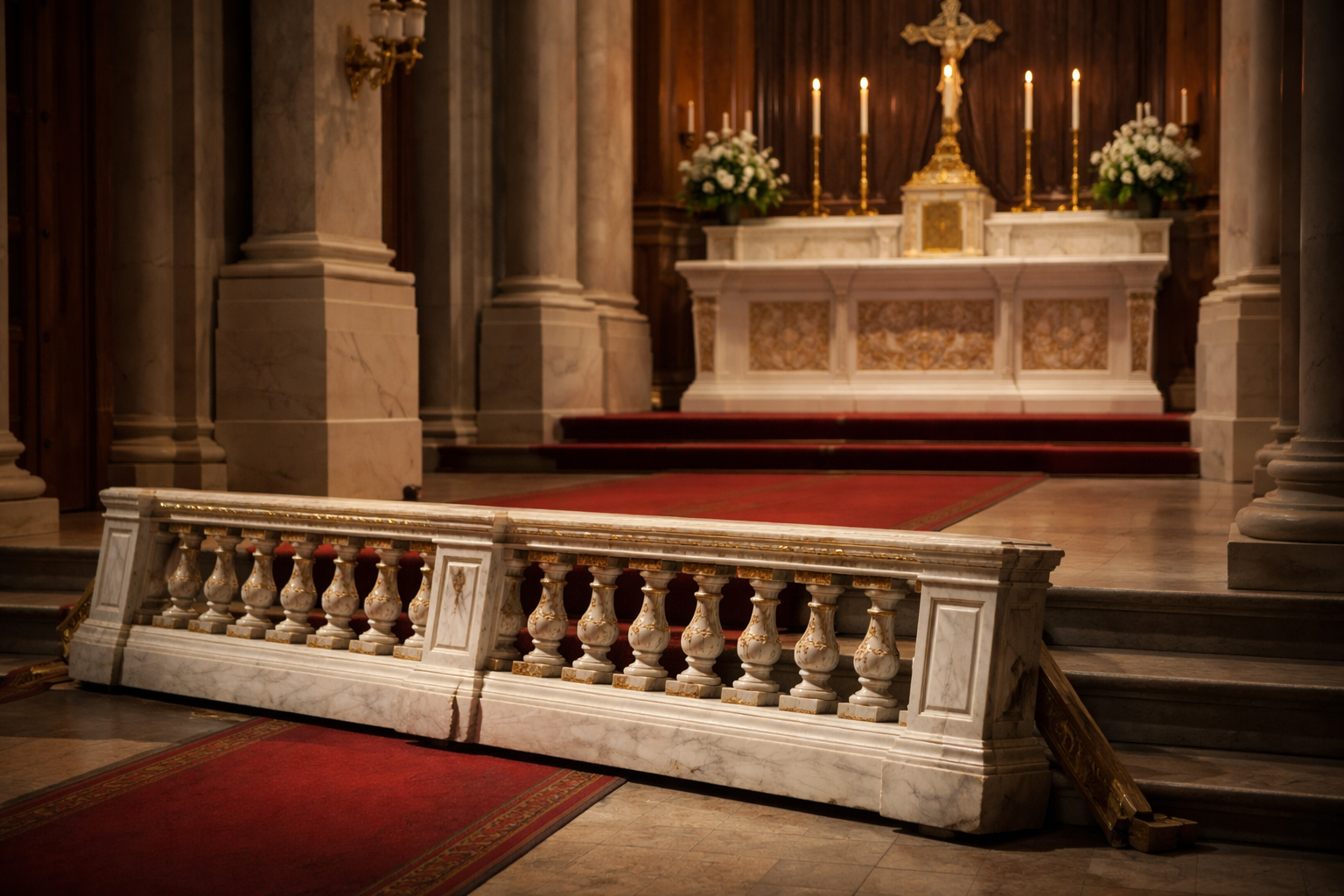
Kneeling Without Rails: How Charlotte Preserves a Right by Destroying Its Practice
In December 2025, Bishop Michael T. Martin of the Diocese of Charlotte issued a pastoral letter on the norms governing the reception of Holy Communion. While framed as a clarification of existing discipline, the letter establishes a categorical diocesan prohibition on altar rails, kneelers, and prie-dieus in public celebrations. This intervention—affirming a right in theory while dismantling its ordinary expression—has made Charlotte a test case in the limits of episcopal interpretation, liturgical continuity, and Eucharistic theology.
The national norm and the acknowledged right to kneel
Bishop Martin begins by restating the American episcopal norm: “The norm in the United States of America is that Holy Communion is to be received standing, unless an individual member of the faithful wishes to receive Communion while kneeling.”¹ This formulation accurately reflects the adaptation of the General Instruction of the Roman Missal for the United States and explicitly recognises kneeling as a lawful posture. Importantly, this right does not derive from episcopal concession but from universal liturgical law.
From law to pastoral narrative
The letter then advances a pastoral caution: “While it is the right of an individual member of the faithful to kneel, pastors should not direct their faithful to do so as something that is ‘better.’”¹ Here the argument moves beyond rubrics into theology. The claim is not that kneeling is illicit, but that it must not be presented as objectively superior. This represents a sharp departure from the Church’s historic treatment of bodily posture as a meaningful expression of doctrinal belief.
‘Not envisioned’: the interpretive sleight of hand
The pivotal claim follows: “The episcopal conference norms logically do not envision the use of altar rails, kneelers, or prie-dieus for the reception of Communion.”¹ The episcopal conference norms do not, in fact, prohibit altar rails. They do not mention them at all. What is offered here is an inference: that what is not described in modern norms is therefore implicitly excluded. Centuries of Catholic liturgical architecture are thus displaced not by legislation, but by interpretation.
From inference to prohibition
That interpretation is then enforced: “Therefore, the use of altar rails, kneelers, and prie-dieus are not to be utilized for the reception of Communion in public celebrations by January 16, 2026.”¹ This sentence establishes binding diocesan policy. A practice never abrogated by Rome, still lawful throughout the Church, is abolished locally on the basis of perceived incompatibility with a preferred visual theology.
The elimination of accommodation
The directive extends further: “Any temporary or movable fixtures used for kneeling at the reception of Communion are to be removed by that date.”¹ The effect is unmistakable. Kneeling remains theoretically permitted, but every structural or pastoral means of facilitating it is removed. The right survives on paper while its exercise is rendered difficult, conspicuous, and unsupported.
The traditional posture for Holy Communion — and why it is better
Contrary to the letter’s implication, the Church has long taught—explicitly and implicitly—that kneeling and reception on the tongue are objectively superior expressions of Eucharistic faith, even where other forms are tolerated.
St Thomas Aquinas teaches that bodily posture forms and expresses belief: *“Man shows reverence to God by outward signs, in order to give expression to the inward humility of his heart.”*² Kneeling is not a neutral option; it is the bodily confession of Christ’s real, substantial presence.
For centuries, the Roman Rite required the faithful to kneel and receive on the tongue precisely to safeguard three truths: the transcendence of the sacrament, the distinction between minister and recipient, and the priority of adoration before reception. Pope Pius XII reaffirmed that external liturgical forms are not arbitrary but “the outward profession of interior worship.”³
Even in the post-conciliar period, the Holy See has repeatedly affirmed the superiority of reception on the tongue. Redemptionis Sacramentum states that Communion on the tongue remains the normative manner of reception, and that no communicant may be compelled to receive in the hand.⁴ Pope Benedict XVI deliberately restored kneeling and reception on the tongue at papal liturgies as a catechetical act, explaining that posture teaches faith more powerfully than instruction alone.⁵
Standing, by contrast, entered the Roman Rite not as a recovery of ancient custom but as a concession driven by modern egalitarian sensibilities. Reception in the hand—explicitly described by Paul VI as a tolerated exception—was permitted only under strict conditions and with grave warnings about loss of reverence and belief.⁶ Those warnings have since been borne out by the collapse of Eucharistic faith across the West.
To assert that kneeling must not be presented as “better” is therefore not doctrinally neutral. It contradicts the Church’s historical practice, theological anthropology, and magisterial caution.
Procession replaces adoration
The letter frames Communion primarily as communal movement, citing episcopal catechesis describing the faithful as “a pilgrim people on their way.”⁷ What is displaced is the altar as place of sacrifice and the communicant as recipient before God. The altar rail—once the physical locus of this encounter—is recast as an impediment to visual uniformity.
Critical commentary and wider concern
Liturgical commentators have noted that the Charlotte directive follows earlier leaked drafts proposing restrictions on Latin, Roman vestments, and traditional practices, prompting widespread criticism.⁸ Catholic World Report has warned that “a bishop’s preferences cannot become law,” particularly where universal norms permit what local policy suppresses.⁹ The National Catholic Register reported strong concern among clergy and laity that the diocese is enforcing conformity not required by Rome.¹⁰
Editorial assessment
The Charlotte directive does not formally ban kneeling. It achieves the same end by dismantling the conditions under which kneeling has meaning, dignity, and continuity. The altar rail is not decorative furniture but a theological statement about mediation, hierarchy, and reverence. Its removal signals not pastoral generosity but a narrowing of acceptable Catholic expression. What is at stake is not posture, but whether inherited forms of belief may be quietly extinguished under the language of unity.
- Michael T. Martin, OFM Conv., Pastoral Letter on Norms for Holy Communion, Diocese of Charlotte, 17 December 2025.
- St Thomas Aquinas, Summa Theologiae, II–II, q.84, a.2.
- Pope Pius XII, Mediator Dei (1947), §20.
- Congregation for Divine Worship and the Discipline of the Sacraments, Redemptionis Sacramentum (2004), §§90–92.
- Benedict XVI, The Spirit of the Liturgy, Ignatius Press, 2000, pp. 89–91.
- Paul VI, Memoriale Domini (1969).
- United States Conference of Catholic Bishops, catechetical commentary on the Communion procession.
- National Catholic Register, reporting on leaked Charlotte diocesan liturgical drafts, May 2025.
- Catholic World Report, “Why a Bishop’s Preferences Can Never Become Law,” June 2025.
- National Catholic Register, coverage of diocesan and parish reactions to the Charlotte Communion norms, November–December 2025.
RELATED ARTICLES


Latest ARTICLES
- Today’s Mass: September 06 Sunday XV Post PentecostThe Fifteenth Sunday After Pentecost’s Mass emphasises the importance of living in accordance with the Holy Spirit, cultivated through the Eucharist. It reflects on Jesus’ compassion for humanity, recalling His miracles. The readings encourage believers to prioritise spiritual matters over worldly anxieties and to embody love for one another, resonating with St. Paul’s teachings.
- Sermon for Fifteenth Sunday after PentecostIn St. Paul’s epistle to the Galatians, he urges believers to live by the Spirit, embodying charity and truth without envy. He emphasises that faith, not race or ritual, defines the people of God. Through Jesus, Gentiles can worship without conversion to Judaism, receiving the Holy Spirit by repentance and baptism.
- Today’s Mass: September 05 Saint Lawrence JustinianSaint Lawrence Justinian, the first Patriarch of Venice, dedicated his life to the poor and the establishment of monasteries, rejecting noble marriage. Renowned for his humility and pastoral dedication, he emphasised the spiritual integrity of Venice’s safety. He was a precursor to the reforms of the Council of Trent, dying on 8 January 1455.
- 06.09.26 Nuntiatoria CXXII: NOMEN MANET, RES DEESTThis edition of Nuntiatoria explores the disconnect between the names of Catholic institutions and the realities they signify. Despite retaining their titles, many aspects of Catholicism—such as episcopal authority in China and religious practice in Poland—exhibit deteriorating substance. The piece cautions against superficial continuity, stressing the importance of genuine faith and practice over mere nomenclature.
- ORDO w/c 06.09.26The document outlines the liturgical schedule for the week of 6 to 13 September 2026, highlighting significant religious observances such as the Fifteenth Sunday after Pentecost and the Nativity of the Blessed Virgin Mary. It reflects on themes of compassion, holiness, fidelity, and humility, underscoring their importance in Christian life.




Leave a Reply