
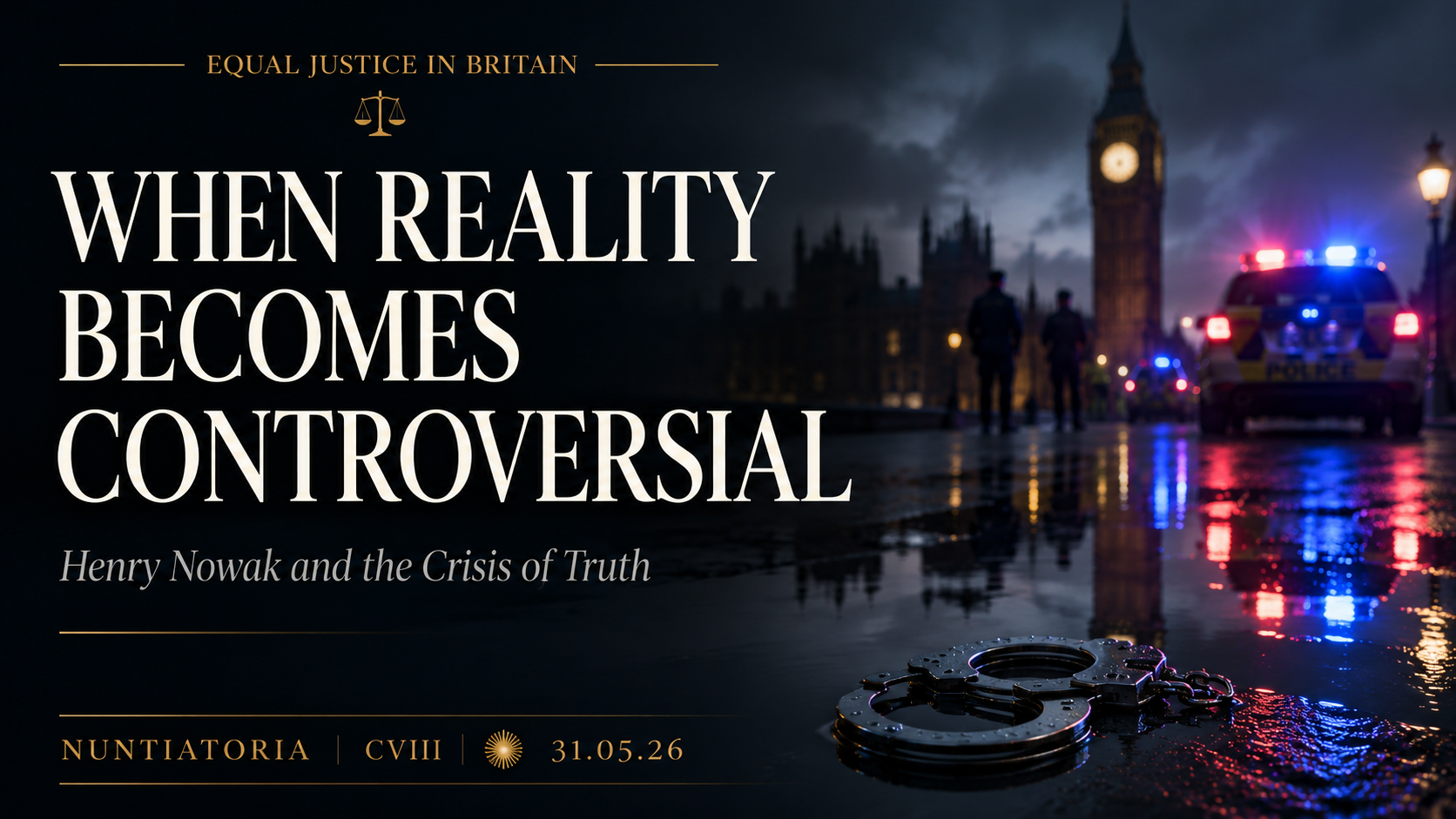
WHEN REALITY BECOMES CONTROVERSIAL: HENRY NOWAK, TRUTH, AND THE EROSION OF LEGITIMATE AUTHORITY IN BRITAIN
The death of an eighteen-year-old student has become a national test of whether truth remains prior to power in modern Britain.

The murder of Henry Nowak has become one of the most consequential public controversies in recent British life, not because the crime itself was uniquely shocking, nor because the courts failed to deliver a verdict, but because the reaction to the events surrounding his death has exposed a deeper and more unsettling question: whether Britain’s institutions still possess the capacity—and the confidence—to recognise reality when it stands plainly before them. What began as a criminal case has become a test of legitimacy, and what is being tested is not merely the conduct of individuals but the intellectual and moral foundations upon which public authority rests.
The essential facts of the case are not in serious dispute. Henry Nowak, an eighteen-year-old student, was fatally stabbed in Southampton. His killer claimed self-defence and alleged racist abuse; the jury rejected that account and returned a conviction for murder. The prosecution described the allegation as a “wicked lie,” deployed to justify an otherwise indefensible act. In legal terms, the matter was concluded. Yet the public response that followed made clear that something far larger than a criminal verdict was now at stake.
The controversy that emerged did not arise from the trial itself but from the release of police body-worn video footage. The footage showed Nowak, gravely wounded, repeatedly stating that he had been stabbed, struggling to breathe, and seeking assistance. What disturbed many viewers was not merely the possibility that mistakes were made in a chaotic and uncertain situation, but the perception that his account appeared, at least initially, to carry less weight than that of the individual who had inflicted the injuries. This perception—whether ultimately confirmed or qualified by investigation—proved decisive in shaping public reaction.
That reaction cannot adequately be explained in partisan terms. It is tempting to frame the controversy as a conflict between political camps, but such an explanation obscures the deeper issue. The intensity of the public response reflects a growing unease that institutions may no longer trust their own capacity to recognise reality. The concern is not simply that an error occurred, but that the conditions exist in which such an error becomes intelligible. The distinction is crucial. A mistake may be forgiven; a framework that renders mistakes predictable is far more difficult to ignore.
The official response underscores the seriousness of the situation. Hampshire and Isle of Wight Constabulary issued a formal apology, acknowledging that Henry Nowak had been handcuffed shortly before his death and that the circumstances required full scrutiny. The force referred itself to the Independent Office for Police Conduct, which has launched an investigation into the officers’ actions, including their decision-making, their treatment of Nowak, and the medical assistance provided. These are not marginal procedural matters. They go directly to the question of how reality was assessed at the scene.
At the same time, it must be acknowledged that competing explanations exist. Some policing experts have argued that the events can be explained by confusion, poor situational awareness, and the difficulties inherent in rapidly evolving incidents. Darkness, visibility, incomplete information, and human error may all have played a role. It is essential that such explanations are taken seriously. A mature public discourse does not foreclose inquiry in favour of predetermined conclusions. Yet even if such explanations prove sufficient, they do not fully resolve the controversy. The scale of the public reaction demands a further question: why did so many people immediately suspect that something more than error might be involved?
It is here that the controversy moves beyond the particulars of the case and enters the realm of principle. For centuries, the English legal tradition rested upon a simple but profound assumption: that truth exists independently of power. The purpose of law is not to create reality but to discover it. This assumption is embedded in the development of English constitutional thought. Magna Carta established that authority itself is subject to law. The jurist Henry de Bracton gave this principle enduring expression in his formulation that the ruler is “under God and under the law,” a statement that places authority beneath an objective moral and legal order. Later jurists, including Coke and Blackstone, developed this tradition further, insisting that law must conform to reality rather than redefine it.
This inheritance shaped the character of British institutions. Courts were understood to be places where facts were established, not constructed. Police were expected to follow evidence rather than narrative. Legitimacy depended upon a shared belief that institutions were attempting, however imperfectly, to discern what had actually occurred. Errors could be corrected because the standard of correction—truth—remained constant.
The anxiety exposed by the Nowak case suggests that this relationship may be weakening. Increasingly, there is a perception that facts are filtered through interpretive frameworks before they are assessed. Categories of identity, power, and social meaning appear to mediate perception itself. The issue is not that such frameworks are inherently illegitimate, but that they risk displacing the more fundamental task of establishing what has taken place. When interpretation precedes observation, judgment becomes vulnerable to distortion.
This philosophical shift has practical consequences. It shapes not only how events are understood but how they are described. The controversy surrounding media coverage of the case illustrates this dynamic. During a widely discussed broadcast, a political figure’s phrase “pure cold rage” was repeatedly rendered with an added racial qualifier that did not appear in the original statement. The subsequent correction and apology did not merely resolve a factual error; they became part of the wider story. For many observers, the incident served as a small but telling example of the broader concern: that interpretation is increasingly applied before description is complete.
Such developments recall the warning articulated by George Orwell, who observed that political language can be used to obscure rather than clarify reality. When words cease to describe what is and instead reshape what is perceived, the boundary between truth and narrative begins to erode. Institutions that lose confidence in straightforward description risk losing confidence in judgment itself.
The consequences for public trust are significant. Modern governance depends not primarily upon coercion but upon legitimacy. The principle that the police derive their authority from public consent presupposes that the public believes them to act fairly and impartially. Trust is sustained not by perfection but by consistency. It is eroded when citizens suspect that reality itself is being interpreted through lenses that distort rather than clarify.
It is therefore necessary to distinguish between legitimate and illegitimate responses to the case. Public anger at perceived injustice is not inherently dangerous; indeed, it has historically played a role in exposing wrongdoing and prompting reform. At the same time, calls for disorder, vigilantism, or the abandonment of lawful authority cannot be justified. The events in Southampton, including public disorder and injuries to police officers, demonstrate how quickly legitimate concern can give way to destabilising reaction. A serious analysis must hold both truths together: the right to question institutions and the obligation to preserve the rule of law.
The deeper significance of the Nowak case lies in its symbolic power. It has become a focal point for a broader unease about the condition of British institutions. The concern is not that they occasionally fail, but that they may be drifting away from the assumptions that once made their authority credible. The question is no longer confined to a single incident. It is whether Britain retains the intellectual and moral framework necessary to recognise reality and act upon it.
History suggests that civilisations rarely decline through sudden collapse. More often they erode gradually as confidence in their institutions diminishes. This erosion begins in language, where words lose their connection to reality. It proceeds into law, where objective standards give way to competing interpretations. It culminates in governance, where institutions become preoccupied with managing narratives rather than discovering truth. By the time the consequences are fully visible, the underlying transformation is already advanced.
The unease provoked by the death of Henry Nowak arises because many citizens believe they have glimpsed such a process at work. Whether that perception proves fully justified is less important than the fact that it has taken hold. For public trust depends not only upon what institutions do, but upon what people believe them to be doing.
The challenge facing Britain is therefore not simply to investigate the events in Southampton. It is to demonstrate that its institutions remain anchored in the principles that once sustained their legitimacy: that reality is not negotiable, that truth is not subordinate to interpretation, and that authority is accountable to fact. Without that foundation, no amount of procedure, training, or reform can restore confidence.
A society can endure error. It can endure controversy. It can even endure injustice for a time. What it cannot endure indefinitely is the suspicion that it has lost its capacity to recognise what is real. For when that capacity is lost, the very possibility of justice is placed in doubt.
- Southampton Crown Court proceedings, June 2026, prosecution submissions.
- Hampshire Police body-worn video footage and subsequent reporting.
- Hampshire and Isle of Wight Constabulary public statement and apology, May–June 2026.
- Independent Office for Police Conduct, investigation announcement and scope, 2026.
- Policing commentary and expert analysis concerning situational awareness and operational error, June 2026.
- Broadcast transcript and subsequent correction concerning “cold rage” remarks.
- Media reports concerning BBC clarification and apology regarding misquotation, June 2026.
- Public commentary on legitimacy of anger and institutional response, including national press debate, June 2026.
- George Orwell, “Politics and the English Language,” Horizon, April 1946.
- Sir Robert Peel, Principles of Policing, 1829.
- Magna Carta, 1215, clauses 39–40.
- Henry de Bracton, De Legibus et Consuetudinibus Angliae.
- Sir Edward Coke, Second Institute of the Laws of England.
- William Blackstone, Commentaries on the Laws of England.
- Lord Bingham, The Rule of Law, 2010.
RELATED ARTiCLES


LATEST ARTICLES
- Today’s Mass: September 05 Saint Lawrence JustinianSaint Lawrence Justinian, the first Patriarch of Venice, dedicated his life to the poor and the establishment of monasteries, rejecting noble marriage. Renowned for his humility and pastoral dedication, he emphasised the spiritual integrity of Venice’s safety. He was a precursor to the reforms of the Council of Trent, dying on 8 January 1455.
- 06.09.26 Nuntiatoria CXXII: NOMEN MANET, RES DEESTThis edition of Nuntiatoria explores the disconnect between the names of Catholic institutions and the realities they signify. Despite retaining their titles, many aspects of Catholicism—such as episcopal authority in China and religious practice in Poland—exhibit deteriorating substance. The piece cautions against superficial continuity, stressing the importance of genuine faith and practice over mere nomenclature.
- ORDO w/c 06.09.26The document outlines the liturgical schedule for the week of 6 to 13 September 2026, highlighting significant religious observances such as the Fifteenth Sunday after Pentecost and the Nativity of the Blessed Virgin Mary. It reflects on themes of compassion, holiness, fidelity, and humility, underscoring their importance in Christian life.
- The Fifteenth Sunday after Pentecost: When the Procession of Death Meets the Lord of LifeThe Fifteenth Sunday after Pentecost focuses on the transformative power of Christ, emphasising the supernatural life granted through grace. The liturgy highlights the Church’s role as a nurturing mother, mourning the spiritually dead while seeking their restoration. Christ’s compassion leads to resurrection, demonstrating that true life is found in dependence on Him.
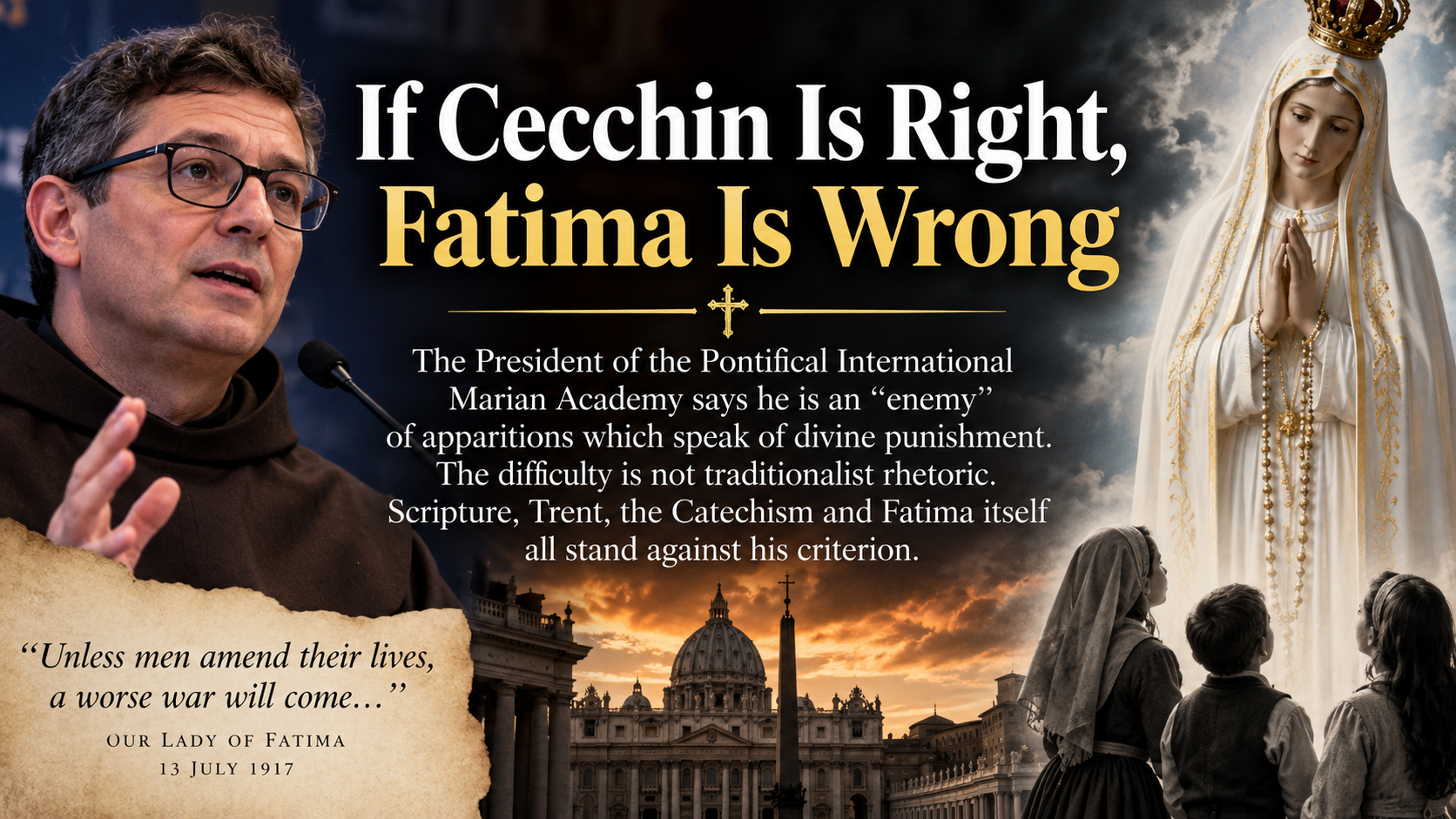
- If Cecchin Is Right, Fatima Is WrongFr Stefano Cecchin, President of the Pontifical International Marian Academy, has declared opposition to apparitions that speak of divine punishment, suggesting they are false. This stance contradicts fundamental Catholic doctrine, including teachings from Scripture, the Catechism, and specifically the Message of Fatima, which warns of divine consequences for sin.
CURRENT EDITION


DAILY MASS ONLINE
One of the earliest online apostolates dedicated to the Traditional Latin Mass, Old Roman TV began broadcasting the Holy Sacrifice on the Feast of the Assumption, 15 August 2008. During the COVID-19 pandemic, additional programming — devotions, catechesis, and conferences — was added to support the faithful in prayer and formation.
Support the daily Holy Mass on Old Roman TV by offering a Mass intention — for loved ones, thanksgiving, or the repose of souls. Your intention helps sustain the sacred liturgy and brings grace to those you remember before God’s altar.
SUPPORT THE DAILY MASS ONLINE
Likely the world’s longest-running daily online broadcast of the
Traditional Latin Mass, streaming faithfully since the
Feast of the Assumption 2008.

This apostolate cannot continue without immediate help
Please support us with a contribution toward
chapel rent, sacristy supplies, operating costs, and web-hosting.
Our essential monthly costs reach £1,000.
MASS INTENTIONS
If your offering is for a Mass Intention, kindly complete the form below in full so we may correctly match it to your donation. For anniversary intentions — birthdays, wedding anniversaries, anniversaries of death — please be sure to include the relevant date.


Today’s Mass Propers
- Today’s Mass: September 05 Saint Lawrence Justinian
 Saint Lawrence Justinian, the first Patriarch of Venice, dedicated his life to the poor and the establishment of monasteries, rejecting noble marriage. Renowned for his humility and pastoral dedication, he emphasised the spiritual integrity of Venice’s safety. He was a precursor to the reforms of the Council of Trent, dying on 8 January 1455.



Leave a Reply