
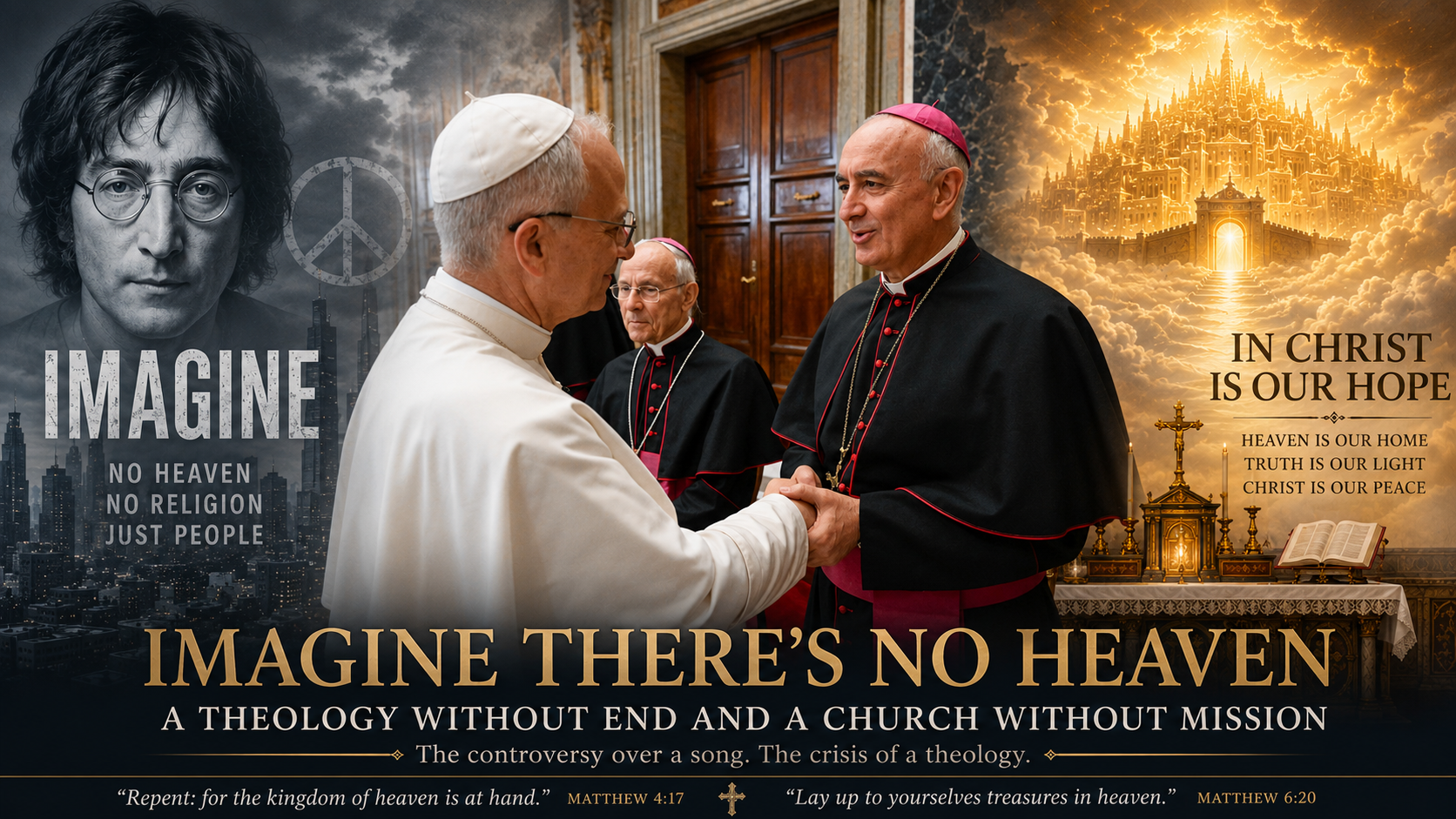
Imagine There’s No Heaven: A Theology Without End and a Church Without Mission

The controversy surrounding Bishop Antonio Staglianò, President of the Pontifical Academy of Theology, has been widely presented as a dispute over a song. In truth, it is a dispute over the nature of Christianity itself. When a senior Vatican theologian publicly declares that “Even Jesus would have sung this song with conviction and without fear of the ideology underlying it,” and, when pressed, affirms “Assolutamente sì” to the proposition that this includes the lines imagining “no heaven” and “no religion too,” the question ceases to be cultural and becomes doctrinal. When he further asserts that “The message of Imagine reaches the heart of Jesus’ preaching on Heaven and on God,” and responds to accusations of heterodoxy by asking, “Come può essere eretico il Presidente della Pontificia Accademia di Teologia?”—“How can the President of the Pontifical Academy of Theology be a heretic?”—before adding, “Forse sono eretici quelli che accusano me di eresia,” the matter becomes not only doctrinal but diagnostic. It reveals a theology that has begun to lose its object.
To understand why these statements have provoked such alarm, one must first attend to the plain meaning of John Lennon’s Imagine. The song’s enduring popularity has dulled its sharper edges, but its logic is unmistakable. Peace is to be achieved not by conversion, redemption, or reconciliation with God, but by subtraction. Remove Heaven and Hell; remove religion; remove transcendent claims that divide; remove ultimate truths that command allegiance—and what remains is a humanity at peace with itself. It is a vision of fraternity without metaphysics, unity without truth, and harmony without God. The conditions of peace are secured by the abolition of the supernatural order. In such a vision, religion is not purified but eliminated; Heaven is not sought but denied.
Set this alongside the words of Christ. “Repent: for the kingdom of heaven is at hand” (Matthew 4:17). “Lay up to yourselves treasures in heaven” (Matthew 6:20). “In my Father’s house are many mansions” (John 14:2). The Gospel does not counsel the imagination of a world without Heaven; it summons men to orient their lives towards it. The Apostolic preaching does not dissolve religion into a vague humanitarianism; it establishes the Church, commands baptism, and teaches all nations to observe whatsoever Christ has commanded (Matthew 28:19–20). The martyrs do not secure peace by suspending ultimate claims; they witness to those claims unto death because they are true. The Church’s worship is not a cultural artefact but a participation in the liturgy of Heaven. In the Christian vision, peace is not purchased by the removal of transcendence but achieved by the right ordering of man to God. To suggest that a song imagining away Heaven “reaches the heart of Jesus’ preaching” is therefore to invert the very direction of revelation.
The classical theological tradition renders the point even clearer. Thomas Aquinas teaches that man’s ultimate end is the Beatific Vision, the direct knowledge of God, which alone satisfies the human intellect and will: *“Man’s happiness consists in the vision of the Divine Essence.”*¹ This end is not reducible to social harmony or temporal flourishing. Likewise, he identifies religion as a virtue belonging to justice, whereby man renders to God what is due to Him.² Religion is therefore not an accidental feature of human life to be discarded in the pursuit of peace; it is a moral obligation grounded in the very nature of man as a creature. To imagine a world without religion is not to imagine a purified humanity but a disordered one.
The patristic witness reinforces this conclusion. Saint Augustine, in his City of God, contrasts the earthly city—founded upon the love of self—with the heavenly city—founded upon the love of God.³ He writes: “Two loves have made two cities: the love of self, even to the contempt of God, has made the earthly city; the love of God, even to the contempt of self, has made the heavenly city.” Remove the latter, and what remains is not peace but a fragile concord of competing desires. Lennon’s vision is, in Augustinian terms, a dream of unity achieved by suppressing the very truths that make unity possible.
Defenders of Bishop Staglianò have appealed to his emphasis on non-violence. He has insisted that there is “a need to purify the idea of God from every trace of violence,” and has claimed that “the mask of the warrior God has ideologically justified even several warrior Popes.” Properly understood, Christianity does not propagate the faith by coercion; belief requires the free assent of the intellect and will. Yet this is not the point under dispute. The critics are not defending violence; they are questioning whether the abolition of religion can be proposed as a solution to its abuses. The Christian answer to religious violence is not the elimination of religion but its purification according to truth. To move from the rejection of coercion to the affirmation of a vision that dispenses with Heaven and religion altogether is not clarification but transformation.
This transformation was foreseen and condemned by Pope Pius X, who warned that Modernism *“lays the axe not to the branches and shoots, but to the very root, that is, to the faith and its deepest fibres.”*⁴ Once revelation is subjected to the categories of contemporary thought, dogma is emptied of its objective content and reduced to experience or sentiment. Within such a framework, the supernatural horizon recedes and is replaced by an ethical or humanitarian one. Christianity is no longer primarily about salvation but about fraternity. It is no longer oriented towards Heaven but towards the improvement of earthly conditions. Once this shift occurs, a song such as Imagine can be reinterpreted not as a denial of Christianity but as a poetic expression of its supposed essence.
Against this, the Magisterium has consistently reaffirmed the supernatural character of the Church’s mission. Pope Pius XI teaches: *“When once men recognise, both in private and in public life, that Christ is King, society will at last receive the great blessings of real liberty, well-ordered discipline, peace and harmony.”*⁵ Pope Pius XII insists that the Church is *“a society far more perfect than any other… because it is the Body of Christ.”*⁶ Pope Leo XIII likewise affirms that *“the world has heard enough of the so-called ‘rights of man.’ Let it hear something of the rights of God.”*⁷ These teachings stand in direct opposition to the premise that peace can be secured by removing the supernatural from human life.
The exchange concerning heresy therefore assumes a particular significance. Faced with criticism, Staglianò appealed to his office: “How can the President of the Pontifical Academy of Theology be a heretic?” Yet the history of the Church demonstrates that office is no guarantee of orthodoxy. Arius was a cleric of standing; Nestorius occupied the Patriarchate of Constantinople; during the Arian crisis, large portions of the episcopate faltered; Pope Honorius I was later condemned in connection with the Monothelite controversy.⁸ The Catholic principle is clear: doctrine judges office, not the reverse. The relevant question is not who speaks, but whether what is spoken accords with the Deposit of Faith.
What is ultimately revealed in this controversy is not merely an isolated error but a broader theological tendency. Christianity is increasingly presented as a project of human solidarity rather than a divine economy of salvation. Heaven becomes metaphor; salvation becomes social harmony; conversion becomes dialogue; mission becomes accompaniment. In such a framework, the claims that once defined Christianity are gradually displaced by the aspirations of modern secular culture. The result is a theology that speaks in Christian language while operating within a fundamentally different horizon.
The irony is profound. The President of the Pontifical Academy of Theology has found in a secular anthem a supposed summary of Christ’s teaching, while the Church’s own sources—Scripture, the Fathers, the Doctors, and the Magisterium—present a radically different vision. Christ does not invite mankind to imagine away Heaven; He opens it. He does not abolish religion; He perfects it. He does not dissolve truth; He embodies it. The unity He establishes is not achieved by subtraction but by reconciliation in Himself. “God was in Christ reconciling the world to himself” (2 Corinthians 5:19).
For this reason, the present controversy must be understood as a symptom of a deeper crisis. It reveals a theology increasingly tempted to conform itself to the categories of the modern world rather than to transform the world by the truth of the Gospel. The Church does not exist to echo the aspirations of secular culture. She exists to proclaim what the world cannot discover by itself: that God has spoken, that Christ has redeemed, that grace is given, that judgement is real, and that eternal life is offered. The Gospel is not an invitation to imagine a world without Heaven. It is the proclamation that Heaven has come near. A theology that forgets this does not merely risk confusion; it risks ceasing to be Christian.
- Third Council of Constantinople (680–681), condemnation of Honorius I; Denzinger–Hünermann, §§550–552.
- Thomas Aquinas, Summa Theologiae, I–II, q. 3, a. 8.
- Ibid., II–II, q. 81, a. 1.
- Saint Augustine, De Civitate Dei, XIV, 28; XIX.
- Pope Pius X (1907), §2.
- Pope Pius XI (1925), §19.
- Pope Pius XII (1943), §13.
- Pope Leo XIII (1900), §13.
RELATED ARTiCLES


LATEST ARTICLES
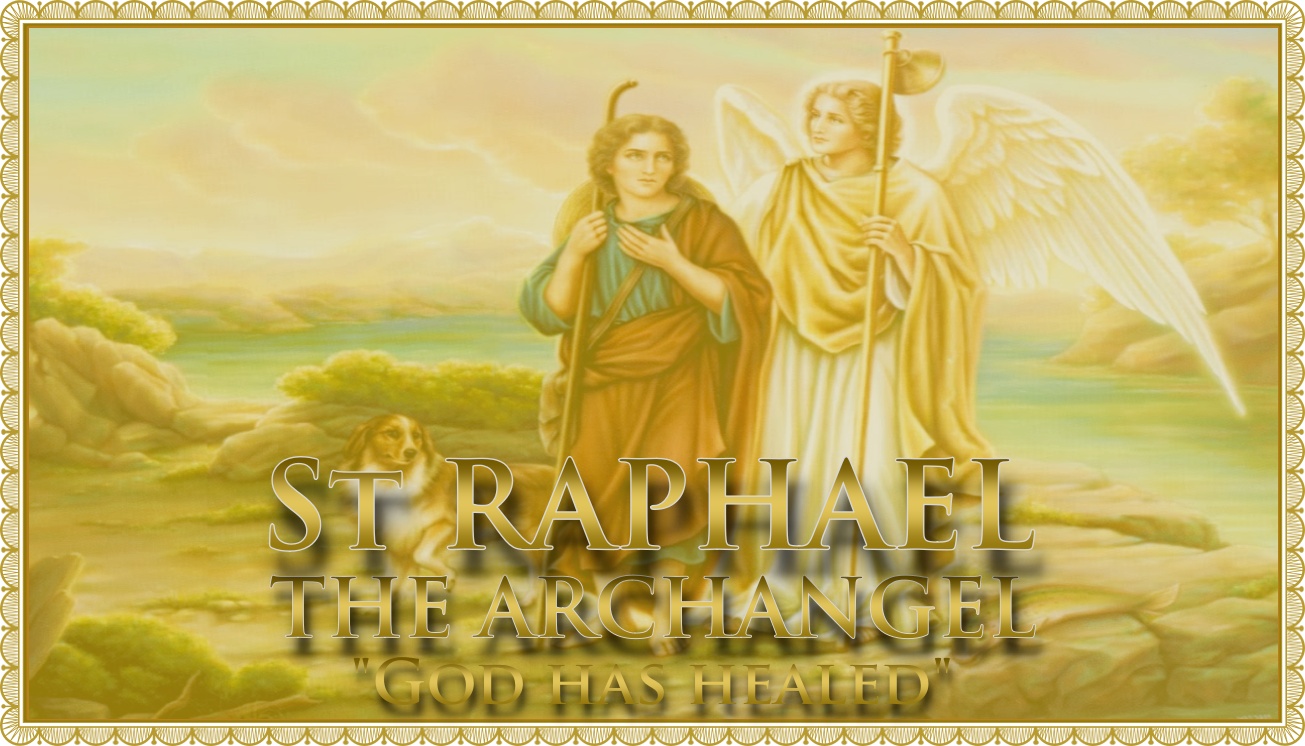
- Today’s Mass: October 24 St Raphael the ArchangelThe Feast of Saint Raphael the Archangel highlights his healing powers as depicted in the Book of Tobit, where he aids Tobit and his son, Tobiah. Venerated as a protector of travellers and the blind, Raphael is celebrated for his miraculous interventions. His legacy includes support for nurses, matchmakers, and Catholic studies.
- 25.10.26 Nuntiatoria CXXIX: CHRISTUS REXThe text discusses the relationship between Christ’s kingship and authority within the Church amidst contemporary challenges. It contrasts ecclesiastical power with genuine faith, emphasising that authority must protect divine truth rather than alter it. The witness of imprisoned priests illustrates the enduring significance of fidelity to Christ over institutional conformity.
- THE DOMESTIC CHURCH: 25 October – 2 November 2026 A Home with Room for Heaven: Preparing for All Saints and All SoulsThe content outlines a week’s plan for traditional Catholic families to prepare for the feasts of All Saints and All Souls. Emphasising daily prayers, remembrance of the deceased, and engagement with children’s activities, it aims to integrate Catholic customs into family life, enriching spiritual practices and fostering a shared faith experience.
- ORDO w/c 25.10.26The text outlines the liturgical calendar for the last week of October and the beginning of November, highlighting key celebrations. Notable events include the Feast of Christ the King, St Evaristus, the Vigil of Saints Simon and Jude, and the Feast of All Saints, emphasising themes of holiness, unity in faith, and the Church’s teachings.
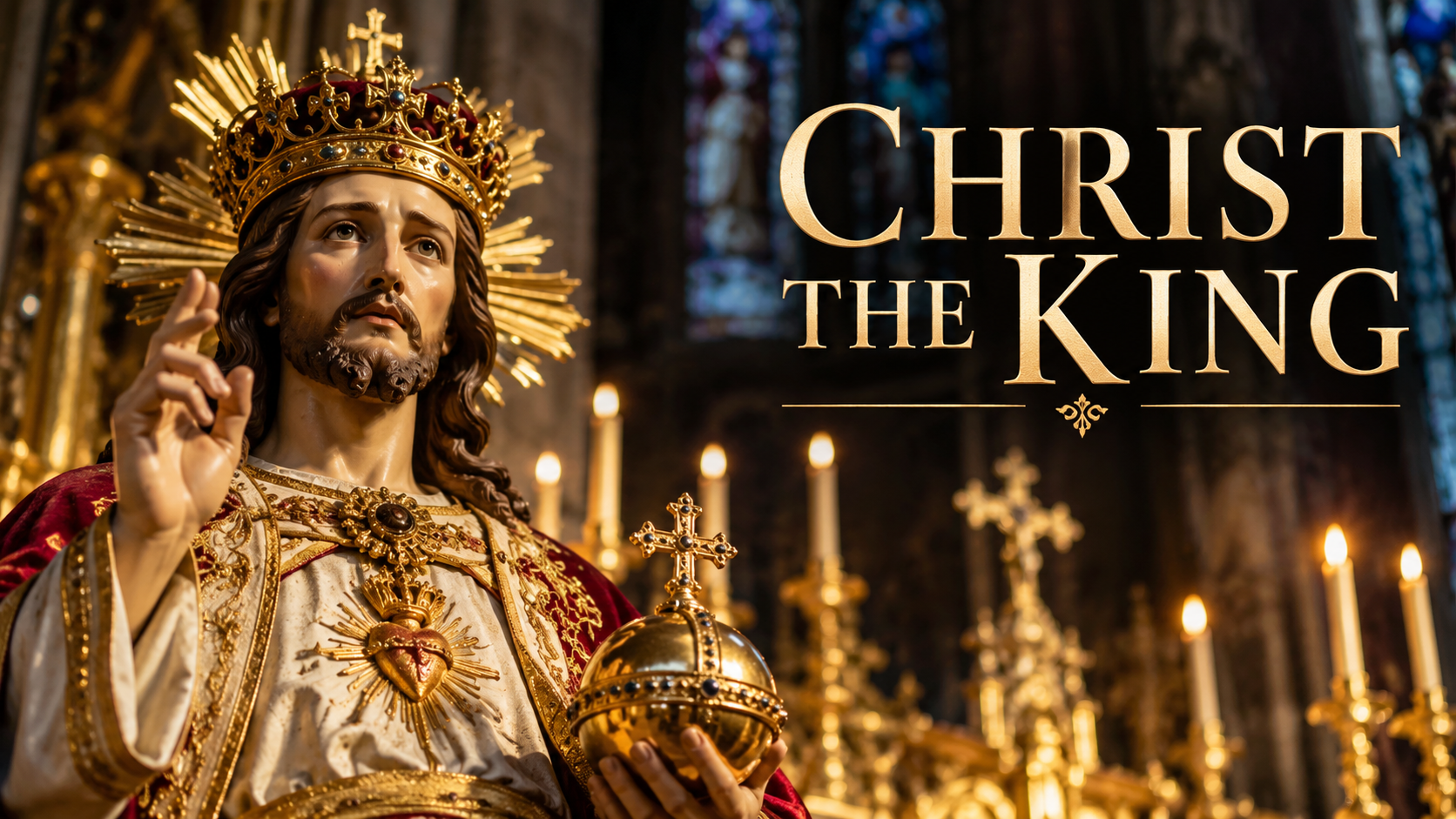
- Christ the King: The Sovereignty of the Crucified RedeemerThe Mass of Christ the King articulates core Catholic beliefs about Jesus’ divine authority, redemptive sacrifice, and the essence of His Kingdom. It emphasises Christ as Prophet, Priest, and King, whose sovereignty is inseparable from His mission of reconciliation, calling the faithful to acknowledge His authority and embrace moral duties rooted in divine truth.
CURRENT EDITION


DAILY MASS ONLINE
One of the earliest online apostolates dedicated to the Traditional Latin Mass, Old Roman TV began broadcasting the Holy Sacrifice on the Feast of the Assumption, 15 August 2008. During the COVID-19 pandemic, additional programming — devotions, catechesis, and conferences — was added to support the faithful in prayer and formation.
Support the daily Holy Mass on Old Roman TV by offering a Mass intention — for loved ones, thanksgiving, or the repose of souls. Your intention helps sustain the sacred liturgy and brings grace to those you remember before God’s altar.
SUPPORT THE DAILY MASS ONLINE
Likely the world’s longest-running daily online broadcast of the
Traditional Latin Mass, streaming faithfully since the
Feast of the Assumption 2008.

This apostolate cannot continue without immediate help
Please support us with a contribution toward
chapel rent, sacristy supplies, operating costs, and web-hosting.
Our essential monthly costs reach £1,000.
MASS INTENTIONS
If your offering is for a Mass Intention, kindly complete the form below in full so we may correctly match it to your donation. For anniversary intentions — birthdays, wedding anniversaries, anniversaries of death — please be sure to include the relevant date.


Today’s Mass Propers
- Today’s Mass: October 24 St Raphael the Archangel
 The Feast of Saint Raphael the Archangel highlights his healing powers as depicted in the Book of Tobit, where he aids Tobit and his son, Tobiah. Venerated as a protector of travellers and the blind, Raphael is celebrated for his miraculous interventions. His legacy includes support for nurses, matchmakers, and Catholic studies.


Leave a Reply