
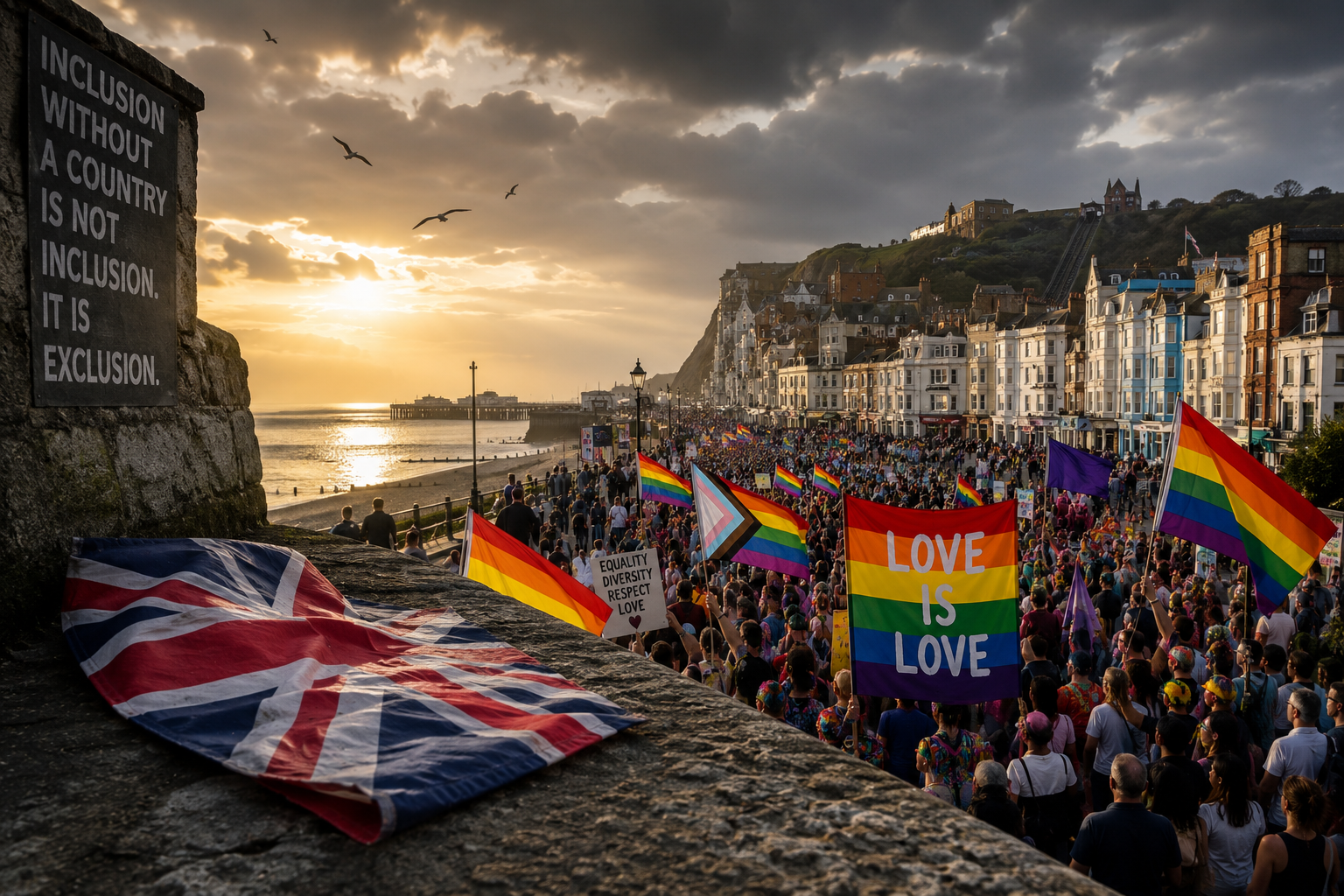
The Flag They Fear: Hastings Pride and the Crisis of Belonging in Britain
The controversy at Hastings Pride is not fundamentally about flags. It is about whether Britain still possesses sufficient confidence in its own identity to regard national belonging as a good rather than a problem. In a society increasingly organised around competing identities, the nation itself has become the last identity that many institutions seem reluctant to defend.
The dispute surrounding Hastings Pride’s reported prohibition of national flags while permitting Pride banners has generated predictable arguments from both supporters and critics. Some have defended the organisers’ right to determine the character of their own event. Others have asked why an event claiming inclusivity would exclude symbols representing the nation in which that event takes place. Yet beneath the immediate controversy lies a far more significant question. Why has the display of the Union Flag or the Cross of St George become controversial at all?
A century ago, the question would have seemed absurd. National flags were widely understood as symbols of a shared inheritance. They represented a people, a history, a culture, and a common civic life. Citizens might disagree vigorously over politics, religion, economics, or social policy, yet they remained united by a sense of belonging to the same national community. The flag symbolised that deeper unity.
Today, however, national identity occupies a curious and increasingly precarious position within public discourse. Expressions of attachment to nationality, heritage, and historical continuity are frequently scrutinised in ways that other forms of identity are not. Symbols rooted in race, sexuality, gender, religion, or political activism are commonly celebrated as legitimate expressions of personal and collective identity. National symbols, by contrast, are often treated as requiring explanation, qualification, or apology.
The Hastings controversy illustrates this inversion with remarkable clarity.
The organisers’ apparent concern was not that national flags were inherently offensive. Rather, the concern appears to have been that such symbols might be interpreted in ways inconsistent with the values the event sought to promote. This reasoning has become increasingly common throughout Western societies. Because certain extremist groups have occasionally appropriated national symbols, the symbols themselves are viewed with suspicion. The result is a remarkable transfer of responsibility. Instead of extremists being condemned for misusing national symbols, the symbols themselves become the object of concern.
Yet this principle is applied with striking inconsistency.
Almost every significant social movement possesses symbols that have acquired political connotations beyond their original purpose. Pride flags, environmental banners, political slogans, campaign logos, and ideological emblems all carry associations that some members of the public regard positively and others regard negatively. No serious observer would argue that the existence of disagreement justifies their exclusion from public events organised around those causes. Yet when national symbols are involved, a different standard often emerges.
The consequence is the creation of an implicit hierarchy of identities. Some forms of belonging are regarded as inherently worthy of public affirmation. Others are tolerated only conditionally.
This hierarchy reveals one of the defining contradictions of contemporary identity politics.
The modern language of inclusion presents itself as universal. It speaks constantly of diversity, representation, acceptance, and belonging. Yet in practice, inclusion often operates selectively. Particular forms of identity are celebrated because they are perceived as historically marginalised. Other identities are regarded with suspicion because they are perceived as historically dominant. The result is not the abolition of identity politics but its expansion. Individuals are increasingly encouraged to understand themselves through the lens of group affiliation while the one affiliation capable of binding those groups together—the nation—is progressively weakened.
This development carries profound consequences for social cohesion.
Every successful society requires a framework capable of transcending difference. Human beings naturally belong to multiple communities simultaneously. They belong to families, neighbourhoods, professions, churches, associations, and friendship networks. Modern societies add further layers of identity rooted in ethnicity, sexuality, ideology, or personal experience. None of these affiliations is inherently problematic. Difficulties arise only when no larger identity remains capable of integrating them into a coherent whole.
Historically, the nation performed precisely this function.
National identity did not erase differences. Rather, it provided a common framework within which differences could coexist. An English Catholic, an English Protestant, an English Jew, and an English atheist might disagree profoundly on matters of ultimate significance. Yet each could still recognise himself as part of a common national story. Citizenship and national belonging created obligations that transcended narrower loyalties.
The weakening of national identity therefore produces effects extending far beyond debates about flags.
When citizens cease to regard themselves as members of a shared national community, politics increasingly becomes a competition between groups seeking recognition, influence, and protection. Public discourse shifts from questions of the common good to disputes over competing claims of identity. The language of citizenship gives way to the language of grievance. Shared obligations become secondary to competing demands.
The late political philosopher Sir Roger Scruton repeatedly warned against precisely this danger. He argued that nations are not arbitrary constructs but communities of loyalty formed over centuries through shared institutions, memories, customs, and sacrifices. Patriotism, properly understood, is not hostility toward others but affection for one’s own. It is the sentiment that enables strangers to cooperate because they recognise one another as participants in the same civic enterprise.
When patriotism is confused with chauvinism, the result is not greater tolerance but greater fragmentation.
Indeed, one of the most striking features of contemporary Britain is the extent to which national identity is increasingly regarded as something from which respectable people should distance themselves. Public institutions frequently display symbols associated with particular causes, campaigns, and movements. Yet the display of national symbols often generates anxiety, qualification, or controversy. Citizens are encouraged to celebrate almost every form of identity except the one identity that historically united the population as a whole.
This tendency has not gone unnoticed. More than a decade ago, Communities Secretary Eric Pickles publicly criticised efforts by local authorities and institutions to treat the Cross of St George as somehow embarrassing or suspect. He argued that England’s national flag belonged to ordinary citizens and should not be surrendered to political extremists. His warning was prescient. When mainstream institutions retreat from national symbols, they do not weaken extremism. They strengthen its claim to represent those symbols.
The lesson is straightforward. If respectable society abandons the national flag, others will inevitably seek to claim it.
The Hastings controversy therefore reveals a paradox at the heart of modern identity politics. Movements that rightly demand recognition for particular communities often struggle to recognise the legitimacy of the broader communities that make peaceful coexistence possible. The language of belonging becomes detached from the institutions and traditions that historically sustained belonging. Diversity is celebrated, but the framework that allows diversity to flourish is neglected.
This paradox becomes even more apparent when viewed through the lens of history.
The United Kingdom is not merely an administrative arrangement. It is the product of centuries of political development, cultural exchange, constitutional evolution, military sacrifice, and social cooperation. The freedoms enjoyed by every citizen—including the freedom to organise, protest, campaign, celebrate, and dissent—exist within a political order built and maintained by generations of people who regarded themselves as members of a common national community.
To display the national flag is not necessarily to endorse every action of the state or every chapter of national history. It is simply to acknowledge membership in that community and gratitude for the inheritance it has provided.
The growing discomfort with such symbols reflects a deeper uncertainty about whether Western societies still believe in themselves. Institutions appear increasingly willing to celebrate diversity while remaining reluctant to defend the civilisational framework that made diversity possible. They champion inclusion while questioning the legitimacy of the national identities through which inclusion was historically mediated.
The result is a society that celebrates belonging in theory while becoming less certain about what it means to belong in practice.
That is why the Hastings dispute matters.
Not because of a parade.
Not because of a flag.
But because it exposes a deeper question confronting Britain and much of the Western world.
Can a nation continue to function as a nation when its own symbols are treated as objects of suspicion? Can a society sustain solidarity when shared identity is steadily subordinated to competing particular identities? Can inclusion endure when the common inheritance that binds citizens together is regarded as morally ambiguous?
These questions extend far beyond Hastings. They concern the future of British public life itself.
A healthy nation should be capable of accommodating many loyalties simultaneously. Citizens should be free to celebrate their faith, their heritage, their causes, their communities, and their convictions. Yet those loyalties require a larger home within which they can coexist. Historically, that home has been the nation.
The true lesson of Hastings Pride is therefore not that national flags are controversial.
It is that the nation itself has become controversial.
And no society can remain confident, cohesive, or free for long once it begins to fear the symbols of its own belonging.
¹ UK Government, Designated Days for Union Flag Flying, Cabinet Office guidance.
² Eric Pickles, Flying England’s National Flag, Department for Communities and Local Government, 20 May 2013.
³ Roger Scruton, England: An Elegy (London: Continuum, 2000); How to Be a Conservative (London: Bloomsbury, 2014).
⁴ David Goodhart, The Road to Somewhere: The Populist Revolt and the Future of Politics (London: Hurst, 2017).
⁵ Benedict Anderson, Imagined Communities: Reflections on the Origin and Spread of Nationalism (London: Verso, 1983).
RELATED ARTICLES


LATEST ARTICLES
- Today’s Mass: September 07 Feria of Sunday XV Post PentecostThe Sunday XV Post Pentecost Mass emphasises the importance of living a life governed by the Holy Spirit, encouraging Christians to act with grace, charity, and humility. St Paul’s teachings remind believers to bear one another’s burdens and avoid self-deceit, ultimately striving for spiritual growth and communion with God through the Eucharist.
- Crisis is the Cause; Necessity is the EffectThe SSPX has clarified its rationale for episcopal consecrations, arguing that a crisis in the Church has led to a “state of necessity” for preserving the Catholic Faith. This distinction stresses the need to prove the necessity and proportionality of their measures against church law, highlighting a significant theological and canonical issue that requires serious examination from both SSPX and Rome.
- A Name on the Letterhead: Grech, Farrell and the Synodalisation of Amoris LaetitiaAdVaticanum reports that Cardinal Farrell’s dicastery might lack substantial input into the October Amoris Laetitia meeting, with Cardinal Grech’s Synod Secretariat effectively leading preparations. This raises concerns about the balance of roles, highlighting potential tensions in handling doctrinal issues, particularly regarding the sacramental practice stemming from Amoris Laetitia.
- Today’s homily: Fifteenth Sunday Post PentecostIn the Gospel of Naim, two processions converge—one of life led by Christ and another of death following a young man. Christ’s compassion interrupts the funeral, symbolising hope amid despair. This message resonates today as Catholics face challenges, encouraging perseverance in faith, tradition, and prayer for revival in families and community.
- Today’s Mass: September 06 Sunday XV Post PentecostThe Fifteenth Sunday After Pentecost’s Mass emphasises the importance of living in accordance with the Holy Spirit, cultivated through the Eucharist. It reflects on Jesus’ compassion for humanity, recalling His miracles. The readings encourage believers to prioritise spiritual matters over worldly anxieties and to embody love for one another, resonating with St. Paul’s teachings.





Leave a Reply