
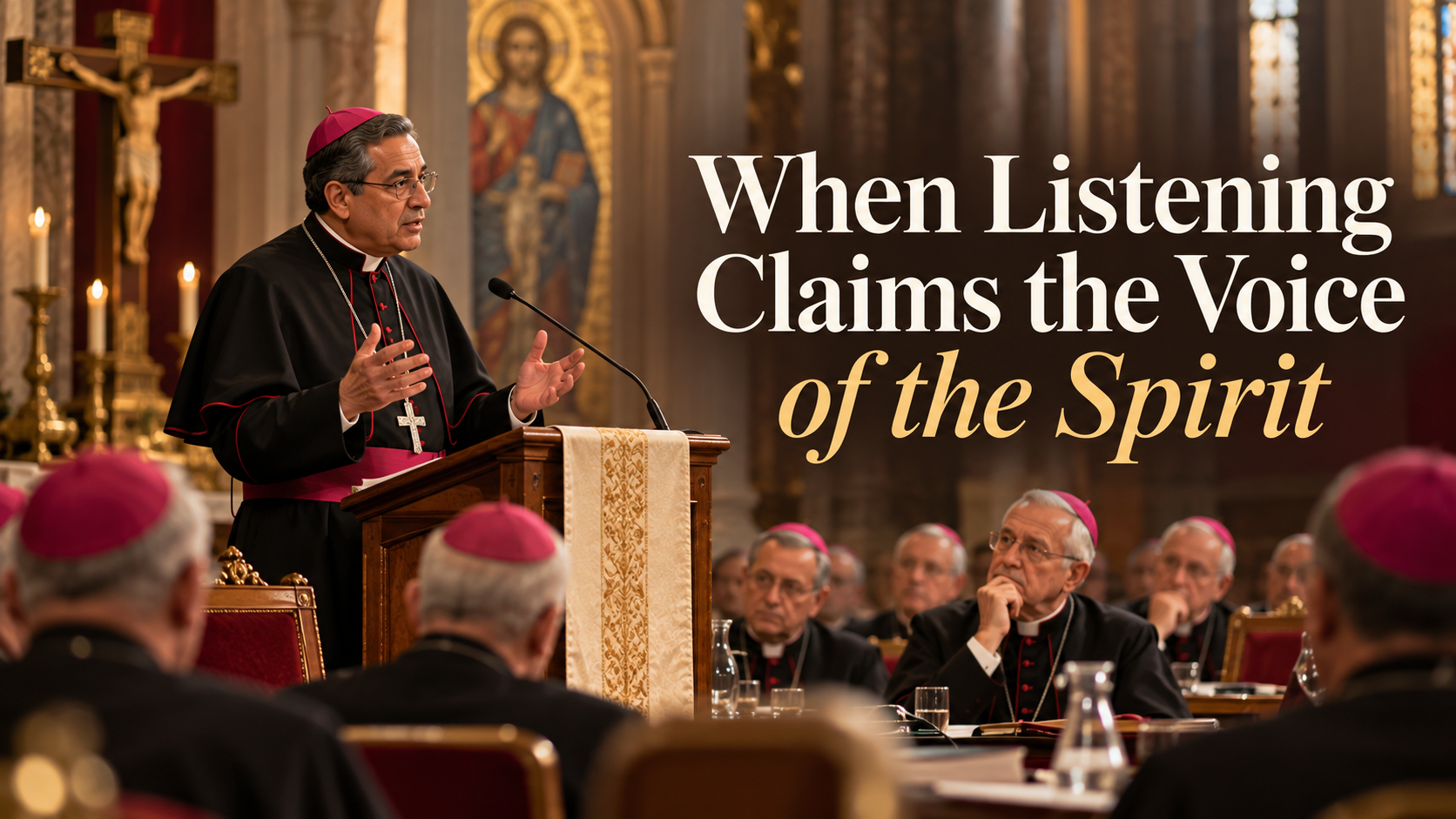
Archbishop Lizardo Estrada has presented Latin America to the Canadian bishops as a “laboratory for synodality”. But his most revealing statement concerned neither committees nor consultation. Synodality, he said, moves the Church from asking what people think to asking what “the Spirit is saying to the Church when we begin listening together”. That is the point at which listening acquires theological authority — and where Catholics must ask who decides which voices constitute discernment, which conclusions express the Holy Ghost, and by what rule they are judged.
Canada’s bishops were given an unusually revealing lesson in synodality during their annual plenary in Montreal. The teacher was Archbishop Lizardo Estrada Herrera, O.S.A., coadjutor Archbishop of Cusco and Secretary General of CELAM, the Latin American and Caribbean Episcopal Council. Estrada spent nearly an hour explaining how the Latin American Church had travelled a much longer synodal road than Canada and had become what he called “a true laboratory for synodality”.¹
The contrast was acknowledged by the Canadians themselves. Bishop Alain Faubert’s report on implementation in Canada lasted only seventeen minutes. Archbishop Donald Bolen of Regina observed that, whereas synodality appeared to have grown organically within the Latin American ecclesial experience, in Canada it felt more like something that had arrived “from the outside”. “We’re experiencing something that’s grown organically for you,” he told Estrada. “It’s a little different experience than for us.”¹
That was more than an incidental remark. Before the plenary even began, the Canadian bishops had written to Pope Leo XIV that Estrada would provide them with “a concrete point of reference” as they considered how synodality might be “further strengthened” in Canada. They also announced a new “facilitated synodal-style reflection” upon the structures of their own episcopal conference.² Synodality, therefore, is not simply being discussed as an interesting ecclesiological theory. One episcopate is openly learning from another how the model may be implemented institutionally.
There is nothing inherently objectionable about bishops listening to one another, priests advising bishops, pastors consulting the faithful or episcopal conferences learning from experience elsewhere. The Catholic Church possessed synods, councils, chapters, presbyteral consultation and innumerable other forms of deliberation centuries before anyone organised a “listening session”. The difficulty begins not with listening but with the theological inflation of listening, when consultation is no longer merely one means by which authority gathers information and exercises prudence, but is invested with a quasi-revelatory significance.
Estrada’s own presentation brought that distinction into unusually sharp focus. He traced CELAM’s development from its foundation in 1955 through Medellín, Puebla, Aparecida and the continental ecclesial assemblies. When Pope Francis was presented with plans for another Latin American conference, Estrada recalled, Francis responded: “Imagine something new.” CELAM did. By 2021 an enormous consultation had drawn contributions from tens of thousands of people through meetings, thematic forums, personal submissions and digital participation. Its listening deliberately extended towards “the peripheries” and even “beyond the Church’s own borders”.¹ ³
Again, consultation is not the problem. The Church must understand the people she evangelises. A bishop who never listens to his priests or faithful will govern badly. Missionaries must understand cultures before they can preach effectively within them. Catholics may learn truths of nature, society and human experience from people who do not share the Faith. The Church has never taught that wisdom cannot be found outside the walls of a presbytery. Yet Estrada went considerably further when he described what he regarded as one of the great transformations achieved by the synodal journey. The question, he said, was no longer merely, “What does each person think?” It had become: “What is the Spirit saying to the Church when we begin listening together?”¹
There lies the real issue. A consultation records human voices, a synthesis interprets them and discernment then judges them. But when the result of that process is presented as evidence of what the Holy Ghost is saying to the Church, the process has crossed an important theological threshold. What began as consultation has acquired a claim upon the conscience of the Church.
The difficulty becomes obvious once the mechanics are considered. Thousands of people may participate, but somebody determines who is invited and which questions are asked. Facilitators determine how conversations proceed. Secretariats collate responses. Editors identify recurring themes. Someone decides which minority voices merit prominence, which disagreements are significant, how tensions should be described and which conclusions survive into the final synthesis. None of this necessarily implies dishonesty. It simply means that the finished document is a mediated human product, and calling that mediation “discernment” does not make the mediation disappear.
That is why the Catholic doctrine of the sensus fidei is so important. The International Theological Commission explicitly warns that the sensus fidei “cannot simply be identified” with either public opinion or majority opinion within the Church. Faith rather than opinion is decisive. Genuine participation in the Church’s supernatural instinct for the Faith presupposes precisely those things increasingly absent from loose descriptions of synodal listening: participation in ecclesial life, attention to the Word of God, adherence to the Magisterium, sacramental life and a willingness to receive rather than reconstruct the Apostolic Faith.⁴
The distinction becomes still more important when consultation deliberately extends beyond the visible boundaries of the Church. The experience or observations of non-Catholics may certainly assist pastoral judgement. They may expose injustice, ignorance or failures Catholics have overlooked. But their inclusion in a consultation does not thereby turn their contribution into the Catholic sensus fidelium. Still less can a synthesis containing such contributions acquire supernatural authority simply because it was produced through a process of “conversation in the Spirit”. The Holy Ghost cannot contradict the Revelation He inspired, and so the Church cannot ask only what emerged from the listening process. She must also ask whether what emerged is consonant with what God has already revealed.
Interestingly, even the International Theological Commission’s own favourable account of synodality supplies this safeguard. Its 2018 document insists that authentic synodal processes must operate within hierarchical communion, in fidelity to the teaching of the Church and “in conformity with the depositum fidei”. It describes the Church as apostolic precisely because she preserves and hands on the teaching received from the Apostles.⁵ Synodality, even according to its own official theology, cannot mean that listening creates doctrine. Accipere, non fingere: receive, do not invent.
Estrada’s invocation of the 1979 Puebla conference is particularly revealing in this respect. St John Paul II certainly urged the Latin American bishops to evangelise in the concrete circumstances of their peoples. He did not, however, romanticise ecclesial processes merely because they arose from Latin America. Looking back upon Medellín, he warned that its conclusions had sometimes received “incorrect interpretations” requiring “calm discernment, opportune criticism, and clear choices of position”.⁶ At the very beginning of the same address, John Paul supplied an even more pertinent warning. He prayed that the bishops would be led by the Holy Spirit, but immediately added that it must be “he and no other spirit” who guided and strengthened them.⁶
Those words expose what is missing from much contemporary synodal rhetoric. The Church has always believed in discernment of spirits precisely because not every inspiration comes from God. Discernment therefore requires an objective rule. Prayerful conversation, sincerity, inclusion, cultural authenticity and consensus cannot themselves establish the divine provenance of a conclusion. One may listen widely and still reach the wrong conclusion; one may achieve consensus and still be mistaken; one may invoke the Spirit and yet misunderstand what fidelity to the Spirit requires.
The question becomes especially concrete in Estrada’s own recent history. As Nuntiatoria reported in August, Estrada attended the Entrelazando Voces por la Dignidad gathering in Cusco on 13 August. The event opened with an Andean pago a la tierra ceremony framed by its leader in terms of “Mother Earth”, during which coca leaves were distributed and deposited as part of the offering. Estrada participated in the action.⁷ Sixteen days later, Pope Leo XIV appointed him coadjutor Archbishop of Cusco.⁸
There is no need to speculate about Estrada’s private intention during that ceremony, nor does the episode invalidate everything he says about ecclesial consultation. It illustrates something more useful. If synodal discernment deliberately encounters indigenous spiritualities, secular organisations, social movements and voices beyond the Church’s visible boundaries, then the criterion by which those voices are judged becomes more important, not less. Cultural meaning cannot itself establish theological legitimacy, inclusion cannot substitute for discernment, and the Catholic question remains whether what is encountered can be reconciled with the worship of the one true God and the Faith once delivered to the saints.
This is where Montreal intersects directly with the argument Nuntiatoria has been developing under the description “Vatican III by stealth”. The phrase has never meant that another ecumenical council has secretly assembled somewhere behind the walls of the Vatican. It describes something both less dramatic and potentially more consequential: a conciliar-scale alteration in the Church’s practical operating system being achieved incrementally without ever being presented as a comprehensive new constitutional settlement.
The sequence is becoming increasingly visible. Listening gathers a wider range of participants and experiences. Those contributions are then synthesised by facilitators, secretariats and ecclesial bodies. The synthesis is subsequently elevated from a report of what people have said into something through which the Church is invited to hear what the Holy Ghost is saying. From that follows pastoral expectation, as bishops, dioceses and parishes are encouraged to “receive” the fruits of the discernment. Pastoral expectation then becomes institutional practice through assemblies, strengthened councils, new consultative relationships, altered procedures of decision-making and permanent mechanisms for participation. Eventually the structures acquire juridical expression.
That final stage is no longer hypothetical. As Nuntiatoria reported this week, proposals arising from the canonical implementation of synodality contemplate precisely the incorporation of synodal structures, communal discernment and broadened participation more deeply into the juridical life of the Church, amid discussion reaching as far as a possible comprehensive revision of canon law.⁹ The importance of the earlier language therefore becomes clear. What begins as a pastoral method may eventually become an ecclesiastical expectation and then a juridical norm.
An episcopal signature may remain necessary. A bishop may remain formally the legislator of his diocese. A parish priest may formally retain his authority. The Pope remains Supreme Pontiff. Yet the practical exercise of authority changes considerably if the questions to be considered, the participants consulted, the method of deliberation, the interpretation of consensus and the conclusions authority is expected to “receive” have already been shaped by a permanent synodal apparatus. The hierarchy may remain intact on paper while the ecclesial environment within which hierarchical decisions are made is substantially transformed.
Canada therefore presents an instructive case. Archbishop Bolen’s candid observation that synodality feels as though it has come to Canada “from the outside” should not be dismissed merely as evidence that Canadian implementation is lagging behind Latin America. It raises a deeper question. If a supposedly constitutive expression of the Church must be imported, taught by specialists, practised through facilitated exercises, reinforced through formation programmes and eventually secured by canonical structures, Catholics may reasonably ask exactly what is organic and what is programmatic in the process.
Nor is it historically persuasive simply to read the contemporary synodal programme backwards into seventy years of CELAM. Latin America unquestionably developed strong traditions of episcopal collaboration and continent-wide pastoral reflection. It does not follow that everything from CELAM’s foundation in 1955 onwards was embryonic “synodality” in the particular sense now being advanced. Earlier history cannot automatically be conscripted into the latest ecclesiological vocabulary merely because that vocabulary now provides the interpretative framework through which the history is being retold.
None of this requires rejecting the genuinely Catholic elements contained within that vocabulary. Bishops should listen. Priests and faithful should be heard. The laity are not ecclesiastical furniture. The Holy Ghost truly acts throughout the Mystical Body of Christ. Consultation can expose failures which authority has failed to perceive, and the history of the Church provides painful examples of what happens when legitimate warnings are ignored. But those truths do not establish a parallel route to Revelation through managed consultation.
The Church listens in order to exercise prudence about how the Faith should be applied; she does not listen in order to discover whether the Faith remains true. She discerns changing circumstances; she does not discern whether Christ has changed His mind. She receives testimony from Catholics and non-Catholics alike when it helps her understand the world she must evangelise; she does not transform every voice she hears into the sensus fidelium. Above all, she does not know that the Holy Ghost has spoken merely because a facilitated assembly has reached a synthesis.
This is therefore the real significance of Montreal. The development called synodality is no longer adequately understood as a series of meetings. It increasingly describes a method of ecclesial government in which listening is followed by synthesis, synthesis by discernment, discernment by reception, and reception by institutionalisation. Once the result of listening is attributed to the Spirit, resistance can begin to appear not merely as disagreement with a pastoral proposal but as resistance to discernment itself. Once that discernment becomes normal procedure, the procedure can be translated into structures; and once the structures are established, canon law can consolidate them.
That is “Vatican III by stealth” in its most precise sense: not another council, but a new ecclesiological operating system becoming normative through praxis before its cumulative implications are ever submitted to the Church as a single proposition. The significance lies not in any one committee, listening exercise or canonical amendment, but in the cumulative effect of all of them when they operate according to the same underlying conception of authority, participation and discernment.
St John Paul II’s warning at Puebla therefore provides a more securely Catholic rule for genuine ecclesial listening than any amount of synodal methodology. The Church should listen, consult widely, discern prayerfully and attend carefully to what the faithful are saying and to what the world reveals about the conditions in which the Gospel must be preached. But she must also make certain that it is the Holy Spirit “and no other spirit” who guides her. For that, listening is not enough. The Church requires a rule by which what she hears can be judged, and she already possesses it in the Faith she has received.
- Canadian bishops at plenary hear about progress on creating a ‘listening’ church — National Catholic Reporter / The Catholic Register / OSV News, 29 September 2026.
- 2026 Letter to the Holy Father — Canadian Conference of Catholic Bishops, 21 September 2026.
- Lizardo Estrada presenta en Canadá la experiencia sinodal de América Latina y el Caribe — CELAM, 25 September 2026.
- Sensus Fidei in the Life of the Church — International Theological Commission, 2014.
- Synodality in the Life and Mission of the Church — International Theological Commission, 2 March 2018.
- Address to the Third General Conference of the Latin American Episcopate at Puebla — Pope St John Paul II, 28 January 1979.
- Pachamama Returns — On the Road to Leo XIV — Nuntiatoria, 21 August 2026.
- Resignations and Appointments, 29.08.2026 — Holy See Press Office, 29 August 2026.
- Synodality’s Next Step: Writing the Revolution into Canon Law — Nuntiatoria, 1 October 2026.


![Today’s Mass: October 03 St Thomas [de Cantilupe] of Hereford](https://nuntiatoria.org/wp-content/uploads/2026/10/thomascantilupemasstitle.jpg)



Leave a Reply