
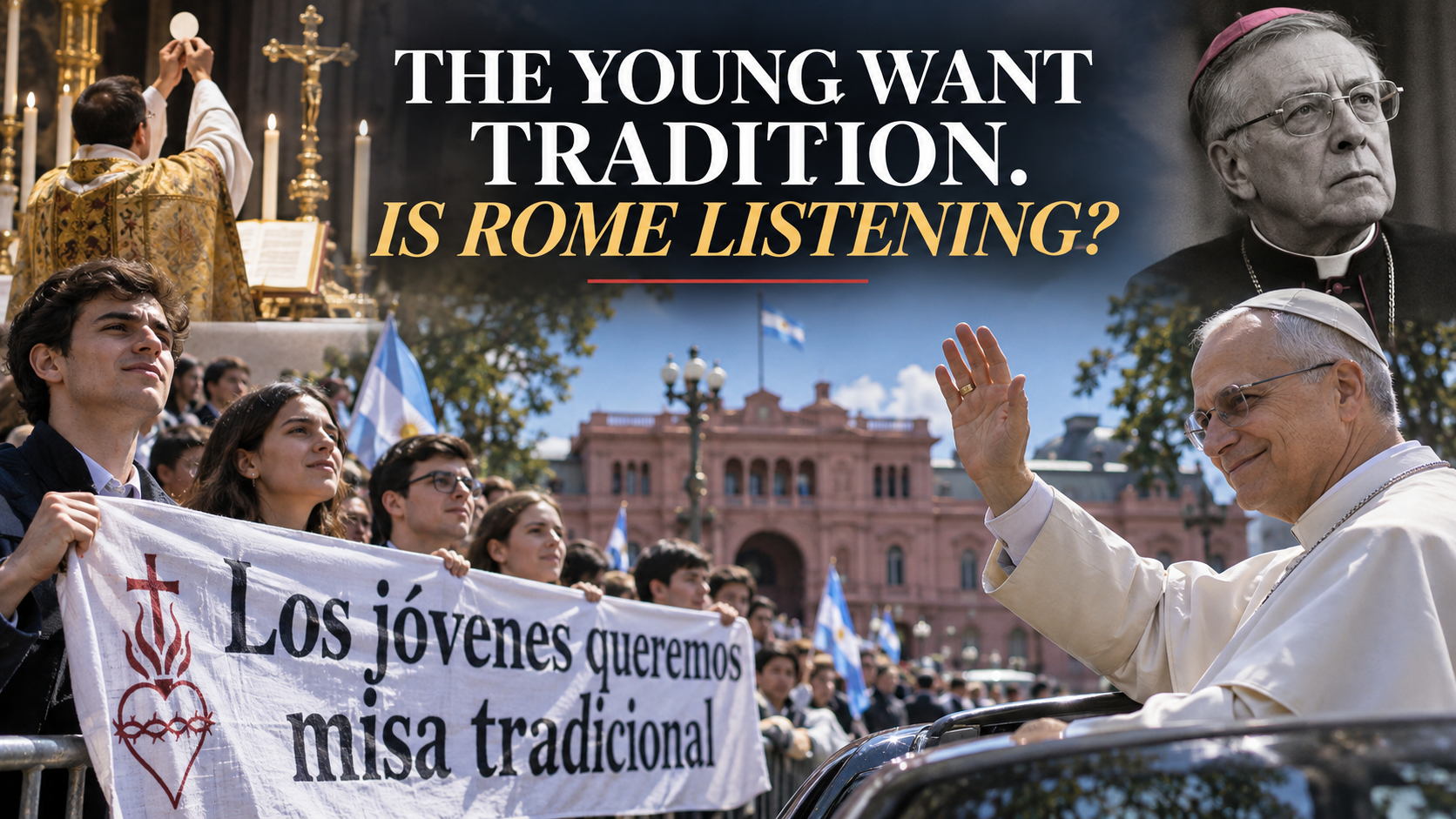
Young Argentine Catholics have appealed to Pope Leo XIV for the restoration of the traditional Roman Mass, confronting the Holy See with the practical meaning of its commitment to synodality and ecclesial inclusion. Their appeal, made during the Pope’s visit to Argentina and coinciding with the final public intervention of Archbishop Héctor Aguer, raises a question which Rome has repeatedly avoided: why should Catholics seeking the worship and doctrine inherited from their forefathers require special permission to remain faithful to them?
On Monday 9 November, as Pope Leo XIV’s motorcade travelled along Avenida del Libertador in Buenos Aires, young Catholics unfurled a large white banner bearing the words Los jóvenes queremos misa tradicional — “We young people want the Traditional Mass.” Others displayed placards calling for freedom for the traditional liturgy. They were university students, members of a group calling itself Jóvenes católicos, who had prepared a public petition, organised prayers and taken advantage of the papal visit to make an appeal which the Argentine hierarchy has shown little inclination to accommodate.¹
Their message attracted the attention of the national press. La Nación reported the banners, while InfoVaticana obtained details of the students’ campaign and their interviews with Argentine journalists. What emerged was a thoughtful and decidedly Catholic appeal from young people who wished priests to be free to celebrate the traditional Roman Mass in their parishes wherever the faithful requested it. They spoke of the silence, reverence and theological richness of the older liturgy, of the direction of worship towards Almighty God, and of their desire to participate in an inheritance which they had discovered for themselves.
One young man, identified as Chaza, admitted that he had initially understood little of the Latin. He had learnt to appreciate it through attending the Mass. Another, Santiago, explained that the older rite brought the worshipper more deeply into the mystery of the Eucharistic Sacrifice. Their request concerned the removal of restrictions upon an established form of Catholic worship, rather than privileges for a particular religious constituency.
The most revealing words appeared in the petition itself. Referring directly to the motto of Leo’s Argentine visit, Bienvenidos todos. Vayan y anuncien — “Everyone is welcome. Go and proclaim!” — the young Catholics wrote:
“Nosotros también queremos ser bienvenidos.”
“We too want to be welcomed.”²
It was an admirably economical response to several years of ecclesiastical discussion about inclusion. The petitioners professed their communion with the Church and fidelity to the Roman Pontiff, invoked the right of the faithful under canon 212 to make their spiritual needs known to their pastors, and requested the restoration of freedom to celebrate Mass according to the 1962 Roman Missal. They rejected the suggestion that their attachment represented nostalgia for a vanished generation. Most had never known the Church before the liturgical reforms. Their interest arose from discovering what those reforms had displaced.
For decades, attachment to the traditional liturgy has been treated in some ecclesiastical circles as an unresolved argument belonging to the 1960s. Younger Catholics were confidently expected to find such controversies increasingly irrelevant. Instead, a generation educated entirely within the post-conciliar Church is asking why a liturgy celebrated by their grandparents, and by countless saints before them, has become so difficult to obtain.
The timing of the demonstration gave the petition additional significance. That evening, celebrating Vespers with the Argentine bishops and synodal teams in the Metropolitan Cathedral of Buenos Aires, Pope Leo spoke about ecclesial unity, recalling the different expressions of Catholic life throughout the country’s regions. He urged the assembled bishops to cultivate communion by “welcoming our legitimate differences with charity” and encouraged the synodal teams to continue listening to one another. The faithful, he explained, must be accompanied according to their particular circumstances, including those experiencing a profound longing for God.³
This was entirely appropriate teaching, particularly on the feast of the Dedication of the Lateran Basilica, the cathedral of the Bishop of Rome and the mother church of the Catholic world. The difficulty is that the Church’s contemporary understanding of legitimate diversity appears to operate rather selectively when confronted with her own liturgical inheritance.
The Pope did not address the students’ petition, and there is no verified evidence that he personally read their banners. His remarks nevertheless establish the principles by which the response of ecclesiastical authority may reasonably be judged. The Catholics who gathered along his route were asking for something which the Roman Church herself had preserved, regulated and transmitted throughout centuries of her history.
Two days later, at the Basilica of Our Lady of Luján, Leo returned to the question of communion. Referring to the different sensibilities and convictions found among Catholics, he described them as a source of richness when firmly grounded in ecclesial unity. The statement was made in a wider pastoral context, yet its application to the young people who had been attempting to make themselves heard was obvious. On the same occasion, a young woman volunteering during the papal visit told Argentine television that she wished the traditional Mass to become freely available in ordinary parishes, in Argentina and throughout the world.⁴
Luján itself offers a particularly instructive example of the problem. In August 2026, more than 2,300 Catholics participated in the seventeenth pilgrimage of Nuestra Señora de la Cristiandad, walking approximately one hundred kilometres from Rawson to the national Marian shrine. The pilgrimage, inspired by the Paris–Chartres movement, had begun in 2010 with eighteen participants. Its organisers have recorded successive increases in attendance, accompanied by traditional Masses, confessions, Rosaries and Eucharistic adoration.
Yet the concluding traditional Mass could not be celebrated inside the basilica. The prohibition imposed following Traditionis custodes remained in force, obliging the pilgrims to celebrate outside before completing their journey to the shrine. Thus, at the very sanctuary where Leo XIV spoke of the richness of different Catholic sensibilities, a growing body of faithful had recently been denied the use of the basilica for their customary liturgy.⁵
This is considerably more revealing than an abstract dispute about liturgical preferences.
When Benedict XVI promulgated Summorum Pontificum in July 2007, he sought to resolve a longstanding injustice and restore peace to the Church’s liturgical life. His legislation recognised the lawful celebration of the older Roman Mass and provided considerably greater freedom for priests and faithful attached to it. His accompanying explanation rested upon the continuity of Catholic worship: the liturgical inheritance of previous generations could not simply be treated as something discredited by subsequent reform.⁶
Francis reversed that settlement through Traditionis custodes in July 2021. The celebration of the older Mass became subject to diocesan authorisation, its use in parish churches was restricted, and bishops were instructed to avoid establishing new groups. Subsequent Roman decisions imposed further conditions. The stated justification concerned divisions associated with traditionalist communities and resistance to the post-conciliar liturgical settlement. Yet the legislation applied broadly to Catholics whose attachment to the inherited liturgy did not necessarily involve any rejection of ecclesiastical authority.⁷
The Pope possesses genuine authority to regulate liturgical discipline. That authority serves the Church’s supernatural purpose and is exercised within her responsibility to preserve the faith which she has received. The question surrounding Traditionis custodes therefore concerns the purpose for which such jurisdiction is being exercised.
A disciplinary policy which progressively confines the older Roman liturgy to authorised enclaves, dependent upon permissions which may be withdrawn, places its ordinary transmission at risk. Families cannot confidently establish a continuing Catholic life around a form of worship whose future depends upon the administrative preferences of successive bishops. Priests cannot reasonably be expected to cultivate an attachment which their ecclesiastical superiors regard with suspicion. Such instability has little to recommend it as a pastoral method, particularly when the faithful affected are often among those most willing to attend Mass regularly, seek confession and encourage vocations.
Nuntiatoria has examined this predicament repeatedly, most recently in its reporting on the restrictions imposed upon the Ad Petri Sedem pilgrimage in Rome and Michael Matt’s open letter to Leo XIV. The pilgrims’ inability to enter St Peter’s Basilica in organised procession, following the refusal of permission for their principal pontifical Mass, illustrated the increasingly precarious position of Catholics seeking to practise their religion according to its inherited forms. The precise circumstances of those decisions remain disputed, but the broader direction of Roman policy is established by the legislation itself.⁸
In Every Voice — Except the Old Mass?, published on 1 November, Nuntiatoria examined the appointment of Father Giacomo Costa SJ and Sister Elena Massimi FMA to senior responsibilities within the General Secretariat of the Synod. Sister Massimi had previously spoken favourably of Traditionis custodes. Her appointment raised a legitimate concern about the willingness of those directing synodal implementation to consider arguments against a liturgical settlement which they already support. The Argentine demonstration has now supplied a particularly immediate example of the voices which such a process ought to receive.⁹
There is an uncomfortable historical irony in the location. Argentina is the homeland of Jorge Mario Bergoglio, whose pontificate produced the restrictions now being challenged. It was also the home of Archbishop Héctor Aguer, one of the most outspoken episcopal opponents of the theological and pastoral direction associated with Francis.
Aguer’s final published interview appeared on 9 November, the very day the students displayed their banners. Speaking to Niwa Limbu of AdVaticanum, the Archbishop Emeritus of La Plata offered a severe assessment of the Argentine episcopate and its treatment of traditional Catholics. Having served as an auxiliary bishop in Buenos Aires and subsequently governed La Plata for nearly eighteen years, he spoke from intimate knowledge of the country’s ecclesiastical affairs. He had known Bergoglio since 1978 and had dealt with him for more than four decades.
Aguer remarked that many Argentine bishops seemed to “live in the stratosphere”, unable to comprehend why younger people were returning to the Church. Their interest, he explained, arose from an encounter with the mystery of Jesus Christ and a desire for sanctification amid an increasingly hostile society. They were not returning to the Church to encounter more of the world which surrounded them. He urged the restoration of Summorum Pontificum and the repeal of the restrictions imposed under Francis.¹⁰
His criticism identified a pastoral misunderstanding extending well beyond the Argentine episcopate. Young Catholics seeking traditional worship are frequently regarded as a constituency requiring management, particularly where their attachment includes a serious interest in doctrinal orthodoxy and traditional moral teaching. Their actual religious aspirations seldom receive comparable attention. The students in Buenos Aires were explaining how the prayers, silence and ceremonial of the Roman Mass helped them to worship God. Aguer was explaining why their contemporaries were finding in that inheritance something which contemporary pastoral programmes had frequently failed to provide.
His account of his own ministry was equally revealing. During his years in La Plata he had ordained forty-nine priests, and he spoke with particular satisfaction of those now serving in parishes and missions, including working-class neighbourhoods. His principal concern remained the formation of priests capable of communicating sound doctrine and bringing souls to Christ. The supernatural purpose of the Church was, for him, the measure by which episcopal policy must be judged.
Aguer died on 10 November, aged eighty-three, during the Pope’s Argentine visit. His final interview had been given while he was in delicate health, unable to participate in the papal events. He spoke of offering his sufferings for the Church and praying that Leo might restore peace to her troubled life. His last published appeal thus accompanied the students’ campaign with the testimony of an experienced bishop who had witnessed the transformation of Argentine Catholicism over nearly half a century.¹¹
The condition of that Catholicism is itself relevant. As Nuntiatoria reported earlier this month, research published by the Pew Research Center indicates a profound decline in Catholic identification throughout Latin America, despite the persistence of widespread belief in God. Argentina, once overwhelmingly Catholic, now has little more than half its adult population identifying with the Church. The decline has occurred across decades in which successive episcopal conferences have pursued programmes of liturgical, catechetical and pastoral adaptation.¹²
Such figures cannot establish that any single reform caused the deterioration. They do, however, deprive ecclesiastical authorities of the luxury of assuming that the existing pastoral settlement has been vindicated by its results. Churches have emptied, seminaries have closed, religious congregations have contracted, and Catholic identity has weakened across societies in which it once shaped public and domestic life. It would be strange indeed if bishops facing these circumstances regarded the appearance of young people passionately interested in Catholic worship as a problem requiring further restrictions.
Nor is the Argentine experience isolated. The organisers of the 2026 Paris–Chartres pilgrimage reported attendance reaching 20,000, approximately half of whom were under twenty-five. The average age was twenty-two. Their published survey found that ninety per cent of respondents described themselves as deeply rooted in sacramental Catholic life, while seventy-seven per cent reported involvement in charitable activities. These figures do not represent a statistical survey of all traditional Catholics, but they provide substantial evidence of the youthful character and religious commitment of one of the largest traditional Catholic gatherings in Europe.¹³
Nuntiatoria examined this development in June when considering Archbishop Aguer’s earlier observations concerning the revival of traditional Catholic life. The significance lies in the character of those involved. They have encountered something which they believe expresses the Catholic faith more fully than much of the religious culture in which they were raised. Their attachment cannot sensibly be attributed to personal recollection of the pre-conciliar Church.¹⁴
The traditional Roman liturgy offers something which much contemporary pastoral language has difficulty expressing. Its prayers place the Holy Sacrifice, divine grace, sin, judgement and eternal salvation unmistakably before the worshipper. The ceremonies direct attention towards the sacred action taking place at the altar. Its silence invites prayer without requiring constant verbal explanation. These are theological realities, inseparable from the Church’s understanding of the Eucharist and the supernatural destiny of man.
The preservation of this inheritance concerns the faithful’s ability to receive and transmit the Catholic religion in a recognisable and coherent form. A policy under which it may survive only within carefully prescribed boundaries risks turning a living tradition into a tolerated exception.
One can recognise the legitimate authority of the Roman Pontiff while questioning whether such a policy serves the good of the Church. Indeed, the distinction is essential to an intelligent Catholic understanding of authority. Traditionis custodes is disciplinary legislation, capable of amendment or repeal. Its provisions cannot acquire the permanence of revealed doctrine merely because they were promulgated by a Pope. Leo XIV possesses the authority to reconsider them, just as Francis exercised his authority to impose them.
It remains unknown whether the Holy See intends to respond to the Argentine petition. The demonstrations were peaceful, the petition was public, and the young Catholics expressly professed fidelity to the Roman Pontiff. Their appeal continued at Luján during the closing stages of the Pope’s visit. No formal papal response has been established.
Rome’s language of welcome will ultimately be judged by the decisions which accompany it. Synodality cannot reasonably claim to have listened to the faithful while treating their attachment to the Church’s inherited worship as a difficulty to be contained. The situation at Luján is especially difficult to defend: more than 2,300 pilgrims may walk to the national shrine, confess their sins, pray the Rosary and adore the Blessed Sacrament, yet the liturgy which animates their pilgrimage remains excluded from its basilica.
The young people of Buenos Aires have exposed a contradiction which successive Roman authorities have preferred to leave unresolved. They seek the freedom to practise a form of Catholic worship which the Church herself sanctified through centuries of use, while the hierarchy speaks incessantly of participation, inclusion and the pastoral needs of the young.
Their words deserve to be remembered alongside those of Pope Leo XIV in Buenos Aires. He called upon the bishops to welcome legitimate differences with charity. They, in turn, asked to be welcomed.
The responsibility for reconciling those statements now belongs to the Apostolic See.
¹ LifeSiteNews, ‘Young people want the Latin Mass’ banner displayed as Pope Leo’s motorcade passes; La Nación, Qué es la misa tradicional por la que jóvenes le reclamaron al papa León XIV
² InfoVaticana, Los jóvenes tras el cartel a León XIV: un documento, un rosario y 5 razones para liberar la misa tradicional
³ Holy See, Leo XIV, Vespers with the Argentine Episcopate and Synodal Teams, Buenos Aires, 9 November 2026
⁴ Holy See, Leo XIV, Holy Mass at Luján, 11 November 2026; InfoVaticana, También en Luján: jóvenes piden a León XIV que libere la Misa tradicional
⁵ InfoCatólica, Más de 2.300 peregrinos recorren cien kilómetros de Rawson a Luján en la XVII Peregrinación de Nuestra Señora de la Cristiandad; Diario Popular, La peregrinación a Luján que pocos conocen y reúne a miles
⁶ Benedict XVI, Summorum Pontificum, 7 July 2007
⁷ Francis, Traditionis custodes, 16 July 2021
⁸ Nuntiatoria, Tradition Behind the Fence; Nuntiatoria, We Are Not Your Enemies: Rome Must Answer Its Own Children
⁹ Nuntiatoria, Every Voice — Except the Old Mass?
¹⁰ AdVaticanum, Niwa Limbu, Exclusive Interview: Archbishop Aguer on the Papal Visit to Argentina and the Legacy of Pope Francis, 9 November 2026
¹¹ AdVaticanum, Archbishop Héctor Aguer, Outspoken Defender of Catholic Tradition, Dies Aged 83
¹² Nuntiatoria, Latin America Still Believes in God. Why Has It Abandoned Catholicism?
¹³ Notre-Dame de Chrétienté, Mot du président au terme du 44e pèlerinage
¹⁴ Nuntiatoria, The Future Is Tradition: The Young Are Passing Judgement on the Modern Church




Leave a Reply