
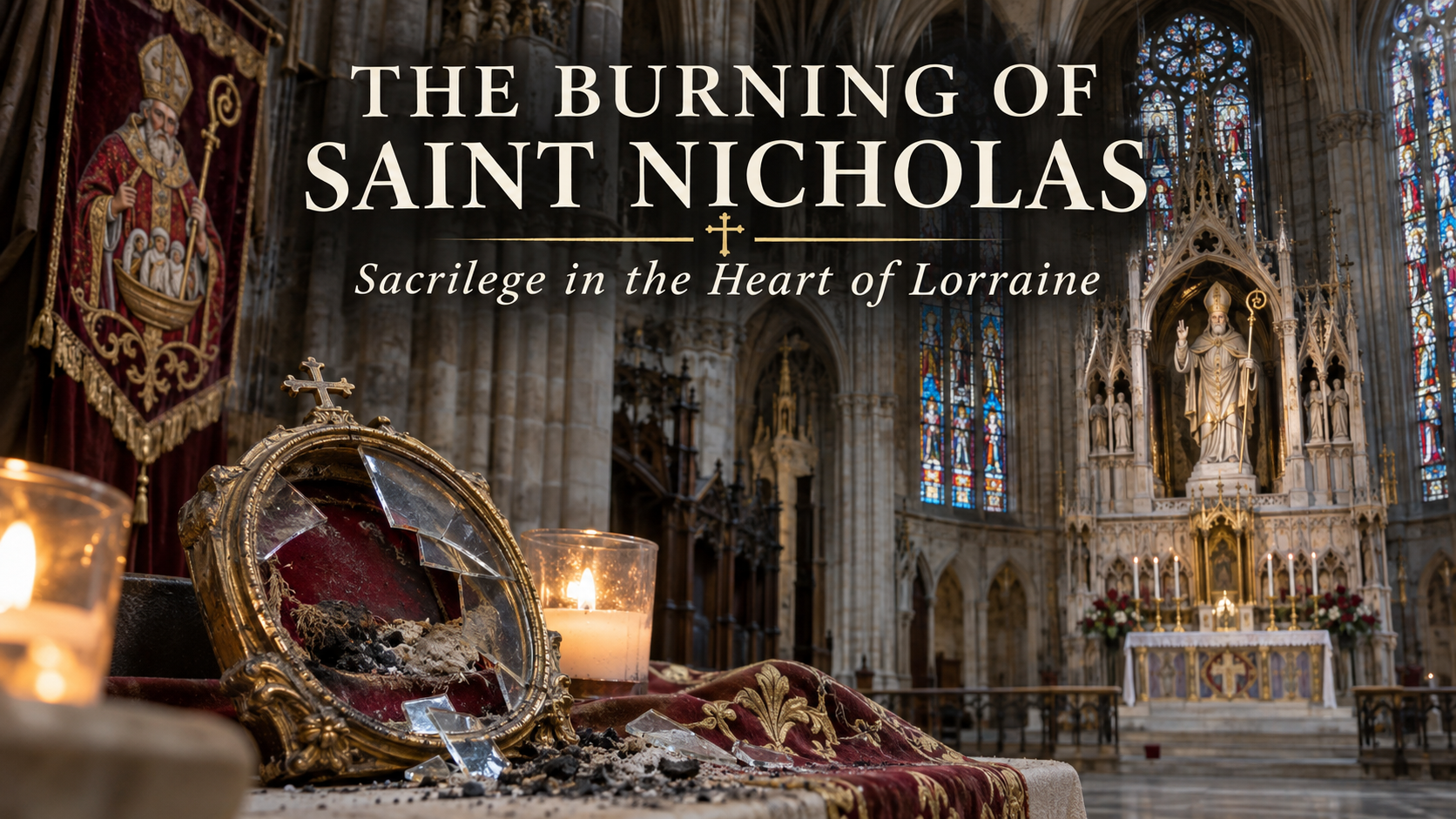
After a relic of Saint Nicholas was stolen, burnt and crushed in a French basilica, the suspect reportedly explained that he wished to destroy a symbol of “fetishism”. The incident raises questions about anti-Christian hostility, the protection of France’s religious heritage and the increasingly neglected Catholic understanding of the sacred.
A fragment of bone, barely two centimetres long, has been deliberately burnt and crushed following its theft from the Basilica of Saint-Nicolas-de-Port in Lorraine. The relic, attributed to the fourth-century bishop of Myra and preserved in a small glass medallion beneath his statue, had been displayed for the veneration of pilgrims. The person responsible broke the glass protecting it and removed the fragment. The basilica’s treasury, where its principal relics and valuable ecclesiastical ornaments are preserved, was not entered.
When police identified and arrested the suspect, he reportedly admitted what he had done. According to a statement issued by the parish of Saint-Nicolas-en-Lorraine on 6 November, he explained that he had acted spontaneously, moved by a désir de destruction, a desire to destroy what he considered a symbol of fétichisme.¹
There was apparently no financial motive, no attempt to sell a precious object, and no suggestion that the relic had been stolen for a private collection. Its religious character seems to have been precisely what provoked the attack. The man wished to destroy it because of what Catholics believed it to represent.
The theft was reported to police on 2 November by Fr Apollinaire Ngun, rector of the basilica. Local accounts differ over whether the incident occurred on 28 or 31 October, although the subsequent investigation is more clearly established. CCTV footage helped municipal and national police identify the suspect, who was arrested at his home and questioned. He is expected to appear before a court in December. His name has not been publicly released.²
The stolen relic consisted of a fragment of bone approximately one or two centimetres long, contained within a small glass medallion in the chapel dedicated to Saint Nicholas. Denis Bourquin, president of the Association for the Knowledge and Restoration of the Basilica, has explained that it was distinct from the principal relics kept in the treasury. The association confirmed on 7 November that the fragment had been installed beneath the statue in the early 2000s. The celebrated arm-shaped reliquary, traditionally associated with the finger bone brought from Bari in the eleventh century, was untouched.³
There is a historical complication worth recording. The association itself acknowledges that the precise provenance of several fragments attributed to Saint Nicholas remains uncertain, and that the present whereabouts of the original dextre bénissante, the blessing finger traditionally brought to Lorraine, cannot be established with confidence. Such uncertainties are familiar to historians of medieval relics. They neither establish nor disprove the authenticity of the particular fragment destroyed. The Church’s recognition of a relic for veneration should not be confused with the sort of scientific certainty which modern readers sometimes imagine must accompany every object inherited from antiquity. Its loss, meanwhile, is beyond dispute.
Saint-Nicolas-de-Port has possessed a place of extraordinary importance in the religious history of Lorraine since the eleventh century. Following the translation of Saint Nicholas’s remains from Myra to Bari in 1087, devotion to the saint spread rapidly through western Christendom. According to the basilica’s historical association, Aubert de Varangéville brought a finger bone from Bari to Lorraine around 1090, depositing it at Port in a small chapel beside the River Meurthe. Abbot Henri de Gorze authorised the construction of a church for the growing number of pilgrims in 1093, shortly before his death. Some local histories give 1098 for Aubert’s journey, although that later date does not accord with the association’s reconstruction of the shrine’s earliest development.⁴
The miraculous deliverance of the Sire de Réchicourt from captivity in the thirteenth century gave rise to the celebrated annual procession. Following the victory of Duke René II at the Battle of Nancy in January 1477, Saint Nicholas’s patronage acquired particular significance for the duchy. The magnificent late Gothic basilica, constructed during the late fifteenth and early sixteenth centuries, bears witness to the importance which generations of rulers, merchants and ordinary faithful attached to the shrine.
Its history also contains episodes which make the present destruction especially painful. During the French Revolution, the basilica’s treasury was confiscated and precious reliquaries disappeared. A new arm-shaped reliquary, fashioned in Lyon, was provided in 1893. Yet even this was removed during the night of 6–7 December 1905, immediately before the enactment of the French law separating Church and State. It reappeared in 1930, in circumstances which remain uncertain. There have been suggestions that the apparent theft was intended to protect the treasure from confiscation during the impending state inventories, although the precise circumstances have never been conclusively established. Kévin Goeuriot, writing for the Lorraine historical publication BLE Lorraine on 12 November, has recalled these earlier losses alongside the damage inflicted during the Thirty Years’ War and the latest incident.⁵
The French Revolution’s destruction of Catholic shrines was undertaken within a very different political and religious environment from that of present-day France. Nevertheless, the underlying assumption that sacred objects may legitimately be destroyed because their religious significance is considered objectionable has an older history than the present suspect’s explanation might suggest.
Christianity has faced accusations of superstition and idolatry over the veneration of relics for centuries. During the Protestant Reformation, the destruction of shrines and sacred images often proceeded from theological objections to practices believed to compromise the exclusive worship owed to God. The Byzantine iconoclastic controversies had earlier raised related questions about sacred representations, although their precise theological and political circumstances differed. The Second Council of Nicaea in 787 defended the legitimate honour accorded to holy images while distinguishing such veneration from the adoration reserved to God alone.
Concerning relics themselves, the Council of Trent gave particularly explicit teaching in its twenty-fifth session in December 1563. The Council declared that the bodies of the saints, having been living members of Christ and temples of the Holy Ghost, are worthy of the faithful’s veneration. They are destined for resurrection and glorification, and God may bestow benefits upon men through them. The bishops were also instructed to guard against superstition, abuses and commercial exploitation. Catholic doctrine has never authorised the treatment of bones as magical objects possessing powers independently of God.⁶
Bishop Pierre-Yves Michel of Nancy and Toul addressed the suspect’s reported accusation directly in comments to Aleteia on 10 November:
“Venerating relics is not fetishism; it is an act of faith that connects us to Christ.”
The Bishop explained that Catholics profess the resurrection of the flesh and regard the saints as members of the same spiritual family, living in communion with Christ. The destruction of their remains consequently carries a significance which cannot be measured by their commercial or archaeological value.⁷
That explanation finds an interesting parallel in something published by Nuntiatoria only days before the incident became widely known. In the homily for the Feast of the Holy Relics on 5 November, the question was posed why the Church should place a fragment of human bone in a precious vessel and invite the faithful to kneel before it. The answer lay in the promised resurrection of the body and the holiness of the person whose remains are preserved. The same homily recalled the early Christians of Smyrna gathering the bones of Saint Polycarp after his martyrdom in the second century. They understood perfectly well that their martyred bishop was neither a deity nor an object of worship. They honoured him because he belonged to Christ.⁸
Scripture itself records a dead man restored to life through contact with the bones of the prophet Eliseus (4 Kings 13:21), while the Acts of the Apostles recounts cures associated with cloths which had touched Saint Paul (Acts 19:12). The Church understands these accounts within the Christian doctrine of the Incarnation and the resurrection of the body. Matter can serve as an instrument of divine grace, and the bodies of the saints, once temples of the Holy Ghost, await the general resurrection. Relics are not sacraments and possess no supernatural power independently of God. Their veneration expresses the honour due to those whom He has sanctified.
The accusation of fetishism therefore rests upon a misunderstanding of what Catholics actually believe. One may dispute the authenticity of a particular relic, question the historical evidence surrounding its translation or criticise the excesses which have sometimes accompanied popular devotions. The Church herself has required abuses to be corrected. None of these objections justifies destroying an object which others lawfully preserve and venerate.
There is also a public question which the French authorities will eventually have to address.
In October 2025, Nuntiatoria examined the continuing destruction and desecration of Catholic churches in France, including the deliberate smashing of a statue of the Sacred Heart at Saint-Hilaire-du-Harcouët in Normandy. That investigation considered both the frequency of attacks and the tendency to discuss them principally in terms of damaged property or heritage. The problem with such language becomes apparent whenever the object has been attacked precisely because it is sacred to those who venerate it.⁹
Saint-Nicolas-de-Port has experienced three reported incidents of vandalism during 2026, including two outbreaks of fire in February. Luc Binsinger, the town’s mayor, has condemned the latest attack and indicated that additional measures to protect the basilica are being considered. The building is at once a major historic monument, a public landmark and a functioning Catholic sanctuary. Its authorities must reconcile the practical necessity of protecting irreplaceable treasures with the purpose for which the church exists.
Bishop Michel has resisted the suggestion that greater security should lead simply to the closure of churches. He has encouraged their continued accessibility, reminding Catholics that churches are intended to receive visitors. His response recognises something frequently forgotten in discussions of ecclesiastical heritage: the great churches of France were built for worship, and their preservation becomes strangely incomplete when they are treated chiefly as architectural monuments.⁷
The legal proceedings may also establish whether the reported religious motivation has any bearing upon the offences charged. The Alliance générale contre le racisme et pour le respect de l’identité française et chrétienne (AGRIF), an organisation concerned with anti-Christian discrimination, has announced its intention to participate in proceedings as a civil party and to seek recognition of an anti-Christian motive as an aggravating circumstance. Its president, Yann Baly, has condemned the destruction and called for a stronger judicial response.¹⁰
Whether the courts accept that argument remains to be seen. The suspect’s statement, as reported by the parish, supplies grounds for examining religious hostility, but the legal characterisation of the offence must rest upon the evidence and the applicable law. Nor does the available information establish the suspect’s own religious affiliation. Suggestions circulating online about his identity and beliefs should not be allowed to substitute for facts established by investigators.
Bishop Michel has described the young man as somewhat disorientated and has asked the faithful to pray for him. This is an appropriate pastoral response, and one which does not diminish the seriousness of the act. The Bishop’s remarks should not be mistaken for a psychiatric assessment, still less for a judicial finding about the suspect’s responsibility. Religious charity requires concern for the offender as well as for the community which has suffered the injury.
The Diocese of Nancy and Toul has condemned the profanation, describing the relic as a tangible link with the saint and with generations of pilgrims. The parish has arranged a Mass of reparation at the basilica on Friday 20 November at 8.45 am. The traditional candlelit procession will take place on Saturday 5 December at 8.30 pm, on the eve of Saint Nicholas’s feast.¹¹
Reparation is the proper religious response to an act which deliberately dishonours something sacred. It expresses the Church’s recognition that an offence against a holy object concerns the worship of God and the reverence owed to those who have served Him. The precise canonical consequences of any violation of the church itself are matters for the competent ecclesiastical authority. The public facts already justify the parish’s decision to offer the Holy Sacrifice in reparation for the profanation.
For centuries, Lorraine has honoured Saint Nicholas as its patron, invoking his assistance in times of danger and giving thanks for his intercession. The shrine has survived political upheaval, war, confiscation and earlier acts of destruction. Its faithful have preserved a devotion whose origins lie in the Christianity of late antiquity and whose significance long preceded the modern association of the saint with Christmas festivities.
The latest destruction has deprived them of a material witness to that inheritance. The courts will decide the suspect’s criminal responsibility, but the religious significance of the act is already evident from the explanation attributed to him. Someone apparently considered Catholic veneration sufficiently objectionable to justify destroying the object of that devotion.
France possesses elaborate arrangements for protecting its historic monuments, and rightly so. Yet the preservation of a religious civilisation requires some recognition of why its people built those monuments, filled them with sacred objects and continued to worship within them long after their original patrons had disappeared. An attack upon a relic cannot be adequately understood by calculating the value of a damaged medallion or a fragment of bone. Where an object is deliberately destroyed because it is held sacred, the injury is directed towards the faith which gives it meaning.
The forthcoming trial will offer an opportunity to establish whether that distinction receives proper consideration. For the Catholic faithful of Saint-Nicolas-de-Port, meanwhile, the matter is painfully clear. Their relic was taken because it was venerated, and, according to the suspect’s reported admission, destroyed for precisely the same reason.
¹ Catholix, Vol et destruction d’une relique de Saint Nicolas à Saint Nicolas de Port, 7 November 2026.
² Magnum la Radio, Saint-Nicolas-de-Port : le médaillon des reliques du saint patron volé, puis détruit, 9 November 2026.
³ Association Connaissance et Renaissance de la Basilique de Saint-Nicolas-de-Port, Accueil.
⁴ Association Connaissance et Renaissance de la Basilique de Saint-Nicolas-de-Port, Saint Nicolas – La relique; La Basilique de saint Nicolas.
⁵ Kévin Goeuriot, Destruction d’une relique de Saint-Nicolas à Saint-Nicolas-de-Port, BLE Lorraine, 12 November 2026.
⁶ Council of Trent, Session XXV: On the Invocation, Veneration, and Relics of Saints, and on Sacred Images, 1563.
⁷ Cécile Séveirac, Lorraine : blessure des fidèles après la profanation d’une relique de saint Nicolas, Aleteia, 10 November 2026.
⁸ Nuntiatoria, Today’s homily: Feast of the Holy Relics, 5 November 2026.
⁹ Nuntiatoria, France’s Forgotten Martyrs: Desecration, Indifference, and the Struggle for the Soul of the Eldest Daughter of the Church, 22 October 2025.
¹⁰ Boulevard Voltaire, Une relique de saint Nicolas volée, brûlée et écrasée en Lorraine, updated 11 November 2026.
¹¹ Nancy Actualité, À Saint-Nicolas-de-Port, une relique volée et détruite dans la basilique, 11 November 2026.





Leave a Reply