
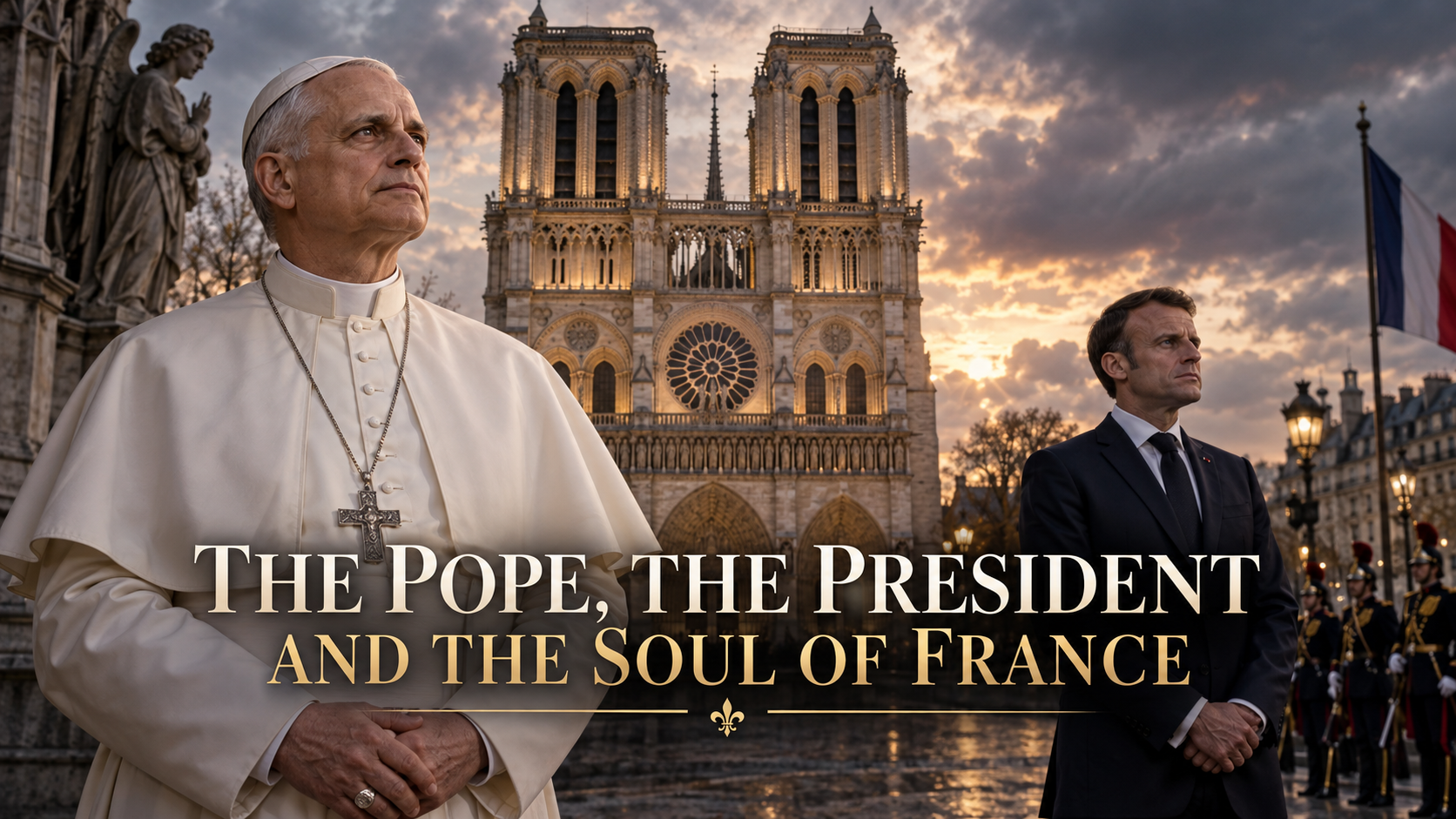
President Emmanuel Macron wanted to accompany Pope Leo XIV through the restored Notre-Dame and show him what France had accomplished. Rome said no. It would be easy to dismiss the disagreement as protocol, were it not for what happened when Notre-Dame reopened in 2024 — and for what has happened in France since. Leo has already confronted Macron over euthanasia. The President has since promulgated the law. Now the Pope is coming to France, and Cardinal ✠Jean-Marc Aveline says the country needs “an awakening of consciousness”.
President Emmanuel Macron wanted to walk Pope Leo XIV through Notre-Dame. Rome declined. According to French reporting, the President had hoped to accompany the Pope for several minutes through the restored cathedral, personally presenting the work carried out after the devastating fire of 2019. The Élysée had other ambitions for the visit too: fuller military honours, a state meal and the Grand Cross of the Légion d’honneur were among the reported proposals. Most disappeared from the final arrangements. The Holy See has been careful not to manufacture a quarrel, and neither should we. But the published programme tells its own story. Macron receives Leo at the Élysée. The Pope addresses the political and diplomatic world there. At Notre-Dame, however, Leo celebrates Vespers with the bishops, priests, deacons, religious and seminarians of France.¹
It is a small distinction carrying a considerable weight of history. France owns Notre-Dame. The Church worships there. The President represents the Republic which spent enormous sums restoring the cathedral; the Archbishop of Paris possesses the ecclesiastical responsibility for what happens within it. Those facts can coexist, but they did not coexist comfortably when the cathedral reopened in December 2024. For weeks, indeed months, the Élysée and the Archdiocese of Paris wrestled with the choreography of the reopening. Would Macron speak inside the nave? Would he speak outside on the parvis? Who would occupy the symbolic centre of the occasion? Le Monde described “endless discussions” between the diocese and the presidential palace. Archbishop ✠Laurent Ulrich at one stage announced that Macron would speak inside. The Élysée subsequently said the speech would take place outside. In the end Storm Darragh intervened and the President spoke indoors.²
It would be careless to turn that episode into evidence of a personal feud between Macron and ✠Ulrich. What occurred was more interesting than that. Two institutions approached the same building with different instincts. The Republic saw the triumphant restoration of perhaps the supreme monument of French patrimony. The Church saw the reopening of a cathedral. France had rebuilt Notre-Dame; ✠Ulrich had to reopen it for the purpose for which it was built. That was why one of the most telling moments of the entire weekend belonged neither to Macron nor to the assembled heads of state. The Archbishop stood outside the closed doors and struck them three times with his crozier. The cathedral answered in song. Then the doors opened. Five years after the fire had emptied Notre-Dame of public worship, the Archbishop entered his cathedral again.
The point was not that France had no claim upon Notre-Dame. Of course it does. The cathedral belongs profoundly to the history of the French nation. The point was that its national significance does not exhaust its meaning. Notre-Dame is not an unusually beautiful public hall which happens to contain an altar. Its stones were raised around that altar. Its windows, towers, sculpture, music and architecture grew out of a civilisation which believed the things done at that altar to be true. Nuntiatoria returned to this dispute last year in “France’s Forgotten Martyrs: Desecration, Indifference, and the Struggle for the Soul of the Eldest Daughter of the Church.” We argued then that the reopening had exposed a peculiar contradiction in modern France: a nation capable of lavishing money, expertise and emotion upon Christian patrimony while remaining deeply uncertain about the Christianity which made that patrimony intelligible. The State can restore the stones. It cannot by itself tell us why they were put there.³
That contradiction now forms the backdrop to Leo XIV’s visit. But Notre-Dame protocol is not the most important thing which has passed between this Pope and this President. Cardinal ✠Jean-Marc Aveline has revealed that when Macron met Leo at the Vatican in April, the Pope raised France’s proposed euthanasia legislation directly with him. The Holy See’s public communiqué after the audience did not disclose that part of the conversation. Aveline now says that Leo subsequently wrote to him and said he had expressed his convictions to the French President “without the certainty of having been heard”.⁴ It is a remarkable sentence because subsequent events have supplied their own commentary upon it. Leo spoke; he was unsure Macron had listened; and France legislated.
On 15 July the National Assembly adopted the proposed law establishing a right to aide à mourir by 291 votes to 241, with 29 abstentions. Following review by the Constitutional Council, Macron promulgated Loi n° 2026-794 du 18 août 2026 relative au droit à l’aide à mourir on 18 August. It appeared in the Journal officiel the following day. What Leo had discussed with Macron in April as impending legislation is now French law.⁵ Here the disagreement between Pope and President is no matter of ceremonial taste. The Catholic position is not obscure. Directly intending the death of an innocent person in order to remove suffering is morally impermissible. That teaching is perfectly compatible with refusing futile or disproportionately burdensome treatment, with proper palliative medicine, and with allowing natural death to occur. Those distinctions matter precisely because the Church does not teach that life must be prolonged by every technologically available means. What she rejects is the transformation of killing into treatment.⁶
Aveline’s account suggests that Leo understands perfectly well what is at stake. The Cardinal says the Pope is attentive both to the striking growth in requests for baptism among French adults and adolescents and to the pressure upon Catholic consciences created by the euthanasia law and the constitutionalisation of abortion. Aveline even reports Leo asking where the French will find the energy to resist these developments. Then comes the judgement which gives this visit its real context: **“The papal visit is providential. It is an awakening of consciousness that we need.”**⁷ Against that background, the argument about who walks through Notre-Dame with whom looks rather less trivial.
The Holy See is not snubbing France. Leo will go directly to the Élysée on the morning of 25 September. He will meet Macron, address the authorities, civil society and diplomatic corps, and later visit UNESCO. The French Republic receives the Pope with the honour due both to the Bishop of Rome and to the sovereign of Vatican City. But the rest of the programme is unmistakably apostolic: Vespers in Notre-Dame, a prayer vigil with young people at the Stade de France, a meeting with catechumens and the newly baptised, Mass in Paris, prayer at the Grotto of Massabielle, meetings with the French bishops and the sick, time with contemplative religious, the Rosary by torchlight at Lourdes, and Mass in Metz.⁸
That is why Rome’s refusal of Macron’s proposed Notre-Dame tour matters. The President’s request was not in itself outrageous. It is entirely understandable that the head of the French State should take pride in one of the most extraordinary restorations of modern times. Nor would there have been anything inherently improper in his explaining aspects of that work to the Pope. But Rome appears to have recognised the danger of allowing the symbol to overwhelm the substance. A papal journey can very easily become state theatre. Cameras, guards of honour, motorcades, medals and presidents swallow the event, while the Successor of Peter becomes the most exotic dignitary in somebody else’s national pageant. Leo’s programme draws a boundary. The President has his proper place. The cathedral has another.
In France that boundary is especially charged because the Republic remains capable of loving Catholicism as heritage while resisting Catholicism as revelation. It will preserve the cathedral and dispute the creed. It will celebrate Gothic stonework and legislate against Christian anthropology. It can admire the saints as figures of national history while finding their beliefs intolerably demanding when translated into moral argument. Notre-Dame is beautiful; the doctrine which made Notre-Dame possible is inconvenient. France is hardly alone in this. It is one of the characteristic disorders of post-Christian Europe. Christian civilisation is preserved aesthetically after being rejected intellectually. Its buildings are treasured, its music performed, its feast days retained in mutilated form, its vocabulary borrowed for civic occasions. Yet when Christianity speaks not about architecture but about what man is, what marriage is, what life is, what death is, what the body is for and what duties creatures owe their Creator, affection for heritage can disappear very quickly.
Notre-Dame therefore remains the perfect place in which this French contradiction becomes visible. The State owns the building. Millions who do not share the Catholic faith cherish it. None of that needs to be begrudged. Yet Notre-Dame cannot be understood merely as a masterpiece of Frenchness. The very name rebukes that reduction. It belongs to Our Lady. Its sanctuary was made for sacrifice. Its bells called men to prayer. Its gargoyles, saints, prophets, glass and stone proclaimed a supernatural world long before tourists queued beneath them. Macron’s France understands the value of the building. Leo’s visit poses the harder question: does France still understand what the building says?
That question was present when ✠Ulrich struck the doors in December 2024. It returns when the Élysée asks to conduct a Pope through the restored nave. And it becomes much more serious when the President who helped restore Notre-Dame signs into law something the Pope had personally warned him about four months earlier. There is no need to invent a diplomatic crisis because the existing facts are more revealing. Leo told Macron what the Church believes about euthanasia and afterwards admitted uncertainty that he had been heard. Macron promulgated the law. Now Leo comes to France.
He comes to a country where unusually large numbers of adults and adolescents are presenting themselves for baptism, even as the State travels further from the anthropology into which those converts are being baptised. He comes to a Church weakened institutionally but discovering unexpected signs of spiritual hunger. He comes to Notre-Dame, whose resurrection from the flames became an international symbol of French achievement but whose reopened doors confront France with something more demanding than achievement. A restored cathedral is not necessarily evidence of a restored civilisation.⁹
That is the real tension beneath this visit. It is not Pope versus President in some theatrical contest for precedence. It is a question of which France survives beneath the ceremony: the France which remembers that Notre-Dame is beautiful, or the France which can still remember why. Cardinal Aveline calls the visit providential. The test of that judgement may prove very simple. The Pope has already spoken. The question now is whether France will hear him this time.
¹ Holy See, “Apostolic Journey of Pope Leo XIV to France and Visit to UNESCO, 25–28 September 2026”; La Dépêche, “Visite du pape Léon XIV : accueil militaire, Notre-Dame de Paris, Légion d’honneur… Emmanuel Macron voulait sortir le grand jeu, le Vatican lui a poliment répondu non”.
² Le Monde, “Réouverture de Notre-Dame : les coulisses d’une cérémonie, objet de discussions sans fin entre le diocèse et l’Elysée”; Le Monde, “Reopening of Notre-Dame: A behind-the-scenes look at the ceremony”.
³ Nuntiatoria, “France’s Forgotten Martyrs: Desecration, Indifference, and the Struggle for the Soul of the Eldest Daughter of the Church”; Holy See, “Message of the Holy Father on the occasion of the reopening of the Cathedral of Notre-Dame, Paris”, 7 December 2024.
⁴ France Catholique, “La visite de Léon XIV doit réveiller nos consciences : l’appel du cardinal Aveline”, 11 September 2026; Holy See Press Office, “Audience with the President of the French Republic”, 10 April 2026.
⁵ Assemblée nationale, “Analyse du scrutin n°8280”, 15 July 2026; Légifrance, “Loi n° 2026-794 du 18 août 2026 relative au droit à l’aide à mourir”.
⁶ Sacred Congregation for the Doctrine of the Faith, “Declaration on Euthanasia — Iura et Bona”, 5 May 1980; Catechism of the Catholic Church, §§2276–2279.
⁷ France Catholique, “La visite de Léon XIV doit réveiller nos consciences : l’appel du cardinal Aveline”.
⁸ Holy See Press Office, “Apostolic Journey of His Holiness Pope Leo XIV to France — Programme”; Vatican News, “Le programme du voyage apostolique du Pape en France dévoilé”.
⁹ France Catholique, “La visite de Léon XIV doit réveiller nos consciences : l’appel du cardinal Aveline”; Vatican News, “French Bishops: There is a spiritual thirst in the country as it awaits the Pope”.





Leave a Reply