
Brigitte Macron and the Eucharist: doctrine, discipline, and public witness
Introduction: a public reception, a public question
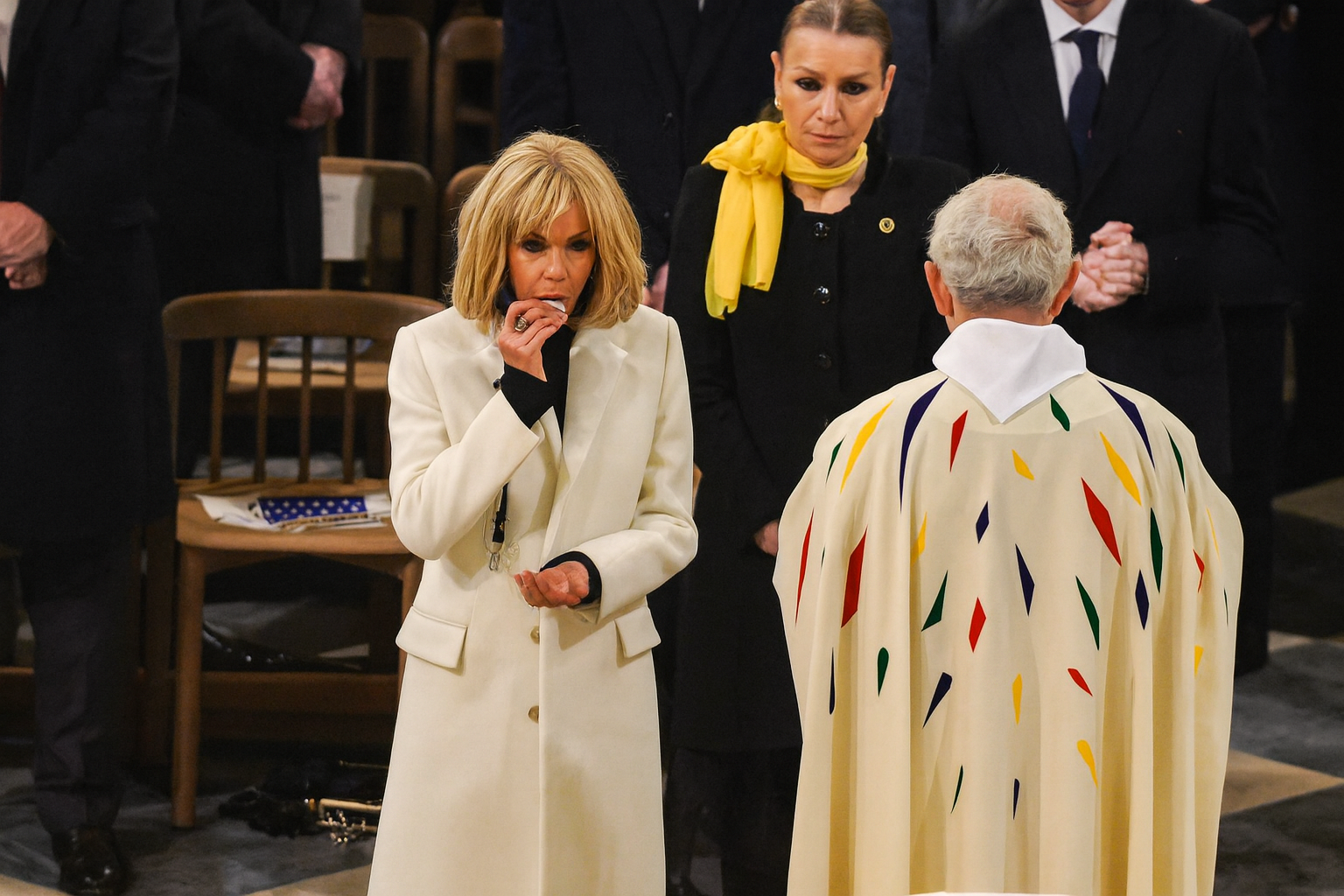
On 8 December 2024, the Cathedral of Notre Dame in Paris hosted its first solemn Mass since the devastating fire of 2019. The liturgy, broadcast live on French public television, was attended by civil and state dignitaries. During the distribution of Holy Communion, Brigitte Macron, the wife of the French President, was clearly seen approaching and receiving the Eucharist. The moment, though brief, has since provoked sustained controversy among clergy, canonists, and the faithful concerning the Church’s discipline on worthy reception of Holy Communion and the handling of sacramental acts involving highly visible public figures.
The event and its public visibility
The Mass marked the formal reopening of Notre Dame after extensive restoration and was intended as a moment of national and cultural significance. Video footage shows Mrs Macron receiving Communion from a bishop, while President Emmanuel Macron remained in his place. Commentators on the broadcast explicitly stated that she had “every right” to receive Communion, a remark that itself contributed to the subsequent debate by framing the act in juridical rather than sacramental terms.¹ The public nature of the liturgy, its national broadcast, and the symbolic importance of the setting distinguish this incident from an ordinary parish Mass.
Ecclesial reaction and clerical protest
In the days following the Mass, criticism emerged from traditional Catholic circles in France and abroad. Most prominently, Fr Guy Pagès, a French diocesan priest, addressed an open letter to Pope Leo XIV, describing the incident as a “profanation of the Eucharist” and calling for papal intervention.² Pagès argued that the public admission of a figure so closely associated with policies and cultural positions widely understood to contradict Catholic moral teaching risked grave scandal and undermined the Church’s sacramental discipline. His appeal has since been echoed by several commentators who regard the episode as emblematic of a broader collapse in eucharistic seriousness.
Claims advanced by critics
Critics of Mrs Macron’s reception of Communion typically advance three arguments. First, they point to her well-documented public support for policies concerning abortion, euthanasia, and contemporary sexual ethics, all of which the Catholic Church has repeatedly identified as gravely contrary to the moral law.³ Second, some commentators raise questions about her marital history, alleging that her civil marriage following divorce may not have been regularised according to Catholic canonical norms, though no public ecclesiastical judgment on this point has been issued. Third, critics note the apparent absence of any visible application of canonical discipline or pastoral clarification during or after the liturgy, despite its extraordinary public profile.
The canonical framework: Canons 915 and 916
Any serious evaluation of the controversy must be grounded in the Church’s law. Canon 915 of the 1983 Code of Canon Law states that those who “obstinately persist in manifest grave sin are not to be admitted to Holy Communion.” This canon governs the duty of the minister of Communion and concerns objective, publicly verifiable situations. Canon 916, by contrast, binds the conscience of the communicant, who must not receive the Eucharist while conscious of grave sin without prior sacramental confession. The distinction is crucial: Canon 915 addresses public order and scandal, while Canon 916 concerns personal culpability before God.
Magisterial teaching on Eucharist and communion
The modern magisterium has repeatedly affirmed that the Eucharist both signifies and effects ecclesial communion. Pope John Paul II taught that the Eucharist “presupposes communion with the Church in her visible structure” and cannot be reduced to a purely private act of devotion.⁴ Redemptionis Sacramentum further insists that ministers of Holy Communion have a grave responsibility to prevent abuses and to safeguard the sacrament from objective sacrilege.⁵ Benedict XVI likewise warned that pastoral charity detached from sacramental discipline ultimately empties the Eucharist of its meaning.⁶
Sacramental theology and the problem of scandal
Beyond canon law, the Church’s constant sacramental theology remains decisive. St Paul’s warning that those who receive unworthily “eat and drink judgment upon themselves” has always been understood as applying not only to the interior state of the communicant but also to the Church’s public witness.⁷ St Thomas Aquinas teaches that to receive the Eucharist in a state of mortal sin constitutes sacrilege, because it contradicts the reality signified by the sacrament itself.⁸ Scandal, in this context, does not mean outrage or offence, but the objective leading of others into confusion about moral truth and ecclesial communion.
Silence from ecclesiastical authorities
As of this writing, no official statement has been issued by the Holy See, the Archdiocese of Paris, or the French Bishops’ Conference clarifying the canonical assessment of the incident or offering guidance on similar situations involving public figures. This silence has allowed competing interpretations to flourish, with some appealing to personal conscience and pastoral accompaniment, and others warning that the absence of visible discipline further erodes belief in the Real Presence and the moral demands of eucharistic communion.
Conclusion: the Eucharist as truth, not gesture
The controversy surrounding Brigitte Macron’s reception of Holy Communion is not fundamentally about personal worth, nor about political alignment. It concerns the integrity of the Eucharist as the sacrament of unity in truth. When highly visible public acts appear to contradict the Church’s moral teaching, the resulting confusion harms not only the faithful but the credibility of the Church’s witness. The episode thus reopens an urgent question for the contemporary Church: whether eucharistic discipline remains a living reality, or whether the sacrament has been reduced, in practice, to a ceremonial gesture devoid of doctrinal content.
¹ Coverage of the Notre Dame reopening Mass and broadcast commentary, December 2024.
² Fr Guy Pagès, open letter calling for papal intervention following the Notre Dame Communion incident.
³ Reporting on Brigitte Macron’s public advocacy and associated criticisms.
⁴ Pope John Paul II, Ecclesia de Eucharistia (2003), §37.
⁵ Congregation for Divine Worship, Redemptionis Sacramentum (2004), §§83–84.
⁶ Benedict XVI, Sacramentum Caritatis (2007), §29.
⁷ 1 Corinthians 11:27–29.
⁸ St Thomas Aquinas, Summa Theologiae III, q.80, a.4.
RELATED ARTICLES


Latest ARTICLES
- The Church Does Not Need Our Denial: Truth, scandal and the false defence of ecclesiastical reputationThe text explores the concept of “spiritual denial” within the Catholic Church regarding serious allegations against church leaders. It argues that this denial, often perceived as loyalty, leads to evasion of uncomfortable truths. The piece emphasises that acknowledging these failures does not undermine the Church’s integrity, urging faithful confrontation of wrongdoing while maintaining justice for all involved.
- The Dossier against the Victim: Bergoglio, Grassi and the Counter-Investigation the Church CommissionedAfter Fr Julio César Grassi was convicted of child sexual abuse, the Argentine Episcopal Conference, under Cardinal Bergoglio, commissioned a counter-investigation claiming his innocence, allegedly costing US$300,000. A new book by Grassi’s victim details intimidation faced by him post-conviction, highlighting the disparity in institutional support between the abuser and the victim.
- What takes priority? Leo XIV, Sexual Morality and the Synodal Reordering of Moral EmphasisPope Leo XIV has not rejected Catholic sexual morality, but his remarks hint at a pastoral shift prioritising issues such as justice and equality over sexual ethics. As the Amoris Laetitia synod approaches, concerns arise about whether moral teachings will remain authoritative as pastoral priorities evolve. The Church’s foundational beliefs may risk being undermined in this reordering.
- After the Mistrial: The Lindsay Clancy Spectacle DeepensThe mistrial concerning Lindsay Clancy’s case revealed a split jury regarding her criminal responsibility for the deaths of her three children. Although eleven jurors seemed to lean towards a lack of guilt due to mental illness, the incident highlights the complex interplay between compassion, public perception, and accountability in tragic cases.
- Today’s homily: Feria II of the Fifteenth Sunday Post PentecostSt Paul urges us not to grow weary in doing good: every prayer, sacrifice, act of charity and fidelity is seed sown for eternity. Our task is to persevere in the sowing and trust God for the harvest.



Leave a Reply