
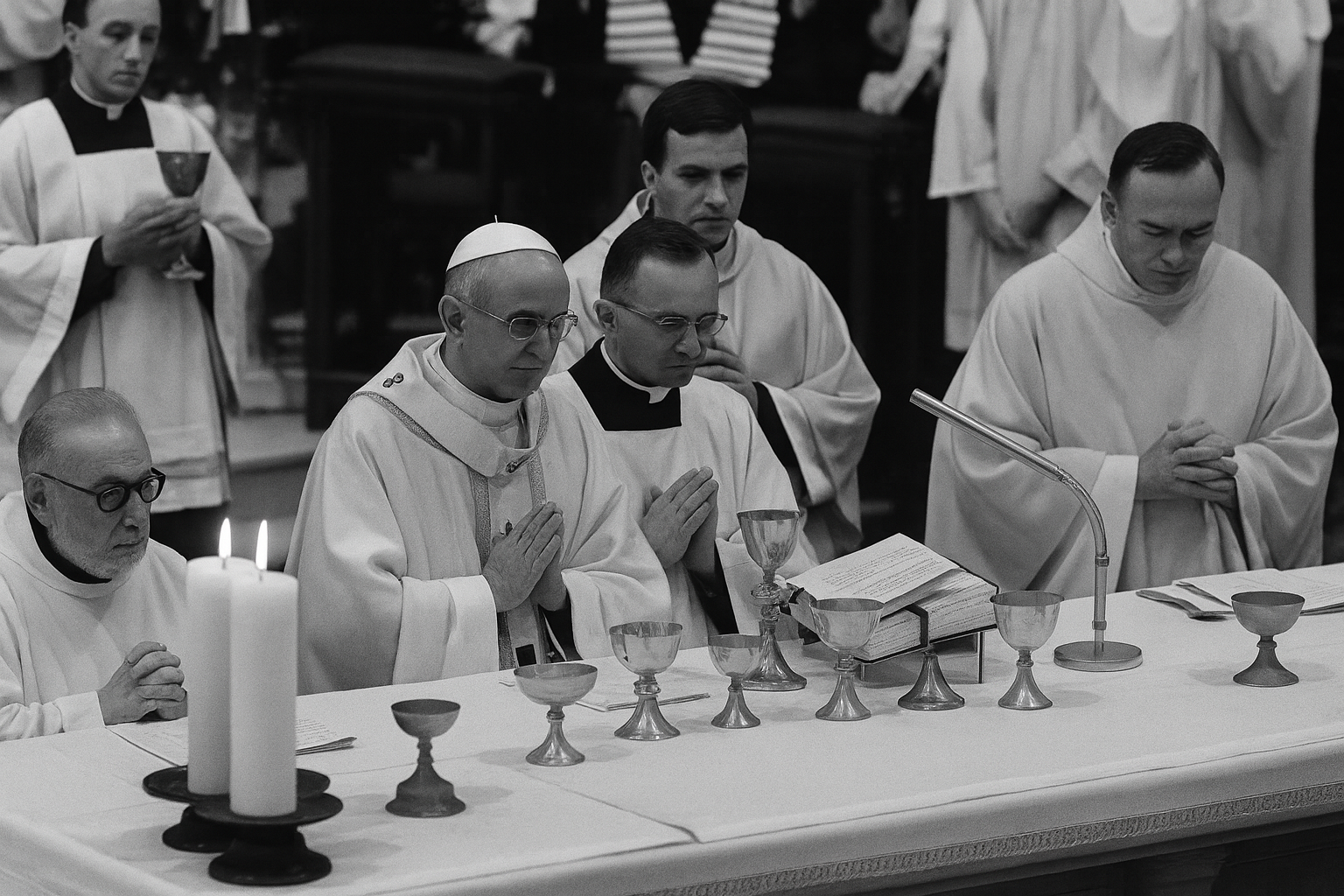
Whither the Mass of Vatican II? The Missal the Council Never Saw
Dom Alcuin Reid, writing in the Catholic Herald to mark the sixtieth anniversary of the close of the Second Vatican Council, has reopened a question many Catholics assume was resolved decades ago. His essay advances a precise historical claim with profound ecclesial implications: that the Mass commonly described as the “Mass of Vatican II” is not, in fact, the liturgy the Council Fathers approved, anticipated, or recognised as their own.¹
This distinction between the reform authorised by the Council and the rites later produced in its name lies at the heart of the post-conciliar liturgical crisis. Reid’s argument is neither nostalgic nor polemical. It is documentary, historical, and grounded in the lived experience of the Council itself.
Reid’s authority to make such a claim does not arise from factional allegiance but from sustained scholarly engagement with the history and theology of the Roman rite. A Benedictine monk and Prior of the Monastère Saint-Benoît in Brignoles, France, he has consistently insisted that organic development is not a matter of aesthetic preference but the Church’s own historical method of liturgical continuity. His seminal work The Organic Development of the Liturgy, published with a preface by Joseph Cardinal Ratzinger, demonstrated with documentary precision that post-conciliar liturgical reform departed not only from inherited ceremonial forms but from the very principles by which the Church had previously reformed her liturgy.²
Reid’s scholarship is marked by a refusal of slogans—whether progressive or traditionalist—and by close attention to conciliar procedure, historical sources, and the limits of legitimate authority. That he advances these arguments in the Catholic Herald, rather than in a niche or partisan outlet, underscores the seriousness of his intervention and the extent to which questions once dismissed as “traditionalist grievances” now command wider ecclesial attention.
It is precisely this methodological seriousness—this insistence on tracing what the Council actually authorised, rather than what was later done in its name—that frames Reid’s critique of the Consilium and the post-conciliar liturgical project that followed.
The Council’s final liturgy and the reform it embodied
On 7 December 1965 Pope Paul VI celebrated the Mass that formally closed the Second Vatican Council in St Peter’s Square. Contemporary observers remarked upon its simplicity. It was not one of the elaborate papal ceremonies traditionally sung by the Pope and the Julian choir, but a sung Mass in which the assembled bishops responded together in Latin chant. One official observer described it as “a simple sung Mass to which the entire assembly responded,” presenting it as a tangible fruit of the Council’s Constitution on the Sacred Liturgy.³
For those present, this was not experienced as rupture but as renewal. The participation of more than two thousand bishops chanting together in Latin embodied precisely what many Fathers believed the Council had achieved: fuller participation in the Sacred Liturgy without abandoning the inherited structure of the Roman Mass. This was the liturgical movement’s original aspiration, long articulated before the Council—participation through understanding and unity, not through ritual novelty.
Throughout 1965 the Holy See implemented changes consistent with this understanding. In January, a revised Order of Mass was promulgated and mandated for inclusion in future editions of the Roman Missal.⁴ Its reception was widely understood as definitive rather than provisional. Bishops, clergy, and liturgical publishers treated it as the Council’s reform, not as an interim experiment. Herder & Herder even published a substantial volume entitled The New Liturgy, documenting its genesis and presenting it as the legitimate outcome of conciliar deliberation.⁵
What the Council actually approved
At the Council itself, the Fathers debated specific proposals and accepted them only after receiving repeated assurances. They were explicitly told that “the current Ordo Missae, which has grown up in the course of the centuries, certainly is to be retained.”⁶ On that basis they approved a defined and limited programme of reform: simplification of repeated gestures; shortening of the prayers at the foot of the altar; proclamation of the readings facing the people; a modest expansion in the number of prefaces; greater audibility of presidential prayers; the audible doxology of the Canon with the people’s response; a clearer arrangement of the Fraction and Pax; and the restoration of the ancient Ambrosian Communion formula, Corpus Christi. Amen.
Latin, critically, was to remain the normative language of the Roman rite, while the vernacular was permitted only in certain parts and subject to episcopal discernment and Roman confirmation.⁷ The Council did not debate Mass facing the people, total vernacularisation, Communion in the hand, the multiplication of Eucharistic prayers, or the conceptual shift from altar to table. These were not matters deferred for later clarification; they were simply not part of the Council’s mandate as the bishops understood it.
Seen in this light, the 1965 Ordo Missae represents something historically coherent: the Roman Mass as it had developed organically over centuries, pruned but not rebuilt, reformed but not replaced.
Paul VI and the confidence of implementation
When Paul VI celebrated the revised Mass in a Roman parish on 7 March 1965, he did so with unmistakable confidence. “Today we inaugurate the new form of liturgy in all the parishes and churches of the world,” he declared.⁸ There was no suggestion that this was a transitional phase or an incomplete reform awaiting further reconstruction.
At the same time, the Pope’s extensive use of Italian signalled a development that would soon exceed the Council’s textual limits. Barely a year after Sacrosanctum Concilium reaffirmed that Latin was to be preserved in the Latin rites,⁹ the vernacular was already becoming dominant. In principle, extensions of vernacular usage required episcopal discernment and Roman confirmation.¹⁰ In practice, permissions were granted rapidly and expansively.
Fr Annibale Bugnini, Secretary of the Consilium charged with implementing the reform, would later boast that the Council’s principle regarding vernacular language had been given a “broad interpretation.”¹¹ What had been presented as a pastoral accommodation increasingly functioned as a norm.
The Consilium and the abandonment of organic development
Unknown to most bishops, however, a different project was already well advanced. Even before the 1965 Order of Mass had been fully received, the Consilium regarded it as merely temporary. Its members moved rapidly toward the construction of what came to be known as the “normative Mass”—a rite no longer governed by the principle of retaining the Ordo Missae that had grown organically through centuries.
Drafts circulated that eliminated the Confiteor, removed sacrificial offertory prayers, omitted the Orate fratres, proposed alterations to or replacement of the Roman Canon, and introduced multiple Eucharistic prayers. The Roman rite was no longer treated as a living inheritance to be carefully pruned, but as one historical source among others from which a new liturgical structure could be assembled.
Joseph Cardinal Ratzinger later diagnosed this rupture with striking clarity. What had been abandoned, he said, was the living process of growth and development, replaced by fabrication—“a banal, on-the-spot product.”¹² Reid places this judgment at the centre of his analysis. The decisive break did not occur at the Council itself, but in its implementation.
From reform to replacement
By the time the bishops encountered the emerging rite publicly at the 1967 Synod of Bishops, many expressed visible unease. What they were shown no longer resembled the reform they believed they had approved. Nevertheless, the process continued. In April 1969 the new Order of Mass was promulgated, and in 1970 the Roman Missal appeared, containing additional Eucharistic prayers never envisaged by the Council, theologically attenuated offertory prayers, and a radical reduction—rather than simplification—of ceremonial gestures.
Paul VI personally intervened to retain certain traditional elements: the sign of the cross at the beginning of Mass, a Confiteor, the Orate fratres, and the Roman Canon.¹³ Yet these were often retained only as options. In practice, they were frequently discarded, leaving the Roman Canon effectively marginalised in many places.
The new Missal also revealed extensive reworking of the Church’s ancient orations. Prayers were revised or replaced to remove themes thought unwelcome to “modern man”: judgment, penance, spiritual combat, and explicit sacrificial language. The reform of the liturgical calendar itself was later criticised by Louis Bouyer, who described the process with memorable severity.¹⁴
The testimony of the Council Fathers
Reid strengthens his case by appealing not to ideology but to testimony. In later years, surviving Council Fathers spoke candidly of their dismay. Bishop Ignatius Doggett OFM described the implementation of the liturgical constitution as “horrible,” insisting that Communion in the hand and the displacement of the altar by the language of mensa were never contemplated during the debates. “The Council was to reform, not to change completely,” he wrote.¹⁵
Such testimony does not deny the validity of the modern rites. It does, however, expose the historical fiction that equates them straightforwardly with Vatican II.
A reform that never arrived
For this reason, Reid argues, it is entirely possible to question the modern rites without rejecting the Council itself. Indeed, fidelity to Vatican II may require precisely such questioning. This was the logic behind the call for a “reform of the reform,” articulated above all by Cardinal Ratzinger. Yet this project was never realised, and today is widely dismissed as undesirable by those who idolise the Missal of Paul VI as well as by those who reject it entirely.
Ironically, Reid observes, the Council’s primary aim—full, conscious, active, and fruitful participation—may often be more clearly realised in contemporary celebrations of the older Roman rites than in many celebrations of the modern use. This does not mean the newer rites cannot nourish faith. It does mean they are not necessary for it.
Conclusion: fidelity, not nostalgia
The Missal promulgated in 1970 is valid, duly authorised, and capable of sanctifying the faithful. But it is not the Mass the Council Fathers voted for, nor the liturgy they recognised in 1965. That Mass—the authentic “Mass of Vatican II”—was eclipsed before it could take root.
Understanding this distinction clarifies much of the present confusion. It explains why questioning the post-conciliar rites is not synonymous with rejecting Vatican II, and why many young Catholics today, searching for depth and continuity, are drawn to the older rites. In them, they encounter not a rejection of the Council, but the living tradition the Council sought to renew.
- Dom Alcuin Reid, “Whither the Mass of Vatican II?”, Catholic Herald, December 2025.
- Dom Alcuin Reid, The Organic Development of the Liturgy, Ignatius Press, San Francisco, 2005; Preface by Joseph Cardinal Ratzinger.
- Council Daybook: Vatican II, vol. III, entry for 7 December 1965, p. 284.
- Acta Apostolicae Sedis 57 (1965), promulgation of the revised Ordo Missae.
- The New Liturgy, Herder & Herder, 1965.
- Relatio presented to the Council Fathers during the debates on Sacrosanctum Concilium, 1963.
- Sacrosanctum Concilium, §§36, 54.
- Paul VI, Homily at All Saints’ Parish, Rome, 7 March 1965.
- Sacrosanctum Concilium, §36.
- Sacrosanctum Concilium, §§22, 36–40.
- Annibale Bugnini, The Reform of the Liturgy 1948–1975, Liturgical Press, 1990.
- Joseph Cardinal Ratzinger, Preface to Reid, The Organic Development of the Liturgy.
- Documentation of papal interventions during the drafting of the new Ordo Missae, 1968–1969.
- Louis Bouyer, Mémoires, Cerf, 2014.
- Bishop Ignatius Doggett OFM, correspondence with Dom Alcuin Reid, cited in Reid, Catholic Herald, 2025.


Latest
- TRADITION BEHIND THE FENCEThe Vatican’s prohibition of the traditional Ad Petri Sedem pilgrimage to St Peter’s Basilica has sparked controversy, especially among traditional Catholics. While some cite scheduling conflicts, the broader issue lies in the restrictive policies of Traditionis custodes, which may confine traditional liturgical practices to specific enclaves, risking the transmission and recognition of Catholic Tradition within the wider Church.
- Today’s Mass: October 24 St Raphael the ArchangelThe Feast of Saint Raphael the Archangel highlights his healing powers as depicted in the Book of Tobit, where he aids Tobit and his son, Tobiah. Venerated as a protector of travellers and the blind, Raphael is celebrated for his miraculous interventions. His legacy includes support for nurses, matchmakers, and Catholic studies.
- 25.10.26 Nuntiatoria CXXIX: CHRISTUS REXThe text discusses the relationship between Christ’s kingship and authority within the Church amidst contemporary challenges. It contrasts ecclesiastical power with genuine faith, emphasising that authority must protect divine truth rather than alter it. The witness of imprisoned priests illustrates the enduring significance of fidelity to Christ over institutional conformity.
- THE DOMESTIC CHURCH: 25 October – 2 November 2026 A Home with Room for Heaven: Preparing for All Saints and All SoulsThe content outlines a week’s plan for traditional Catholic families to prepare for the feasts of All Saints and All Souls. Emphasising daily prayers, remembrance of the deceased, and engagement with children’s activities, it aims to integrate Catholic customs into family life, enriching spiritual practices and fostering a shared faith experience.
- ORDO w/c 25.10.26The text outlines the liturgical calendar for the last week of October and the beginning of November, highlighting key celebrations. Notable events include the Feast of Christ the King, St Evaristus, the Vigil of Saints Simon and Jude, and the Feast of All Saints, emphasising themes of holiness, unity in faith, and the Church’s teachings.



Leave a Reply