
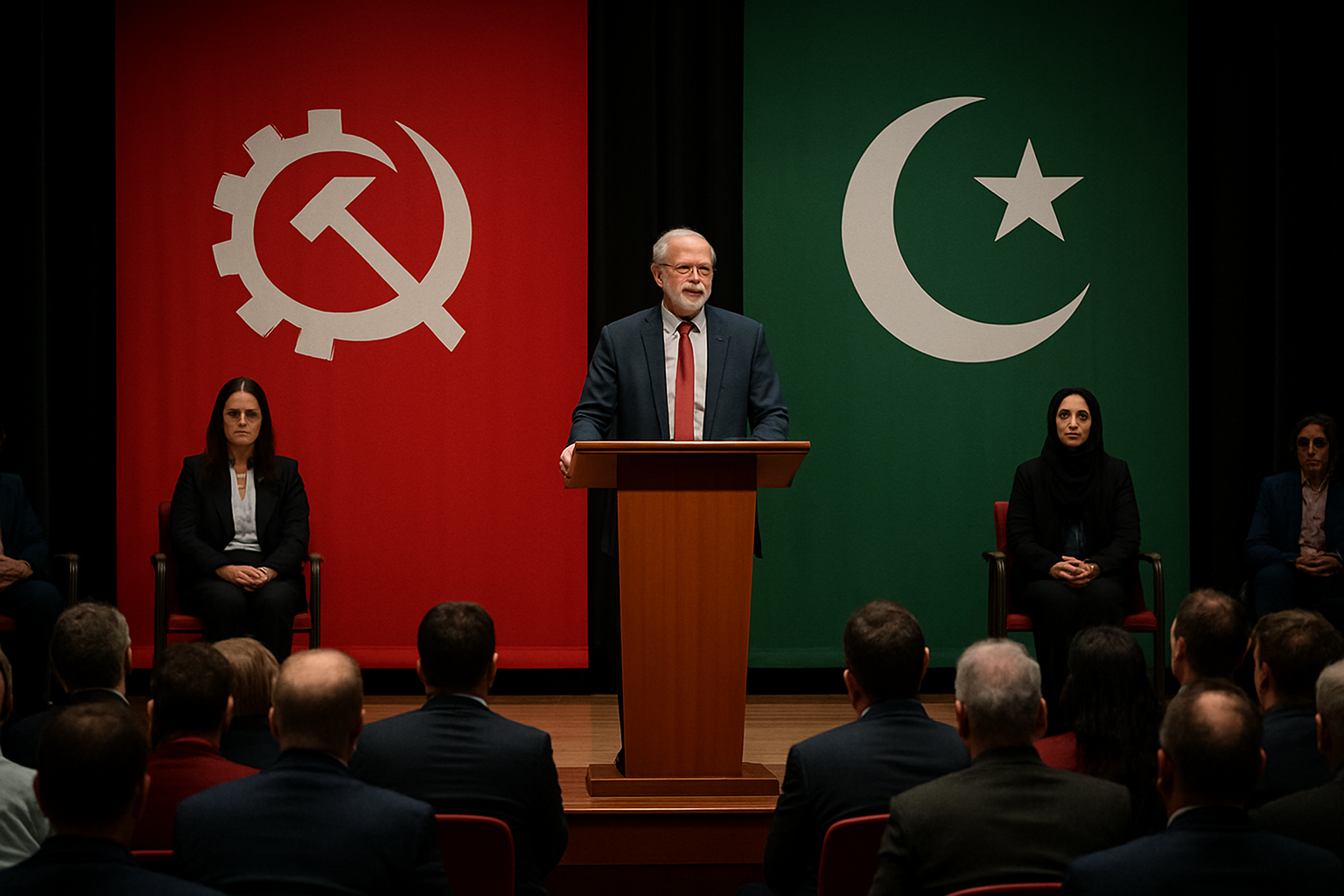
Fractured allies: the collapse of Britain’s Islamo-Leftist experiment
Introduction: an alliance built on tension
The implosion of Your Party—the provisional name for the new left-wing movement launched by Jeremy Corbyn and Zarah Sultana—has exposed deep fault-lines in Britain’s attempt to fuse Islamist-leaning Muslim activism with progressive social ideology. Marketed as an anti-war, anti-austerity vehicle for disillusioned Labour voters and pro-Gaza independents, the project is already mired in resignations, factionalism, and accusations of prejudice from within its own Muslim ranks.¹
This crisis is more than the story of one chaotic party. It crystallises broader trends in British politics: the consolidation of a self-consciously Muslim electoral bloc, the growing assertiveness of sectarian Muslim politics at local and national level, the Labour leadership’s willingness to redefine “Islamophobia” along activist lines, and the reluctance of councils, police forces and now the Starmer government to confront scandals—such as grooming gangs or consanguineous marriage risks—where religion, culture and public welfare collide.
Your Party and the limits of the Islamo-Left alliance
From the outset, Your Party depended on holding together two constituencies whose world-views overlap on foreign policy but diverge sharply on sexual ethics: hard-left socialists committed to an expansive LGBTQ+ agenda, and Muslim politicians whose voters are often socially conservative on questions of gender, sexuality and family life.²
Adnan Hussain, the Blackburn MP and practising Muslim, was central to the steering group that tried to shape this coalition.³ His departure in November, citing “persistent infighting” and “veiled prejudice” against Muslim men within the party, was the first public sign that the project’s internal contradictions were becoming unmanageable.⁴ Within days, Dewsbury and Batley MP Iqbal Mohamed followed, complaining of “false allegations and smears” and pointing explicitly to clashes over his gender-critical views.⁵
Jules Gomes, reporting for Focus on Western Islamism, argues that the project amounted to an “Islamo-Leftist coalition” whose internal civil war over sexual morality has now driven observant Muslims out.⁶ Robert Carter of 5Pillars, writing after attending the Liverpool founding conference, described a party “squandering its potential through internal chaos and hostility towards religious Muslims,” and warned that “internal hostility towards socially conservative Muslims—subtle in some places, blatant in others—has driven many away.”⁷
Muslim MPs challenge progressive dogma
The immediate spark was the clash over transgender ideology. Hussain publicly affirmed that “trans women are not biologically women,” invoking the Supreme Court ruling that biological sex, not gender identity, governs access to single-sex spaces in law.⁸ Sultana responded in uncompromising terms, insisting there was “no room for socially conservative views in a left-wing socialist party. Period.”⁹
Mohamed similarly argued that it was wrong for “white or brown men” to instruct “biological women” to surrender their rights and single-sex spaces to males, while stressing that he also supported the human rights of trans-identified people.¹⁰ In an interview with The Canary, he explicitly endorsed the Supreme Court’s definition of sex and defended women’s rights to protected spaces as non-negotiable, adding that it would be “misogynistic” to demand women share such spaces with males.¹¹
These positions—unremarkable within mainstream Islamic moral teaching and increasingly echoed by secular feminist groups—were nevertheless treated inside Your Party as ideological heresy. New Statesman reporting described the fallout as an “existential spat over trans rights,” cutting to the core of what the party was for and whose values would be allowed to shape it.¹²
That response confirms a deeper pattern. In his own explanation for quitting, Hussain wrote that some on the Left treat socially conservative views as a pathology to be corrected, and that working-class or religious voters are expected to “relinquish their cultural or religious attachments to be politically acceptable”—a form of liberal paternalism masquerading as liberation.¹³
Financial opacity and collapsing trust
The party’s moral turmoil has been amplified by financial controversy. Disputes over control of hundreds of thousands of pounds in donations, channelled through a company directed by Sultana, have dominated pre-conference coverage. A group of MPs allied to Corbyn complained that money “donated in good faith” had been withheld, while Sultana’s team insisted that legal and administrative liabilities required a phased transfer.¹⁴
According to The Times, Hussain linked his resignation not only to prejudice against Muslim men but also to frustrations over delayed transfers from MOU Operations Ltd, with only part of the roughly £800,000 requested being released.¹⁵ The Guardian similarly reported that internal tensions over £850,000 in donations had fuelled accusations of bad faith and widened the rift between Sultana and her co-founders.¹⁶
In a movement already battling accusations of ideological purism and entryism by Trotskyist groups, the combination of doctrinal rigidity and financial opacity has proved toxic. The impression is of a party more interested in purging dissenters than in basic institutional competence.
Islamist media, grassroots Muslims and the ‘socially conservative purge’
At the Liverpool conference these tensions erupted in public. Sultana boycotted the first day, denouncing what she called a “witch hunt,” and only addressed delegates on the Sunday.¹⁷ During her speech, Robert Carter—an Islamist-leaning journalist with 5Pillars—interrupted to ask about a “socially conservative purge,” pointing to the departure of Hussain and other Muslim figures.¹⁸ Sultana responded by accusing him of misogyny for interrupting a Muslim woman speaking.¹⁹
Carter subsequently wrote that Your Party was alienating one of the “most mobilised and politically-awakened communities in the country” just as British Muslims were discovering their electoral leverage through pro-Gaza independent candidates.²⁰ He concluded that Muslims should not “wait for the party to mature” but instead prioritise their own political organisation.
From the other side, commentators such as Fiyaz Mughal of Tell MAMA have mocked the spectacle as a far-left reenactment of Life of Brian: endless factional splits between a “Judean People’s Front” of radical socialists and a “People’s Front of Judea” of socially conservative Muslims, bound together only by opposition to Israel and Western foreign policy.²¹
Muslim representation and demographic asymmetry
The backdrop to this drama is the growing organisational self-consciousness of Britain’s Muslim minority. Around 6% of the UK population identified as Muslim at the 2021 Census, with London’s figure closer to 15%.²² Following the 2024 General Election, a record 25 Muslim MPs—about 3.8–4% of the House of Commons—entered Parliament, most of them on Labour benches or as left-leaning independents.²³
On one reading, Muslims remain slightly under-represented numerically when compared with their share of the population. Yet the distribution is highly uneven: Muslim MPs and councillors are heavily concentrated in particular urban constituencies and local authorities, many of which also act as hubs for pro-Palestinian activism and intra-Muslim political competition.²⁴ The Labour Muslim Network’s 2025 survey found that a majority of Muslim representatives felt their concerns—particularly over Gaza—were not taken seriously by the Labour leadership, and over half reported that the party did not handle Islamophobia complaints adequately.²⁵
Within London’s public sector, the pattern is similarly complex. Greater London Authority workforce data show that around 8% of staff who declare a faith identify as Muslim—below their share of the capital’s population, but still a substantial bloc within a single employer.²⁶ In some boroughs and service areas, Muslims are under-represented; in others, they wield significant institutional influence through local political machines, professional networks and activist NGOs.²⁷
This patchwork makes sweeping claims of over- or under-representation too crude. But it does illustrate the emergence of Muslim identity politics as a distinct force—sometimes aligned with the Left, sometimes at odds with it, and increasingly capable of exerting targeted pressure on public institutions.
The Islamophobia definition debate and its chilling effects
The Labour Party has recommitted itself to adopting a formal definition of Islamophobia closely modelled on the 2018 All-Party Parliamentary Group (APPG) on British Muslims, which defines Islamophobia as “rooted in racism” and targeting “expressions of Muslimness or perceived Muslimness.”²⁸ The party’s own Islamophobia policy explicitly cites this wording as a reference point.²⁹
Critics across the political spectrum have warned that such formulations risk collapsing legitimate criticism of Islamic ideas, practices or political projects into “racism.” A Civitas anthology and a Policy Exchange report both argue that the APPG definition blurs the line between hatred of Muslims and scrutiny of Islam or Islamism, and could be used to shut down debate on Sharia-inspired norms, gender roles or sectarian power structures.³⁰
Baroness Falkner of Margravine, former chair of the Equality and Human Rights Commission, has cautioned that Islamophobia definitions framed around “expressions of Muslimness” may be deployed to silence Muslim women—or their advocates—who criticise patriarchal control in their own communities.³¹ She has also told parliamentary committees that the term “Islamophobia” is so contested, and its definitions so politicised, that it risks being weaponised by fundamentalists to treat theological disagreement as “hate.”³²
Labour’s own briefing acknowledges that the APPG wording is not aligned with the Equality Act 2010 and that previous governments warned adopting it wholesale could have “consequences for freedom of speech.”³³ Yet under pressure from Muslim MPs and lobby groups amid a documented rise in anti-Muslim hate crimes, ministers are now moving towards an official non-statutory definition.³⁴
In this climate, it is unsurprising that local officials, social workers and police chiefs report anxiety about confronting sensitive issues—fearful that legitimate concern over religiously-inflected practices will be labelled racist or Islamophobic.³⁵
Grooming gangs and institutional reluctance
Nowhere is that anxiety more morally fraught than in the grooming gang scandal. Recent inquiries have uncovered patterns of group-based child sexual exploitation in which a disproportionate number of perpetrators came from Pakistani or other South Asian Muslim backgrounds, while most victims were white working-class girls.³⁶ The Casey audit on group-based CSE found that failures were often linked to a reluctance by authorities to identify ethnic and cultural factors explicitly.³⁷
Kemi Badenoch, now Leader of the Opposition, has argued that previous Labour-run councils and police forces “feared being called racist more than they feared failing vulnerable girls,” and has insisted that any serious inquiry must examine ethnicity and religion as part of its remit.³⁸
The Starmer government has finally announced a three-year, £65 million national inquiry into grooming gangs, chaired by former Children’s Commissioner Anne Longfield, with explicit terms of reference to examine how ethnicity, religion and culture influenced both the crimes and institutional responses.³⁹ Longfield has promised to “confront difficult truths” and to work alongside a parallel National Crime Agency operation reviewing hundreds of previously closed cases.⁴⁰
Yet the path to this inquiry has been dogged by resignations from survivors’ representatives and disagreements over whether to foreground or downplay ethnicity and religion.⁴¹ Critics argue that Labour’s reliance on Islamophobia definitions influenced by Muslim advocacy groups creates a built-in reluctance to speak plainly about patterns of abuse in which some perpetrators are drawn from tightly knit, culturally conservative Muslim communities.⁴²
Consanguineous marriage, public health and cultural pressure
A parallel controversy concerns health risks from first-cousin marriage, which is more common in some British Pakistani and other Muslim communities. The “Born in Bradford” cohort study, one of the most robust UK-based datasets, found that first-cousin unions roughly doubled the risk of congenital anomalies—from 3% to 6%—and accounted for around 30% of genetic disorders in that population, even after adjusting for deprivation.⁴³ A subsequent evidence briefing reiterated that consanguinity significantly increases the risk of recessive conditions.⁴⁴
A 2019 safeguarding report in Bradford similarly identified cousin marriage as a “significant factor” in child deaths due to genetic and congenital abnormalities.⁴⁵ In 2025, a House of Lords debate on first-cousin marriage highlighted that Pakistanis account for around 3.4% of births but 30% of recessive gene disorders nationally, and noted that NHS services now employ staff specifically to address consanguinity-related conditions.⁴⁶
Some campaigners have proposed restrictions or discouragement of cousin marriage; others favour targeted genetic counselling and education instead. The government has so far resisted legislative bans, citing concerns about stigmatising specific communities.⁴⁷ Meanwhile, parts of the Muslim commentariat portray public-health warnings as thinly veiled Islamophobia, and there is political pressure—especially on Labour—to avoid any appearance of pathologising “Muslim culture.”⁴⁸
The result is a familiar pattern: robust epidemiological evidence coexists with institutional nervousness about saying so plainly, lest criticism of a prevalent practice be condemned as racist.
Policing, protest and the West Midlands Police affair
This dynamic is also visible in policing. The most recent flashpoint is West Midlands Police’s role in banning Maccabi Tel Aviv supporters from attending a Europa League match against Aston Villa at Villa Park in November 2025. The force advised the local safety advisory group that allowing Israeli fans in could pose significant disorder risks, citing alleged past incidents involving Maccabi supporters and purported concerns reported by Dutch police.⁴⁹
Subsequent disclosures suggest that key elements of this “intelligence” were either unsubstantiated or flatly contradicted by Dutch authorities, who described claims attributed to them as “not true” and “obviously inaccurate.”⁵⁰ At Westminster, both the Commons and Lords have heard sharp criticism of the decision and of West Midlands Police’s evidence.⁵¹
The force then told MPs that Birmingham’s Jewish community had been consulted and supported the ban—only to admit days later that this was false and issue an apology to community representatives.⁵² Commentators such as Stephen Pollard and the Campaign Against Antisemitism have questioned how such a serious misrepresentation could have occurred in the first place.⁵³
The Home Secretary has now commissioned an inspection by His Majesty’s Inspectorate of Constabulary into how risk assessments were provided for the match and for other high-profile fixtures.⁵⁴ Critics argue that the force appeared more concerned about managing the optics of pro-Palestinian mobilisation and “community tensions” than about equal treatment of Jewish supporters in line with normal policing standards.⁵⁵
This sits alongside wider controversies over differential policing of public protests, with Jewish and gender-critical demonstrators alleging a heavier hand than that used for large pro-Palestinian marches. While the evidence base is still emerging, the Maccabi case provides a concrete example of a police force making questionable decisions, then misrepresenting community consent, in a context where Islamist and pro-Palestinian politics exert significant local pressure.
Islamophobia, grooming, protest: a shared pattern
Taken together, the Islamophobia definition debate, the grooming gangs inquiry, the cousin-marriage controversy and the Maccabi policing scandal reveal a shared pattern. Public bodies are pulled between the genuine need to protect Muslim citizens from bigotry and violence, and the equally real need to confront practices, ideologies or patterns of criminality that are over-represented in some Muslim settings.
Islamist and sectarian Muslim actors naturally press for maximum protection for “expressions of Muslimness,” while progressive allies often frame this in the language of anti-racism. But the price of this coalition can be a culture of institutional self-censorship, in which uncomfortable facts about sexual exploitation, public-health risks or political intimidation are downplayed to avoid accusations of Islamophobia.
Your Party attempted to turn this fragile understanding into an explicit political project: a common front in which radical Leftists and religious Muslims would fight Western capitalism and Zionism together, while agreeing to disagree on questions of sex and family life. In practice, this meant that one side’s “non-negotiable” commitments—LGBTQ+ orthodoxy for the Left, traditional sexual ethics for Muslims—were placed on a collision course.
When Muslim MPs invoked biological sex and single-sex spaces, they collided head-on with a leadership that had already internalised gender-identity ideology as axiomatic. When Muslim activists looked for space to defend Islamic sexual morality, they found themselves labelled bigots within a party that had promised to welcome them as natural allies. When feminist critics outside Muslim communities raised parallel concerns, they too risked being branded Islamophobic if their arguments touched on cultural or religious patterns.
The failure of Britain’s Islamo-Leftist experiment
The collapse of this experiment does not mean that Muslims and the Left will cease to cooperate. They continue to align on Gaza, foreign policy, immigration, welfare and anti-racism. But the Your Party debacle demonstrates that there are limits to how far a coalition can be stretched over incompatible anthropologies.
On one side stands a vision of human identity in which gender is fluid, sexual self-expression is central to personal fulfilment, and traditional sexual morality is recast as oppression. On the other stands a religious ethic in which sex difference is created, not chosen; marriage is ordered to procreation and family stability; and same-sex acts and gender self-determination are viewed as sinful or at least morally disordered.
For a time, such tensions can be submerged under the rhetoric of “inclusion” and “solidarity.” But eventually, the coalition must decide whose conscience prevails in law, policy and party discipline. Your Party has answered that question by driving out those who refuse to conform to progressive sexual dogma—even when those dissenters are the very Muslim MPs whose mobilisation made the project viable.
At the same time, Labour’s embrace of expansive Islamophobia definitions, its cautious handling of grooming gang inquiries, its sensitivity around cousin-marriage debates and its reluctance to confront policing failures like those in the West Midlands all signal a wider unwillingness to expose the costs of sectarian Muslim politics to public scrutiny.
In that sense, the implosion of Your Party is less a freak accident than a symptom. It reveals a political culture in which two absolutist world-views—progressive individualism and religious communalism—are locked in an uneasy alliance, each seeking to instrumentalise the other while denying the depth of their disagreement.
That alliance may still win elections in heavily Muslim constituencies. But as Your Party has shown, it is ill-equipped to govern a plural society, to protect the vulnerable without fear or favour, or to sustain the trust of those—Muslim or non-Muslim—who are no longer willing to keep silent in the face of ideological incoherence.
- Jules Gomes, “U.K. Islamo-Leftist Coalition Fractures Over Muslim Sexual Morality,” Focus on Western Islamism, 5 December 2025.⁶
- “What does Adnan Hussain’s departure mean for Your Party and the British left?” Middle East Eye, 14 November 2025.³⁷
- “Your Party (UK),” Wikipedia entry, accessed 12 December 2025.³¹⁹
- “MP Adnan Hussain quits Your Party over ‘persistent infighting’,” The Guardian, 14 November 2025.³³⁴; Adnan Hussain, “Why I walked away from Your Party,” PoliticsHome, 28 November 2025.³³⁰
- “Iqbal Mohamed becomes second MP to leave Your Party,” Middle East Eye, 21 November 2025.³³⁹; “Another blow for Corbyn and Sultana as second MP quits Your Party,” LBC, 22 November 2025.³³¹⁸
- Gomes, “U.K. Islamo-Leftist Coalition Fractures…”.³³
- Robert Carter, “Your Party is squandering its potential and Muslims shouldn’t wait,” 5Pillars, 1 December 2025.⁵²
- “Your Party’s existential spat over trans rights,” New Statesman, 16 September 2025.³³²²
- Ibid.; quoted also in Middle East Eye conference coverage: “What I learned at the inaugural Your Party conference,” 1 December 2025.⁵⁶
- “Your Party in fresh trans row,” The Telegraph, 16 November 2025.³³¹
- “Iqbal Mohamed quits Your Party blaming ‘false allegations’,” The Canary, 21 November 2025.³³¹⁶
- “Your Party’s existential spat over trans rights,” New Statesman, 16 September 2025.³³²²
- Hussain, “Why I walked away from Your Party.”³³⁰
- “Your Party receives ‘small portion’ of withheld supporters’ donations,” The Guardian, 13 November 2025.³³⁹
- “Adnan Hussain claims ‘prejudice against Muslim men’ as he quits Your Party,” The Times, 2025.³³⁶
- “MP Adnan Hussain quits Your Party over ‘persistent infighting’,” The Guardian, 14 November 2025.³³⁴
- “Squabbles and smears as Your Party’s debut conference kicks off,” The Times, early December 2025.³³⁴²
- “Zarah Sultana heckled as Your Party row erupts over Muslim views on trans rights,” The Telegraph, 1 December 2025.⁵⁵¹
- Ibid.
- Carter, “Your Party is squandering its potential…”.⁵²
- Gomes, “U.K. Islamo-Leftist Coalition Fractures…”.⁵⁹
- “Islam in the United Kingdom,” Wikipedia entry, using 2021 Census data.⁴¹⁶
- “Who are the Muslim MPs after the 2024 elections?” Muslim Women’s Network UK, 11 July 2024; “Record number of Muslims elected to UK Parliament,” Anadolu Agency, 10 July 2024.⁴¹⁻⁴¹³
- Parveen Akhtar, “Changing pattern amongst Muslim voters: the Labour Party, Gaza and voter volatility,” in UK Election Analysis 2024.⁴²²
- “Survey of Labour Muslim MPs shows extent of disquiet over Gaza stance,” The Guardian, 5 June 2025.⁴²¹
- “GLA Workforce Report – March 2024,” Greater London Authority.⁴²⁵
- House of Commons Library, “Ethnic diversity in politics and public life,” Research Briefing SN01156, 20 October 2025.⁴⁰
- All-Party Parliamentary Group on British Muslims, Islamophobia Defined: The Inquiry into a Working Definition of Islamophobia, 2018.²¹²
- “Labour’s Islamophobia Policy,” Labour Party, updated 3 December 2025.²²⁸
- Islamophobia: An Anthology of Concerns, Civitas, 2019; On Islamophobia: Closing off Criticism of Islamism?, Policy Exchange, 2019.²²¹³
- “Labour’s Islamophobia definition risks ‘harming women’s rights’,” GB News, 2025; see also The Sun reporting on Baroness Falkner’s comments, December 2025.²²⁴³⁻²²⁹
- House of Commons Home Affairs Committee, “Oral evidence: Islamophobia,” 21 May 2019.²²¹
- House of Commons Library, “The Definition of Islamophobia,” Debate Pack CDP-2021-0140, 8 September 2021.²²⁰
- “MPs urge minister to adopt definition of Islamophobia amid rise in hate crime,” The Guardian, 2 November 2025.⁴²⁴⁰
- Steven Greer, “Islamophobia, Islamist Extremism and Free Speech,” 2025.²²⁵
- Shabana Mahmood and Baroness Casey, statements reported in Hansard, “Grooming Gangs: Independent Inquiry,” 11 December 2025.²²²
- Ibid.
- Kemi Badenoch, remarks on grooming gangs inquiry, June and December 2025, including press conference and social-media statements.²²³⁻²²⁷
- “Update on Independent Inquiry into Grooming Gangs,” UK Government press release, December 2025; “Grooming gangs inquiry: chair announced,” Community Care, 10 December 2025.²²²⁻²²³¹⁸
- “Former children’s commissioner Anne Longfield to chair grooming gangs inquiry,” The Guardian, 9 December 2025; “Grooming gangs probe to expose ‘ethnicity and religion’,” The Sun, December 2025.²²⁴⁰⁻²²⁴²
- “Starmer’s ‘grooming gangs inquiry’ rocked by survivors’ resignations,” Socialist Worker, 22 October 2025.²²¹⁵
- Greer, “Islamophobia, Islamist Extremism and Free Speech”; Islamophobia: An Anthology of Concerns, Civitas.²²¹³⁻²²⁵
- “Cousin marriage and congenital anomalies in a multiethnic birth cohort,” Born in Bradford project summary.¹⁶³
- “Genes and Health – Evidence Briefing,” Born in Bradford / Bradford Institute for Health Research, 2022.¹⁶
- “Cousin marriages cited as significant factor in Bradford child deaths,” reporting on Bradford Safeguarding Children Board review, The Guardian, 15 February 2019.¹⁷
- House of Lords, “First-Cousin Marriage,” Hansard, 20 January 2025.²¹
- A. O’Dowd, “NHS pulls controversial blog on first cousin marriage—but debate continues,” BMJ, 2025.¹⁰
- “Right definition for the right fight,” Institute of Race Relations, 23 May 2019.²²⁸
- House of Commons, “Maccabi Tel Aviv FC: Away Fans Ban,” Hansard, 24 November and 8 December 2025.¹⁹⁻¹⁷
- Ibid.; see also The Sunday Times reporting on Dutch police denials, summarised in UK news coverage.¹⁹³⁰
- House of Lords, “West Midlands Police: Maccabi Tel Aviv Match,” Hansard, 11 December 2025.¹¹
- “UK police wrongly told MPs Jewish community supported Maccabi Tel Aviv ban – report,” Times of Israel, 7 December 2025; “Police apologise over claim that Jews supported Israeli football ban,” The Telegraph, 6 December 2025; ITV Central report, 7 December 2025.¹²⁻³¹⁻²⁴
- Stephen Pollard, “Jewish fans deserve the truth about Maccabi Tel Aviv’s Villa Park ban,” The Spectator, 8 December 2025; “It is time for accountability in the West Midlands,” Campaign Against Antisemitism, December 2025.¹¹⁻²⁶
- Hansard, “West Midlands Police: Maccabi Tel Aviv Match,” 11 December 2025.¹¹
- Pollard, “Jewish fans deserve the truth…”; Campaign Against Antisemitism, “It is time for accountability in the West Midlands.”¹¹⁻²⁶
related articles


Latest articles
- Today’s homily: Christ the KingThe homily reflects on Christ’s kingship as seen in the Gospel narrative. It contrasts earthly authority with divine truth, emphasising that true allegiance to God requires genuine obedience and transformation. Believers are called to examine their personal commitments and respond to Christ’s demands in everyday life, ultimately recognising their identity as bearers of God’s image.
- Sermon for Christ the KingToday marks the celebration of Christ the King and the Twenty Second Sunday after Pentecost, a feast asserting Christ’s sovereignty against totalitarianism. St. Paul emphasised Christ’s supremacy over power and principalities, challenging early Gnostic beliefs. The early Church’s victory over evil is affirmed in Christ’s resurrection, offering hope and unity amidst contemporary struggles.
- Today’s Mass: October 25 SOVEREIGNTY OF OUR LORD JESUS CHRIST, SUPREME KINGThe Feast of the Sovereignty of Our Lord Jesus Christ celebrates Christ’s dual kingship by birth and conquest. Established by Pius XI, it aims to deepen faith and counter anti-clericalism. The liturgical observance underscores His authority as King, advocating for societal recognition of His reign to bring peace and harmony.
- TRADITION BEHIND THE FENCEThe Vatican’s prohibition of the traditional Ad Petri Sedem pilgrimage to St Peter’s Basilica has sparked controversy, especially among traditional Catholics. While some cite scheduling conflicts, the broader issue lies in the restrictive policies of Traditionis custodes, which may confine traditional liturgical practices to specific enclaves, risking the transmission and recognition of Catholic Tradition within the wider Church.
- Today’s Mass: October 24 St Raphael the ArchangelThe Feast of Saint Raphael the Archangel highlights his healing powers as depicted in the Book of Tobit, where he aids Tobit and his son, Tobiah. Venerated as a protector of travellers and the blind, Raphael is celebrated for his miraculous interventions. His legacy includes support for nurses, matchmakers, and Catholic studies.





Leave a Reply