
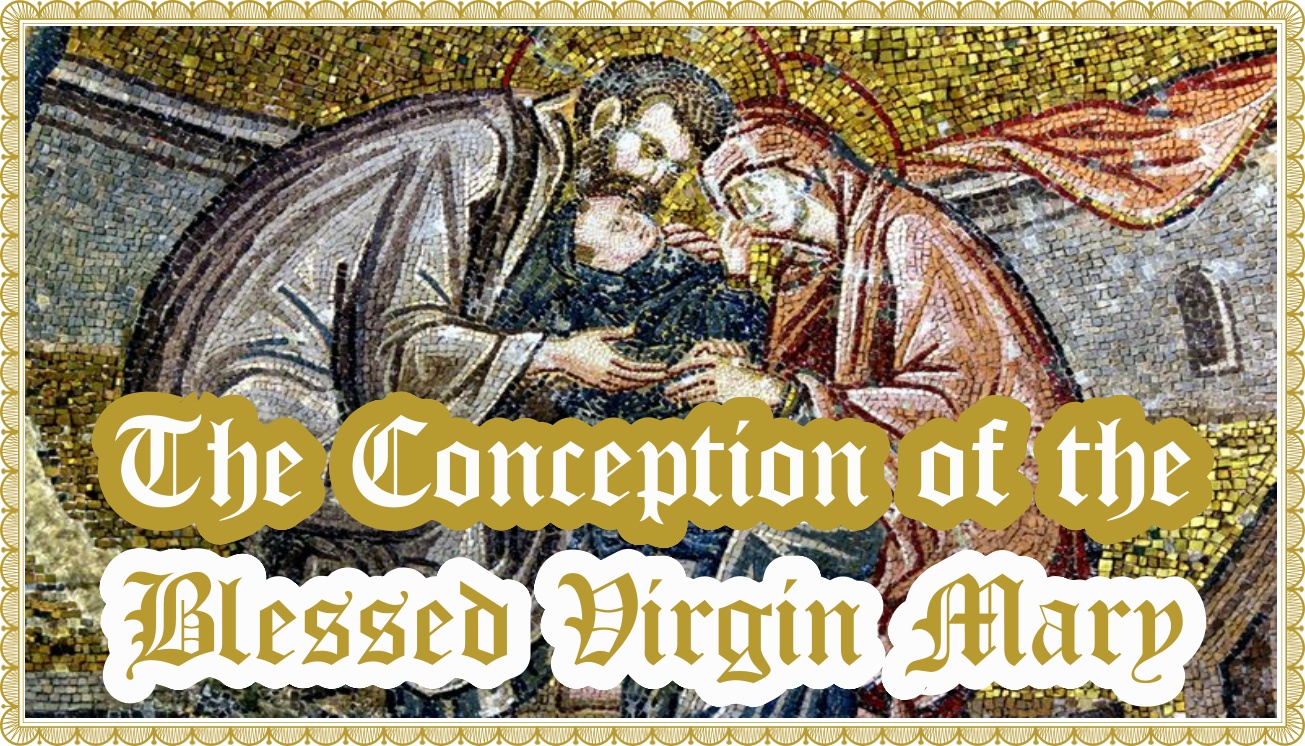
Conception of the Blessed Virgin Mary (Dec 08)
by the Revd Dr Robert Wilson PhD (Cantab), Old Roman Apostolate UK
Today we celebrate the great feast of the Conception of the Blessed Virgin Mary. Since the Incarnation is the distinctively Christian dogma that marks it out from other religions, the Church rightly gives especial veneration to the mother of God Incarnate, who was chosen to be the mother of the Word made flesh. The Council of Ephesus in 431 affirmed her to be the theotokos, the God bearer, for she conceived in her womb the Word made flesh. As the hymn has it
How blest that Mother in whose shrine
The great Artificer divine
Whose hand contains the earth and sky
Ordained as in his Ark to lie.
The Church honours Mary as pre-eminent among the saints, not as a figure of independent greatness in her own right, but rather in relation to the child whom she bore, born of a woman, born under the law, in order to redeem those under the law, that they might obtain the adoption of sons.
Blessed were the chosen people,
Out of whom her Lord did come
Blessed was the land of promise,
Fashioned for his earthly home
But more blessed was the mother,
She who bare him in her womb.
God in Christ has entered the world to redeem us from the curse that fell upon our race as a consequence of the fall of man. For as in Adam all die, even so in Christ shall all be made alive. The Church Fathers develop this point further by saying that Mary’s positive response to the angel Gabriel at the Annunciation, Be it unto me according to thy word, reverses Eve’s disobedience. Our vocation as Christians is to become by grace what he is by nature, who humbled himself to share our humanity that we might share his divinity. Mary is the supreme example of one who became by grace what he is by nature. It is therefore right that we celebrate her Conception, her Nativity, her Purification in the Temple and her Dormition or Assumption.
Today’s feast, her Conception by her parents St. Joachim and St. Anne, is celebrated in both the Western and the Eastern Church. It has unfortunately been the subject of controversy in the Western Church over the issue of whether Mary was conceived without original sin (the doctrine of the Immaculate Conception). Following Duns Scotus the Franciscans taught that Mary was preserved from the stain of original sin from the moment of her conception on the ground that it was most fitting for one chosen to be the mother of the Word made flesh. By contrast, the Dominicans followed Thomas Aquinas (who followed St. Augustine, St. Anselm and St. Bernard of Clairvaux) in teaching that Christ alone was without original sin and that if Mary had been conceived without original sin she would not have needed redemption. The Eastern Church has generally tended to reject the doctrine that Mary was conceived without original sin. Indeed, it may well be regretted that this question has been raised at all, as it is a matter of theological speculation which it does not seem to be of supreme importance for the Christian to either accept or reject. It is not like the doctrines of the Trinity and the Incarnation which are articles of faith on which Christianity stands or falls.
Unfortunately, the promulgation of the dogma of the Immaculate Conception in 1854 by Pope Pius IX led to the replacement of the traditional Mass for the Conception of Mary with a new Mass designed to teach more explicitly the new dogma which had just been proclaimed. It is important to emphasise this point at the present time. Attention is rightly being given to the renewed attempt to suppress the traditional Roman rite, and how this cannot be reconciled with the traditional view of the role of the Bishop of Rome to be the guardian of the deposit of faith, rather than an innovator. It is less commonly realised that the root cause of the present crisis lies in the triumph of Ultramontanism in the nineteenth century under Pope Pius IX at the First Vatican Council in 1870. This replaced the older conception of the Bishop of Rome as the guardian of the deposit of faith with a new understanding of his role as an innovator who could make novel dogmas and innovate in matters of liturgy. This unfortunately led to the replacement of the traditional rites for both the respective feasts of the Conception (in 1854) and the Assumption of Mary (in 1950). This was a foretaste of what was to come after the Second Vatican Council, when a new Mass was promulgated that was less securely rooted in the tradition of the Church than the older rite, which it had previously been the role of the Bishops of Rome to safeguard. It is especially important at the present time that we hold fast to the traditional Roman rite and the older teaching of the Bishop of Rome as a guardian of the deposit of faith, rather than an innovator.
What matters in regard to the role of the mother of the Word made flesh was well expressed by the great Russian theologian Vladimir Lossky: “The Mother of God was never a theme of the public preaching of the Apostles; while Christ was preached from the housetops and proclaimed for all to know in an initiatory teaching addressed to the whole world, the mystery of his mother was revealed only to those who were in the Church. It is not so much an object of faith as a foundation of our hope, a fruit of faith, ripened in tradition. Let us therefore keep silence, and let us not try to dogmatise about the supreme glory of the Mother of God.”
We honour Mary, as higher than the cherubim and more glorious than the seraphim, because she above all, in giving birth to the Word made flesh in time and history, and being at the foot of the Cross in his passion, sought first the Kingdom of God and his righteousness.
Praise O Mary. Praise the Father
Praise thy Saviour and thy Son
Praise the Everlasting Spirit
Who hath made thee Ark and Throne
O’er all creatures high exalted
Lowly praise the three in One
Hail Mary! Hail Mary! Hail Mary! Full of grace.



Leave a Reply