
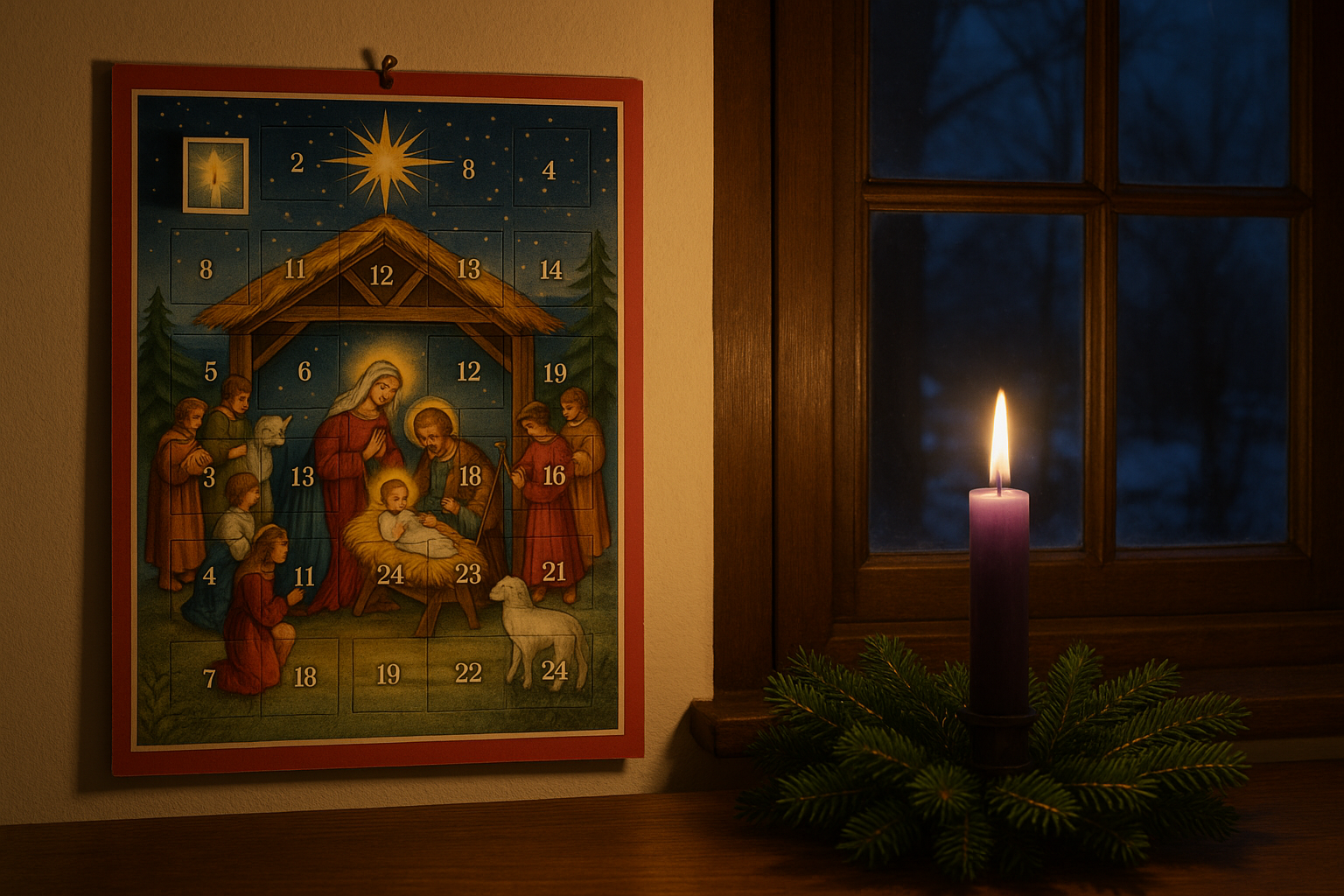
Advent Calendars: History and Devotional Purpose
Introduction
The Advent calendar, now a familiar companion of December, began not as a commercial novelty but as a profoundly Christian practice of marking sacred time. Long before perforated cardboard windows and chocolate inserts, families used simple visual signs — chalk marks, candles, devotional images — to enter more deeply into the Church’s season of watchful preparation. Properly restored to its meaning, the Advent calendar remains a domestic school of expectation, teaching Christian families to “wait with the Church” for the coming of the Lord.
Early Origins in German Christian Households
The earliest forms of Advent calendars appear among German Christian families in the first half of the nineteenth century. Households marked each day of Advent with chalk lines on doors, daily devotional pictures, or the gradual illumination of candles. These practices provided children and adults with a concrete sense of the season’s unfolding. The Oxford Encyclopedia of Christmas notes that such numbered devotional practices were well established in German-speaking lands by the mid-1800s, long before printed calendars emerged.¹
By the late nineteenth century, printed Advent calendars began to circulate. In 1902, the Munich firm Reichhold & Lang issued one of the first commercial versions.² Gerhard Lang — inspired, as he later recalled, by his mother attaching twenty-four small pastries to a board so he could take one each day — went on to pioneer the little cardboard doors that would become the model for later calendars.³ These early calendars were entirely religious: each opening revealed Scripture verses, angels, Messianic symbols, or scenes from salvation history.
The Devotional Purpose: A School of Christian Expectation
The true meaning of an Advent calendar is not the countdown to presents, but the shaping of Christian expectation. As the Church’s liturgy moves from its early apocalyptic warnings to the near-Nativity joy of the Great O Antiphons, the calendar mirrors this spiritual progression in the home. Each opened door is a lesson in the virtue of waiting — a reminder that grace unfolds gradually, that the Messiah came in hiddenness, and that He will come again “at an hour that you know not.”⁴
Used devotionally, the calendar forms three habits particularly needed in Christian life:
Patience — It slows the approach to Christmas, resisting the cultural rush and sanctifying each day of preparation.
Hope — Each unveiling hints at the larger revelation of the Word made flesh, echoing Israel’s centuries of longing.
Contemplation — A daily moment of stillness becomes a domestic echo of the liturgy, creating a rhythm of prayer within the household.
From Family Piety to Evangelising Tool
The twentieth century brought widespread secularisation of Advent calendars — chocolates, toys, advertising tie-ins — but the underlying structure retains its Christian DNA. Many families, catechists, and Catholic communities now restore the devotional focus by using calendars with Scripture texts, titles of Christ from Isaiah, symbols of salvation history, or scenes from the Nativity. In this way, the calendar becomes a gentle catechesis for children and adults alike, rooting them in the mystery of the Incarnation.
At its best, the Advent calendar serves as a daily reminder that the Nativity is not merely a memory but a preparation for the Second Coming. It transforms the season from a commercial countdown into a spiritual ascent. It trains the faithful in the perennial posture of Advent: vigilance, longing, and readiness.
A Domestic Tradition Worth Preserving
In an age marked by hurry, distraction, and premature celebration, Advent calendars offer a small but significant way to reclaim sacred time. They recall the gradual dawning of divine light in a darkened world and draw families into the Church’s prayer: “Rorate caeli desuper — Drop down dew, ye heavens, from above.” As a domestic liturgical tradition, they are worth preserving and elevating, restoring them to their original spiritual purpose: to teach Christians to await Christ with watchfulness, hope, and love.

Practical Ways to Use Advent Calendars Devotionally
Choose a calendar with Scripture or sacred imagery
Select calendars that reveal short Scripture passages, names of Christ, O Antiphons, or scenes from salvation history. Avoid purely commercial or secular ones when possible, or at least add a spiritual practice alongside them.
Create a “family ritual” around opening each window
Open the day’s window after lighting the Advent wreath. Say the Collect of the day, or simply pray:
“Come, Lord Jesus.”
This anchors the calendar within the domestic liturgy.
Use the calendar as a miniature catechism
For each revealed image or text, offer a one-minute explanation:
- Who is this figure?
- What prophecy is this symbol?
- How does this point to Christ?
This keeps catechesis gentle but daily.
Combine with small acts of charity
Instead of receiving something each day, place one item into a box daily to donate at Christmas:
- canned food
- toiletries
- warm clothing
- books or toys for children
This turns the calendar into an exercise of Advent almsgiving.
For adults: use a “reverse calendar” of spiritual discipline
Assign one practice per day:
- “Fast from social media for one hour.”
- “Pray Psalm 24.”
- “Write a letter of encouragement.”
- “Meditate for five minutes on the Last Things.”
A calendar becomes a rule of life.
Use an Advent calendar as part of catechism class
At each lesson, open the next window and explain its connection to the Messiah.
Children love the anticipation; adults appreciate the structure.
In chapels: place a large communal Advent calendar in the narthex
Numbered envelopes or boxes can contain:
- quotations from the Fathers
- lines from the Advent prophecies
- short reflections from the Archbishop of Selsey
- lines from the Traditional O Antiphons
This becomes a shared devotional journey.
Pair each day with a hymn verse
Open a window and sing one verse of:
- Veni Emmanuel
- Rorate Caeli
- Conditor Alme Siderum
- Creator Alme Siderum
This unites image, text, and sacred song.
Use the calendar to teach the rhythm of Advent’s two halves
Explain that days 1–16 emphasize preparation, watchfulness, and judgement.
Days 17–24 emphasise the nearness of the Incarnation, culminating in the O Antiphons.
The calendar becomes a visual map of the Church’s liturgy.
For pastoral use: assign short “check-in” reflections
Encourage the faithful to ask each evening:
- What grace was offered to me today?
- Did I grow in patience?
- Have I made room for Christ?
The calendar thus aids spiritual accountability.
- The Oxford Encyclopedia of Christmas (Oxford University Press, 2010), entry on “Advent Calendar.”
- Germany’s early printed Advent calendars are documented in the Deutsches Historisches Museum‘s catalogue of nineteenth- and early twentieth-century Christmas materials.
- Gerhard Lang’s recollection of his mother’s homemade Advent board is cited in G. Bäumer, Weihnachten: Geschichte und Bräuche (Munich, 1985), pp. 112–113.
- Cf. Matthew 24:44.
related articles


Latest articles
- Today’s Mass: September 19 St. Januarius, Bishop and Companion MartyrsSt. Januarius and companion martyrs were martyred during the persecution under Diocletian. St. Januarius, patron of the city of Naples and bishop of Beneventum, was beheaded with his deacons and some others.
- Sermon for St. Januarius and his CompanionsToday we celebrate the feast of St. Januarius and his companions. About St. Januarius little is known except that he was among the many martyrs during the great persecution under the Emperor Diocletian.
- 20.09.26 Nuntiatoria CXXIV: QUOD ACCEPIMUS, CUSTODIMUS ET TRADIMUSThe editorial emphasises the importance of understanding our inheritance as custodians rather than owners. It highlights the obligation to preserve and transmit the Christian Faith, sacraments, and traditions to future generations. Through gratitude and fidelity, those who receive must ensure that what has been entrusted does not end with them.
- ONE LORD, ONE FAITH, ONE BAPTISM: The Seventeenth Sunday after PentecostThe Seventeenth Sunday after Pentecost emphasises the love of God and neighbour, rooted in divine justice. The Mass articulates the necessity of one faith and baptism, ensuring charity is not sentimental but deeply theological. The Gospel challenges believers to recognise Christ’s dual nature as both David’s son and Lord, reinforcing true Christian charity.
- AN AWARD IS NOT A MEETINGLambeth Palace has withdrawn the Hubert Walter Award given to Hafiz Tahir Ashrafi for reconciliation, citing previously unknown controversial comments. This raised questions about the vetting process prior to the award. While Ashrafi has defended his record of protecting minority rights, the Palace must clarify why such issues were overlooked initially.




Leave a Reply