
Belfast’s Nuisance Noise Byelaws and the Uneasy Question of Selective Speech Control
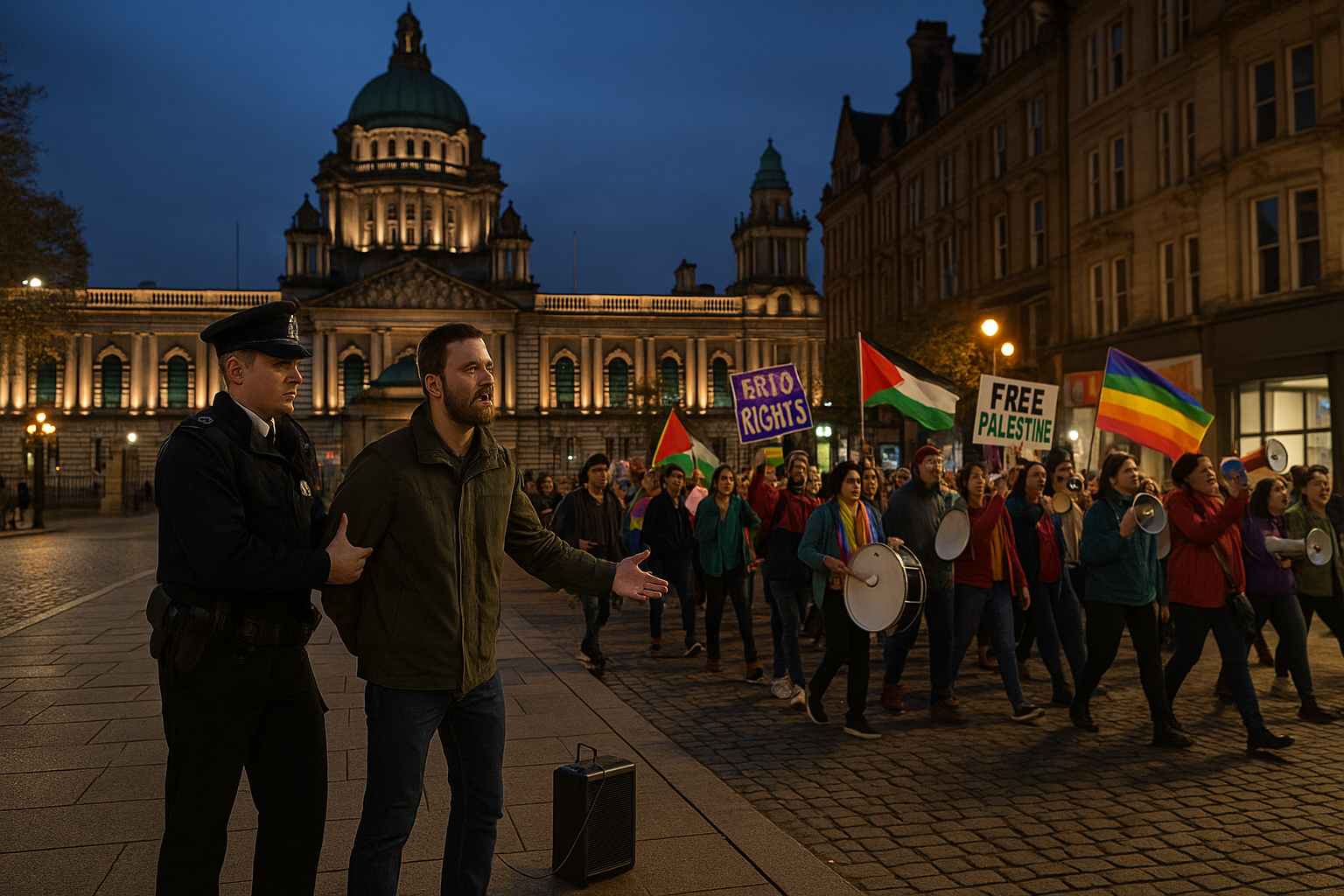
The newly approved “nuisance noise” byelaws in Belfast City Centre have reopened a difficult and long-standing question: when the state claims to regulate noise, is it in practice regulating speech? Few local controversies illustrate the issue as vividly as the decision to impose a 70-decibel cap on buskers and street preachers—one only marginally above ambient city noise—while granting sweeping exemptions to the loudest organised activities in the city.
The byelaws emerged in 2022 after a series of open-air sermons outside City Hall, most prominently those of street preacher Ryan Williamson. His use of amplification while preaching against homosexuality provoked political discomfort, leading the council to explore legally defensible ways to restrict similar activity without breaching human rights obligations. Last week, the council committee approved a rule that any “performer” using amplification may not exceed 70 decibels, with violations carrying fines of up to £500.
Yet this limit is not universal. In fact, it is precisely the selective nature of the regulation that has drawn the sharpest criticism.
Unequal Burdens and Broad Exemptions
Nathan Anderson, of the civil-liberty group Liberty NI, argues that the byelaws place the tightest controls on the groups least capable of generating high noise levels in the first place—street preachers and small buskers—while exempting precisely those activities that are notoriously loud. Parades, state-approved events, council events, charity collections, official pickets, and demonstrations with landowner permission are all exempt from the decibel ceiling¹.
“If noise is truly the issue,” Anderson asks, “why are the loudest activities exempt?” He warns that the low threshold risks singling out religious expression and small-scale artistic performance, raising uncomfortable questions about equality and free expression.
Equally concerning is the council’s intention to introduce a “code of conduct” for those using public-address systems. Anderson views this as a reintroduction of “speech permits through the back door,” an intrusion incompatible with the right to free and spontaneous public speech.
Trade unions, however, welcome the new structure. Gerry Murphy of the ICTU notes that the council addressed union concerns by ensuring trade-union pickets and rallies remain exempt under the definition of “pickets,” describing such activities as “key to any functioning democracy.” His argument is clear: the byelaws must defend unwilling audiences—such as shop workers—from intrusive performers, while preserving the traditional protections afforded to organised civil-society action.
Yet this, too, exposes the paradox. The more institutional and politically organised the speech, the more freedom it enjoys; the more individual and unaligned the speaker, the tighter the constraints.
A Nationwide Trend: Regulating Noise as a Proxy for Regulating Expression
Belfast’s proposals fit squarely into a broader UK trend in which councils increasingly treat noise controls as tools for managing public expression—especially religious speech, busking, and solo public address.
Across the country, councils have gravitated toward two mechanisms: hard legal instruments such as PSPOs and byelaws, and softer “busking codes” that are easily weaponised when complaints arise.
Birmingham represents one of the most striking examples. In 2025 it introduced a city-centre Public Space Protection Order that effectively banned all amplified speech, music, and even the use of “items used as musical instruments” within a defined zone². The council’s own justification singled out “noise associated with busking, street entertaining, street preaching and public speaking”³, with breaches carrying fines up to £1,000. Officials openly admitted that traditional nuisance laws were too slow and burdensome, as every new busker or preacher required a fresh investigation⁴.
If Birmingham’s measures are heavy-handed, the London Borough of Hillingdon offers the opposite lesson: legal overreach can collapse under challenge. In 2023 the borough imposed a PSPO that restricted amplification, religious literature distribution, and the display of Bible verses near Uxbridge town centre⁵. Christian groups mounted a challenge, and in 2025 the council withdrew the PSPO rather than defend it in court—a tacit admission that the order had crossed the line into suppressing protected religious expression⁶.
Rushmoor Borough Council similarly attempted to use civil injunctions to restrict preachers in Aldershot and Farnham, proposing bans on amplification and even “singing, shouting or screaming” in town centres⁷. After legal concerns were raised about the breadth and vagueness of the proposed injunction, the application was paused. Again, noise regulation seemed to mask a far more substantive attempt to control public speech.
Alongside such hard instruments, many local authorities deploy softer “codes of conduct” that appear content-neutral but often frustrate informal public expression in practice. Newcastle requires buskers to ensure their sound is not audible above ambient noise at 20 metres⁸. Manchester prohibits performance that causes a “nuisance” by volume or duration⁹. Sunderland, Norwich, St Albans and others instruct performers to remain “just above ambient noise,” to move on regularly, and to avoid extended stays in one place¹⁰. These rules may not explicitly mention preachers, but the effect is clear: loud, stationary expression—religious or otherwise—is strongly discouraged.
Civil-liberties campaigners have increasingly noted the pattern. The Manifesto Club’s Silencing of Public Space report catalogues the use of PSPOs and related mechanisms to control busking, leafleting, and preaching, warning that ambiguous “nuisance” thresholds invite selective enforcement based on content¹¹. Christian organisations similarly warn that councils are stretching concepts such as “anti-social behaviour” to encompass ordinary evangelism, creating a creeping sense that public witness requires bureaucratic permission.
In this national context, Belfast’s byelaws stand out less for their novelty than for their familiar imbalance: strict limits on individuals, lenient exemptions for institutions.
Noise, Speech, and the Paradox of Democratic Protection
The defenders of the Belfast byelaws argue that parades and protests require special safeguarding because of their historical and political significance. That claim carries weight. Yet the paradox remains: the noisiest forms of speech receive the most robust protection, while solitary or small-scale expression—often religious, cultural, or artistic—is boxed in by low thresholds and tight controls.
When regulations mirror prevailing political sympathies, they risk ceasing to be content-neutral. The real danger is not simply that noise is managed, but that public space is curated. The preacher and the busker are constrained; the march and the rally are celebrated. The more acceptable the message, the louder one may shout it.
Conclusion
If Belfast City Council’s objective is genuinely to reduce excessive noise, it must explain why the loudest activities are exempt from its restrictions. Until it does, the suspicion will remain that the regulation concerns not noise, but the management of certain forms of public expression. Belfast now finds itself facing a question confronting many British cities: is it seeking peace and quiet—or a quieter public square for particular voices?
- Belfast City Council committee papers on the proposed byelaws; exemptions include parades, state-approved events, charity collections, council events, and trade-union pickets.
- Birmingham City Council, City Centre PSPO (2025), restricting amplified sound in designated zones.
- Ibid., explanatory memorandum identifying “busking, street preaching, street entertaining and public speaking” as targeted sources of noise.
- Birmingham City Council reports on statutory nuisance investigations and enforcement difficulties.
- London Borough of Hillingdon PSPO (2023) targeting amplification and religious outreach near Uxbridge town centre.
- Christian Concern, legal correspondence on the withdrawal of the PSPO (July 2025).
- Rushmoor Borough Council draft injunction materials concerning Aldershot and Farnham town centres.
- Newcastle City Council Buskers’ Code of Practice.
- Manchester City Centre Busking Guidelines.
- Sunderland, Norwich, St Albans, and other councils’ busking codes emphasising low-volume, mobile performance.
- The Manifesto Club, The Silencing of Public Space (2020).
related articles


Latest articles
- Today’s homily: St Eustace & Co. Martyrs, XVII Post PentecostThe reflection on St Eustace and his family’s martyrdom highlights the profound commitment required of Christian households to love God entirely. Their example illustrates that true love for God often entails sacrifices, including comfort and earthly bonds, and that a family must priority spiritual unity over worldly concerns to cultivate faith and strive for eternal salvation.
- Today’s Mass: September 19 S. Eustace & Companions, MartyrsSt. Eustachius, formerly General Placidus, experienced a transformative vision of Christ while hunting. After converting with his family, he endured persecution, losing them temporarily. Reuniting after military success, he ultimately refused to worship pagan deities, leading to his martyrdom with his family. They were later honoured with a church.
- Sermon for St. Eustacius/ Seventeenth Sunday after PentecostThe feast of St. Eustacius, celebrated on the Seventeenth Sunday after Pentecost, commemorates early Christian martyrs who refused to renounce their faith. Despite limited historical knowledge of St. Eustacius, his story embodies the courage of many Christians who, facing persecution from the Roman Empire, chose martyrdom over idolatry, ultimately shaping the Church’s foundation.
- Today’s Mass: September 19 St. Januarius, Bishop and Companion MartyrsSt. Januarius and companion martyrs were martyred during the persecution under Diocletian. St. Januarius, patron of the city of Naples and bishop of Beneventum, was beheaded with his deacons and some others.
- Sermon for St. Januarius and his CompanionsToday we celebrate the feast of St. Januarius and his companions. About St. Januarius little is known except that he was among the many martyrs during the great persecution under the Emperor Diocletian.




Leave a Reply