
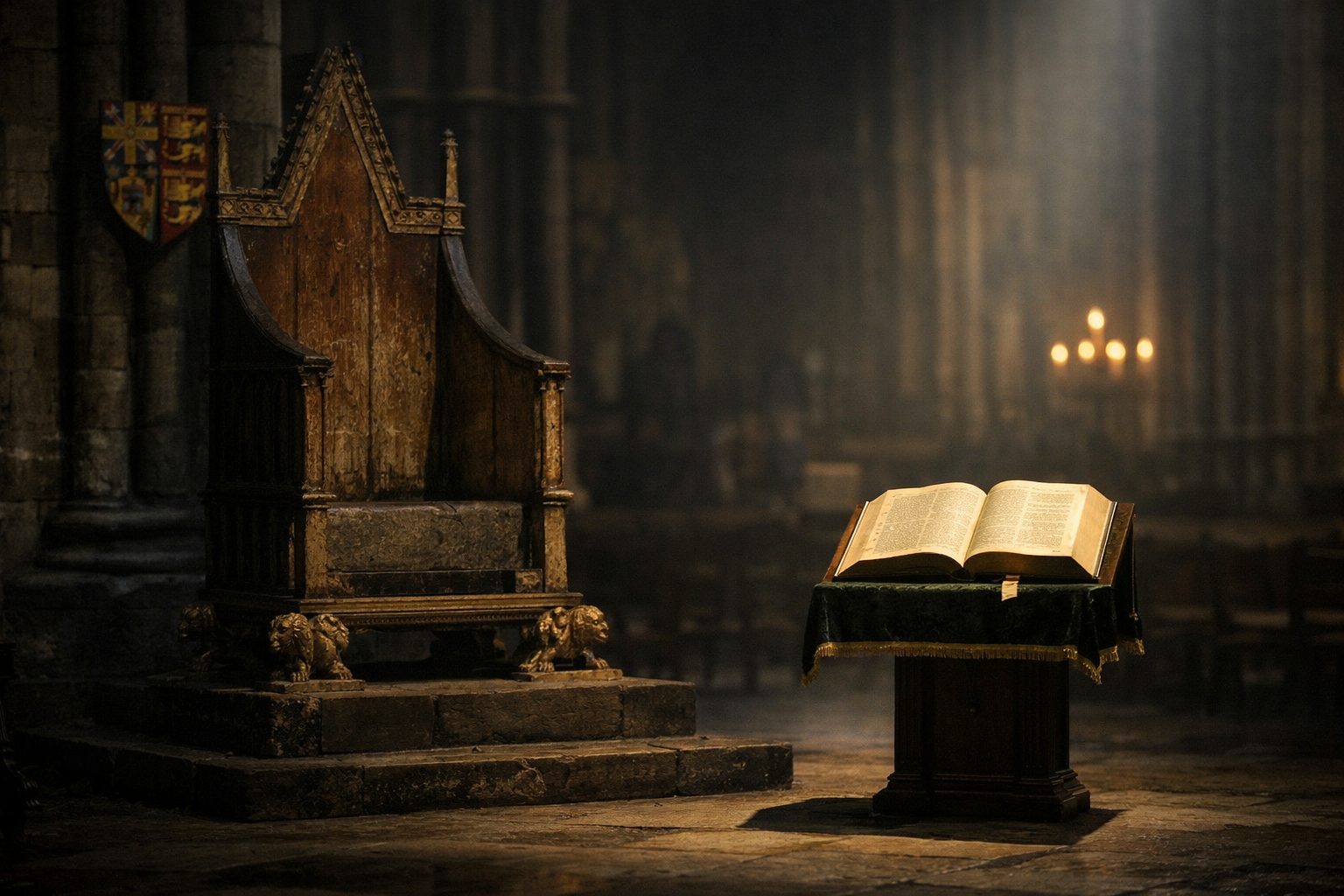
Prince William, the Crown, and the Crisis of Defensor Fidei
In an article published on 22 March 2026 in The Telegraph, royal correspondent India McTaggart reported that Prince William “may not be at church every day” but nevertheless believes in his duty toward the Church of England. The remarks were not delivered directly by the Prince, but attributed to a senior aide, and were issued in advance of his attendance at the installation of Sarah Mullally. According to that source, the moment was intended to “draw a line in the sand” and clarify “where he stands” amid ongoing questions regarding his religious commitment. The intervention was therefore not incidental, but deliberate: a managed effort to define the Prince’s relationship to the Church of England before that relationship is defined for him.
This context is decisive. For what is presented as reassurance in fact exposes a deeper ambiguity. The Prince is said to possess a “quiet” and “personal” faith; he affirms the importance of the Church of England; he intends to support it and to take his future role seriously. Yet at no point—either in this report or in comparable public statements—has there been a clear profession of the central claim of Christianity: that Jesus Christ is Lord, that He is the Saviour and Redeemer of mankind, and that salvation is found in Him alone.¹ The distinction is not rhetorical. It is the distinction between affiliation and belief, between institutional loyalty to the Church of England and confessional adherence to the faith it purports to uphold.
The gravity of this distinction is heightened by the nature of the office the Prince is destined to assume. Since the Act of Supremacy 1534, the English sovereign has stood not merely as a ceremonial patron, but as Supreme Governor of the Church of England itself—a role embedded within the constitutional and religious fabric of the nation. The Coronation rite presumes that the monarch governs under God, upholds the Gospel, and maintains the doctrine of the Church of England.² This is not a symbolic association, but a theological commitment expressed in public form. The office presupposes belief—not in abstraction, but in substance.
It is at this point that the historic title Defensor Fidei—Defender of the Faith—must be properly understood. First granted to Henry VIII by Pope Leo X in 1521 for his defence of the sacraments, the title was later retained within the royal style after the English Reformation and confirmed in statute under Edward VI.³ It has never been a merely ornamental designation. It signifies a charge: that the sovereign is bound to defend not religion in general, nor a plurality of beliefs, but a defined and professed faith. It is inseparable from the Coronation Oath and from the legal settlement that binds Crown and Church of England together.⁴
Yet in recent decades, and particularly under Charles III, the interpretation of this title has undergone a subtle but consequential shift. In a 1994 interview, he expressed a preference to be seen as a “Defender of Faith” rather than “Defender of the Faith,” signalling a broader, pluralistic understanding of the role.⁵ While subsequent clarifications affirmed his commitment to the Church of England as established by law, the conceptual shift remains significant. For if the Crown is understood to defend faith in general, rather than a specific confession, then the content of what is defended becomes indeterminate.
It is precisely here that the present moment acquires its full significance. The position now attributed to Prince William does not represent a departure from this trajectory, but its continuation. A “quiet,” personal faith, expressed in terms of duty, support, and institutional relevance, aligns seamlessly with a redefined Defensor Fidei—one in which the sovereign affirms religion without explicitly confessing Christ. The result is a Crown that upholds the Church of England in form, while leaving undefined the faith it is charged to defend.
This raises a question of unavoidable clarity: what, precisely, remains to be defended?
The difficulty is compounded by the present condition of the Church of England itself. For the issue is no longer confined to doctrinal ambiguity, but extends to a deeper pattern of accommodation. The Church of England has, with increasing frequency, aligned itself with prevailing cultural currents, often reframing its moral teaching in response to contemporary social debates.⁶ Such alignment may be intended to preserve relevance, but it carries an inherent cost. For when an institution continually conforms to the spirit of the age, it forfeits its capacity to challenge it.
The consequences are now visible. According to the Office for National Statistics, approximately 53 per cent of the population of England and Wales identify as Christian, down from 59.3 per cent in 2011, while those reporting no religion have risen significantly.⁷ At the same time, official figures from the Church of England show continued declines in average weekly attendance and electoral roll membership, with ageing congregations and limited replacement among younger cohorts.⁸
This contraction is not only demographic but material. Reports on church closures and the disposal of historic buildings underscore a visible retreat from the local presence that once defined the Church of England’s role in national life.⁹ The result is a Church that increasingly speaks in the language of heritage even as its living structures diminish.
Thus Christianity is invoked less as a truth to be believed than as an inheritance to be preserved. Yet heritage cannot sustain belief. It can be curated, but not proclaimed; admired, but not obeyed. A Church of England that speaks of its past more readily than its doctrine is, in effect, conceding the ground upon which its authority once stood.
It is within this framework that the alliance between Crown and Church of England must be evaluated. If that alliance rests upon constitutional form and cultural relevance rather than shared confession, it cannot restore what has been lost. It can only perpetuate the existing trajectory. A monarchy that supports the Church of England without clearly confessing its faith will mirror its ambiguity; a Church of England that seeks validation from the culture will continue to dissolve into it.
The wider implications are unavoidable. For when Christianity ceases to function as the ordering principle of public life, the space it vacates is not neutral. It is occupied by systems of belief that retain coherence and confidence. The issue is not one of hostility, but of conviction. A faith that knows what it is will inevitably shape a society more effectively than one that does not.
The contrast with Elizabeth II is therefore not merely historical, but diagnostic. Her explicit confession of Christ as “a Saviour, with the power to forgive”¹⁰ ensured that the Crown did not participate in the ambiguity that now characterises both monarchy and Church of England. It provided a point of clarity—a recognition that the authority of the Crown is accountable to a truth beyond itself.
What now stands exposed is not merely a question of personal belief, but a structural contradiction. A monarch cannot meaningfully be Defensor Fidei if neither he nor the Church of England he governs can clearly state what that faith is. The title remains; the obligation is obscured. The form is preserved; the substance is in question.
The issue, therefore, is not whether Prince William is sincere, nor whether he respects the Church of England, nor whether he intends to fulfil his role with seriousness. It is whether the Crown still possesses a faith to defend.
¹ Holy Bible, John 14:6; Acts 4:12 (Douay-Rheims).
² The Form and Order of Service that is to be performed… at the Coronation of Her Majesty Queen Elizabeth II (London: Eyre & Spottiswoode, 1953).
³ Title granted by Pope Leo X in 1521; retained in English royal style under statute 1 Edw. VI c.1 (1547).
⁴ Act of Supremacy 1559 (1 Eliz. I c.1), establishing the monarch as Supreme Governor of the Church of England.
⁵ Charles III, interview with Jonathan Dimbleby, 1994; discussed in Charles: The Private Man, the Public Role (London: Little, Brown, 1994).
⁶ Church of England, General Synod reports and Living in Love and Faith (LLF) process documentation, 2020–2023.
⁷ Office for National Statistics, Census 2021: Religion, England and Wales, 29 November 2022.
⁸ Church of England, Statistics for Mission 2022 (Archbishops’ Council, 2023).
⁹ Church Commissioners and media reports on parish closures and asset disposals, 2015–2023 (see Church of England annual reports).
¹⁰ Elizabeth II, Christmas Broadcast, 25 December 2011.
Related Articles


Latest Articles
- Today’s homily: Fifteenth Sunday Post PentecostIn the Gospel of Naim, two processions converge—one of life led by Christ and another of death following a young man. Christ’s compassion interrupts the funeral, symbolising hope amid despair. This message resonates today as Catholics face challenges, encouraging perseverance in faith, tradition, and prayer for revival in families and community.
- Today’s Mass: September 06 Sunday XV Post PentecostThe Fifteenth Sunday After Pentecost’s Mass emphasises the importance of living in accordance with the Holy Spirit, cultivated through the Eucharist. It reflects on Jesus’ compassion for humanity, recalling His miracles. The readings encourage believers to prioritise spiritual matters over worldly anxieties and to embody love for one another, resonating with St. Paul’s teachings.
- Sermon for Fifteenth Sunday after PentecostIn St. Paul’s epistle to the Galatians, he urges believers to live by the Spirit, embodying charity and truth without envy. He emphasises that faith, not race or ritual, defines the people of God. Through Jesus, Gentiles can worship without conversion to Judaism, receiving the Holy Spirit by repentance and baptism.
- Today’s Mass: September 05 Saint Lawrence JustinianSaint Lawrence Justinian, the first Patriarch of Venice, dedicated his life to the poor and the establishment of monasteries, rejecting noble marriage. Renowned for his humility and pastoral dedication, he emphasised the spiritual integrity of Venice’s safety. He was a precursor to the reforms of the Council of Trent, dying on 8 January 1455.
- 06.09.26 Nuntiatoria CXXII: NOMEN MANET, RES DEESTThis edition of Nuntiatoria explores the disconnect between the names of Catholic institutions and the realities they signify. Despite retaining their titles, many aspects of Catholicism—such as episcopal authority in China and religious practice in Poland—exhibit deteriorating substance. The piece cautions against superficial continuity, stressing the importance of genuine faith and practice over mere nomenclature.




Leave a Reply