
The Hollow Crown and the Age of Double Speech: Britain’s Constitutional Order in an Era of Managed Meaning
There was a time when a man who swore an oath believed himself bound by it—not merely socially or politically, but morally, and ultimately before God. Titles imposed duties. Words carried weight. To speak publicly was to commit oneself. That world has not entirely vanished. Its forms remain intact—indeed, they are meticulously preserved. The Crown is still crowned, the Church still established, Parliament still sovereign, the law still proclaimed. But something essential has slipped away. The words remain. The meaning does not.
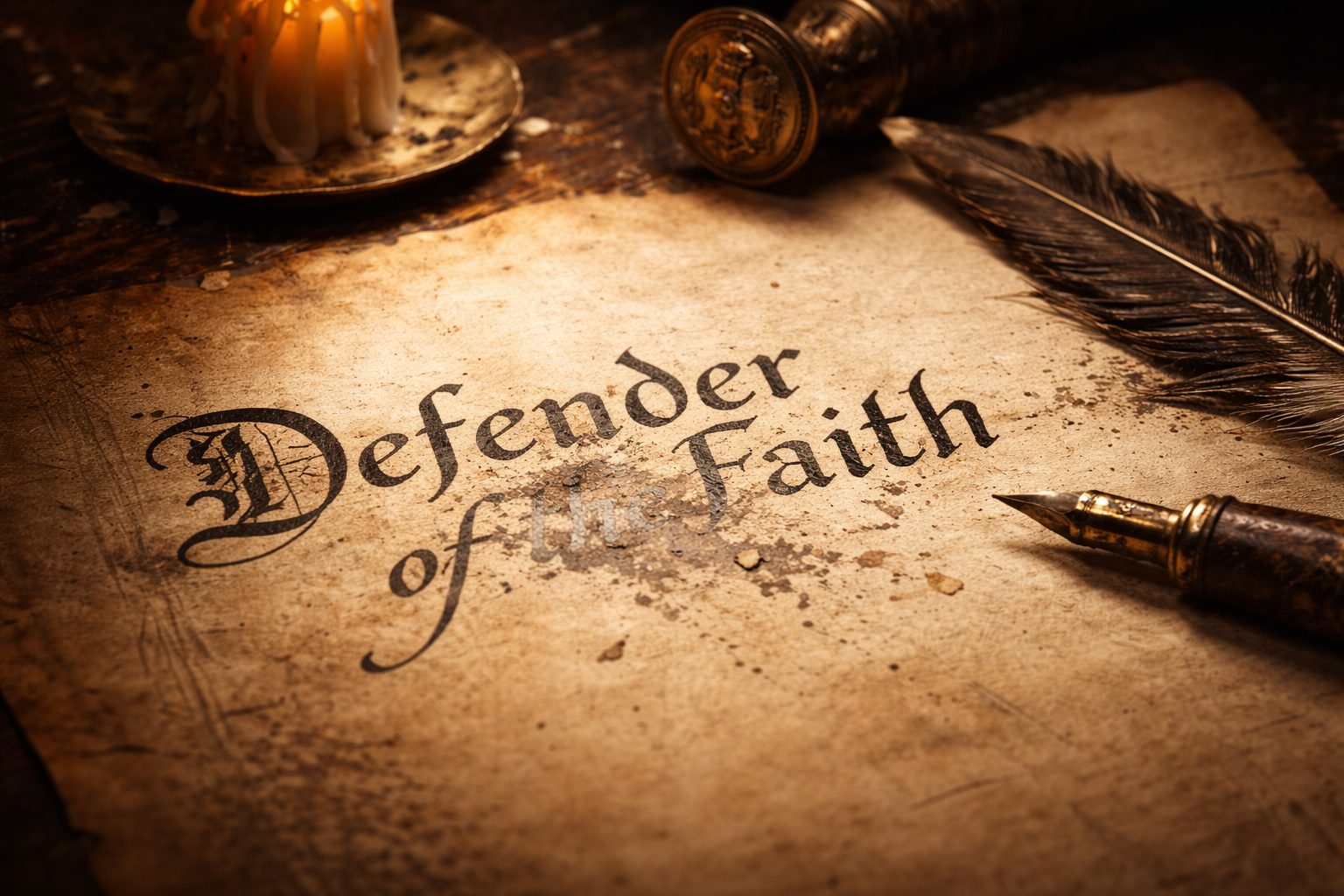
What we are witnessing is not simply hypocrisy, nor even inconsistency. It is something more pervasive and more dangerous: a condition in which institutions must continue to speak a language they no longer fully believe, while acting in ways that quietly contradict it. Nowhere is this more visible than in the monarch’s ancient title: Defender of the Faith.
The Crown Without Conviction
The title, first granted to Henry VIII and later embedded within the English constitutional settlement, is not a ceremonial relic. It is a legal and theological obligation. Under the Coronation Oath Act 1688, the sovereign must swear to maintain “the Protestant Reformed Religion established by law.”¹ The Act of Settlement 1701 further binds the monarch to communion with the Church of England.² This is not optional. It is definitional.
The coronation of Charles III on 6 May 2023 retained this substance. In the rite authorised for use in Westminster Abbey, the King swore:
“I… solemnly and sincerely… promise and swear… to maintain the Protestant Reformed Religion established by law.”³
And yet, even before his accession, he had articulated a different conception of the role: “I would much rather see it as ‘Defender of Faith’, not the Faith.”⁴ A single word removed; an entire constitutional meaning dissolved. The oath remains, the title remains, the form remains—but the content is gently, politely, almost imperceptibly reinterpreted. Later clarification did not resolve the tension: “As a Christian, I am conscious that my role is to uphold the faith, but also to protect the space for other faiths.”⁵ The sentiment is agreeable. The contradiction is structural.
Similarly, Prince William has been consistently described by royal correspondents as adopting a personal, rather than institutional, approach to religion—marked by low public liturgical participation and an emphasis on private conviction.⁶ The Crown retains its language. It relinquishes its certainty.
From Truth to Management
To understand why this is happening, one must look beyond personalities to the structure of modern society itself. Earlier political orders were, at least in principle, oriented toward truth. Authority was justified by reference to something objective and binding—divine law, natural law, or settled doctrine. Modern institutions operate under a different logic. Their primary aim is not truth but management: the balancing of interests, the mitigation of conflict, the maintenance of social cohesion.
Truth, by its nature, divides. It excludes. It binds. Management requires flexibility. It rewards ambiguity. It avoids finality. Thus institutions increasingly speak in two registers: a formal language that preserves continuity and legitimacy, and an operational language that permits adaptation.⁷ The result is not crude dishonesty but structured ambiguity. Words are retained precisely so that their meaning can be adjusted.
Pluralism Without Anchoring
Modern Britain is plural, and pluralism demands a mode of coexistence. But a society must either affirm a truth that orders its public life or treat all claims as provisional. Increasingly, Britain has chosen the latter. Yet governance cannot function without real distinctions. Laws must define; institutions must decide; authority must assert. The compromise is as ingenious as it is unstable: truth is retained linguistically while neutralised operationally.
Thus Defender of the Faith becomes Defender of Faith. Establishment becomes heritage. Doctrine becomes dialogue. Law becomes guidance. Nothing is abolished. Everything is transformed.⁸
The Church Without Authority
The Church of England embodies this contradiction with particular clarity. Its bishops sit in the House of Lords as Lords Spiritual—twenty-six diocesan bishops who hold seats ex officio.⁹ This arrangement presupposes a theological claim about the nature of the state. Yet the Church increasingly speaks as though its role were advisory rather than authoritative. Doctrine is softened, certainty reframed, moral teaching rendered provisional.
The contradiction is not merely theological; it is constitutional. The Church retains its legal privileges while relinquishing the doctrinal clarity that justified them. Establishment persists in form while dissolving in substance. It becomes not the conscience of the nation, but its echo.
The Law Without Constraint
The same pattern extends into the wider political and administrative class. Statutes are enacted, debated, and proclaimed. But their application is mediated through guidance, policy frameworks, and administrative interpretation that reshape their meaning in practice. As Adam Tomkins observes, modern public law increasingly recognises the central role of executive interpretation in determining how statutes operate in reality.¹⁰ What Parliament declares in principle is often recalibrated in execution. The letter remains; the substance shifts.
This is not the abolition of law, but its transformation into something more pliable. The rule of law persists formally, but its content becomes increasingly negotiable.
The Loss of Honour
What has been lost is not merely doctrinal clarity or constitutional precision, but the culture that sustained them. The British system relied upon an assumption that those entrusted with office would take their words seriously—that oaths bound, that titles obliged, that roles carried intrinsic duties. Classical accounts of the constitution presupposed precisely this moral seriousness.¹¹ That assumption can no longer be taken for granted.
In its place emerges a thinner ethic: procedural compliance, reputational management, the avoidance of controversy. One may keep the form while discarding the substance. One may speak the words while withholding assent.
Everything continues—except conviction.
Conclusion: A Civilisation of Managed Meaning
Modern Britain has not abandoned its institutions. It has learned to inhabit them differently. The language of obligation is preserved because it confers legitimacy. The substance of obligation is relaxed because it constrains flexibility. Between the two emerges a system sustained by ambiguity and maintained by reinterpretation.
This is not merely hypocrisy. It is the structural condition of a society that no longer believes in binding truth, yet cannot function without it. And such a society must, inevitably, speak with two voices—one that affirms, and one that adapts; one that preserves the form, and one that dissolves the meaning.
For a time, the balance can be maintained. The ceremonies will continue. The titles will be spoken. The laws will be enacted. But no constitutional order can endure indefinitely on words that no longer bind.
A crown that does not bind the conscience cannot bind the nation—and a nation that cannot bind itself cannot long endure.
¹ Coronation Oath Act 1688 (1 Will & Mar c 6), statutory wording.
² Act of Settlement 1701 (12 & 13 Will III c 2).
³ “The Form and Order of Service… Coronation of His Majesty King Charles III,” Lambeth Palace, 2023.
⁴ Jonathan Dimbleby, The Prince of Wales: A Biography (London: Little, Brown, 1994), 395.
⁵ Charles III, remarks at St James’s Palace, 2015; reported in The Telegraph, 9 February 2015.
⁶ Roya Nikkhah, royal correspondent reporting on Prince William, The Sunday Times, 2023.
⁷ Christopher Hood, The Tools of Government (London: Macmillan, 1983), on administrative flexibility and governance.
⁸ Alasdair MacIntyre, After Virtue (Notre Dame: University of Notre Dame Press, 1981), on the fragmentation of moral language.
⁹ UK Parliament, House of Lords Library, “Lords Spiritual,” confirming 26 bishops sit as of right.
¹⁰ Adam Tomkins, Public Law (Oxford: Oxford University Press).
¹¹ A.V. Dicey, Introduction to the Study of the Law of the Constitution (1885), especially chapters on constitutional morality.
RELATED ARTICLES


LATEST ARTICLES
- QUI BENE DISTINGUIT, BENE DOCET ~ He who distinguishes well, teaches well: Spiritual Conference for Nuntiatoria CXXIIIIn a series of Tuesday conferences, the speaker explores themes about recognising reality, receiving divine gifts, and understanding spiritual truths. He highlights the importance of making careful distinctions to maintain sound judgment, especially in an age consumed by distractions and superficial assessments. True wisdom lies in distinguishing truth from perception and nurturing an authentic inner life centred on Christ.
- Today’s homily: Impression of the Stigmata upon St FrancisFrom serving the lepers he once shunned to receiving Christ’s wounds upon Mount Alvernia, Saint Francis shows how grace transforms a soul through obedient love. His stigmata call us to let the Cross shape our lives, beginning with the particular act of mercy or sacrifice we have been reluctant to offer.
- Today’s Mass: September 17 Impression of the Stigmata of St Francis of AssisiSaint Francis received the stigmata because he had first allowed the Cross to transform his soul. His wounds were not a spectacle, but God’s answer to a world growing cold: the visible sign of a life consumed by crucified love. We may never bear Christ’s wounds in our flesh, but we must bear their likeness through penance, fidelity, patience, mercy and sacrificial love.
- Sermon for Stigmata of St. FrancisToday marks the feast of St. Francis’ stigmata, celebrating his transformation from a wealthy merchant’s son to a devoted preacher of poverty and humility. He founded the Franciscan order, emphasising evangelisation and simplicity. His experience of receiving the stigmata exemplifies the Christian doctrine of redemption through suffering, distinguishing it from other faiths.
- Today’s homily: Wednesday Michaelmas EmberThe homily reflects on the significance of fasting and prayer in the Christian faith, emphasising their role in spiritual growth and self-mastery. By juxtaposing scripture from Amos and the Gospel of Mark, it highlights the need for gratitude and humility during abundance, urging believers to recognise their dependence on God. True repentance transforms and restores one’s relationship with Him.



Leave a Reply