
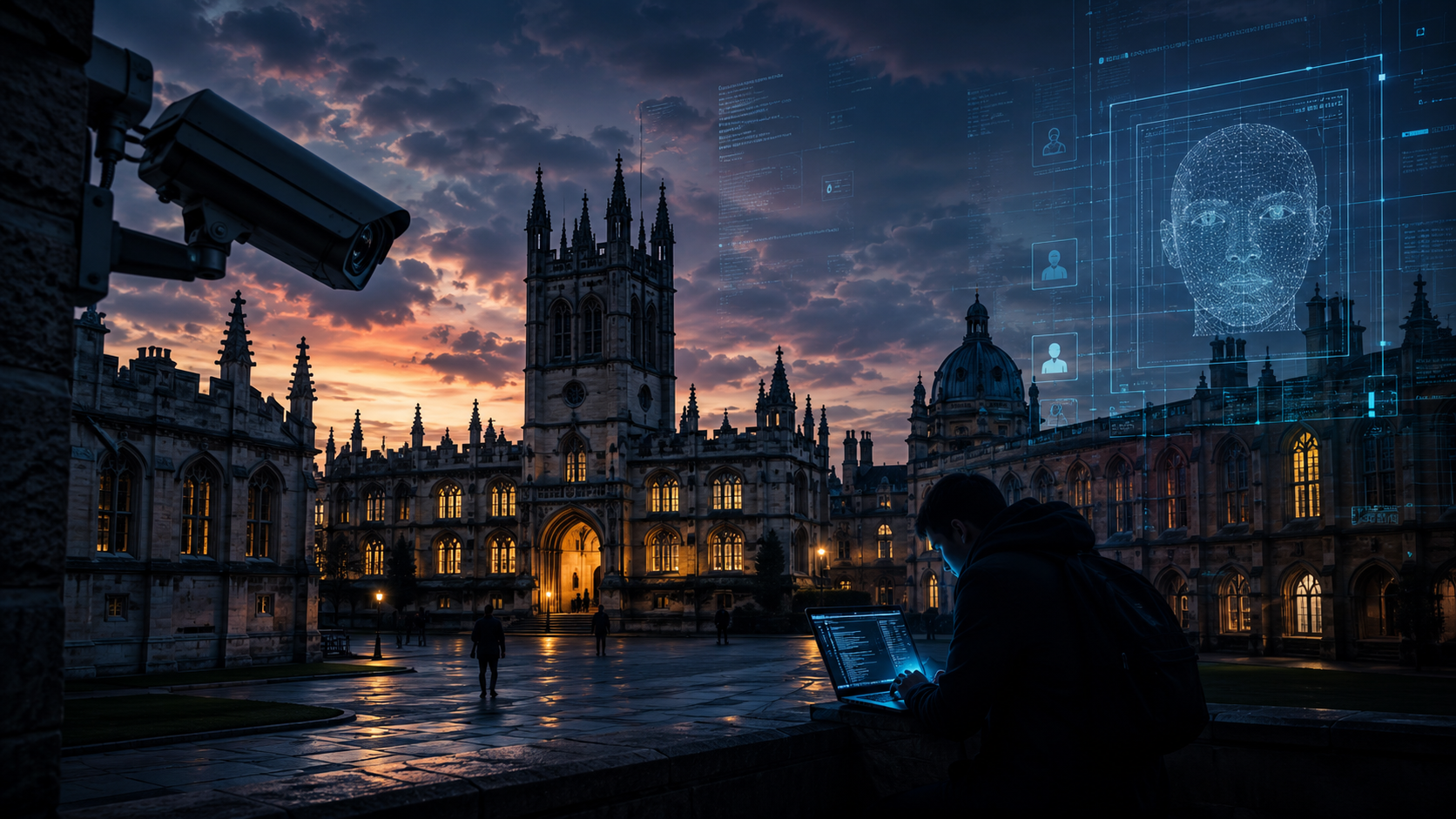
The Securitisation of Thought: Universities, Surveillance, and the Quiet Death of Truth

A new orthodoxy enforced not by argument, but by risk management
There was a time when the university existed as a sanctuary of truth—a place where ideas were tested, contested, refined, and, when necessary, rejected. That time is passing. In its place, a new paradigm is emerging: not the pursuit of truth, but the management of risk; not the contest of ideas, but the surveillance of those who hold them. What is now unfolding within British higher education is not an isolated policy drift, but a structural transformation—one that threatens to redefine the very nature of intellectual life.
Recent revelations concerning the use of private intelligence firms by British universities, together with the Government’s proposed expansion of Prevent guidance, confirm what many have long suspected: the modern university is drifting from its intellectual vocation into something closer to a securitised administrative apparatus. The implications are not merely academic. They are civilisational.
From free inquiry to monitored speech
The intervention by the Committee for Academic Freedom (CAF) has brought into sharp relief a deeply troubling development. Universities across the United Kingdom—including multiple Russell Group institutions—have collectively paid more than £440,000 to private firms such as Horus Security to conduct “counter-terror ‘threat assessments’” on academics, students, and invited speakers.¹ These assessments have included the monitoring of social media activity and the revisiting of historic allegations, even where such claims have already been dismissed by courts or by the individuals’ home institutions.²
The case of Manchester Metropolitan University is emblematic. Emails revealed that the university sought a “counter-terror ‘threat assessment’” of an invited academic speaker—not on the basis of unlawful conduct, but on the perceived implications of her scholarship.³ The resulting report scrutinised her social media presence and revived allegations that had previously been dismissed, prompting her to observe: “You’re supposed to be innocent until proven guilty […] but they actually made an assumption of guilt and started investigating me because of my scholarship.”⁴
Here, the distinction between speech and action—long a cornerstone of both common law reasoning and academic freedom—begins to dissolve. Ideas are no longer treated as propositions to be evaluated, but as risk indicators to be profiled.
The legal fiction of balance
Defenders of such practices invariably invoke the Prevent duty under the Counter-Terrorism and Security Act 2015, which requires specified authorities to have “due regard to the need to prevent people from being drawn into terrorism.”⁵ Yet this duty is not freestanding. Parliament, fully aware of the potential for overreach, embedded a countervailing obligation within the same legislative framework. Section 31 provides that institutions must have “particular regard to the duty to ensure freedom of speech within the law” and to “the importance of academic freedom.”⁶
This is not a marginal qualification; it is the statutory hinge upon which the entire Prevent regime turns. The law does not license universities to suppress lawful speech in the name of security. It requires them to hold security and liberty in principled tension.
What the CAF intervention reveals, however, is that this balance is increasingly fictional in practice. The Government’s own language signals the shift. Universities are to be guided by principles that will “help… assess when speech… is lawful but could enable a ‘permissive environment’ for radicalising influences.”⁷
This phrase—“permissive environment”—is as vague as it is expansive. It does not refer to actions, intentions, or incitement. It refers to atmospheres, climates, and associative risks. It lowers the threshold of intervention from demonstrable harm to speculative possibility. In doing so, it transforms the logic of regulation itself.
From evidence to atmosphere
Once the category of the “permissive environment” is admitted, the entire structure of free speech protection begins to erode. For if lawful speech may be curtailed not because it is unlawful, nor because it directly incites harm, but because it contributes to an environment in which harm might, at some indeterminate point, arise, then there is no principled limit to intervention.
This is not conjecture. It follows a pattern already observed in other regulatory domains. Under the Equality Act 2010, the statutory definition of harassment requires that conduct be assessed with regard to reasonableness and context.⁸ Yet in practice, institutional policies have frequently drifted toward perception-led standards, where subjective offence is treated as sufficient grounds for sanction. The result has been predictable: over-reporting, administrative overreach, and the chilling of lawful expression.
The same dynamic is now taking hold under Prevent. The threshold is shifting—from evidence to inference, from conduct to climate; from demonstrable risk to imagined contagion.
The rise of outsourced orthodoxy
Compounding this shift is the increasing reliance on private intelligence providers. By outsourcing “threat assessment” to firms such as Horus Security, universities are not merely delegating administrative tasks; they are importing into the academic sphere a fundamentally different epistemology. In this model, ideas are not debated; they are classified. Speakers are not engaged; they are profiled.
CAF has rightly questioned whether such firms possess the competence—or indeed the mandate—to distinguish between genuine counter-terror concerns and other forms of institutional anxiety, including reputational sensitivity, political controversy, or the lawful but contentious nature of the speech itself.⁹ The risk is obvious: that categories designed for national security are repurposed for the management of dissent.
What emerges is a system in which the logic of intelligence gathering displaces the logic of academic inquiry. The university becomes less a forum of debate and more a node within a broader surveillance network.
The deeper crisis: truth replaced by safety
At its root, this transformation reflects a deeper philosophical crisis. The university, historically grounded in the conviction that truth is objective, intelligible, and worth seeking—even at personal or institutional cost—is being reconstituted on a different foundation: the primacy of safety over truth.
But safety, when absolutised, becomes indistinguishable from control.
When ideas are treated as hazards rather than arguments, the intellectual life collapses into risk management. The operative question ceases to be “Is this true?” and becomes instead “Is this safe?” And because truth is often disruptive—because it challenges prevailing assumptions, unsettles consensus, and exposes error—a system that privileges safety above all else will inevitably suppress it.
The Christian inheritance of the university
This represents not merely an institutional shift, but a repudiation of the university’s own inheritance. The medieval university arose from the conviction that truth is grounded in the Logos—“In the beginning was the Word [Logos]” (John 1:1)—that reality is ordered, intelligible, and accessible to reason because it is created and sustained by God.¹⁰ To seek truth, therefore, was not an act of defiance, but of fidelity.
It is this inheritance that underwrote the great intellectual traditions of Europe: the disputation, the lecture, the open contest of ideas. It is this inheritance that made possible the very notion of academic freedom—not as licence, but as a disciplined commitment to the pursuit of truth wherever it might lead.
A university that monitors its scholars, scrutinises their social media, and subjects their ideas to counter-terrorism assessment has severed itself from that inheritance. It has exchanged the pursuit of truth for the management of risk, the discipline of reason for the calculus of suspicion.
A university that fears ideas has already ceased to understand them.
A warning and a choice
The CAF intervention is both timely and necessary. Its call for “robust procedural and evidential safeguards” is not merely a technical recommendation, but an implicit recognition that the present trajectory is unsustainable.¹¹ Without such safeguards, the logic of securitisation will continue to expand—lowering thresholds, broadening categories, and normalising surveillance.
But safeguards alone will not suffice. What is required is a reassertion of first principles: that the university exists to pursue truth, not to enforce orthodoxy; to cultivate reason, not to manage atmospheres; to form minds, not to monitor them.
The choice is now unavoidable. Either the university remains what it has always claimed to be—a community ordered to truth—or it becomes something else entirely: an institution in which thought itself is subject to assessment, classification, and control.
If that transformation is allowed to proceed, the university will not collapse in scandal or fall in open crisis. It will simply forget what it is for.
And a university that has forgotten truth has already lost it.
- Attenborough, “CAF Warns New Prevent Guidance Could Chill Lawful Academic Speech.”
- Frederick Attenborough, “CAF Warns New Prevent Guidance Could Chill Lawful Academic Speech,” Committee for Academic Freedom, May 21, 2026.
- Ibid.
- Ibid.
- Ibid.
- Counter-Terrorism and Security Act 2015, c. 6, §26 (UK).
- Ibid., §31 (“Freedom of speech in universities, etc.”).
- Attenborough, “CAF Warns New Prevent Guidance Could Chill Lawful Academic Speech.”
- Equality Act 2010, c. 15, §26 (UK).
- Attenborough, “CAF Warns New Prevent Guidance Could Chill Lawful Academic Speech.”
- The Holy Bible, Revised Standard Version (San Francisco: Ignatius Press, 2006), John 1:1.
RELATED ARTiCLES


LATEST ARTICLES
- Today’s homily: Wednesday Michaelmas EmberThe homily reflects on the significance of fasting and prayer in the Christian faith, emphasising their role in spiritual growth and self-mastery. By juxtaposing scripture from Amos and the Gospel of Mark, it highlights the need for gratitude and humility during abundance, urging believers to recognise their dependence on God. True repentance transforms and restores one’s relationship with Him.
- Today’s Mass: September 16 Wednesday Michaelmas EmberThe post commemorates the Ember Days, originally aligned with Roman agricultural festivals. The Catholic Church adopted these days early in its history to honour true worship and avoid disrupting Roman converts’ practices. The Ember Days promote fasting, prayer, and gratitude towards God for nature’s gifts while assisting the needy.
- SEPTEMBER EMBERTIDEThe September Ember Days, rooted in ancient Roman liturgy, are a time of reflection, fasting, and thanksgiving, coinciding with the autumn harvest. Marked by communal penance and prayers for clergy sanctification, these observances connect biblical themes of creation and sacrifice, urging Christians to evaluate their spiritual fruitfulness.
- Today’s homily: Seven Sorrows of the Blessed Virgin MaryOn the Feast of the Seven Sorrows, the Church contemplates not merely Mary’s grief but her fidelity beneath the Cross. Through the liturgy, St Bernard, St John Damascene and St Thomas Aquinas, the homily shows that Christian resignation does not mean calling suffering good, but remaining faithful to God when suffering cannot be removed or understood. Mary’s stabat becomes the model of a faith which the sword can pierce, but cannot conquer.
- Today’s Mass: September 15 The Seven Sorrows of the Blessed Virgin MaryThe Feast of the Exaltation of the Holy Cross, celebrated on September 14, commemorates the historical finding of the True Cross by Saint Helena, the dedication of churches by Constantine, and its restoration by Heraclius II. It honours the cross as the symbol of salvation, transforming a method of execution into a source of life and hope.
CURRENT EDITION


DAILY MASS ONLINE
One of the earliest online apostolates dedicated to the Traditional Latin Mass, Old Roman TV began broadcasting the Holy Sacrifice on the Feast of the Assumption, 15 August 2008. During the COVID-19 pandemic, additional programming — devotions, catechesis, and conferences — was added to support the faithful in prayer and formation.
Support the daily Holy Mass on Old Roman TV by offering a Mass intention — for loved ones, thanksgiving, or the repose of souls. Your intention helps sustain the sacred liturgy and brings grace to those you remember before God’s altar.
SUPPORT THE DAILY MASS ONLINE
Likely the world’s longest-running daily online broadcast of the
Traditional Latin Mass, streaming faithfully since the
Feast of the Assumption 2008.

This apostolate cannot continue without immediate help
Please support us with a contribution toward
chapel rent, sacristy supplies, operating costs, and web-hosting.
Our essential monthly costs reach £1,000.
MASS INTENTIONS
If your offering is for a Mass Intention, kindly complete the form below in full so we may correctly match it to your donation. For anniversary intentions — birthdays, wedding anniversaries, anniversaries of death — please be sure to include the relevant date.


Today’s Mass Propers
- Today’s Mass: September 16 Wednesday Michaelmas Ember
 The post commemorates the Ember Days, originally aligned with Roman agricultural festivals. The Catholic Church adopted these days early in its history to honour true worship and avoid disrupting Roman converts’ practices. The Ember Days promote fasting, prayer, and gratitude towards God for nature’s gifts while assisting the needy.





Leave a Reply