
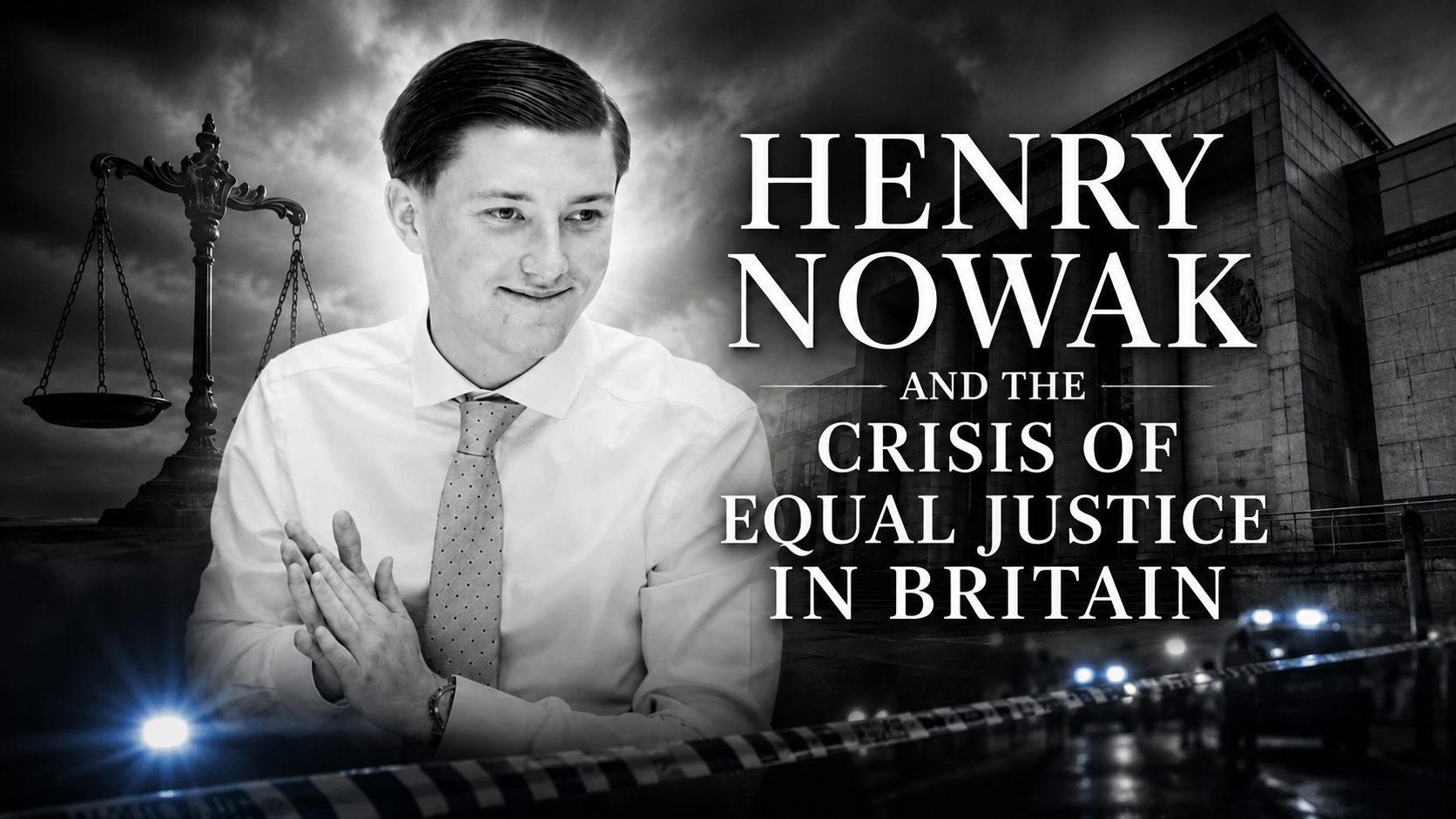
Henry Nowak and the Crisis of Equal Justice in Britain

The Fact of a Death, the Burden of a Trial
The death of Henry Nowak in Southampton in December 2025 is, first and foremost, the loss of a young life. That fact must remain primary. The ongoing proceedings at Southampton Crown Court concern whether that death constitutes murder or a lawful act of self-defence. The accused, Vickrum Digwa, denies murder and asserts that he acted in fear after alleged racial abuse and interference with his turban—an act which, within Sikh religious observance, carries deep personal and symbolic significance.¹
The prosecution case now rests in part on recorded evidence. The court has heard that Henry Nowak’s own phone captured the beginning of the encounter. In that footage, he is reported to have said:
“You’re a bad man, say you’re a bad man, go on,”
to which the defendant replied:
“I am a bad man.”²
This exchange, trivial in isolation, has assumed evidential weight because it anchors the encounter in recorded fact rather than retrospective reconstruction. The prosecution has further described the weapon as an “extremely large knife,” emphasising both its size and lethality.³
These remain competing accounts. The principle of sub judice requires restraint. But where evidence has been placed before the court, it may properly be examined for its wider implications.
The Allegation that Changed the Case
What has transformed this case from a tragic homicide into a national controversy is the allegation—now more precisely reported—that police officers responding to the scene initially handcuffed Henry Nowak before fully appreciating the severity of his injuries.⁴
Reporting indicates that officers restrained him following an accusation of racial abuse, before later administering first aid after he collapsed unconscious and emergency medical assistance arrived.⁵
This clarification matters. The issue is no longer crudely whether a dying teenager was handcuffed, but whether operational priorities—control and restraint—were applied before the primary duty to preserve life was fully engaged.
That is a narrower claim, but a more serious one. It goes directly to professional judgment under pressure. And it is precisely the kind of moment upon which public confidence in policing turns.
Parliamentary Intervention and the Language of Trust
The issue entered the formal record when Robert Jenrick raised the matter during Prime Minister’s Questions. In the Commons, he stated:
“An 18-year-old young man… was stabbed and as he lay dying, police allegedly handcuffed him after accusations of racism. Does the Prime Minister understand why so many people believe policing in this country has lost its way?”⁶
This intervention did not determine facts. It did something more consequential: it translated a contested incident into a question of institutional legitimacy.
Courts determine guilt. But public trust determines whether those determinations are accepted as just.
Self-Defence: Subjective Fear and Objective Proportionality
At the centre of the trial lies the doctrine of self-defence. English law permits a defendant to use force where he honestly believes it necessary to defend himself.⁷ This is a subjective test.
But it is immediately constrained by an objective requirement: the force used must be reasonable and proportionate in the circumstances as the defendant believed them to be.⁸
The prosecution has now sought to challenge the defence narrative directly. It is reported that the video evidence contains no audible racial slurs and no clear indication of the alleged interference with the defendant’s turban.⁹ This does not disprove the defence claim—but it introduces tension between assertion and evidence that the jury must resolve.
The legal question is therefore sharpened: even if fear existed, was the force used proportionate? The law insists that the answer must be grounded not only in belief, but in reason.
Religious Accommodation and Its Limits
The case also raises the question of religious accommodation. The carrying of a kirpan is recognised under the Criminal Justice Act 1988, which provides a defence for bladed articles carried for religious reasons.¹⁰
However, the prosecution has emphasised that the defendant was already carrying a smaller concealed kirpan, and that the larger blade allegedly used in the attack went beyond what was required for religious observance.¹¹
This distinction is critical. The law protects religious expression. But it does not permit that protection to extend to the use of weapons in a manner that threatens life. Accommodation has limits, and those limits are defined by the duty of the state to protect the public.
Conduct After the Act and Its Evidential Weight
A further development in the prosecution case concerns the defendant’s conduct immediately after the stabbing. The court has heard it alleged that:
“He didn’t seek help for the man he had injured with his sizeable knife, instead he accused him of being a racist and being drunk.”¹²
This allegation, if accepted, carries evidential weight. Post-incident conduct can inform a jury’s assessment of intent, state of mind, and credibility.
It also intersects with the broader public controversy. The accusation of racism, raised at the scene, is now central both to the defence case and to the criticism of the police response.
Policing, Perception, and the Question Few Will State Plainly
Public reaction has been immediate and polarised. Figures such as Suella Braverman have questioned whether the alleged police response reflects a broader distortion of operational priorities, while commentators including Laurence Fox have pointed to perceived disparities in media attention and public mobilisation.¹³
These responses are often rhetorically charged. Yet their persistence reveals a deeper issue: a widening gap between institutional assurances and public perception.
That gap converges on a question increasingly difficult to ignore:
Would the response—police, media, and political—have been the same if the identities in this case were reversed?
The law requires that the answer be yes. Public confidence increasingly hesitates.
The Moral Foundation of Equal Justice
This is not merely a legal problem. It is a moral one. Justice requires impartiality—not only in fact, but in perception.
The Christian tradition expresses this principle succinctly: “There is no respect of persons with God.”¹⁴ Justice, to retain legitimacy, must reflect that same impartiality. It cannot be seen to bend according to identity, nor yield to cultural pressure.
If it is perceived to do so, it ceases to function as justice and begins to be regarded as preference.
Conclusion: The Threshold Has Moved
It must be stated clearly: this case has not yet established systemic failure. The trial is ongoing. The facts remain contested. No finding of police misconduct has been made.
But the threshold has shifted. The issue is no longer whether confidence might be affected, but whether it already has been.
A substantial portion of the public now questions—not conclusively, but instinctively—whether the law is applied evenly. That instinct, once formed, is difficult to reverse.
The law does not collapse in a moment. It erodes. Gradually, imperceptibly at first, then unmistakably.
Henry Nowak’s death is a tragedy.
If it becomes a symbol of unequal justice—whether grounded in fact or sustained by perception—it will not remain an isolated case. It will become part of a pattern in the public mind.
And once justice is widely perceived as partial, its authority is no longer assumed. It must be defended—and, if necessary, restored.
- “Sikh man tells court he stabbed student in self-defence after alleged abuse,” ITV News, May 2026.
- “Man killed student with 21cm knife after saying ‘I’m a bad man’, court told,” ITV News, May 2026.
- “Student stabbed with ‘extremely large knife’ after night out,” Sky News, May 2026.
- Ibid.
- Ibid.; ITV News court reporting, May 2026.
- UK Parliament, House of Commons, Prime Minister’s Questions, statement by Robert Jenrick, May 2026.
- R v Gladstone Williams.
- R v Palmer.
- Court reporting analysis, The Catholic Herald, May 2026.
- Criminal Justice Act 1988, s.139.
- Sky News court reporting, May 2026.
- “Student stabbed with 21cm knife…,” ITV News / syndicated reporting, May 2026.
- Public commentary by Suella Braverman and Laurence Fox, May 2026.
- Romans 2:11.
RELATED ARTiCLES


LATEST ARTICLES
- WHEN THE BISHOP BECOMES THE MESSAGE: The Cult of Personality, Episcopal Pride and the Betrayal of Apostolic TrustArchbishop Josef Grünwidl of Vienna has openly advocated for women’s ordination, reflecting a troubling trend among bishops who express personal opinions at odds with established Catholic doctrine. This practice undermines their primary role of teaching the faith and raises concerns about episcopal pride and the proper handling of doctrinal authority by the Church.
- SANDIE PEGGIE: WHEN THE UNION FAILS THE WOMEN IT SHOULD DEFENDThe Royal College of Nursing successfully defended its actions in a discrimination case brought by Sandie Peggie, yet the ruling highlights concerns about the union’s failure to acknowledge members’ rights amid ideological conformity. This raises critical questions regarding the adequacy of trade union representation for employees facing complex workplace issues.
- Today’s homily: St Winefride of HolywellSt Winefride’s courage, and the survival of devotion to her through centuries of persecution, reveal the cost and beauty of Christian fidelity. Her feast challenges us to move beyond outward observance, cultivate genuine holiness, resist compromise, and persevere in sanctifying grace, ready to meet Christ, our divine Bridegroom.
- Today’s Mass: November 3 St Winefride of HolywellThe spring attached to her legend has given its name to Holywell (Tre Ffynnon), Clwyd, and down the centuries, and right up to the present day, pilgrims have travelled there in the hope of finding healing for their illnesses. Such pilgrimages even continued throughout the Reformation with 14,000 people and 150 priests gathered there on St Winefride’s feast day in 1629 – a time when Catholics were still dying as martyrs.
- THE GOSPEL IS NOT AN ALIBI FOR BUREAUCRACYBishop Philip North contends that spiritual renewal is paramount for the Church of England, sidelining organisational reform. He defends diocesan administration despite concerns over rising costs and declining clergy and congregations. This editorial emphasises the need for both faithful evangelisation and responsible financial stewardship as interconnected necessities for the Church’s survival.
CURRENT EDITION


DAILY MASS ONLINE
One of the earliest online apostolates dedicated to the Traditional Latin Mass, Old Roman TV began broadcasting the Holy Sacrifice on the Feast of the Assumption, 15 August 2008. During the COVID-19 pandemic, additional programming — devotions, catechesis, and conferences — was added to support the faithful in prayer and formation.
Support the daily Holy Mass on Old Roman TV by offering a Mass intention — for loved ones, thanksgiving, or the repose of souls. Your intention helps sustain the sacred liturgy and brings grace to those you remember before God’s altar.
SUPPORT THE DAILY MASS ONLINE
Likely the world’s longest-running daily online broadcast of the
Traditional Latin Mass, streaming faithfully since the
Feast of the Assumption 2008.

This apostolate cannot continue without immediate help
Please support us with a contribution toward
chapel rent, sacristy supplies, operating costs, and web-hosting.
Our essential monthly costs reach £1,000.
MASS INTENTIONS
If your offering is for a Mass Intention, kindly complete the form below in full so we may correctly match it to your donation. For anniversary intentions — birthdays, wedding anniversaries, anniversaries of death — please be sure to include the relevant date.


Today’s Mass Propers
- Today’s Mass: November 3 St Winefride of Holywell
 The spring attached to her legend has given its name to Holywell (Tre Ffynnon), Clwyd, and down the centuries, and right up to the present day, pilgrims have travelled there in the hope of finding healing for their illnesses. Such pilgrimages even continued throughout the Reformation with 14,000 people and 150 priests gathered there on St Winefride’s feast day in 1629 – a time when Catholics were still dying as martyrs.





Leave a Reply