
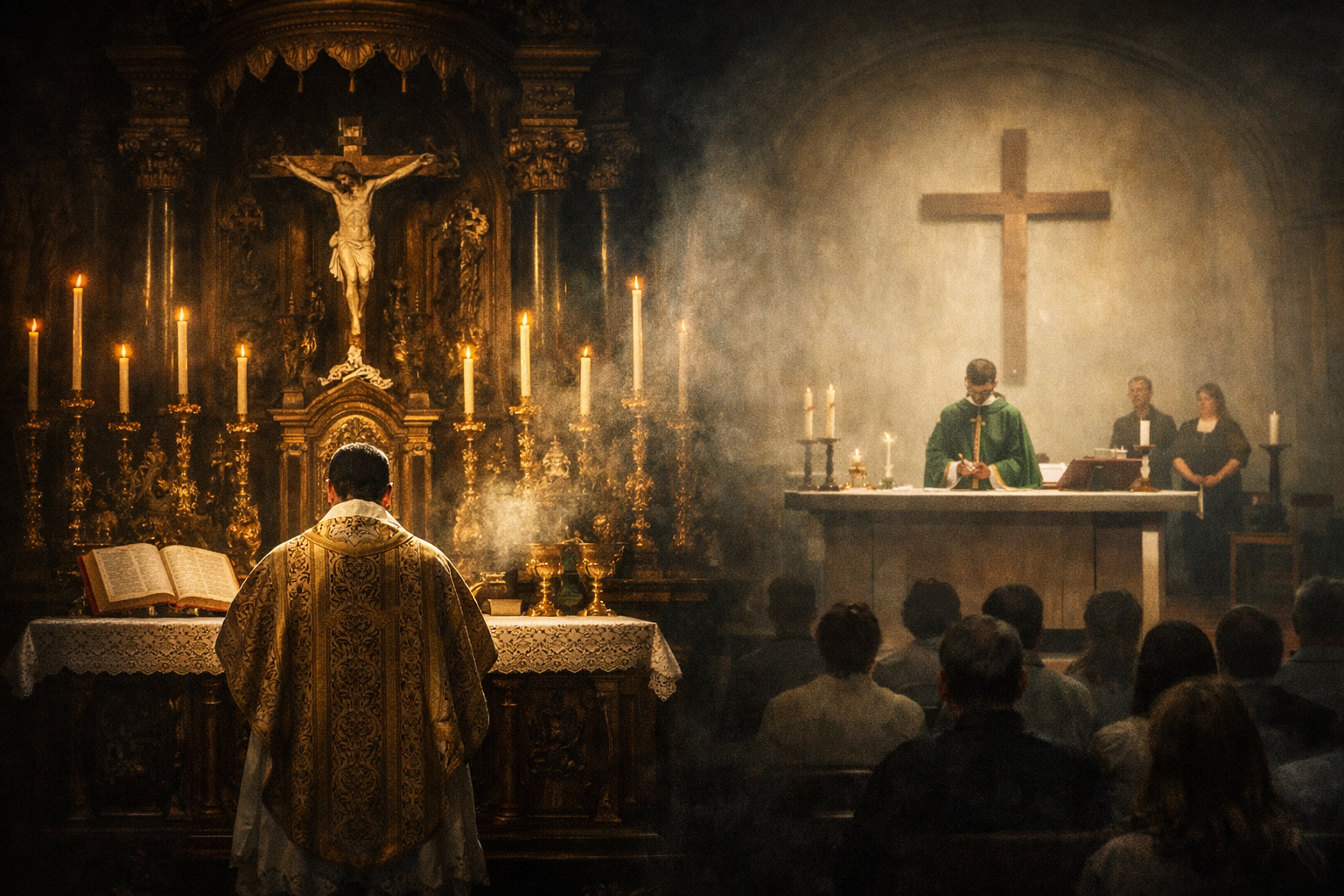
A Valid Rite, A Diminished Faith: The Crisis of Eucharistic Expression After 1969
In 1969, under Pope Paul VI, the Catholic Church promulgated a reformed Roman Missal that reshaped the liturgical life of the Latin Church worldwide. The resulting rite—commonly called the Novus Ordo—has been defended as valid and pastorally beneficial, and criticised as a rupture with tradition. This editorial argues that the decisive issue is neither nostalgia nor legality, but theological expression: whether a rite that retains sacramental validity has nevertheless weakened the Church’s ability to form belief in the Eucharistic sacrifice.
The Question Properly Framed
In April 1969, by the Apostolic Constitution Missale Romanum, Pope Paul VI promulgated a new order of Mass for the Latin Church, replacing in ordinary use the missal codified after the Council of Trent and organically developed over centuries. The question this raises cannot be resolved by appeal to authority alone, nor by catalogues of abuses. Catholic sacramental theology, articulated with precision at the Council of Florence, establishes that a sacrament depends upon matter, form, minister, and intention¹—that is, what is used, what is said, who acts, and what is intended. If these remain, the sacrament occurs; if they fail, it does not. The stakes, therefore, are immediate and concrete: whether the Mass is still understood and expressed as a true propitiatory sacrifice offered to God, or increasingly perceived as a communal act of remembrance.
The Sacrificial Structure of the Traditional Rite
The Council of Trent defined the Mass not ambiguously but precisely: the same Christ is offered in an unbloody manner upon the altar². This doctrine was not merely asserted but enacted. The Offertory explicitly anticipates sacrifice; the Canon sustains it; the priest acts in persona Christi as sacrificer. As Pope Pius XII reaffirmed, the Mass is “the supreme act of worship” offered by the priest in the person of Christ³. The rite teaches by what it does. Where the rite is dense, belief is reinforced; where it is thinned, belief is weakened.
This structure is not medieval excess but apostolic inheritance. John Chrysostom speaks of the priest as standing “at the altar, performing the same sacrifice,” not symbolically but sacramentally⁴. Thomas Aquinas provides the governing principle: a sacrament must clearly signify what it effects, for it is a sign that causes what it signifies⁵. If the sign is diminished, comprehension of the reality is proportionately diminished.
The Reform and Its Methodological Shift
The reform under Pope Paul VI did not formally deny sacrificial theology, but it did alter the method by which that theology is expressed. Archbishop Annibale Bugnini records that elements which might impede ecumenical rapprochement—particularly with Protestant communities—were deliberately reconsidered⁶. This must be understood accurately: not as explicit doctrinal abandonment, but as a conscious recalibration of emphasis. Yet such recalibration is not neutral. The liturgy is not merely descriptive; it is formative. To reduce the explicit articulation of sacrifice is not merely to simplify language—it is to alter the conditions under which belief is formed.
Structural Alteration and Doctrinal Weight
The reform’s significance lies not in isolated changes, but in their cumulative logic. The traditional Offertory—replete with sacrificial language such as “this spotless victim” and “for our sins and offences”—was replaced with formulas derived from Jewish table blessings, emphasising thanksgiving rather than propitiation⁷. The Roman Canon, once fixed, became optional; multiple Eucharistic prayers introduced varying theological density. Cardinal Alfredo Ottaviani warned that the result represented a “striking departure” from the Tridentine articulation⁸.
The pattern is clear and demonstrable: remove explicit sacrificial anticipation, reduce the centrality of a fixed Canon, multiply options, and reorient liturgical space toward the assembly. The theology remains—but it is no longer structurally unavoidable. What was once imposed upon the faithful by the very form of the rite becomes something that must be inferred.
Validity and Its Limits
The essential form of consecration remains intact. The words “This is my Body… This is my Blood” are preserved, and the relocation of mysterium fidei does not invalidate the sacrament, as comparative liturgical evidence confirms⁹. Intention requires only the will to do what the Church does. On these grounds, intrinsic invalidity cannot be demonstrated.
But validity is not sufficiency. As Thomas Aquinas insists, the sign must be proportionate to the reality it effects¹⁰. A sacrament may exist while its intelligibility is diminished. The question is no longer binary—valid or invalid—but qualitative: clear or obscured, formative or ambiguous.
Dilution Without Denial
The reform does not deny sacrifice; it renders it less explicit, less central, less inevitable. The principle lex orandi, lex credendi remains operative. Empirical evidence reinforces what theology predicts. A 2019 study by the Pew Research Center found that only 31% of self-identified Catholics in the United States affirm the Church’s teaching on the Real Presence¹¹. While multiple factors contribute to this collapse, the transformation of the liturgical environment cannot be excluded as a primary cause. A rite that presents itself ambiguously will be received ambiguously.
From Reform to Consequence
Nor can the proliferation of liturgical abuses be dismissed as incidental. The Church herself, in Redemptionis Sacramentum, explicitly condemns practices such as the alteration of Eucharistic prayers and the substitution of proper elements¹². Yet beyond these grave cases lies a broader pattern: the blurring of priestly and lay roles, the erosion of Eucharistic reverence, the normalisation of improvisation, and the transformation of sacred music into performance.
Joseph Ratzinger observed that applause within the liturgy is a sign that its essence has been lost¹³. This is not rhetoric but diagnosis. A rite stripped of density becomes permeable. What was once resistant to distortion becomes adaptable to it.
The abuses are not the argument—they are the symptom. They reveal what becomes possible when a rite’s internal constraints are reduced. And what becomes possible will, in time, become normative.
Rupture in Expression, Not in Essence
The Eucharist remains. But its expression has been destabilised. Validity concerns existence; integrity concerns fullness; clarity concerns formation. The reform represents a rupture not in essence, but in expression—and that rupture has consequences.
Conclusion
The claim that the reformed Roman Rite is intrinsically invalid cannot be sustained on sacramental grounds. Such a claim requires demonstrable defect in matter, form, or intention—defect that, upon disciplined examination, is not present. The Eucharist is still confected; the sacrifice still occurs. But this recognition, far from resolving the crisis, exposes it in its most acute form. For the question is not exhausted by whether the Mass exists, but whether it is understood, expressed, and believed as the Church has always intended.
Neither can the reform be defended as a neutral or harmless development. The cumulative evidence—textual, structural, and empirical—points instead to a more troubling reality: a valid rite that has been rendered theologically attenuated, pastorally unstable, and catechetically deficient. What was once dense, unmistakable, and theologically overdetermined has become lighter, more flexible, and interpretively open. The sacrificial character of the Mass has not been denied, but it has been displaced from the centre of the liturgical experience.
The tragedy of the reform is not that it destroyed the Mass, but that it made it possible for the meaning of the Mass to be diminished without the Mass itself disappearing. It created the conditions in which the Eucharistic sacrifice could remain ontologically present while becoming psychologically and culturally obscured.
And this is the decisive point: a Church in which the sacrifice remains present but no longer clearly perceived is a Church in which belief will not long survive. For faith does not endure in abstraction; it is sustained by clarity, reinforced by repetition, and embodied in signs. Where those signs are weakened, belief will follow.
¹ Council of Florence, Decretum pro Armenis (1439), DH 1312.
² Council of Trent, Session XXII, Chapter 2 (1562), DH 1743.
³ Pius XII, Mediator Dei (1947), §68.
⁴ John Chrysostom, Homilies on Matthew, Homily 82.
⁵ Thomas Aquinas, Summa Theologiae, III, q.60, a.2.
⁶ Annibale Bugnini, The Reform of the Liturgy 1948–1975, p. 370.
⁷ Missale Romanum (1969); cf. Ratzinger, Spirit of the Liturgy, pp. 207–210.
⁸ Ottaviani & Bacci, Short Critical Study (1969).
⁹ Jungmann, Missarum Sollemnia, II.
¹⁰ Aquinas, ST III, q.60, a.7.
¹¹ Pew Research Center (2019).
¹² Redemptionis Sacramentum (2004), §51.
¹³ Ratzinger, Spirit of the Liturgy, p. 198.
Related Articles


Latest Articles
- Today’s Mass: September 19 St. Januarius, Bishop and Companion MartyrsSt. Januarius and companion martyrs were martyred during the persecution under Diocletian. St. Januarius, patron of the city of Naples and bishop of Beneventum, was beheaded with his deacons and some others.
- Sermon for St. Januarius and his CompanionsToday we celebrate the feast of St. Januarius and his companions. About St. Januarius little is known except that he was among the many martyrs during the great persecution under the Emperor Diocletian.
- 20.09.26 Nuntiatoria CXXIV: QUOD ACCEPIMUS, CUSTODIMUS ET TRADIMUSThe editorial emphasises the importance of understanding our inheritance as custodians rather than owners. It highlights the obligation to preserve and transmit the Christian Faith, sacraments, and traditions to future generations. Through gratitude and fidelity, those who receive must ensure that what has been entrusted does not end with them.
- ONE LORD, ONE FAITH, ONE BAPTISM: The Seventeenth Sunday after PentecostThe Seventeenth Sunday after Pentecost emphasises the love of God and neighbour, rooted in divine justice. The Mass articulates the necessity of one faith and baptism, ensuring charity is not sentimental but deeply theological. The Gospel challenges believers to recognise Christ’s dual nature as both David’s son and Lord, reinforcing true Christian charity.
- AN AWARD IS NOT A MEETINGLambeth Palace has withdrawn the Hubert Walter Award given to Hafiz Tahir Ashrafi for reconciliation, citing previously unknown controversial comments. This raised questions about the vetting process prior to the award. While Ashrafi has defended his record of protecting minority rights, the Palace must clarify why such issues were overlooked initially.



Leave a Reply