
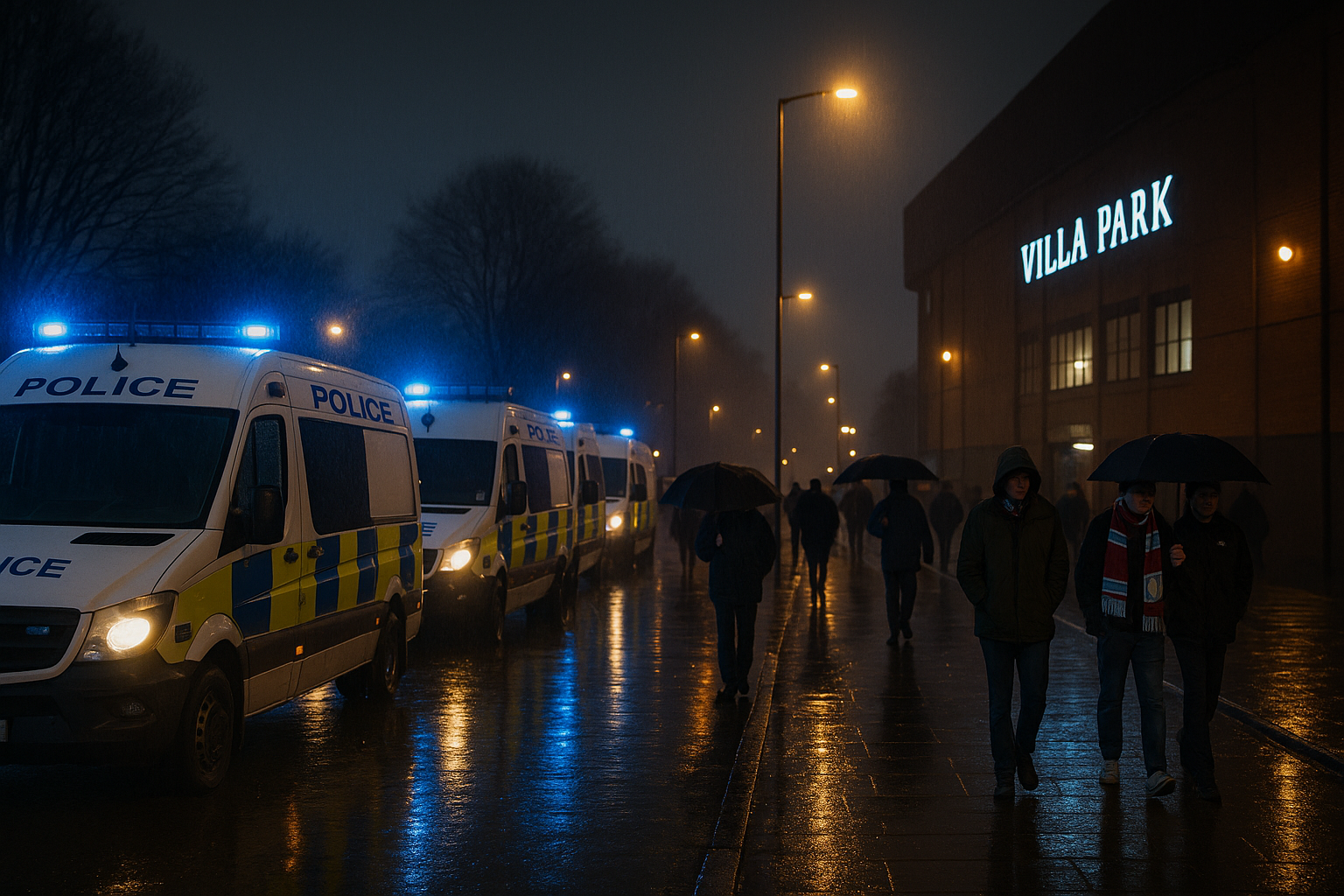
Police Fabrication and the New Double Standard: The Maccabi Ban, Sectarian Politics, and the Moral Collapse of British Institutions
The decision by West Midlands Police to ban all Maccabi Tel Aviv supporters from attending the Europa League fixture at Villa Park has now been shown to rest on claims that Dutch authorities say are false. The Times of London reported that the force relied on “fake claims” to justify the prohibition, including allegations that supporters had thrown “innocent members of the public” into a river in Amsterdam and had “targeted Muslim communities” en masse.¹ Dutch police state they have no record of such incidents and explicitly dispute the scale and characterisation of the British intelligence.²
This scandal reveals two profound crises in contemporary Britain: the emergence of anti-Jewish double standards, and the moral collapse of national institutions, where political pressure, fear of controversy, and ideological sensitivities override the pursuit of truth and the safeguarding of fundamental rights.
Anti-Jewish Double Standards in Contemporary Britain
British Jews faced the highest levels of recorded antisemitism in modern UK history following the Hamas atrocities of 7 October 2023.³ The Metropolitan Police reported a 1,353% surge in antisemitic offences.⁴ Yet rather than increasing protections for Jewish communities, public bodies increasingly treat Jewish visibility itself as a public-order risk.
The Maccabi ban is a stark example. West Midlands Police justified the exclusion by presenting Maccabi supporters as “highly organised” violent actors, citing an Amsterdam fixture as evidence.⁵ Dutch authorities flatly contradict this: there were no such attacks, no evidence of mass disorder, and no incidents resembling the British allegations.²
Meanwhile, clubs with well-documented hooligan histories continue to play under managed risk.⁶ Protest groups associated with repeated disorder in 2023–25 continue to receive public facilitation.⁷ There are no blanket bans, no pre-emptive exclusions, no fabricated intelligence.
The differential treatment is unmistakable.
Jewish-associated supporters were banned on the basis of claims that did not happen.
Sectarian Politics and the Rise of the Activist MP
The political environment surrounding this scandal is inseparable from the rise of sectarian and activist politics in Britain. The House of Commons now features an unprecedented number of MPs whose political identities are anchored in ethnic, religious, or foreign-policy blocs, especially related to Middle Eastern conflicts.⁸ Scholars and policy analysts have noted the emergence of “identity-anchored representation,” in which MPs act less as legislators of the whole realm and more as representatives of transnational or communal causes.⁹
Parallel to this is the rise of the activist MP—parliamentarians who behave as pressure-group operatives within Parliament, driving campaigns, petitions, and public agitation aimed at shaping institutional behaviour.¹⁰ This new breed of MP bypasses traditional norms of impartial governance and exerts direct pressure on public bodies, including policing.
Such dynamics create an environment in which policing decisions become vulnerable to ideologically charged narratives and externally amplified moral claims, especially when those claims align with sectarian sensitivities. Analysts have warned that Britain risks importing foreign conflicts into domestic political life, fragmenting national cohesion.¹¹
In this context, the Maccabi case becomes a symptom of a larger structural shift: policing decisions shaped not by evidence, but by the demands and expectations of sectarian or activist blocs.
Political Amplification, Prejudice Risk, and the Role of Ayoub Khan MP
Ayoub Khan, MP for Birmingham Perry Barr, illustrates this dynamic. He publicly supported the ban, described it as a “moral question,” and circulated narratives of supposed Maccabi “violence” at a derby in Amsterdam.¹² ¹³ These claims were later contradicted by Dutch police and prosecutors.²
The Jewish Chronicle reports that the campaign to bar Israeli supporters relied heavily on “fake news and chilling slurs,” describing it as driven by radical anti-Israel MPs and naming Khan among those involved.¹⁴ The same reporting notes past controversies surrounding Khan, including comments minimising the atrocities of 7 October and remarks directed at a freed Israeli hostage that reframed Gaza’s situation in politicised terms.¹⁵
While none of this proves personal malice, it does establish:
- active political amplification of unverified claims
- support for a policing narrative later shown to be false
- involvement in a campaign that disproportionately harmed a Jewish-associated group
- a context in which prejudice could influence institutional outcomes
When an MP repeats allegations that foreign police authorities say are untrue—and when these allegations directly shape operational policing—the risk of discriminatory effect becomes clear.
Political amplification did not create the false intelligence, but it magnified its power.
Institutional Moral Collapse and the Erosion of Truth
The scandal cannot be viewed in isolation. It reflects a deeper moral failing across public institutions, which increasingly operate without commitment to truth, impartiality, or duty.
In Smith v Chief Constable of Northumbria Police (2024), the High Court condemned a police force for presenting politically influenced assumptions as objective fact, breaching its statutory duty of neutrality.¹⁶ The Casey Review similarly documented widespread integrity failures within the Metropolitan Police, including “institutional defensiveness” and resistance to confronting the truth.¹⁷ HMICFRS has repeatedly warned that police integrity in intelligence handling is under “systemic strain.”¹⁸
The Maccabi case displays these pathologies with painful clarity:
- False intelligence was adopted uncritically.
- Verification mechanisms failed.
- Political pressure intersected with operational decisions.
- Jewish supporters were penalised without evidence.
- Institutional self-protection trumped justice.
A police force willing to rebuild reality around the political pressures of the moment is a force unanchored from moral duty. A society in which public institutions cannot tell the truth is a society drifting into incoherence.
Consequences for Trust and National Cohesion
Three consequences follow.
First, public trust collapses. Jewish communities—already the most targeted religious minority in UK hate-crime statistics—see their rights restricted on demonstrably false grounds.¹⁹
Second, equality before the law dissolves. If fabricated intelligence can be used to restrict the freedoms of one group, then rights become contingent upon political convenience.
Third, truth itself erodes. When “risk” becomes a euphemism for “political optics,” institutions cease to function in the public interest.
The Maccabi ban is not a minor policing error. It is a warning that Britain’s institutional culture is losing its capacity for truth, justice, and impartiality.
- The Times, “Police ‘used fake claims’ to ban Maccabi fans from Aston Villa game,” 22 November 2025.
- Dutch police responses cited in The Times, ibid.; Amsterdam Police Communications Office.
- Community Security Trust (CST), Antisemitic Incidents Report 2024.
- Metropolitan Police Service, Hate Crime Dashboard, Oct–Dec 2023.
- West Midlands Police statements as reported in The Guardian, 21 October 2025.
- The Times, op. cit.; Dutch Public Prosecution Service.
- Home Office, Football-Related Arrests and Banning Orders 2023–24.
- House of Commons Library, Ethnicity of Members of Parliament, 2024.
- David Goodhart, Head, Hand, Heart (2020); Policy Exchange, The New Sectarianism (2023).
- Institute for Government, The Rise of Campaigning MPs, 2024.
- Robin Simcox, Commissioner for Countering Extremism, Rethinking Extremism (2024); Shawcross Review of Prevent (2023).
- Khan’s characterisation of the ban as a “moral question”: Wikipedia biography citing parliamentary comments.
- The National, “Tel Aviv derby violence shows UK ban is correct, says UK MP,” 20 October 2025.
- The Jewish Chronicle, “Truth about the toxic, fake-news-driven campaign to ban Israeli fans,” 2025.
- The Jewish Chronicle, ibid., reporting remarks to Israeli hostage and commentary on 7 October.
- Smith v Chief Constable of Northumbria Police [2024] EWHC 1775 (Admin).
- Baroness Casey, The Casey Review (2023).
- HMICFRS, State of Policing 2024.
- Home Office, Hate Crime, England and Wales 2023–24, Table 2.1.
RELATED ARTICLES


Latest ARTICLES
- Today’s Mass: October 24 St Raphael the ArchangelThe Feast of Saint Raphael the Archangel highlights his healing powers as depicted in the Book of Tobit, where he aids Tobit and his son, Tobiah. Venerated as a protector of travellers and the blind, Raphael is celebrated for his miraculous interventions. His legacy includes support for nurses, matchmakers, and Catholic studies.
- 25.10.26 Nuntiatoria CXXIX: CHRISTUS REXThe text discusses the relationship between Christ’s kingship and authority within the Church amidst contemporary challenges. It contrasts ecclesiastical power with genuine faith, emphasising that authority must protect divine truth rather than alter it. The witness of imprisoned priests illustrates the enduring significance of fidelity to Christ over institutional conformity.
- THE DOMESTIC CHURCH: 25 October – 2 November 2026 A Home with Room for Heaven: Preparing for All Saints and All SoulsThe content outlines a week’s plan for traditional Catholic families to prepare for the feasts of All Saints and All Souls. Emphasising daily prayers, remembrance of the deceased, and engagement with children’s activities, it aims to integrate Catholic customs into family life, enriching spiritual practices and fostering a shared faith experience.
- ORDO w/c 25.10.26The text outlines the liturgical calendar for the last week of October and the beginning of November, highlighting key celebrations. Notable events include the Feast of Christ the King, St Evaristus, the Vigil of Saints Simon and Jude, and the Feast of All Saints, emphasising themes of holiness, unity in faith, and the Church’s teachings.
- Christ the King: The Sovereignty of the Crucified RedeemerThe Mass of Christ the King articulates core Catholic beliefs about Jesus’ divine authority, redemptive sacrifice, and the essence of His Kingdom. It emphasises Christ as Prophet, Priest, and King, whose sovereignty is inseparable from His mission of reconciliation, calling the faithful to acknowledge His authority and embrace moral duties rooted in divine truth.




Leave a Reply