
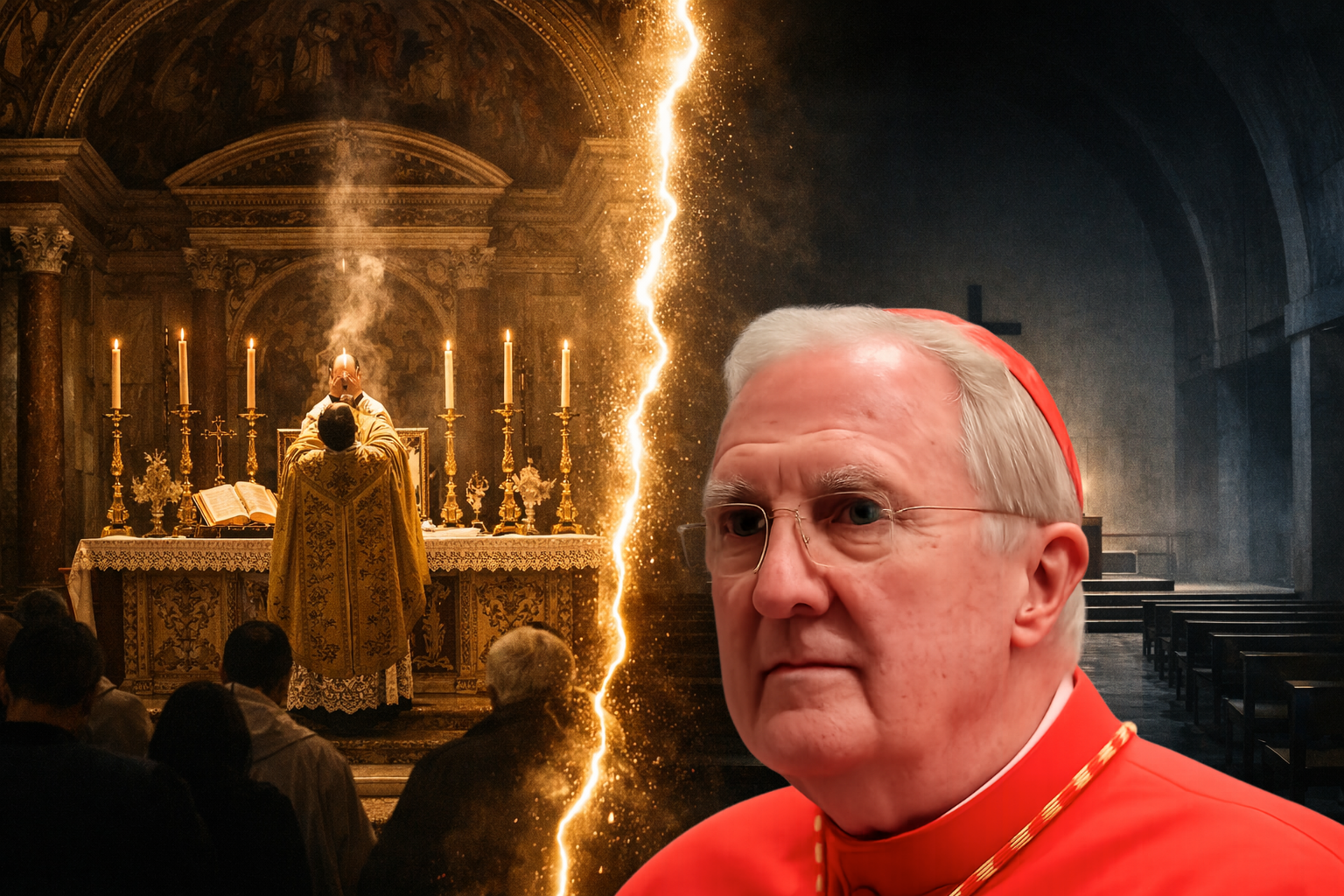
In a recent interview (27 March 2026), Arthur Roche publicly defended the Vatican’s restrictions on the traditional Latin Mass, arguing that such measures are necessary to safeguard the unity of the Church.¹ His remarks must be read in light of the 2021 motu proprio Traditionis Custodes, which significantly curtailed the permissions previously granted for the celebration of the preconciliar Roman rite—commonly known as the Traditional Latin Mass or the 1962 Missal.² What is at stake in this debate is not merely a question of liturgical discipline, but a deeper question concerning the nature of tradition, authority, and continuity within the Catholic Church.³
To understand the present controversy, one must situate it within its proper historical and theological context. Following the Second Vatican Council (1962–1965), the revised Roman Missal of 1969—commonly known as the Novus Ordo Missae—was promulgated by Pope Paul VI as part of the liturgical reform envisioned in Sacrosanctum Concilium.⁴ While intended as a renewal, the reform represented what even sympathetic commentators have described as a “radical reconstruction” of the Roman rite.⁵ For many of the faithful, attachment to the older form of the Mass, codified under Pope John XXIII in 1962, was rooted not in nostalgia but in continuity—particularly regarding the sacrificial character of the Mass and the priest’s mediatory role.⁶
Recognising these tensions, Pope John Paul II issued Quattuor Abhinc Annos and later Ecclesia Dei, explicitly affirming the faithful’s “rightful aspirations” and calling for generous application of permissions.⁷ These were not merely pragmatic concessions but ecclesial acts aimed at preserving communion after the rupture occasioned by Archbishop Lefebvre’s episcopal consecrations.⁸
This trajectory reached its theological and juridical culmination under Pope Benedict XVI. In Summorum Pontificum, he declared that the 1962 Missal “was never juridically abrogated.”⁹ In his accompanying letter, he articulated a principle of continuity:
“What earlier generations held as sacred, remains sacred and great for us too.”¹⁰
This was not a concessionary framework, but a doctrinally grounded recognition that the Church cannot repudiate her own liturgical inheritance without calling into question her continuity.¹¹
It is precisely this principle that is destabilised by Traditionis Custodes. The document reasserts episcopal control, restricts celebrations, and conditions the use of the traditional liturgy upon acceptance of the post-conciliar reforms.¹² Cardinal Roche’s defence rests upon the assertion that the older rite had become a vehicle for resistance to the Council and thus a threat to unity.¹³
Yet this argument depends upon a prior redefinition: that the traditional Roman rite is a concession rather than an inheritance. This distinction is decisive. A concession is contingent and revocable; an inheritance is received and transmitted.¹⁴ To reclassify what was for centuries the normative liturgy of the Latin Church as a concession is to relocate it from the domain of tradition into that of administrative control.¹⁵
Here the deeper theological question must be confronted. Does authority in the Church serve tradition, or does it stand over it? The Catholic tradition has consistently affirmed the former. As Pope Benedict XVI stated, “the Church’s authority is bound to the tradition of faith.”¹⁶ Likewise, the Second Vatican Council itself teaches that the Magisterium “is not above the Word of God, but serves it.”¹⁷ Authority is therefore custodial, not creative.¹⁸
Cardinal Roche’s appeal to unity must be evaluated within this framework. Unity, in Catholic theology, is not reducible to uniformity. Historically, the Church has maintained multiple rites—Ambrosian, Mozarabic, Dominican—without fracture.¹⁹ As liturgical historian Josef Andreas Jungmann notes, “unity in the Roman Church has never required absolute uniformity of rite.”²⁰
The current argument therefore produces a striking inversion. A liturgical form that for centuries embodied Catholic unity is now presented as divisive, while a reformed liturgy marked by significant variation is presumed to guarantee unity.²¹ Unity defined as uniformity is not Catholic unity, but administrative consolidation.²²
**What, then, underlies the urgency with which the traditional liturgy is now restricted? One possible answer—rarely stated explicitly but increasingly difficult to ignore—is that the post-conciliar settlement itself has not produced the unity, vitality, or renewal that had been anticipated. Across much of the Western world, the decades following the Council have witnessed measurable declines in Mass attendance, priestly vocations, sacramental practice, and doctrinal literacy.²³ While correlation does not in itself establish causation, the scale and consistency of these trends have prompted serious reflection among theologians and pastors alike.²⁴ In this light, the persistence—and indeed growth—of communities attached to the traditional Roman rite presents not merely a pastoral anomaly, but a theological challenge: it raises the uncomfortable possibility that what was set aside in the name of renewal may in fact have preserved elements essential to Catholic life.²⁵
It is precisely here that the question of unity becomes acute. If the post-conciliar liturgical reform had achieved its intended ends in a clear and compelling manner, the attraction of the older form would likely have diminished organically. That it has not done so—and that, in many places, the traditional liturgy has drawn younger and growing congregations—suggests that the issue cannot be reduced to nostalgia or resistance.²⁶ Rather, it points to a deeper tension within the Church’s recent history: a tension between reform as implemented and tradition as received. To restrict the latter without fully reckoning with the former risks addressing the symptom while leaving the underlying question unresolved.**
This tension has been explicitly identified by critics. Athanasius Schneider has warned that suppressing the traditional liturgy constitutes “a break with the organic development of the liturgy,” arguing that “no authority has the right to forbid the immemorial Mass.”²⁷ Likewise, Raymond Leo Burke has observed that treating the older rite as both legitimate and yet pastorally dangerous creates “a grave inconsistency,” undermining confidence in the Church’s liturgical authority.²⁸ These are not marginal opinions, but reasoned theological objections grounded in the Church’s own understanding of tradition.
A further inconsistency emerges in the treatment of liturgical abuse. Cardinal Roche acknowledges that abuses have existed in every age and attributes them to poor formation. Yet the application of this principle is asymmetrical. Abuses within the post-conciliar liturgy are treated as deviations requiring correction; abuses associated with the traditional liturgy are invoked as justification for restricting the rite itself.²⁹ If abuse does not invalidate the ordinary form, on what coherent basis does it justify curtailing the traditional?³⁰ The absence of a consistent principle here is not incidental—it reveals that the issue is not abuse per se, but the perceived theological posture of those who adhere to the older form.
The Cardinal’s explanation for the appeal of the traditional liturgy—its silence, its refuge from modern noise—further illustrates the limits of this analysis. The attraction of the traditional Roman rite cannot be reduced to aesthetic or psychological factors. As Joseph Ratzinger observed, the liturgy is “not a show… but an entering into the liturgy of heaven.”³¹ Peter Kwasniewski similarly argues that the traditional rite “embodies transcendence in its very structure.”³²
Perhaps most troubling is the emergence of a rhetorical posture of suspicion. The suggestion that “something else is afoot” among those attached to the traditional liturgy introduces an implicit questioning of motives without engaging the substance of their arguments.³³ Yet suspicion is not a theological method. It neither clarifies nor persuades; it obscures.³⁴
Here the central contradiction must be stated without qualification. If, as Summorum Pontificum affirms, the traditional Roman rite was never abrogated,³⁵ then on what basis is it now treated as contingent upon ongoing permission? If it remains a legitimate expression of the Church’s lex orandi, why is its vitality regarded as a problem to be managed rather than a patrimony to be preserved?³⁶
What emerges, therefore, is not simply a disciplinary policy, but a set of underlying assumptions: that tradition may be reclassified as concession, that unity requires uniformity, that continuity is negotiable, and that authority may delimit what it has previously recognised.³⁷ These assumptions, once articulated, demand scrutiny—not because they concern the Latin Mass alone, but because they touch the very identity of the Church as custodian of what she has received.³⁸
The controversy surrounding Traditionis Custodes is thus not ultimately about liturgical preference. It is about whether the Church understands herself as bound to her tradition or empowered to redefine it.³⁹ In seeking to enforce unity through restriction, Cardinal Roche risks obscuring the deeper foundation of that unity: the faithful transmission of what has been received.⁴⁰ Without that foundation, unity ceases to be an inheritance and becomes instead an imposition—and in that transformation, something essential is lost.⁴¹
- OSV News, interview with Cardinal Arthur Roche, 27 March 2026.
- Traditionis Custodes.
- Joseph Ratzinger, The Spirit of the Liturgy (Ignatius Press, 2000), 165–170.
- Sacrosanctum Concilium, §§21–23.
- Annibale Bugnini, The Reform of the Liturgy (1990), 26–30.
- Ratzinger, Spirit of the Liturgy, 172–175.
- Ecclesia Dei, §5.
- Ibid.
- Summorum Pontificum, art. 1.
- Ibid., Letter to Bishops.
- Benedict XVI, Curia Address, 2005.
- Traditionis Custodes, arts. 1–3.
- OSV News, 2026.
- Yves Congar, Tradition and Traditions, 287–290.
- Ibid.
- Benedict XVI, Curia Address, 2005.
- Dei Verbum, §10.
- Congar, 312.
- Jungmann, Mass of the Roman Rite, 18–25.
- Ibid.
- Kwasniewski, Noble Beauty, 45–52.
- Ecclesiological synthesis (Congar).
- CARA; Pew Research Center reports.
- Ratzinger, Ratzinger Report, 29–45.
- Kwasniewski, Resurgent, 15–30.
- Bullivant, Mass Exodus, 1–20.
- Schneider, The Catholic Mass, 210–212.
- Burke, Statement (2021).
- Redemptionis Sacramentum, §§4–6.
- Analytical conclusion.
- Ratzinger, Spirit of the Liturgy, 22.
- Kwasniewski, Noble Beauty, 48.
- OSV News, 2026.
- Aquinas, Summa Theologiae, I, q.1.
- Summorum Pontificum.
- Logical implication.
- Synthesised analysis.
- Dei Verbum.
- Ecclesiological implication.
- Benedict XVI, Curia Address.
- Final synthesis.
Related Articles


Latest Articles
- Today’s Mass: September 19 St. Januarius, Bishop and Companion MartyrsSt. Januarius and companion martyrs were martyred during the persecution under Diocletian. St. Januarius, patron of the city of Naples and bishop of Beneventum, was beheaded with his deacons and some others.
- Sermon for St. Januarius and his CompanionsToday we celebrate the feast of St. Januarius and his companions. About St. Januarius little is known except that he was among the many martyrs during the great persecution under the Emperor Diocletian.
- 20.09.26 Nuntiatoria CXXIV: QUOD ACCEPIMUS, CUSTODIMUS ET TRADIMUSThe editorial emphasises the importance of understanding our inheritance as custodians rather than owners. It highlights the obligation to preserve and transmit the Christian Faith, sacraments, and traditions to future generations. Through gratitude and fidelity, those who receive must ensure that what has been entrusted does not end with them.
- ONE LORD, ONE FAITH, ONE BAPTISM: The Seventeenth Sunday after PentecostThe Seventeenth Sunday after Pentecost emphasises the love of God and neighbour, rooted in divine justice. The Mass articulates the necessity of one faith and baptism, ensuring charity is not sentimental but deeply theological. The Gospel challenges believers to recognise Christ’s dual nature as both David’s son and Lord, reinforcing true Christian charity.
- AN AWARD IS NOT A MEETINGLambeth Palace has withdrawn the Hubert Walter Award given to Hafiz Tahir Ashrafi for reconciliation, citing previously unknown controversial comments. This raised questions about the vetting process prior to the award. While Ashrafi has defended his record of protecting minority rights, the Palace must clarify why such issues were overlooked initially.



Leave a Reply