
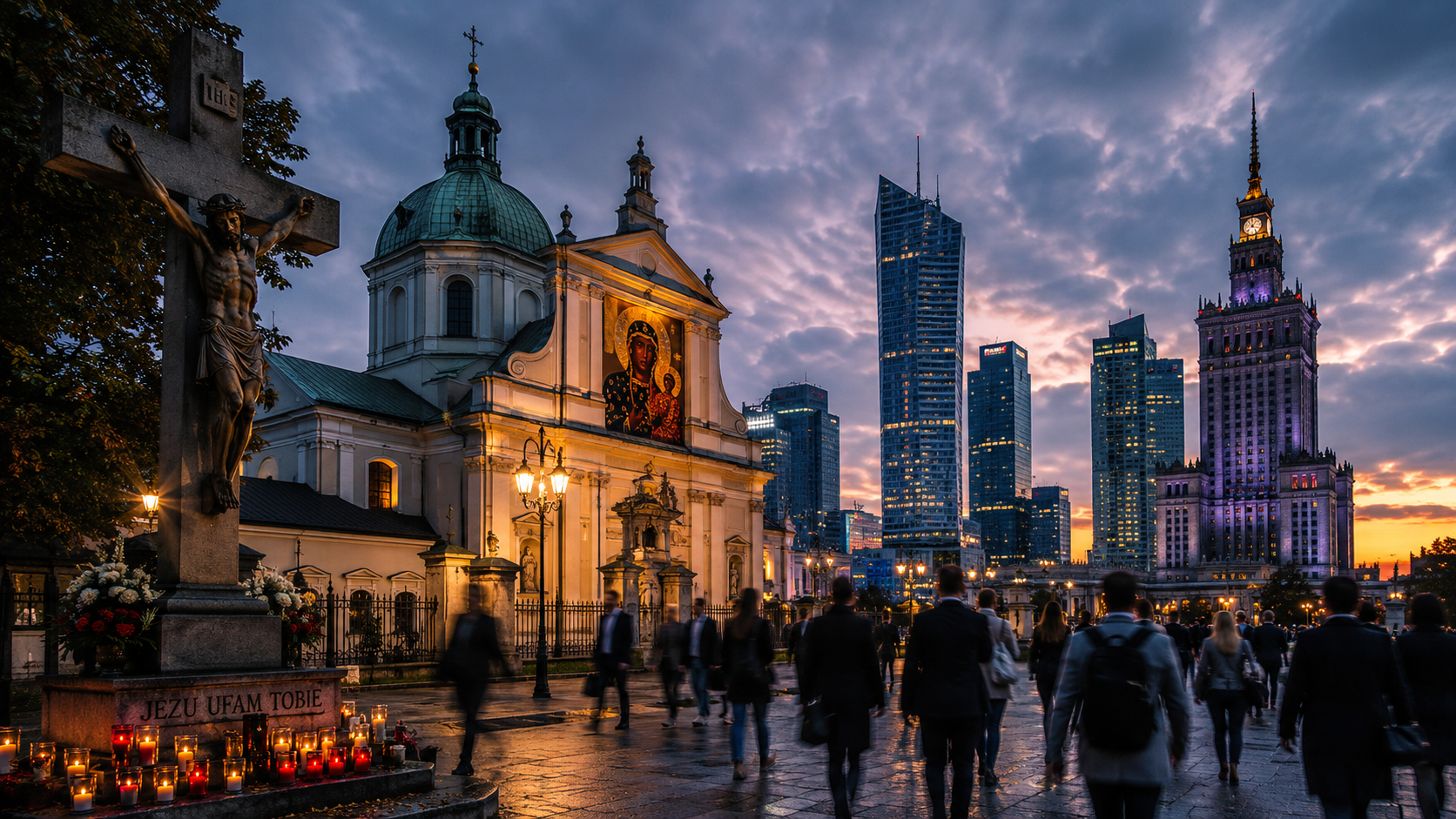
Poland’s Catholic Crossroads: A Nation Still Baptised, but No Longer Secure
Poland remains one of Europe’s most visibly Catholic nations, yet its bishops now face an increasingly profound conflict between inherited Catholic identity and rapid secularisation among younger urban populations. The crisis is no longer merely political or cultural. It concerns the transmission of the Faith itself.

Poland has long occupied a singular place in the imagination of Catholic Europe. It was the land of Jasna Góra and the Black Madonna of Częstochowa; the nation whose clergy endured occupation, persecution, imprisonment, and Communist repression; the homeland of Cardinal Stefan Wyszyński and Pope John Paul II; the country where Catholicism was not merely a private conviction but a civilisational identity. In Poland, the parish church was historically more than a place of worship. It was a guardian of memory, language, resistance, family life, and national continuity.
For decades, many Catholics elsewhere in Europe looked to Poland as proof that modern secularisation was neither inevitable nor irreversible. While churches emptied across Western Europe, Polish sanctuaries remained crowded. While vocations collapsed in neighbouring countries, Poland continued producing priests and religious in significant numbers. While Catholic moral teaching was increasingly marginalised in public life elsewhere, Poland still retained visible traces of Christian order within its schools, institutions, and national consciousness.
Yet the situation confronting Poland’s bishops today is increasingly grave precisely because the outward structures of Catholic identity still survive while the inward foundations weaken. Poland has not suddenly forgotten Catholicism. Rather, Catholicism increasingly risks becoming memory instead of conviction, inheritance instead of conversion, symbolism instead of life.
Pew Research Center’s 2026 analysis illustrates the paradox clearly. Fully 96 per cent of Polish adults reported having been raised Catholic, while 92 per cent still identified as Catholic in adulthood.¹ By European standards these figures remain extraordinary. Poland retains one of the highest levels of Catholic self-identification in the Western world. Yet affiliation alone cannot sustain a civilisation. A nation may continue calling itself Catholic while gradually losing the habits, beliefs, disciplines, and sacramental life that make Catholicism something more than ancestry.
The statistics published by the Institute for Catholic Church Statistics (Instytut Statystyki Kościoła Katolickiego, ISKK) reveal both continuity and erosion. Poland still possessed 10,352 Catholic parishes in 2024, served by 23,274 incardinated priests.² Such numbers remain immense compared with much of Europe. Yet the trend beneath them is unmistakable. The number of priests has continued to decline, diocesan seminaries continue to shrink, and sacramental participation has weakened significantly over recent decades.
Most revealing are the Mass attendance figures. The ISKK reported that the dominicantes index — the proportion of Catholics attending Sunday Mass — stood at 29.57 per cent in 2024.³ The communicantes index — those receiving Holy Communion — stood at 14.64 per cent. These numbers represented a modest increase over the immediate post-pandemic years, but the longer trajectory remains deeply concerning. In 2019 Sunday Mass attendance stood at 36.9 per cent. In 1990 it exceeded 50 per cent. During the Communist era in the early 1980s, it approached 57 per cent.⁴
The historical irony is difficult to ignore. State persecution failed to extinguish Catholic Poland. Material prosperity, cultural liberalisation, digital modernity, and internal ecclesiastical disillusionment may yet accomplish what Communist coercion could not.
The sacramental figures tell a similar story. The number of sacramental marriages has declined dramatically over the past decade, falling to 68,285 in 2024.⁵ First Holy Communion numbers remain substantial, yet even here the deeper question concerns perseverance rather than ceremony. The issue is no longer whether children continue appearing for sacramental milestones. The question is whether those sacraments are embedded within a living Catholic order capable of sustaining belief into adulthood.
This distinction lies at the heart of the present crisis. Cultural Catholicism can preserve memory for a generation or two. It can preserve feast days, processions, pilgrimages, architecture, family customs, and patriotic symbolism. But memory alone cannot transmit supernatural faith. A child may inherit Catholic identity while never being truly catechised into Catholic reality.
Cardinal Stefan Wyszyński once warned that “a nation which kills its own children is a nation without a future.”⁶ The remark is often quoted in debates concerning abortion, but its deeper significance extends further. A civilisation cannot survive when it ceases transmitting the truths necessary for its own continuity. Biological survival alone is insufficient. A nation must also hand on moral and spiritual inheritance.
The Polish bishops themselves increasingly recognise this danger. In September 2025, during Education Week observances, the Polish Bishops’ Conference declared that “religious education in school is an important element of integral education.”⁷ The statement came amid growing controversy over the Polish government’s decision to reduce religion lessons in state schools from two hours weekly to one.
The changes, signed by Education Minister Barbara Nowacka, also stipulated that religion or ethics classes should ordinarily be scheduled at the beginning or end of the school day where participation was not universal.⁸ The government presented the reforms as administrative modernisation. The bishops viewed them differently: as a symbolic and practical downgrading of religion within public life.
Their concern was not misplaced. Timetables reveal priorities. What a civilisation places at the centre of education, it implicitly declares essential. What it moves to the margins becomes optional, private, peripheral. Once religion becomes merely another extracurricular preference, rather than part of the intellectual and moral formation of the person, secularisation accelerates not only socially but psychologically.
Yet the bishops also face a more uncomfortable truth. Institutional religious instruction cannot compensate for the collapse of Catholic culture within the home. The Catechism of the Catholic Church teaches that parents possess the “first responsibility for the education of their children.”⁹ The Second Vatican Council’s Gravissimum Educationis likewise affirmed that parents are the “primary and principal educators” of their children.¹⁰ If fathers no longer lead their families to Mass, if prayer disappears from domestic life, if Catholic morality is treated as negotiable, and if children are formed principally by digital media rather than Christian discipline, then religion lessons alone cannot preserve the Faith.
The crisis is therefore not fundamentally pedagogical but anthropological and spiritual. Increasing numbers of younger urban Poles inhabit a moral world radically different from that of their grandparents. The older Catholic Poland was shaped by parish life, pilgrimage, family devotion, sacrifice, historical suffering, and a transcendent understanding of human destiny. The emerging secular Poland is shaped increasingly by expressive individualism, therapeutic morality, digital culture, consumer aspiration, and Western liberal assumptions concerning sexuality, identity, autonomy, and religion.
This transformation is especially visible in Poland’s major cities and university centres. Warsaw, Kraków, Poznań, Gdańsk, and Wrocław increasingly resemble the broader secularising capitals of Western Europe. The divide is therefore not merely political but civilisational. Two Polands increasingly coexist uneasily within the same nation: one formed by Catholic memory, the other by post-Christian modernity.
Pope John Paul II warned repeatedly that freedom detached from truth ultimately becomes destructive rather than liberating. In Veritatis Splendor, he cautioned against moral systems which reduce conscience to subjective preference and sever freedom from objective moral order.¹¹ That warning now hangs heavily over much of Europe, including the Poland he once helped spiritually sustain.
The bishops’ difficulties are intensified further by declining institutional trust. According to a 2025 IBRiS poll, trust in the Catholic Church fell from 58 per cent in 2016 to 35.1 per cent in 2025, while distrust rose to 47.1 per cent.¹² Clerical abuse scandals, perceived political entanglements, failures of governance, and financial controversies have all contributed to the erosion of confidence.
Even where legal culpability remains contested, the symbolic damage has been severe. Reuters reported in February 2026 that Bishop Andrzej Jeż of Tarnów stood trial accused of delays in reporting clerical sexual abuse allegations involving priests in his diocese. Bishop Jeż denied wrongdoing and pleaded not guilty, while apologising to victims and all those wounded by abuse scandals.¹³ Regardless of the judicial outcome, the spectacle itself reflects the broader collapse of institutional confidence confronting the hierarchy.
Bishop Artur Ważny of Sosnowiec acknowledged this moral crisis directly, warning against shepherds who “feed themselves rather than the flock,” echoing the condemnation found in Ezekiel 34.¹⁴ Such statements matter because the Church’s authority cannot rest indefinitely upon historical prestige alone. The memory of heroic clergy under Nazism and Communism cannot substitute for present credibility, discipline, sanctity, and trustworthiness.
Poland’s bishops therefore confront a challenge far deeper than electoral politics or educational policy. They are facing the fragmentation of the very moral imagination that sustained Catholic Poland for centuries. Younger generations are not merely rejecting certain teachings. Many are being formed within an entirely different conception of the human person.
The contemporary secular order does not simply deny Catholic doctrine. It offers an alternative anthropology. It teaches that identity is self-created, that freedom consists primarily in expressive autonomy, that morality derives from consent and personal fulfilment, and that religion belongs principally within the sphere of private sentiment. Against such assumptions, weak or purely cultural Catholicism cannot survive.
A Catholicism reduced to heritage tourism, patriotic symbolism, or occasional ritual observance will eventually collapse under the pressure of a totalising secular culture. Sentiment cannot withstand ideology. Nostalgia cannot withstand formation. A Church that merely preserves external identity while neglecting doctrinal clarity, sacramental discipline, reverent liturgy, catechesis, and moral seriousness will steadily lose its young.
This is why the Polish crisis matters far beyond Poland itself. The country represents a test case for the future of Christianity in Europe. If Catholicism can weaken so visibly in one of Europe’s most historically devout nations, then no Christian civilisation can safely presume upon memory alone.
Yet Poland also retains resources that much of Western Europe has already lost. It still possesses a living Catholic memory at scale. Pilgrimages still draw crowds. Parish life still exists in many regions. The sacramental structure of society has not entirely collapsed. The language of Catholicism remains publicly intelligible in ways that it no longer is in much of the West.
Whether these remaining strengths become the basis of renewal or merely the relics of a fading civilisation will depend largely upon whether Poland’s bishops recover confidence in the supernatural character of the Faith itself.
The Church in Poland cannot ultimately preserve itself through bureaucracy, public relations campaigns, or appeals to nostalgia. It will endure only if it once again forms Catholics who believe that Christianity is objectively true; that the sacraments are necessary; that the Mass is not symbolic theatre but sacrifice; that marriage is indissoluble; that parents bear grave responsibility for the souls of their children; and that salvation concerns eternity rather than cultural identity.
Poland is still baptised. The question now confronting its bishops is whether Poland will remain converted.
¹ Pew Research Center, “Catholicism Has Lost People to Religious Switching in Many Countries, While Protestantism Has Gained in Some,” 23 April 2026.
² Instytut Statystyki Kościoła Katolickiego SAC, Annuarium Statisticum Ecclesiae in Polonia 2024 (Warsaw: ISKK SAC, 2026), 6, 10, 13.
³ Ibid., 35.
⁴ Ibid.
⁵ Ibid., 25–27.
⁶ Cardinal Stefan Wyszyński, statement frequently cited in Polish pro-life and pastoral literature: “Naród, który zabija własne dzieci, jest narodem bez przyszłości” (“A nation which kills its own children is a nation without a future”).
⁷ Polish Bishops’ Conference, “Religious Education in School Is an Important Element of Integral Education,” statement issued during Education Week, 6 September 2025.
⁸ Polish Ministry of National Education regulations implementing revised religion and ethics timetable provisions for state schools effective September 2025; see also Notes from Poland, “Poland Halves Number of Weekly Religion Classes in Schools,” 20 January 2025.
⁹ Catechism of the Catholic Church, §2223.
¹⁰ Gravissimum Educationis, §3.
¹¹ Veritatis Splendor, §§32–35.
¹² OSV News, “Poll: Half of Poles Declare Distrust of Catholic Church as It Loses Its Moral Authority,” 19 September 2025; IBRiS polling data cited therein.
¹³ Reuters, “Polish Bishop on Trial Over Child Sex Abuse Reporting Delays,” 18 February 2026.
¹⁴ OSV News, “Poll: Half of Poles Declare Distrust of Catholic Church as It Loses Its Moral Authority,” citing remarks by Bishop Artur Ważny of Sosnowiec referencing Ezekiel 34.
Related Articles


Latest Articles
- Blue Labour discovers the Common GoodJonathan Hinder criticises “hyper-liberalism” for prioritising individual autonomy over community values. His emphasis on family and societal duties echoes Christian teachings often overlooked in modern politics. Although Hinder promotes aspects of Blue Labour as solutions to social issues, he underscores the necessity of returning to deeper truths about human nature and moral authority for genuine societal cohesion.
- INCLUSION BY COMPULSION: Caius College, STOP HATE UK and the boundary between law and ideologyCaius College’s decision to mandate ninety minutes of inclusivity training by Stop Hate UK for undergraduates raises concerns about academic freedom and the potential imposition of ideological conformity. Questions about the accuracy of legal definitions and the distinction between lawful disagreement and unlawful conduct further complicate the issue, warranting careful scrutiny.
- THE ADHĀN IN THE CHURCH: Dialogue or the erasure of sacred boundaries?In September, the Islamic call to prayer was recited inside a German church, highlighting evolving Christian views on sacred spaces. This incident raises concerns over whether hosting Islamic practices within churches constitutes misplaced hospitality and blurs the boundaries between religions, challenging the integrity of Christian worship environments.
- Rome Built a Door Out of Écône ~ Priests Are Walking the Other WaySince July’s consecrations, a route has been established for priests to leave the Society of St Pius X (SSPX), but few have done so, while more priests continue to join. The ongoing appeal of the SSPX reflects deep convictions about liturgy and doctrine, contrasting with a declining diocesan environment, which prompts a significant movement towards traditional practices.
- The Pope came to speak of France’s soul ~ the streets have answeredDuring his visit to France, Pope Leo XIV focused on proclaiming Christ, emphasising the need for life, doctrinal integrity, and priestly vocations. He faced tensions in reconciling revolutionary ideals with Christian teachings. While affirming the Eucharist, his interpretations shifted towards community experiences, sparking debates about theological priorities and liturgical significance.


Leave a Reply