
Europe’s Christmas Under Siege: Anti-Christian Violence, Public Incidents, and the Normalisation of Fear
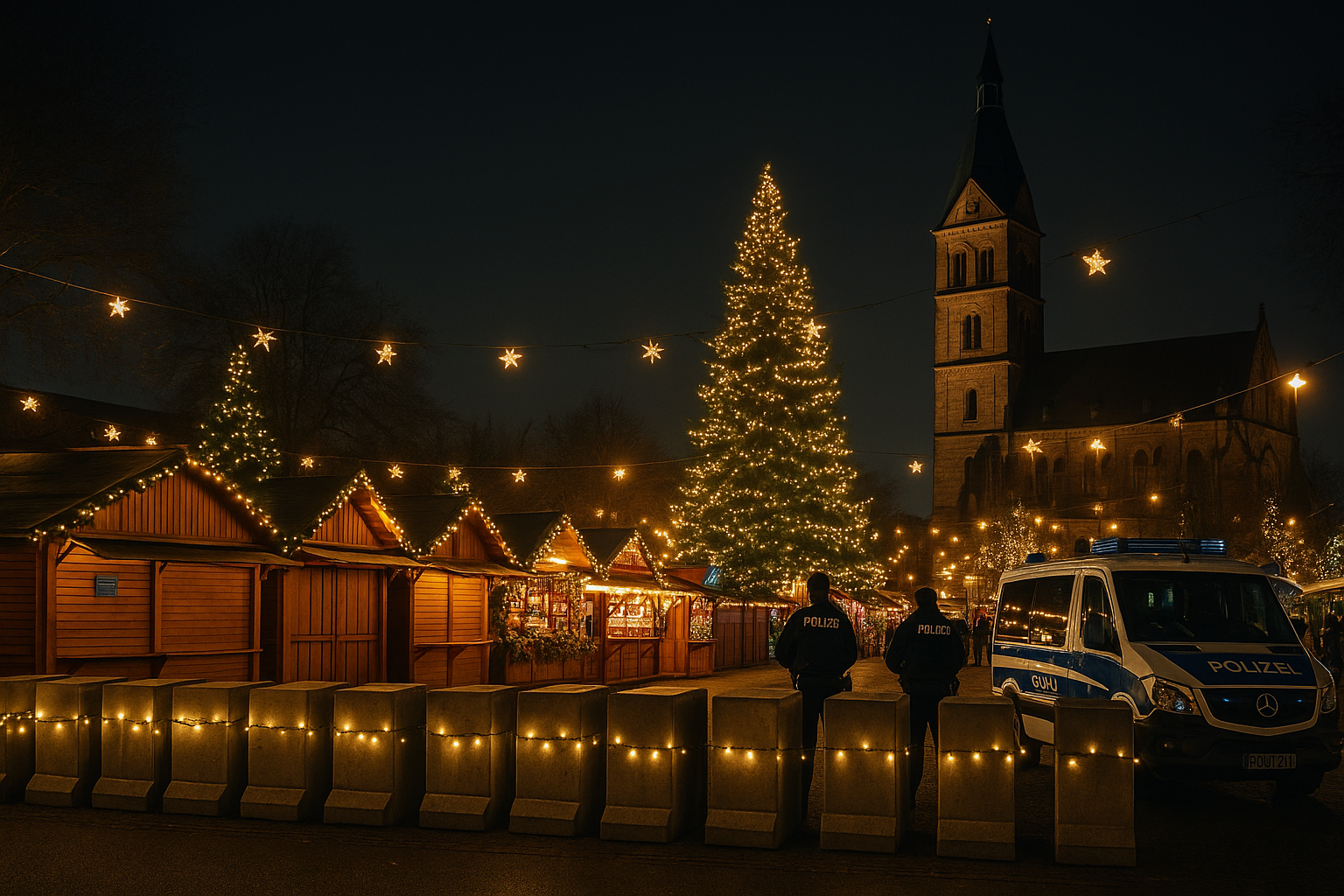
Across Europe, Christmas is no longer merely celebrated; it is managed, secured, and increasingly contained. The season that once marked the public confidence of Christian civilisation now unfolds behind concrete barriers, armed patrols, cancelled events, and routine warnings to remain vigilant. Churches are vandalised, nativity scenes destroyed, Christmas markets attacked or abandoned, and sacred images profaned. These are not isolated or anecdotal occurrences. They form a pattern—one that European authorities are increasingly unwilling to analyse honestly, and one that has reshaped how Christmas itself is permitted to exist in public.
What is unfolding is not simply a matter of crime statistics, but a civilisational shift: the steady relegation of Christianity from confident public presence to managed cultural liability.
A measurable and worsening trend
Independent monitoring confirms that anti-Christian hostility across Europe is rising. The Observatory on Intolerance and Discrimination Against Christians in Europe (OIDAC Europe) continues to document hundreds of incidents annually, including vandalism, threats, physical assaults, and arson attacks on churches.¹ In recent reporting cycles, arson attacks against Christian sites nearly doubled, with Germany and France featuring prominently.²
OSCE-ODIHR data, while hampered by inconsistent national reporting, corroborates the trend: Christianity remains among the most frequently targeted religions for hate-motivated offences in Europe.³ The precise totals vary by methodology, but the trajectory is clear.
Christmas as a recurring target
The Christmas season has emerged as a focal point for anti-Christian hostility precisely because it places Christian symbols in public view. Markets, nativity scenes, and church celebrations are visible, communal, and recognisably Christian—and therefore uniquely vulnerable.
During Advent and Christmas 2025, a series of reported incidents underscored this reality:
In Erbach im Odenwald, Germany, a Christmas market and nearby Protestant church were attacked in early December. A live nativity scene was destroyed, the donkeys used in the crèche were beaten, and the church itself was vandalised and defiled with human excrement. Police confirmed deliberate criminal damage and animal abuse.⁴
In Amiens, France, a nativity display associated with the Christmas market was vandalised, part of a broader pattern of anti-Christian attacks reported during the festive season.⁵
In Fonsorbes, France, an arson attack was carried out inside Saint-Jean-Baptiste Church during Advent. Straw taken from a nativity scene was reportedly used to fuel the fire, combining property destruction with deliberate symbolic desecration.⁶
In Villar de Olalla, Spain, nativity figures were vandalised in December, one of several Christmas-season incidents targeting Christian symbols.⁶
In Geesthacht, northern Germany, a parish Christmas market was cancelled following a threatening letter that prompted police intervention and security assessments.⁶
In Durham, England, a Christmas market event was disrupted following an incident that led to police involvement and heightened concern for public safety. While details were carefully limited in official communication, the episode contributed to a growing sense that even England’s historic cathedral cities are no longer immune from Christmas-season threats.⁷
Each incident differs in scale, but together they reveal a consistent reality: Christmas is increasingly treated as a security risk rather than a shared inheritance.
The shadow of vehicle attacks
No feature of the modern European Christmas landscape better symbolises this shift than the omnipresence of anti-ram barriers.
This security architecture is not speculative. It is the direct result of lethal attacks on Christmas markets over the past decade. The most infamous remains the 2016 Berlin Breitscheidplatz attack, in which a jihadist used a lorry to plough into a Christmas market, killing twelve people and injuring dozens. That attack permanently altered how European cities approach festive gatherings.
More recently, the December 2024 vehicle-ramming attack at the Magdeburg Christmas market killed six people and injured hundreds. The market reopened in November 2025 under heavy security, concrete barriers, and armed patrols. The ongoing trial of the accused has kept public attention fixed on the vulnerability of Christmas gatherings.⁸
These are not historical curiosities. They are the reason that concrete blocks, steel bollards, and armed police now frame Christmas markets across Germany, Austria, France, and beyond. What was once a space of warmth and conviviality has become a fortified zone.
Paris and the retreat from public celebration
Paris has provided one of the clearest illustrations of how public celebration itself is now being recalibrated under the logic of security. In late 2025, city authorities confirmed that a number of traditional outdoor Christmas events would not take place, citing public-safety and crowd-management concerns rather than financial or logistical constraints (Reuters, 19 November 2025). This withdrawal from customary festive installations in major public and commercial spaces reflected heightened anxiety about large gatherings during the Advent season. The retreat was followed by the cancellation of the large open-air New Year’s Eve concert on the Champs-Élysées, an event that in previous years had drawn hundreds of thousands of participants, with officials explicitly invoking security and crowd-control risks (Reuters, 2 December 2025; Associated Press, 10 December 2025).⁹
A reduced fireworks display was retained, the cumulative effect is not the abolition of Christmas or New Year in Paris, but their contraction: lights remain, symbols persist, yet mass public celebration is increasingly judged too dangerous to permit. What was once assumed as a civic expression of continuity is now treated as a liability to be managed. The message is unmistakable. The city that once embodied public festivity now treats mass celebration as a liability to be avoided rather than defended.
Who is responsible—and why clarity is avoided
Public concern inevitably turns to questions of motive and responsibility. In some high-profile cases where perpetrators have been identified through police or court proceedings, offenders have been recent migrants from Muslim-majority countries, and in some instances attacks have been officially classified as Islamist-motivated. The desecration of the Marian shrine at Einsiedeln Abbey in Switzerland by an Afghan asylum seeker remains one of the most notorious examples of explicit sacrilege.¹⁰
It must be stated plainly: not all anti-Christian attacks are committed by Muslims. Many incidents remain unsolved; others involve anti-theist vandals, far-left activists, or individuals acting without coherent ideology. Aggregate European hate-crime datasets generally do not record offenders’ religion, making universal attribution impossible and irresponsible.
Yet this necessary caution has been transformed into systematic avoidance.
European authorities routinely disaggregate ideology, background, and motive in cases of antisemitism or far-right extremism. In anti-Christian cases, by contrast, official communication often defaults to euphemism—“disturbed individuals,” “confused youths,” “isolated incidents”—even when later proceedings reveal clearer ideological or religious hostility. This asymmetry undermines public trust and prevents serious analysis of emerging patterns.
From protection to marginalisation
Defending Christian worship and symbolism is not an act of hostility toward others. It is the minimum requirement of religious liberty and cultural continuity. Yet European discourse increasingly treats Christian visibility as provocative, while reframing aggression against Christian symbols as an unfortunate but understandable side effect of diversity, trauma, or social tension.
Even within the Church, appeals to “dialogue” and “coexistence” too often become substitutes for moral clarity. Sacrilege is softened, hatred euphemised, and the faithful left with the impression that their leaders are more concerned with avoiding offence than defending the sanctity of the altar.
A civilisational reckoning
What Europe faces is not merely a security challenge, but a test of confidence. Can a civilisation defend the public expression of its faith without apology? Can it analyse threats honestly without collapsing into ideological fear? Can it preserve Christmas as a living inheritance rather than a managed risk?
A society that accepts barricades as the natural setting for its sacred celebrations has already conceded something profound. A civilisation that cannot name the forces eroding its religious heart will struggle to defend what remains of it.
- Observatory on Intolerance and Discrimination Against Christians in Europe (OIDAC Europe), Annual Report on Anti-Christian Hate Crimes in Europe.
- Ibid., sections on arson and property destruction.
- OSCE Office for Democratic Institutions and Human Rights (ODIHR), Hate Crime Data.
- German police and regional press reporting, Erbach im Odenwald, December 2025.
- Local and regional reporting, Amiens, December 2025.
- OIDAC Europe, All Cases Archive, December 2025 entries.
- UK local reporting and police statements relating to a Christmas-season incident in Durham, 2025.
- Proceedings and security reporting following the December 2024 Magdeburg Christmas market attack.
- Paris municipal announcements regarding cancellation of New Year’s Eve celebrations, 2025.
- Swiss police and court reporting on the Einsiedeln Abbey desecration.
RELATED ARTICLES


Latest ARTICLES
- TRADITION BEHIND THE FENCEThe Vatican’s prohibition of the traditional Ad Petri Sedem pilgrimage to St Peter’s Basilica has sparked controversy, especially among traditional Catholics. While some cite scheduling conflicts, the broader issue lies in the restrictive policies of Traditionis custodes, which may confine traditional liturgical practices to specific enclaves, risking the transmission and recognition of Catholic Tradition within the wider Church.
- Today’s Mass: October 24 St Raphael the ArchangelThe Feast of Saint Raphael the Archangel highlights his healing powers as depicted in the Book of Tobit, where he aids Tobit and his son, Tobiah. Venerated as a protector of travellers and the blind, Raphael is celebrated for his miraculous interventions. His legacy includes support for nurses, matchmakers, and Catholic studies.
- 25.10.26 Nuntiatoria CXXIX: CHRISTUS REXThe text discusses the relationship between Christ’s kingship and authority within the Church amidst contemporary challenges. It contrasts ecclesiastical power with genuine faith, emphasising that authority must protect divine truth rather than alter it. The witness of imprisoned priests illustrates the enduring significance of fidelity to Christ over institutional conformity.
- THE DOMESTIC CHURCH: 25 October – 2 November 2026 A Home with Room for Heaven: Preparing for All Saints and All SoulsThe content outlines a week’s plan for traditional Catholic families to prepare for the feasts of All Saints and All Souls. Emphasising daily prayers, remembrance of the deceased, and engagement with children’s activities, it aims to integrate Catholic customs into family life, enriching spiritual practices and fostering a shared faith experience.
- ORDO w/c 25.10.26The text outlines the liturgical calendar for the last week of October and the beginning of November, highlighting key celebrations. Notable events include the Feast of Christ the King, St Evaristus, the Vigil of Saints Simon and Jude, and the Feast of All Saints, emphasising themes of holiness, unity in faith, and the Church’s teachings.





Leave a Reply