
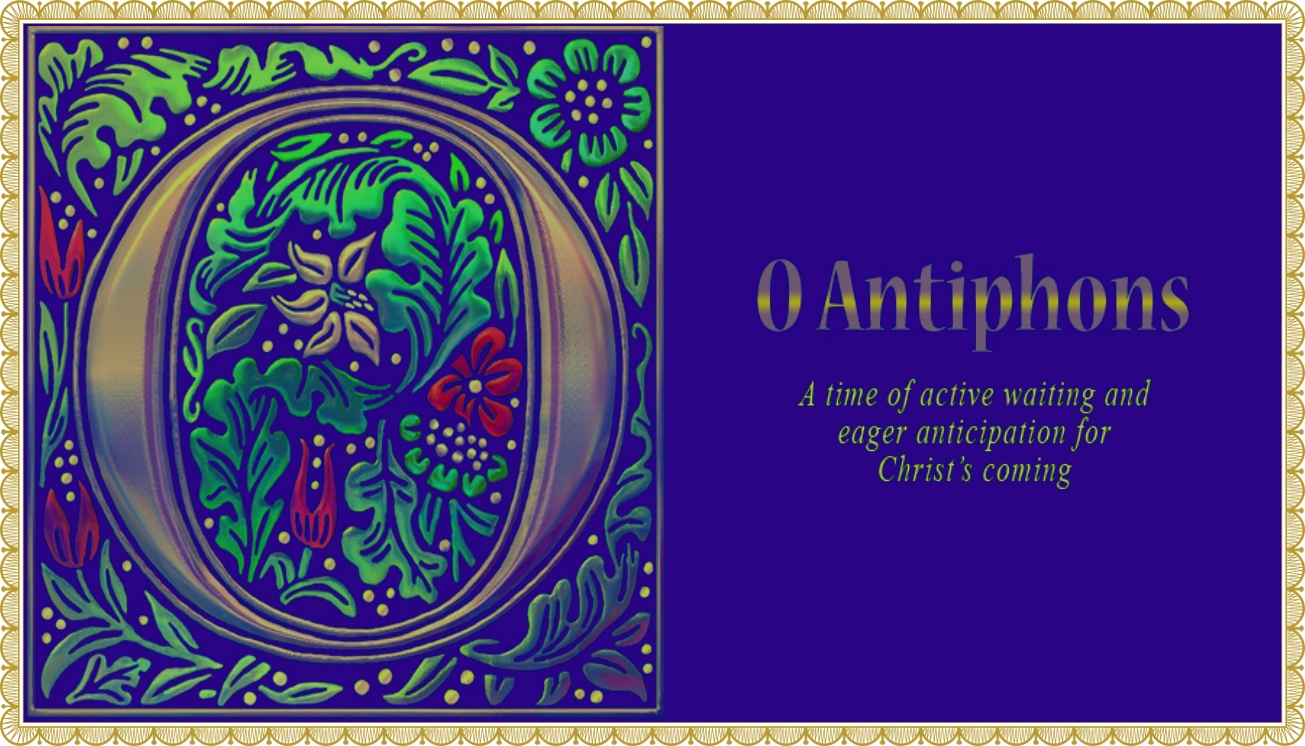
“Ero cras”: The Great O Antiphons and the Church’s Final Advent Cry
In the Roman liturgical tradition, the final seven days before Christmas Eve are marked by an intensification of expectation known as the Greater Ferias of Advent. At their heart stand the Great “O” Antiphons, sung at Vespers from 17 to 23 December, which gather the Church’s Advent longing into a single, solemn supplication addressed directly to Christ. These antiphons are not devotional ornamentation but the liturgical crown of Advent, containing in concentrated form the Church’s doctrine of the Incarnation, her reading of prophecy, and her understanding of salvation history.¹
Each antiphon begins with the vocative “O” and invokes Christ under a distinct messianic title drawn principally from Isaias, with resonances in Micheas, the Psalms, and the Wisdom literature. Each ends with the imperative veni—“come.” In this final week, the Church no longer speaks about the coming Christ; she speaks to Him. Advent’s pedagogy reaches its climax not in explanation but in invocation.
The liturgical setting: Vespers, Mary, and the evening of the world
The Roman Rite assigns the Great Antiphons to Vespers, and specifically to the Magnificat. They are sung both before and after the canticle, as on double feasts, to mark their exceptional solemnity.² This placement is deliberate and doctrinal. As the Magnificat is the canticle of the Blessed Virgin Mary, the Church thereby confesses that the Saviour whom she implores comes to her through Mary, and that the fulfilment of prophecy enters history by way of her obedience.³
Vespers itself is the hour of light’s decline. As the liturgy sings elsewhere, Christ comes at the “evening of the world” (vergente mundi vespere)—when history has grown old, when human confidence has waned, and when the night seems longest.⁴ The Church’s most urgent Advent supplication is therefore placed precisely at sunset, when the natural order itself preaches need and expectancy.
The seven titles: a doctrinal ascent
The sequence of titles is neither arbitrary nor merely poetic. It forms a theological ascent, moving from eternity to history, from abstraction to intimacy.
O Sapientia (17 December)
The first antiphon addresses Christ as eternal Wisdom, proceeding from the mouth of the Most High and ordering all things “mightily and sweetly.”⁵ The Incarnation is thus placed within the framework of divine providence: not as a reaction to sin, but as the unfolding of an eternal counsel. As Isaias foretells, the Messias is endowed with the spirit of wisdom, understanding, counsel, and fortitude.⁶ Dom Prosper Guéranger notes that this Wisdom governs even the ambitions of emperors, turning the census decree of Augustus into the instrument that brings Mary to Bethlehem, “men thinking they obey man, while it is God whom they obey.”⁷ Divine strength here works without coercion, achieving infallible ends while respecting human freedom.
O Adonai (18 December)
The second antiphon names Christ as Lord and Lawgiver, the God who appeared to Moses in the burning bush and gave the Law on Sinai.⁸ The Child to be born is identified without ambiguity as the Lord of the Old Covenant. Yet the petition now asks that this Lord redeem His people not with terror, but with humility. Guéranger observes the contrast: the God once revealed amid thunder now comes wrapped in swaddling bands, delivering man not from Egypt, but from pride.⁹
O Radix Jesse (19 December)
With the Root of Jesse, the antiphons turn decisively toward the Davidic promises. The Messias springs from a real lineage, yet stands as a sign to the nations, before whom kings fall silent.¹⁰ Scripture itself interprets this promise universally: in Him the Gentiles shall hope.¹¹ Guéranger reads this antiphon through Marian typology, identifying the Virgin as the living Ark bearing the divine Manna on its final approach to the place of rest.¹² The Church here prays not only for Christ’s coming, but for the gathering of all peoples around His standard.
O Clavis David (20 December)
Christ is now invoked as Key and Sceptre, the One who opens and no one shuts.¹³ Authority and kingship come into sharp focus. The antiphon’s petition is explicitly liberative: to lead forth the captive from the prison-house of darkness. Guéranger identifies this captivity not merely with external oppression, but with the interior bondage of sin and disordered desire.¹⁴ The Incarnation is revealed as a juridical and moral act: the rightful King enters His realm to unlock what has been closed by the Fall.
O Oriens (21 December)
At the threshold of the winter solstice, the Church calls Christ Dayspring and Sun of Justice.¹⁵ The imagery is cosmic and experiential: light breaking into darkness, warmth into cold. Yet Guéranger insists that this Light comes unnoticed. Crowds pass Mary and Joseph on the road, unaware that the Sun of Justice is near.¹⁶ The antiphon therefore becomes a prayer for interior readiness: that faith and love may be increased, lest the Light come and remain unrecognised.
O Rex Gentium (22 December)
Christ is confessed as King of the Nations and Cornerstone, the One who unites what is divided.¹⁷ The antiphon gathers together kingship, peace, and reconciliation, echoing Isaias’ vision of a kingdom without end and a judgment that ends war.¹⁸ Guéranger dwells on the mystery of Mary’s interior dispositions as the journey nears completion: awe before divine majesty, trembling before intimacy, and longing for the Birth that will restore fallen creation.¹⁹ Salvation here is explicitly creational: man is saved as the creature formed from the dust.
O Emmanuel (23 December)
The final antiphon names Christ most simply and most profoundly: Emmanuel, God with us.²⁰ The sequence reaches its terminus not in power, but in presence. Guéranger situates this antiphon in Jerusalem, where Mary bears within her the true Ark into the Temple, fulfilling the prophecy that the glory of the latter house would surpass the former.²¹ The Lawgiver Himself enters His sanctuary, hidden within the Virgin. The Church’s final plea is urgent and unadorned: veni ad salvandum nos. The hour has come.
“Ero cras”: Christ’s answer
Read backwards, the initial letters of the seven antiphons spell ERO CRAS—“Tomorrow I shall be [there].” This is not a curiosity, but a liturgical confession. After seven evenings of imploring veni, the Church hears, hidden within her own prayer, Christ’s reply. The Bride calls; the Bridegroom answers.
In the Roman Rite, the O Antiphons thus teach that Advent is not sentiment but recognition. To prepare for Christmas is to know who Christ is: Wisdom, Lord, Root, Key, Dawn, King, Emmanuel. Only then can the faithful receive not merely a Child in a manger, but the Lord of history made flesh.
- Roman Breviary, Officium de Tempore, Greater Ferias of Advent, Vespers, 17–23 December.
- Ibid.; cf. rubric governing antiphons at the Magnificat on greater feasts.
- Luke 1:46–55; cf. Roman Breviary, Vespers of Advent.
- Hymn Conditor alme siderum, Roman Advent Office.
- Wisdom 8:1; Roman Breviary, Antiphona ad Magnificat, 17 December.
- Isaias 11:2–3.
- Dom Prosper Guéranger, The Liturgical Year, Advent, “The Great Antiphons,” 17 December.
- Exodus 3:2; Exodus 20; Isaias 33:22.
- Guéranger, The Liturgical Year, Advent, 18 December.
- Isaias 11:1, 10.
- Romans 15:8–13.
- Guéranger, The Liturgical Year, Advent, 19 December.
- Isaias 22:22; Isaias 9:6.
- Guéranger, The Liturgical Year, Advent, 20 December.
- Isaias 9:2; Malachias 4:2.
- Guéranger, The Liturgical Year, Advent, 21 December.
- Isaias 2:4; Isaias 9:7.
- Ibid.
- Guéranger, The Liturgical Year, Advent, 22 December.
- Isaias 7:14.
- Aggeus 2:9; Guéranger, The Liturgical Year, Advent, 23 December.
related articles


Latest articles
- THE DOMESTIC CHURCH: 8–15 November 2026The article encourages Catholic families to recover Martinmas traditions through prayer, hospitality, lanterns, seasonal meals and practical charity. It connects remembrance of the dead, saints’ feasts and preparation for Advent, highlighting historic St Martin’s Lent and the Eastern Nativity Fast. A daily programme offers family activities, devotions, fasting and charitable works.
- Forgotten Rubrics: Why Request a Mass Intention?Mass intentions apply the spiritual fruits of Christ’s one, unrepeatable sacrifice to particular living or deceased persons and needs. The article explains the Mass’s impetratory, propitiatory and satisfactory benefits, Gregorian Thirty Masses, priests’ obligations and the stipend’s proper meaning. It encourages renewed prayer for the living, the departed and personal sanctification.
- THE DEBT THAT DOES NOT DIECatholic teaching holds that souls dying in God’s friendship may require purification before entering Heaven, while remaining certain of salvation. Scripture, tradition and Church councils affirm that Masses, prayers, almsgiving and good works can assist them. The living therefore owe the departed charity, gratitude and fidelity, especially by fulfilling promised suffrages and remembering forgotten souls.
- ORDO w/c 08.11.26The week moves from the Octave of All Saints to the Dedication of the Lateran Basilica, commemorating saints exemplifying Catholic pastoral, missionary, doctrinal and contemplative holiness. It concludes with St Gertrude the Great and the Twenty-fifth Sunday after Pentecost. Particular attention is given to traditional Roman rubrics, English observances, Friday penance and prayers for the departed.
- WHO ALLOWED THE FALSE PRIEST TO HEAR CONFESSIONS?A man posing as a Coptic priest ministered in three Turin parishes before fraudulent credentials were exposed. The Archdiocese removed him and reported the case, but questions remain about verification and authorisation. If unordained, his attempted Masses and absolutions were invalid, requiring pastoral guidance, renewed confessions and review of Mass intentions.






Leave a Reply