

At the Threshold of the Incarnation: The Fourth Sunday of Advent
The Fourth Sunday of Advent in the Tridentine Rite marks a decisive narrowing of focus within the Church’s preparation for Christmas. The liturgy no longer multiplies prophetic images or extends the horizon of expectation. Instead, it gathers inward. The question is no longer whether the Messiah will come, but whether He will be recognised. Advent, at this final stage, becomes less about anticipation and more about disposition.
This Sunday does not invite excitement, but attentiveness. The Church stands on the threshold of the Incarnation in silence, having heard the prophets and the Forerunner, awaiting not explanation but encounter.
The Introit: Rorate and the Manner of Christ’s Coming
The Introit establishes the theological character of the day:
*Roráte caéli désuper, et nubes pluant justum; aperiátur terra, et gérminet Salvatórem.*¹
The imagery is strikingly restrained. Salvation is not announced with thunder or violence, but with dew, rain, and organic growth. Heaven does not rupture history; it descends gently into it. The Incarnation is revealed not as disruption but as condescension.
The patristic tradition consistently interprets this imagery as expressive of the humility with which the Word enters the world. Augustine articulates this understanding when he observes that Christ comes “quietly, like rain upon the fleece, not with noise or terror, but with gentle mercy.”² The manner of Christ’s coming already anticipates the manner of His reception: unobtrusive, vulnerable, and easily overlooked.
Liturgically, this marks a shift in Advent’s tone. As Guéranger notes, by the Fourth Sunday the Church no longer merely announces the Messiah’s future arrival but implores His immediate coming.³ The cry of Rorate is no longer didactic; it is urgent, intimate, and confident that the promise is at hand.
The Collect: Delay as Moral, Not Chronological
The Collect intensifies this urgency while identifying its true obstacle:
*Excita, quaesumus, Domine, potentiam tuam, et veni…*⁴
The prayer explicitly acknowledges that grace is hindered not by divine reluctance but by human sin. The Church does not ask God to overcome external circumstances, but to remove what we have placed in His way. Advent preparation is thus directed inward, toward repentance and moral reordering.
This principle is foundational in the patristic understanding of salvation. Gregory the Great expresses it with characteristic clarity when he notes that God is always ready to give, while man is often unready to receive.⁵ The Fourth Sunday therefore presses the faithful toward examination of conscience rather than heightened anticipation. Christ is not delayed; we may be.
The Epistle: Joy Without Noise
The Epistle from Philippians announces a restrained but unmistakable joy:
Gaudete in Domino semper… Dominus enim prope est.
This joy is not exuberant or emotive. It is sober, disciplined, and grounded in the nearness of the Lord rather than in circumstances. St Paul immediately binds it to gentleness, prayer, and freedom from anxiety, indicating that Christian joy arises from interior order rather than stimulation.
Patristic exegesis confirms this reading. Chrysostom explains that the command to rejoice is inseparable from moderation and trust, noting that true joy belongs to those whose peace flows from prayerful reliance on God rather than from emotional excess.⁶ The Tridentine liturgy preserves this balance with precision. Joy is real, but it is quiet; it is deepened by restraint, not diminished by it.
The Gospel: The Forerunner and the Refusal of False Identity
The Gospel presents St John the Baptist under interrogation, pressed to define himself by titles he refuses to accept. His repeated negations are not evasions but acts of theological clarity. John understands that to claim an identity not given by God would obscure the One he is sent to reveal.
The Fathers consistently interpret this self-emptying as integral to John’s mission. Origen notes that the Baptist’s refusal to claim honour is itself a confession of truth, since by denying false identities he preserves the uniqueness of Christ.⁷ John defines himself only as a voice—a role that exists solely to pass away once the Word is heard.
This distinction reaches its classical expression in Augustine’s formulation: “John is the voice; Christ is the Word. The voice passes; the Word remains.”⁸ Advent reaches its ascetical climax here. Preparation for Christ requires not assertion but diminution, not self-expression but self-withdrawal.
Presence Without Recognition
The Gospel’s most searching moment follows John’s testimony:
In medio vestrum stetit, quem vos nescitis.
The danger identified here is not hostility but blindness. Christ is already present, yet unrecognised. Patristic commentary insists that this is not merely a historical condition but a perennial one. Cyril of Alexandria warns that Christ continues to stand among His people, yet remains unknown wherever the heart is dulled by unbelief or pride.⁹
The Fourth Sunday of Advent therefore reorients the faithful’s attention. The question is no longer when Christ will come, but whether He will be recognised when He does.
Birth and the Condition of the Soul
The Fathers are unanimous that Christ’s coming demands interior readiness. Ambrose expresses this principle with precision, teaching that Christ is born in the soul that receives Him, but not where pride reigns.¹⁰ The Incarnation is not only an event remembered; it is a reality either welcomed or refused.
This understanding governs the Tridentine Advent. Christmas is not delayed because the Church lacks enthusiasm, but because she insists upon preparation. Recognition precedes celebration.
Silence, Mary, and the Final Vigil
As Advent draws to a close, liturgical commentators note a deliberate quieting of tone. Guéranger observes that the figure of the Blessed Virgin increasingly fills the liturgical horizon, not through speech or action, but through presence.¹¹ Mary embodies the final posture of Advent: silence, consent, and receptivity.
Parsch similarly remarks that as Christmas approaches, the Church gathers herself inwardly, awaiting the Lord in stillness rather than anticipation.¹² The Tridentine Rite refuses premature festivity. It teaches that the final preparation for the Nativity is not activity, but watchfulness.
Conclusion
The Fourth Sunday of Advent in the Tridentine Rite stands as a threshold rather than a climax. Christ is no longer distant. He is near. He may already be standing among His people—hidden, sacramental, unrecognised.
The liturgy does not resolve the tension it creates. Instead, it leaves the soul with a single, searching question:
Will He be recognised when He comes?
¹ Missale Romanum (1962), Dominica IV Adventus, Introitus; Isaias 45:8.
² Augustine, Enarrationes in Psalmos, Psalm 71 (72), §6.
³ Prosper Guéranger, The Liturgical Year, Advent, vol. I.
⁴ Missale Romanum (1962), Collect for the Fourth Sunday of Advent.
⁵ Gregory the Great, Homiliae in Evangelia, I, 1.
⁶ John Chrysostom, Homilies on the Epistle to the Philippians, Homily XIII.
⁷ Origen, Commentary on the Gospel of John, Book VI, §24.
⁸ Augustine, Tractatus in Ioannem, Tractate III, §3.
⁹ Cyril of Alexandria, Commentary on John, Book I, ch. 9.
¹⁰ Ambrose, Expositio Evangelii secundum Lucam, II, 26.
¹¹ Prosper Guéranger, The Liturgical Year, Advent, vol. I.
¹² Pius Parsch, The Church’s Year of Grace, Advent, vol. I.
related articles


Latest articles
- SEPTEMBER EMBERTIDEThe September Ember Days, rooted in ancient Roman liturgy, are a time of reflection, fasting, and thanksgiving, coinciding with the autumn harvest. Marked by communal penance and prayers for clergy sanctification, these observances connect biblical themes of creation and sacrifice, urging Christians to evaluate their spiritual fruitfulness.
- Today’s homily: Seven Sorrows of the Blessed Virgin MaryOn the Feast of the Seven Sorrows, the Church contemplates not merely Mary’s grief but her fidelity beneath the Cross. Through the liturgy, St Bernard, St John Damascene and St Thomas Aquinas, the homily shows that Christian resignation does not mean calling suffering good, but remaining faithful to God when suffering cannot be removed or understood. Mary’s stabat becomes the model of a faith which the sword can pierce, but cannot conquer.
- Today’s Mass: September 15 The Seven Sorrows of the Blessed Virgin MaryThe Feast of the Exaltation of the Holy Cross, celebrated on September 14, commemorates the historical finding of the True Cross by Saint Helena, the dedication of churches by Constantine, and its restoration by Heraclius II. It honours the cross as the symbol of salvation, transforming a method of execution into a source of life and hope.
- Sermon for Blessed Virgin Mary/Octave of the Nativity of the Blessed Virgin MaryToday is the feast of the Seven Sorrows of the Blessed Virgin Mary, as well as the Octave of her Nativity. Today’s feast, the Seven Sorrows, shows Mary not only as the theotokos, the God bearer, but also as the Mater Dolorosa, the Mother of Sorrows.
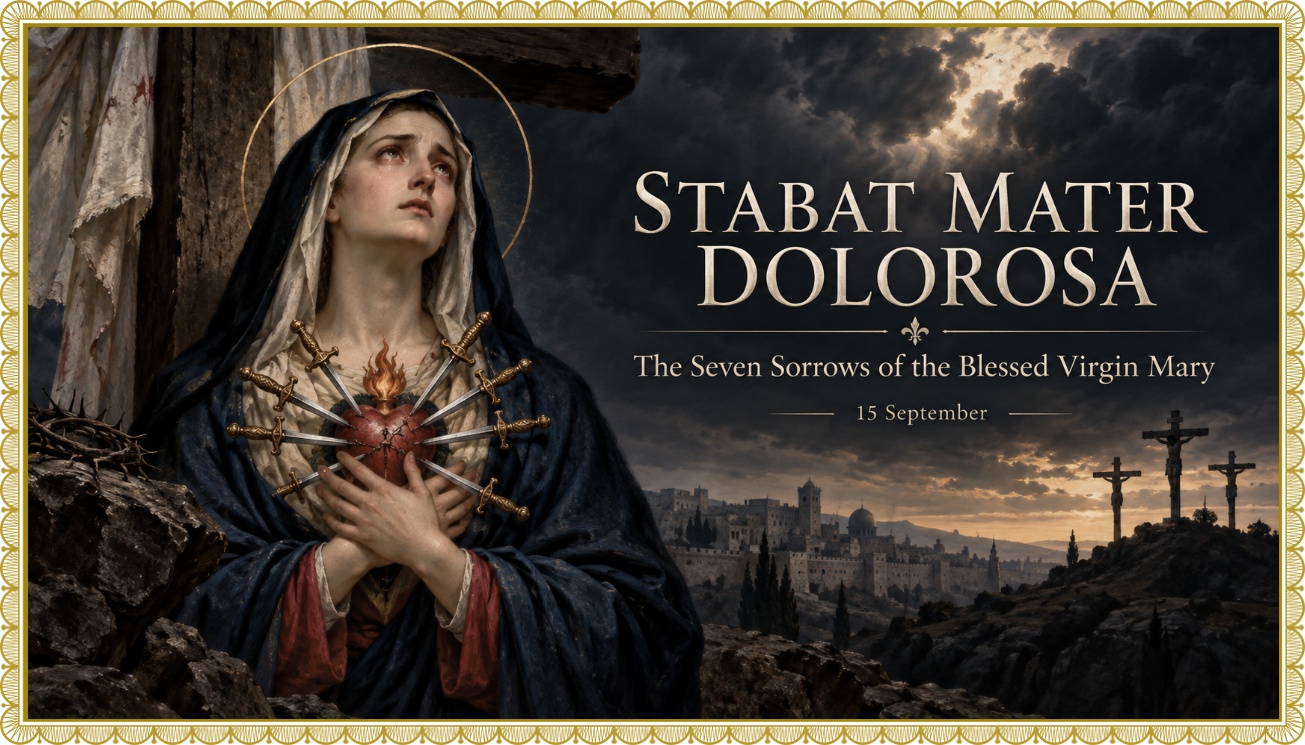
- STABAT MATER DOLOROSA: The Seven Sorrows of the Blessed Virgin MaryThe traditional feast of the Seven Sorrows on 15 September contemplates Mary’s spiritual martyrdom from Simeon’s prophecy to the Burial of Christ. Distinct in origin from the Passion Friday feast of the Compassion, the September observance came especially through the Servite tradition and was extended to the Latin Church by Pius VII before being raised in rank and fixed to 15 September under St Pius X. Its Mass, Stabant juxta Crucem, presents Mary’s sorrow not as sentimental grief but as perfect faith, charity and conformity to Divine Providence, wholly dependent upon and ordered to the unique redemptive Sacrifice of Christ.



Leave a Reply