
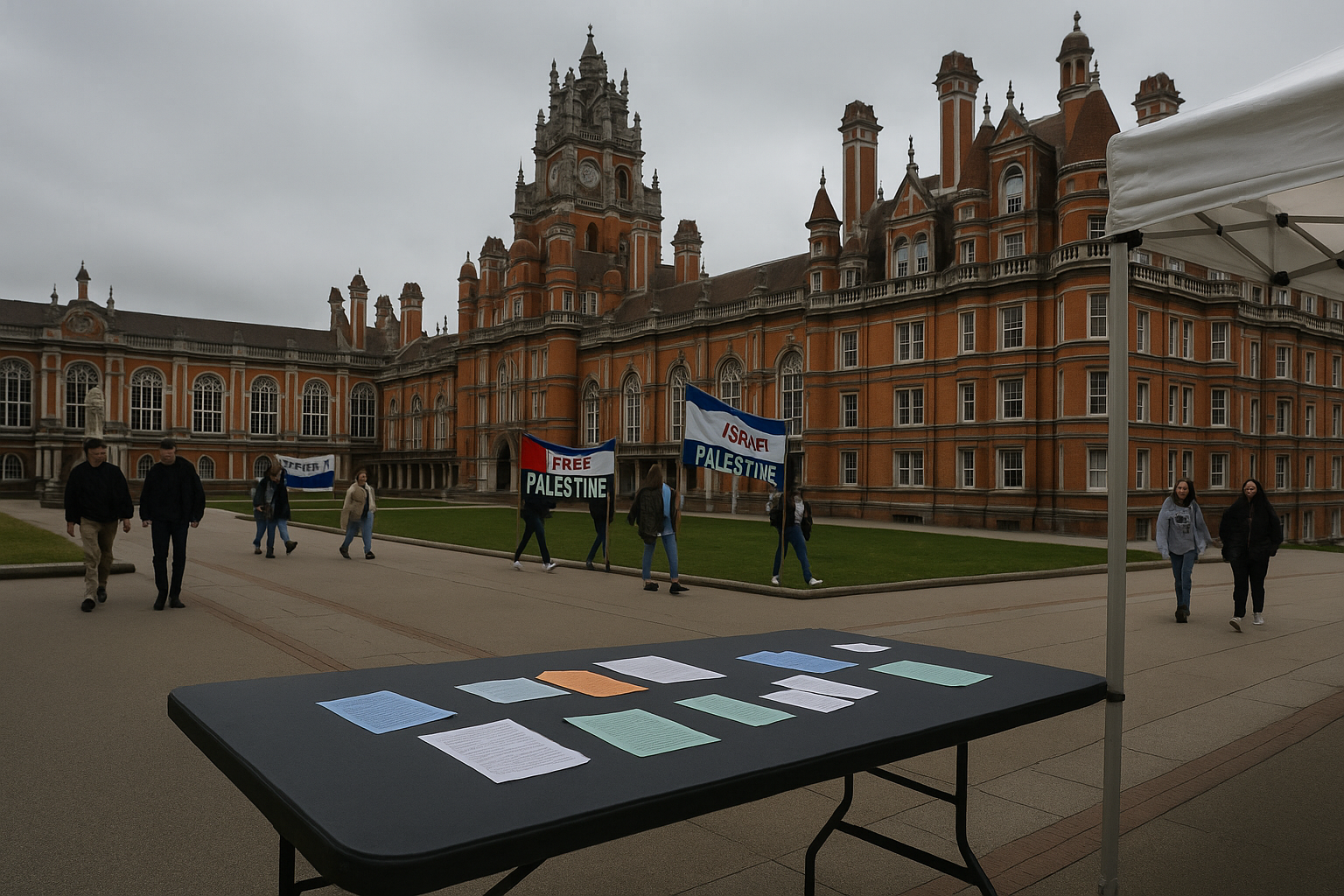
ROYAL HOLLOWAY IN THE DOCK: CAMPUS DISCIPLINE, FREE SPEECH, AND THE NEW BOUNDARIES OF POLITICAL IDENTITY
Introduction
The High Court case brought by Royal Holloway student Brodie Mitchell marks an inflection point in the fraught debate over political identity, academic freedom, and university discipline in the United Kingdom. A heated exchange at a London campus Freshers’ Fair has escalated into litigation over suspension, exclusion orders, and the alleged denial of educational opportunity. Beneath the surface lies a deeper issue: the struggle of universities to navigate Israel–Palestine controversies fairly, protect students from intimidation, and preserve lawful free expression without sliding into ideological enforcement.
The Incident and Disciplinary Action
Mitchell, a 19-year-old non-Jewish but outspoken Zionist student, is in his second year studying politics and international relations at Royal Holloway and Bedford New College, University of London. He has been active in campus political life through the Conservative Association and is supported by the Free Speech Union. According to evidence presented before Mr Justice Mansfield, the confrontation began when a member of the campus Friends of Palestine allegedly mocked him as a “wannabe Jew” and referred to his lack of a kippah.¹
Mitchell recorded the exchange and replied by mocking the student’s keffiyeh. He has since acknowledged in sworn testimony that his retort was “poorly expressed and inappropriate,” while insisting it was a political response to a pre-emptive ethnic slur.² His counsel, Francis Hoar, argued that Royal Holloway framed the incident one-sidedly and applied disciplinary measures without due regard to context.
The following day, Royal Holloway suspended Mitchell for “conduct that could be considered hate speech” and for filming without consent. He was temporarily evicted from university accommodation, subjected to a Campus Exclusion Restriction Order, and ordered before a “major misconduct panel” on allegations ranging from aggressive behaviour to causing distress or fear to students or staff.³ The complainant did not participate in the disciplinary proceedings, and Mitchell’s request for an internal appeal was refused.
Legal Action and Educational Harm
Mitchell claims he has lost seven weeks of tuition, amounting to 68 teaching hours, due to the suspension and exclusion order. He states he has worked extreme hours to catch up academically, including completing an essay at 4:30 am after employment shifts.⁴ His legal team seeks an interim mandatory injunction requiring the university to extend deadlines and provide private tuition to rectify academic disadvantage.
Hoar told the court that Royal Holloway had shown “intransigence” and would “only buckle when prompted by a judge.”⁵ The university, represented by Gemma White KC, has disputed the practicality of one-to-one tuition and questioned whether such a remedy is financially sustainable.
A Microcosm of National Tensions
Although personal, this case reflects broader national trends. Since late 2023, Israel–Palestine disputes have triggered disciplinary investigations across at least 28 UK universities, affecting more than 100 students and staff.⁶ In many cases, participation in encampments, demonstrations, or political societies has resulted in sanctions ranging from exclusion orders to the threat of expulsion.
Royal Holloway itself has been the scene of contentious debate. In mid-2025, attempts to ratify an Israel Society generated campus polarisation and petitions of hundreds of signatures. Supporters framed the society as the legitimate expression of political and cultural identity; opponents viewed it as inflammatory during ongoing geopolitical conflict.
Elsewhere, universities have used both internal procedures and legal instruments to contain campus activism:
Cambridge University secured a temporary injunction in 2025 restricting pro-Palestine demonstrations on specific sites, citing disruption and safety concerns.⁷ Civil-liberties groups warned this could chill lawful speech and assembly.
Seven LSE students initiated legal action after being banned from campus following protest activity, arguing that their rights to expression and belief were violated.⁸
At the University of Birmingham, two students faced expulsion for participating in an encampment described as “unauthorised,” despite claims from protestors that they acted peacefully.⁹
The pattern is not unilateral: legal challenges have also pushed back. In 2024, an employment tribunal found that anti-Zionist philosophical beliefs held by former Bristol professor David Miller were protected under UK equality law.¹⁰ This judgment complicates the assumption that strong political expression on either side of the Israel–Palestine divide falls outside the scope of protected beliefs.
Regulatory Backdrop
In response to escalating controversy, the Office for Students (OfS) issued guidance in 2025 directing universities to avoid blanket protest bans and to uphold lawful free speech, while acknowledging a duty to protect students — particularly Jewish students — from harassment.¹¹ The guidance implicitly questions the proportionality of sweeping disciplinary measures and demands careful distinction between offensive speech and unlawful conduct.
The Mitchell case therefore unfolds against a backdrop of shifting expectations: courts are increasingly called upon to adjudicate the limits of campus authority, while regulators insist on preserving both academic freedom and student safety.
The Institutional Challenge
Universities today face a paradox. They are expected simultaneously to be bastions of free inquiry and guardians against intimidation. In highly polarised contexts, disciplinary processes risk becoming entangled in ideological disputes. Quick resort to exclusion, eviction, or injunction may compound grievances rather than resolve them. Meanwhile, opaque procedures, lack of participation from complainants, and refusal of appeals invite scrutiny of due process.
Whether Royal Holloway’s actions were proportionate will be determined by the courts. Yet the case raises a wider question: are universities — pressured by political activism, media narratives, and internal bureaucracy — becoming arbiters of geopolitical legitimacy rather than facilitators of protected debate?
Conclusion
The High Court’s handling of the Mitchell injunction will be closely watched by campaigners on every side. For traditional defenders of academic freedom, the stakes are not ideological but structural: does a university have the power to impose severe educational consequences before the merits of a dispute are fairly examined? And can institutions avoid becoming battlegrounds where political identity triggers punitive action without adequate recourse?
What began as a petty exchange at a campus stall has become a test case for national principles. The outcome will not only affect one student’s education but may help define the future boundaries of political expression in British universities.
¹ Jenni Frazer, Jewish News, “Royal Holloway faces legal action over suspension of pro-Israel student,” 5 December 2025.
² Ibid., witness statement summary.
³ Ibid., disciplinary charges presented to High Court.
⁴ Ibid., evidence submitted regarding lost tuition.
⁵ Ibid., remarks by barrister Francis Hoar.
⁶ Liberty Investigates, “The worsening crackdown on pro-Palestinian activism at UK universities,” 2025.
⁷ Garden Court Chambers reporting on Cambridge injunction, March 2025.
⁸ Leigh Day Solicitors, “Students double down on legal action against LSE,” March 2025.
⁹ AF Communications, “Two University of Birmingham students face expulsion,” January 2025.
¹⁰ Employment Tribunal ruling in Miller v University of Bristol, 2024.
¹¹ Office for Students (England), “Guidance on student protests and freedom of speech,” June 2025.
related articles


latest articles
- TRADITION BEHIND THE FENCEThe Vatican’s prohibition of the traditional Ad Petri Sedem pilgrimage to St Peter’s Basilica has sparked controversy, especially among traditional Catholics. While some cite scheduling conflicts, the broader issue lies in the restrictive policies of Traditionis custodes, which may confine traditional liturgical practices to specific enclaves, risking the transmission and recognition of Catholic Tradition within the wider Church.
- Today’s Mass: October 24 St Raphael the ArchangelThe Feast of Saint Raphael the Archangel highlights his healing powers as depicted in the Book of Tobit, where he aids Tobit and his son, Tobiah. Venerated as a protector of travellers and the blind, Raphael is celebrated for his miraculous interventions. His legacy includes support for nurses, matchmakers, and Catholic studies.
- 25.10.26 Nuntiatoria CXXIX: CHRISTUS REXThe text discusses the relationship between Christ’s kingship and authority within the Church amidst contemporary challenges. It contrasts ecclesiastical power with genuine faith, emphasising that authority must protect divine truth rather than alter it. The witness of imprisoned priests illustrates the enduring significance of fidelity to Christ over institutional conformity.
- THE DOMESTIC CHURCH: 25 October – 2 November 2026 A Home with Room for Heaven: Preparing for All Saints and All SoulsThe content outlines a week’s plan for traditional Catholic families to prepare for the feasts of All Saints and All Souls. Emphasising daily prayers, remembrance of the deceased, and engagement with children’s activities, it aims to integrate Catholic customs into family life, enriching spiritual practices and fostering a shared faith experience.
- ORDO w/c 25.10.26The text outlines the liturgical calendar for the last week of October and the beginning of November, highlighting key celebrations. Notable events include the Feast of Christ the King, St Evaristus, the Vigil of Saints Simon and Jude, and the Feast of All Saints, emphasising themes of holiness, unity in faith, and the Church’s teachings.





Leave a Reply