
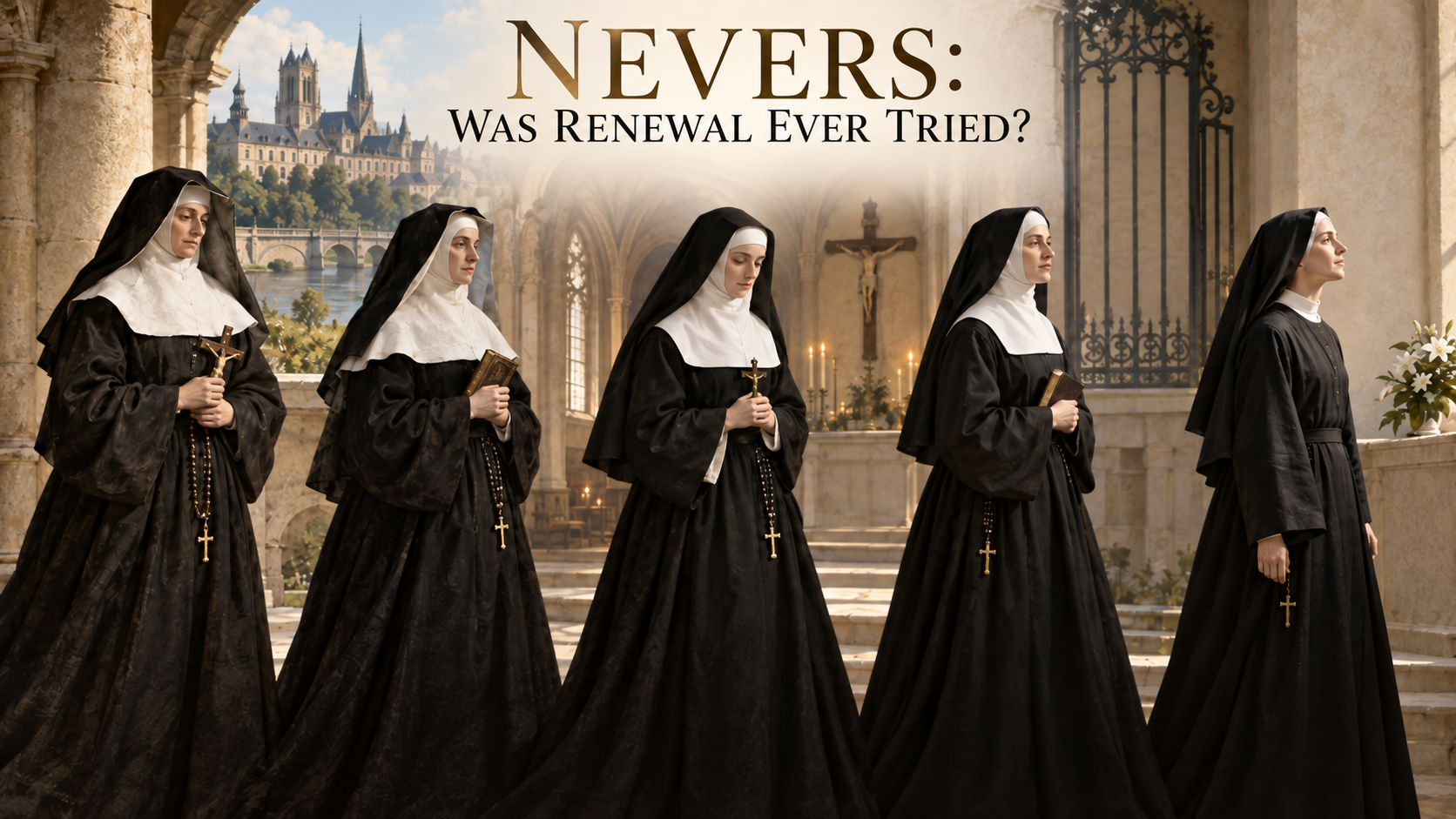
The Visitandines of Nevers are preparing to leave a city in which their Order has been present since 1620. It is tempting to describe the ending as the unavoidable consequence of age and diminishing numbers. Yet by 2024 Nevers had already been canonically affiliated to the substantially larger monastery at Paray-le-Monial — precisely the mechanism by which Rome says a weakened contemplative house may be tested for “recovery and rebirth”. Before one of the Visitation’s earliest foundations disappears, there is therefore a question which deserves an answer: what was actually attempted to make it live?
The furniture sale at Nevers is not the most important part of the story. Desks, cupboards, tables, sideboards and crockery can be catalogued, priced and removed. What cannot so easily be accounted for is the disappearance of a religious presence which belongs to the first flowering of the Order of the Visitation itself. The sisters arrived in Nevers in 1620, ten years after St Francis de Sales and St Jane Frances de Chantal founded the Visitation at Annecy and while both founders were still alive. Contemporary Salesian records contain instructions addressed to the superior and sisters of the new Nevers foundation; St Francis was still directing the life of this young house while the Order itself was taking shape. By his death in December 1622, the Visitation had only thirteen monasteries. Nevers therefore does not represent some peripheral foundation of a later age. It belongs to the Order’s founding generation.¹
Nor was its subsequent history protected from catastrophe. The revolutionary destruction of French religious life broke the old continuity; the community was restored at La Charité-sur-Loire in 1818, returned to Nevers in 1854, was driven into exile in Belgium in 1908, came back again in 1935 and moved to its present site on the Route des Saulaies in 1993. In other words, the Nevers community survived circumstances in which external powers actually made its continued existence difficult or impossible. Its present disappearance is different. There is no suppression by an anticlerical government, no confiscation and no prohibition upon the Visitation. The legal and ecclesiastical freedom to live the vocation remains. What has failed is the transmission of the community itself.²
The figures are stark, but they must be stated accurately. In 2013 there were fourteen Visitandines at Nevers, not fourteen in the Order as a whole. Their own community described sisters aged between forty-nine and eighty-nine, drawn from France and beyond, maintaining the monastery, its prayer and its hospitality. At the beginning of 2025 the Nevers house had fallen to four. Two elderly sisters then left in March, one for Thonon-les-Bains and another for Paray-le-Monial, leaving Sister Marie-Odile and Sister Marie-de-Fatima in Nevers. Eighteen months later, the monastery announced its two vide-couvent sales of 12 and 19 September 2026 as preparations for departure proceeded. The wider Order continues; what is disappearing is this particular ancient house.²
If that were all we knew, the conclusion might seem obvious. Two elderly religious cannot be expected indefinitely to sustain a substantial contemplative monastery, and no responsible superior could manufacture vocations which do not exist. But the official directory of the Visitation supplies another fact which changes the nature of the question. By November 2024 Nevers was already listed within the France-North Federation as affiliated to Paray-le-Monial, with Mother Maria Guadalupe identified as its canonical superior by reason of that affiliation. Nevers had therefore already passed beyond the situation of a fully autonomous monastery simply confronting its difficulties alone. The Order’s own structures had recognised that the house required juridical support.³
The purpose of that mechanism is particularly significant. Cor Orans, the Holy See’s implementing instruction for women’s contemplative life, defines affiliation as juridical support intended to determine whether a monastery’s inability to govern its life autonomously is temporary or irreversible. The affiliating house assumes responsibility precisely while that question is tested. The same instruction later says explicitly that affiliation can offer an opportunity for “recovery and rebirth” when autonomy has been partially compromised; suppression belongs to the alternative case in which incapacity has proved irreversible. It also charges federations with facilitating mutual assistance, including the exchange of sisters and material goods.⁴
That does not mean that Paray-le-Monial could simply have been ordered to surrender half a dozen young sisters to Nevers. Autonomous contemplative monasteries are not branch offices of a centrally staffed congregation, and the freedom, stability and canonical membership of the religious themselves matter. Nor does the published number at Paray justify pretending that its personnel were readily deployable. The community there presently describes itself as comprising twenty-nine Visitandines aged roughly thirty to ninety, while frankly acknowledging that the majority are elderly. Twenty-nine sisters on a website is not the same thing as twenty-nine sisters capable of founding, governing or reinforcing another monastery.⁵
Nevertheless, the legislation makes clear that affiliation did not itself close the door upon renewal. An affiliated monastery may still accept candidates. Their novitiate and initial formation must take place at the affiliating monastery or another house designated by the federation, but profession can be made for the affiliated monastery itself. That provision is important because it demonstrates that the canonical status of Nevers did not necessarily condemn it to managed extinction. The law envisages the possibility that a weakened house may receive future members while relying upon a stronger community for the formation it can no longer provide on its own.⁴
The distinction is crucial. It is one thing to establish that a monastery has become incapable of autonomous government; it is another to establish that it cannot recover. Rome’s legislation deliberately separates those questions. It asks first whether weakness can be overcome and identifies the number and age of the sisters, capacity for government and formation, prolonged absence of candidates and ability to live and transmit the charism among the factors relevant to deciding whether incapacity has become irreversible. The public facts show that Nevers was affiliated and is now preparing to close. What they do not presently show is how the intervening discernment was conducted.⁴
That is where the legitimate question lies. Was a deliberate attempt made to reconstitute the Nevers community rather than merely sustain its final members? Were other French Visitandine houses asked whether sisters could assist for a defined period? Was the possibility of a small re-founding group considered within the federation? Were suitable candidates ever encouraged to enter for Nevers while receiving their formation elsewhere, as Cor Orans expressly allows? Was assistance from the wider international Visitation explored? There may be entirely satisfactory answers to each of these questions. They may exist in correspondence, visitation reports, federal deliberations or Roman decisions which are not public. Until those facts are known, it would be unjust to allege that nothing was attempted. It would be equally unjust to the importance of the house simply to assume that everything possible must have been done.
The historical weight of Nevers makes that inquiry more than sentimental antiquarianism. Its foundation belongs to the extraordinary first expansion of the Visitation under the founders themselves. St Francis corresponded with those responsible for its early life; St Jane Frances lived to see the Order spread through scores of houses. The old Sainte-Marie chapel in the centre of Nevers remains as the architectural witness to that beginning, although it is now desacralised and presented by the city as cultural patrimony, opened for guided visits, heritage events and exhibitions. There is nothing objectionable in conserving such a monument. But a Catholic civilisation is not successfully preserved merely because the building in which its religious once prayed remains available for visitors.¹ ⁶
The difference between heritage and tradition is precisely the difference between something remembered and something transmitted. Heritage can place an altar behind a velvet rope and explain what happened there. Tradition requires another generation to kneel before it. A monastery may possess valuable architecture, archives and associations, but the essential continuity of a religious house lies in women receiving from other women a form of consecrated life and freely making it their own. Once that transmission ends, the building may survive magnificently while the thing for which it was built has vanished.
Nevers also cannot be detached from the larger French picture already examined by Nuntiatoria. Research by sociologist Isabelle Jonveaux found that ninety-one of the 303 French contemplative monasteries identified in 2007 had disappeared by 2026. Women’s communities had contracted particularly severely, and approximately thirty per cent of the Visitation houses represented in that study had closed. Nuntiatoria has previously considered this wider extinction of contemplative houses in France and elsewhere, together with the uncomfortable contrast between institutions experiencing terminal contraction and communities whose stronger identity and observance continue, in some cases, to attract younger vocations. None of this permits the facile conclusion that every traditional monastery flourishes or that every reformed one dies. It does make the habitual presentation of each closure as an isolated demographic misfortune increasingly implausible.⁷
The Church undoubtedly confronts social causes she did not create. European fertility has collapsed; secularisation has reshaped family life and education; marriage itself is delayed or rejected; religious belief no longer supplies the cultural atmosphere from which large numbers of priests and religious once emerged. The modern woman considering a contemplative vocation faces possibilities, expectations and pressures radically different from those encountered by her counterpart a century ago. Any diagnosis which attributes the whole collapse to Vatican II or the reform of religious life mistakes polemic for history.
Yet the opposite explanation is no more satisfactory. The Church did not simply stand still while modernity happened around her. Western religious life underwent an immense programme of institutional adaptation during precisely the decades in which its capacity for reproduction deteriorated. Constitutions, customs, formation, dress, governance, liturgical practice and relationships with the surrounding world were extensively reconsidered. These alterations were defended as renewal. It is therefore reasonable, after sixty years, to include the reforms themselves among the historical variables to be examined rather than treating them as the one element excluded in advance from scrutiny.
Indeed, the actual conciliar decree is more demanding of continuity than the history of its implementation sometimes suggests. Perfectae Caritatis called not merely for adaptation but for a continual return to the sources of Christian life and the original inspiration of each institute. It required founders’ spirit, proper character and sound traditions to be faithfully preserved, while contemplative institutes were to safeguard their separation from the world and the exercises proper to their vocation. The question facing communities such as the Visitation is therefore not whether they have changed enough, but whether the authentic Salesian contemplative life can still be transmitted with sufficient confidence and integrity to persuade another generation that it is worth giving an entire life to it.⁸
This is where administrative consolidation deserves particular scrutiny. Concentration can be prudent and sometimes unavoidable. Moving sisters from a failing house to a healthier monastery may provide proper common life, adequate care and stronger observance for the religious themselves. Yet repeated consolidation has an obvious cumulative effect: each apparently sensible decision leaves the institute with one fewer living centre from which vocations might arise. A receiving monastery becomes numerically stronger while the Order’s geographical and institutional presence becomes smaller. If that pattern repeats often enough, contraction can acquire the appearance of stability simply because the remaining members have been concentrated into progressively fewer houses.
The purpose of affiliation ought therefore to matter enormously. If it becomes chiefly a mechanism for making decline orderly, the language of “recovery and rebirth” becomes theoretical. If, on the other hand, affiliation genuinely tests whether a house can be restored — through temporary personnel, common formation, renewed recruitment, spiritual reform or other means appropriate to the institute — then even suppression after such an attempt carries a different meaning. The Church could say that she did not confuse an ageing community with a necessarily dead charism.
At Nevers we cannot yet know which account is correct. The public record establishes the decline in local numbers, the affiliation to Paray-le-Monial and the approaching departure. It establishes that the wider Order remains in existence and that Paray itself is substantially larger. It establishes that the Church’s governing legislation provided mechanisms through which an affiliated house could receive support and even candidates. What the public record does not disclose is whether those possibilities were tried, rejected after serious examination, rendered impossible by circumstances, or never judged realistic in the first place.
That missing account is now the most important part of the story.
For centuries the Nevers community survived because interruption did not automatically mean extinction. Revolution scattered religious. Anticlericalism exiled them. Houses were lost and locations changed. Yet another generation repeatedly judged the Visitandine life worth restoring. The present crisis is more difficult precisely because there is no persecutor to blame. The Order is free. The federation exists. The canonical structures exist. Other monasteries remain. Yet Nevers has reached two remaining sisters and the dispersal of its household.
Perhaps nothing prudent could have saved it. If so, the facts should be capable of showing why. Religious superiors are not required to preserve every historic foundation regardless of human reality, and no monastery has a right to immortality simply because it is old. But neither should a foundation belonging to the lifetime of St Francis de Sales and St Jane Frances de Chantal be allowed to pass from living tradition into municipal heritage without anyone asking whether extinction was genuinely the last available course.
That is the question Nevers now poses to a Church which has spent sixty years speaking of renewal. Renewal cannot finally mean the dignified administration of diminishing numbers. In a religious institute it must somewhere include the capacity to hand the life on.
The question is therefore no longer why two elderly sisters could not maintain Nevers.
The question is what was done before only two remained.
And, once affiliation had begun, whether anyone seriously tried to make Nevers a monastery with a future again.
¹ Musée de la Visitation, “History of the Museum”; Fondation Héritage Salésien, “The Order of the Visitation”; Œuvres de Saint François de Sales, correspondence and instructions concerning the new Visitation at Nevers.
² Visitation de Nevers, “La prière façonne le quotidien des Sœurs de la Visitation”; Tribune Chrétienne, “À Nevers, quatre siècles de présence religieuse s’achèvent : les Visitandines organisent leur ‘vide-couvent’”.
³ Ordre de la Visitation Sainte-Marie, Cahier d’adresses des monastères, November 2024.
⁴ Congregation for Institutes of Consecrated Life and Societies of Apostolic Life, Cor Orans: Implementing Instruction of the Apostolic Constitution Vultum Dei quaerere on Women’s Contemplative Life, especially nn. 55–70 and 92.
⁵ Paroisse du Sacré-Cœur en Val d’Or, “Visitandines”.
⁶ Ville de Nevers, “Chapelle Sainte-Marie”; Culture Nevers, “Visite de la chapelle Sainte-Marie”; Culture Nevers, “Ouverture de la Chapelle Sainte-Marie + exposition ‘La Plume Verte’”.
⁷ Nuntiatoria, “Ninety-One Monasteries Closed: The Liturgical Divide in France’s Vocational Collapse”; Nuntiatoria, “The Extinction of the Cloister: Compiègne, La Trappe, and Mount Melleray as Signs of an Anthropological Crisis in the Church”; Nuntiatoria, “Christianity Without Contrast: Vocational Decline in the West and the Adoption of the Zeitgeist”.
⁸ Second Vatican Council, Perfectae Caritatis: Decree on the Adaptation and Renewal of Religious Life, 28 October 1965; Paul VI, Ecclesiae Sanctae, 6 August 1966.



Leave a Reply