
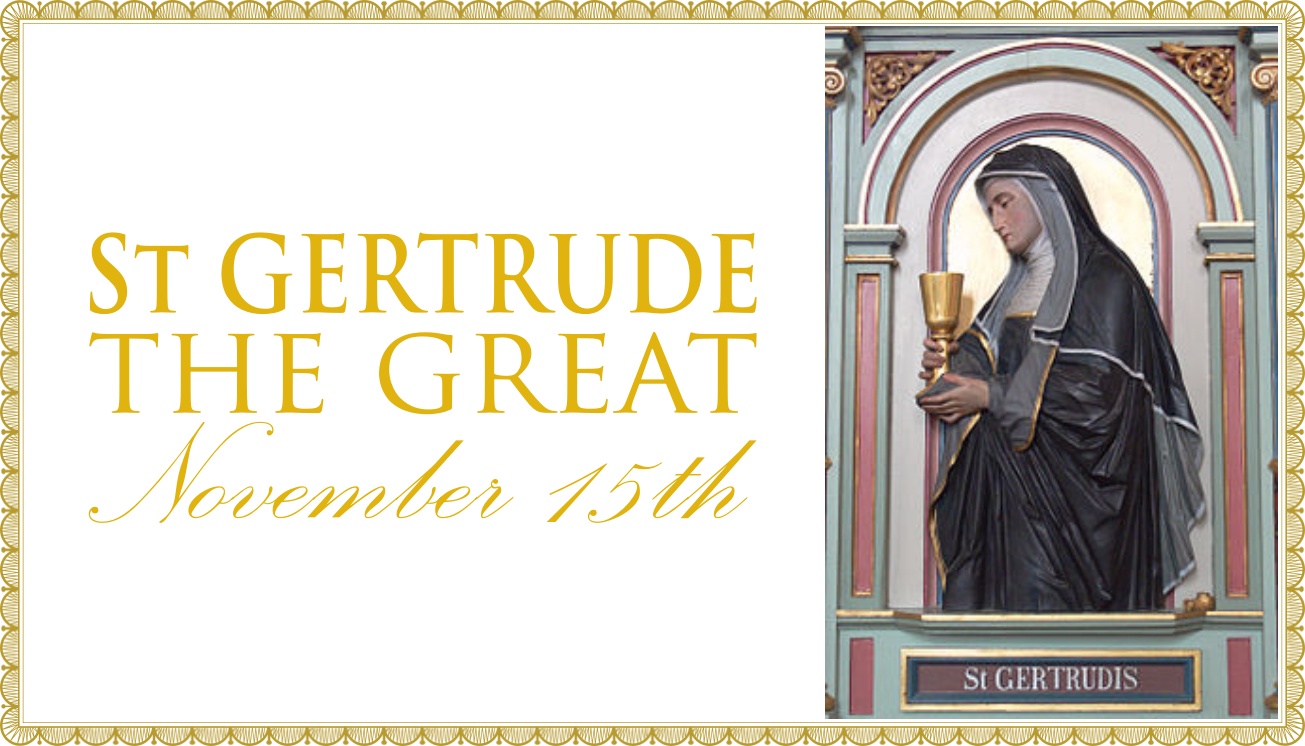
St. Gertrude
Today we celebrate the feast of St. Gertrude. She was born of a noble family at Eisleben in Saxony in 1264. Her life was almost entirely spent in the cloister. She became an oblate at the age of five in the nunnery at Rodalsdorf. According to the Breviary “from that time forth she was utterly estranged from earthly things, ever striving for things higher, and began to lead a kind of heavenly life. To learning in human letters she added knowledge of the things of God…. In the thirtieth year of her age she was elected Abbess of Rodalsdorf, where she had professed herself in the religious life, and afterwards of Heldelfs. The office she bore for forty years in love, wisdom and zeal for strict observance, so that the house seemed like an ideal example of a sisterhood of perfect nuns….The love of God oftentimes threw her into trances, and she was given the grace of the deepest contemplation, even to union of spirit with God.”
On January 27, 1281, when she was just over twenty five, Christ revealed himself to her as the spouse of her soul and consoled her in a trial which tormented her. She received remarkable visions during the following eight years, subsequently related in a book entitled, “Revelations of St. Gertrude”. She died in 1334.
But what is the place of mysticism in Christianity? To describe someone as a mystic suggests that they are far removed from ordinary life and experience, and may suggest something esoteric. It should be said at once that Christianity is not primarily about mystical experience, but rather service of God and neighbour. The revelation of God recorded in the Law and the Prophets and incarnate in the Word made flesh is a public revelation addressed to all, rather than a mystical experience only addressed to some.
The Law received by Moses on the mountainside was addressed to the people of Israel as a whole. It was not an esoteric or private mystical experience only attainable by certain elect souls. The prophets likewise addressed themselves to the people as a whole, whether they will hear or whether they will forbear. Since Christ came to fulfil the Law and the Prophets he too addressed himself to the people as a whole, not just an elect few. The Christian faith is for all nations, tribes and tongues.
That is why the early Church rejected Gnosticism (the belief in salvation by esoteric or secret knowledge inaccessible to the multitude). The message of the Incarnation is all about the Word becoming flesh in time and history, so that the human race can be redeemed from sin and death. The message of redemption is for all, not just some. It is not like the impassioned serenity of the Buddha, detached from the world of suffering in an impersonal nirvana.
However, though Christianity is not primarily about mystical experience, this does not mean that there is no place for mysticism in the Christian life. What distinguishes Christian from non-Christian mysticism is that it is focused on Christ, and takes as its basis the Scriptures and liturgy of the Church. Precisely because it is centred on Christ it is a mysticism that is addressed and accessible to all, not just a private revelation for the few. It is not about withdrawal from the world of suffering, but about redemption through suffering.
St. Gertrude embraced the way of the Cross and sought redemption through it. It was from this experience that she could write about the life of holiness, and the need to become detached from worldly attitudes to focus on God. The human race has fallen from grace because it has sought for happiness in the things of this world. Redemption can only be found through detachment from the things of this world and being reborn in Christ.
Yet, as we are reborn and renewed and less absorbed by worldly standards and attitudes, we are able to become more, not less, involved in this world because we are able to see what really matters. We can become by grace what Christ is by nature.
But what of the particular mystical experiences of St. Gertrude herself? They clearly belong within the Cistercian tradition within which she was formed and in particular the devotion to the Sacred Humanity which can be traced back to St. Bernard of Clairvaux in particular. They belong on the same level as other mystical experiences of other saints such as St. Bridget of Sweden, St. Catherine of Siena and St. Theresa of Avila.
They are not part of the public revelation of the Gospel of Jesus Christ, a message received always, everywhere and by all. Acceptance of their particular mystical experiences and spirituality is not an essential part of the Christian faith, but we acknowledge their witness and the testimony of their lives as saints precisely because they are so clearly deeply rooted in the faith received always, everywhere and by all.
Ultimately, the criterion we must use is not so much an analysis of the type of experience itself, which may be related to the particular personality of the individual Christian believer, but the fruit that it bore both in their own lives and in the lives of others. “By their fruits ye shall know them.”
If the Christian believer claims to have particular mystical experiences, and yet they do not strive to lead a life of service to God and neighbour then there would seem to be good grounds for questioning the genuineness of the experiences. If on the other hand the Christian believer claims to have particular mystical experiences, and they strive to lead a life of service to God and neighbour then there would seem to be good grounds for accepting the genuineness of them.
If they are truly faithful to Christ they will not claim to base their faith on their own particular experience, though it may well give them added strength and consolation in times of adversity, but rather on the public revelation of the faith once delivered to the saints, and received everywhere, always and by all.
If we are to remain stedfast to that faith and live in love and service to God and neighbour, then we will be truly following the example of St. Gertrude and of all the saints who have been the chosen vessels of God’s grace and lights to the world in their several generations.
Let us make our own the words of today’s Collect:
“O God, who in the heart of the holy virgin Gertrude didst provide for thyself a pleasing abode; through her merits and prayers, do thou cleanse from our hearts every stain of sin, and grant that we may enjoy fellowship with her for evermore, through our Lord Jesus Christ thy Son, who livest and reignest with thee in the unity of the Holy Spirit, ever one God, world without end. Amen.”
by the Revd Dr Robert Wilson PhD (Cantab), Old Roman Apostolate UK



Leave a Reply