
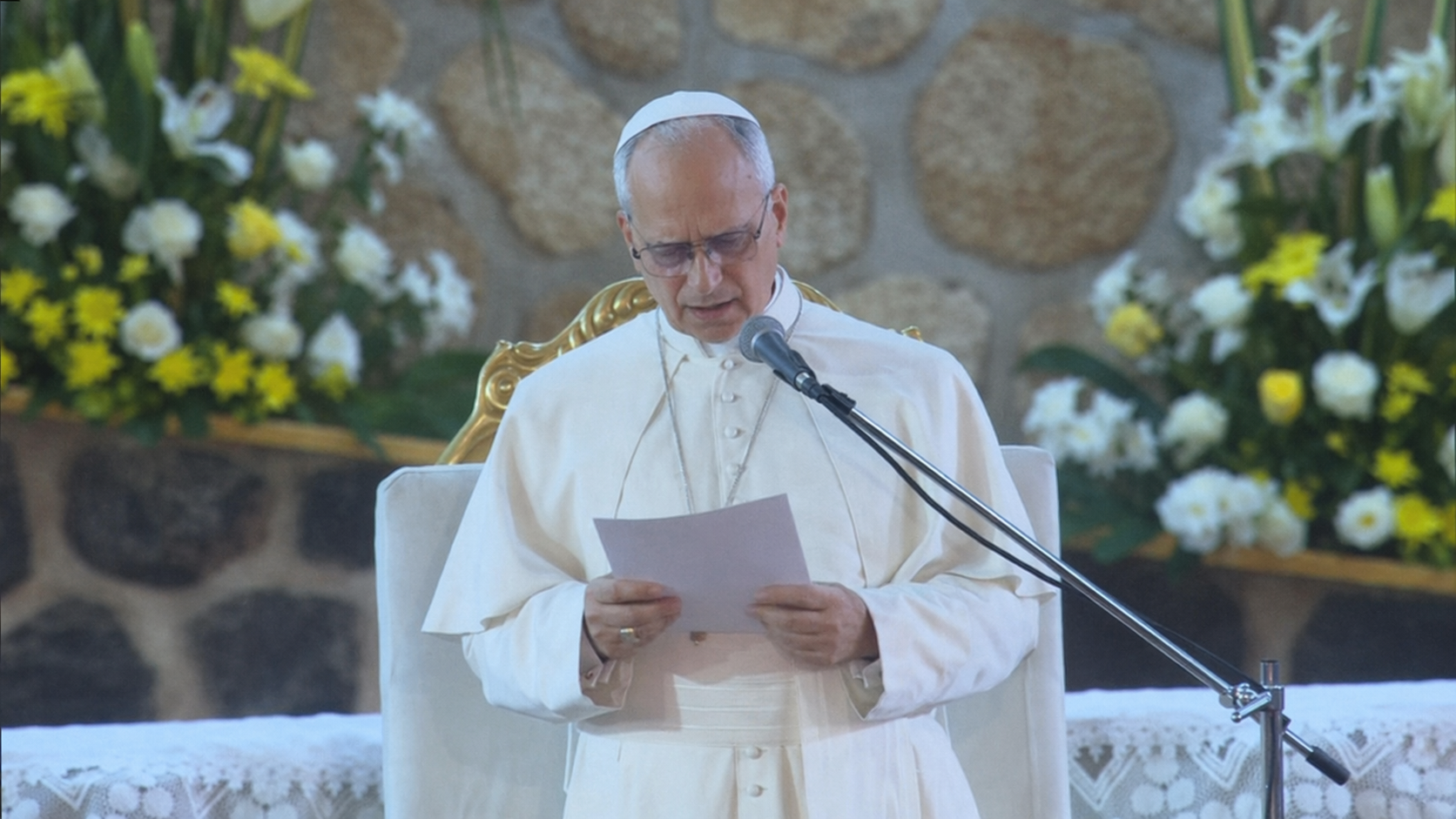
Is Leo politicising the Papacy?
A Pontificate Defined in Real Time
In the weeks following the January Consistory and his Letter to the College of Cardinals (12 April 2026), Pope Leo XIV establishes the operative vocabulary of his pontificate. Drawing on the missionary framework of Pope Francis, he directs the Church toward “the peripheries” and toward confronting “structures of exclusion.”¹ In that April letter he insists that the Church must “welcome, accompany and integrate those who find themselves excluded or displaced.”² The language is recognisably Catholic; its timing and framing render it politically legible. The question is therefore precise: does the papacy here articulate enduring principles, or does it enter the field of policy by implication?
Migration: Principle Stated, Counter-Principle Restored Only in Theory
The triad “welcome, accompany, integrate” is not controversial. What is decisive is its isolation from the counter-principle that governs Catholic teaching on migration: the authority of the state to regulate borders for the sake of the common good. Pope Pius XII states without ambiguity that “the State must watch over the common good… in receiving immigrants.”³ The classical structure is therefore explicit—charity toward the migrant, authority of the state, primacy of the common good.
Leo XIV’s formulation omits the balancing clause in its operative presentation. Issued on 12 April 2026, within seventy-two hours of renewed U.S. congressional negotiations on border enforcement thresholds and Department of Homeland Security administrative adjustments to asylum processing protocols announced 9–11 April 2026,⁴ the statement is not received abstractly. It is received as commentary. A universal principle, delivered at a moment of legislative contestation, becomes a directional signal.
Critics have begun to articulate this concern explicitly. Bishop Athanasius Schneider has warned that contemporary Church discourse risks “obscuring the full integrity of moral teaching by emphasising one aspect to the neglect of others,” particularly in matters touching civil authority and social order.¹² Conversely, defenders such as Cardinal Blase Cupich argue that emphasis on the migrant reflects “the urgent demands of the Gospel in concrete historical circumstances,” and that failure to stress welcome risks moral abdication.¹³ The dispute is therefore not about principle, but about emphasis and framing.
Economic Justice: Moral Architecture Replaced by Diagnostic Register
In consistory reflections (January 2026; reiterated in April correspondence), Pope Leo XIV warns against “systems that marginalise” and “structures that generate exclusion.”⁵ These claims are morally valid; they are structurally incomplete unless paired with the governing constraints of Catholic social teaching.
Pope Leo XIII teaches that “the right of private property… is derived from nature,”⁶ while Pope Pius XI establishes subsidiarity: “it is an injustice… to assign to a greater… what lesser… can do.”⁷ These are not adjuncts; they are limits.
The contrast is therefore exact:
- classical doctrine: justice bounded by order and limit
- contemporary rhetoric: critique without structural counterweight
The timing fixes the perception. Leo XIV reiterates these themes in the fortnight preceding the IMF and World Bank Spring Meetings (Washington, 15–20 April 2026), where policy debate centred explicitly on inflation mitigation, fiscal expansion, and redistribution frameworks among G7 and G20 finance ministers.⁸ Moral language enters a pre-defined policy arena and is heard accordingly.
Here too, contemporary voices sharpen the divide. Dr. Peter Kwasniewski has criticised modern ecclesial language for adopting “categories foreign to the scholastic and magisterial tradition,” warning that such shifts risk dissolving doctrinal precision into sociological rhetoric.¹⁴ By contrast, Cardinal Mario Grech has defended synodal-era language as a necessary “pastoral translation” of perennial truths into contemporary contexts.¹⁵ The tension is thus between precision and accessibility, with real consequences for interpretation.
Climate: Exhortation Convergent with Regulatory Trajectory
On environmental questions, Pope Leo XIV calls for urgent responsibility and coordinated global action.⁹ The claim is legitimate; the framing is decisive. Pope Benedict XVI insists upon “human ecology” and warns against technocratic absolutism.¹⁰ The earlier articulation embeds limits; the present articulation aligns in practice with prevailing regulatory frameworks under negotiation.
The convergence is temporal and exact. Leo XIV’s ecological address is delivered in late March 2026, within days of preparatory sessions for multilateral climate negotiations among OECD economies (Brussels preparatory forum, 27–29 March 2026) ahead of Q2 emissions framework discussions.¹¹ The exhortation is therefore received not as abstract principle but as reinforcement of a policy trajectory under active negotiation.
This dynamic has been noted even among sympathetic commentators. Cardinal Pietro Parolin has emphasised that the Holy See seeks to act as a “moral voice within the international community,”¹⁶ a formulation that implicitly acknowledges the Church’s increasing proximity to global governance structures.
The Structural Issue: Compression of Prudential Judgment
The classical distinction is not in dispute:
- principles bind
- applications admit legitimate diversity
What is altered is the field of perception. By foregrounding particular emphases, omitting balancing principles in operative rhetoric, and speaking at moments of acute political salience, the papal voice contracts the visible range of legitimate application. The prudential layer remains doctrinally intact; it is functionally compressed.
Temporal Convergence: The Decisive Mechanism
The pattern is cumulative and demonstrable. Across migration, economics, and climate, papal interventions:
- coincide with identifiable legislative, administrative, or multilateral policy events;
- employ language already operative within those debates;
- are issued at moments of maximum political visibility.
This is temporal convergence. It requires no allegation of coordination. The Holy See operates within the same информацион environment as governments and markets. Timing governs reception.
Historically, the magisterium spoke at a deliberate remove from legislative cycles. The encyclicals of Pope Leo XIII and Pope Pius XI were not synchronised with parliamentary timetables or summit calendars. Their authority was reinforced by that distance. The contemporary model—developed under Pope Francis and continued by Leo XIV—operates with frequency, immediacy, and contextual proximity. The consequence is structural: interpretation collapses into current events; neutrality becomes untenable in reception; theology is translated into policy language at the point of delivery.
Counterpoint: The Necessity of Immediate Witness
The strongest defence asserts that moral crises unfold in real time; therefore the papacy must speak in real time. This is correct. It is also insufficient. The obligation to speak does not dispense with the obligation to preserve the distinction between eternal principle and contingent application. Where that distinction is not explicitly maintained in the act of speaking, it is not preserved in reception.
Conclusion: From Moral Voice to Political Grammar
It is inaccurate to claim that Pope Leo XIV issues directives against particular states. It is accurate to conclude that his rhetoric—by content, emphasis, and timing—converges, at identifiable moments, with active Western policy debates, rendering it functionally indistinguishable from participation in those debates. The shift is not declarative. It is structural. The papacy now operates within the grammar of politics, even when it intends to speak theology.
¹ Evangelii Gaudium, §§20–24.
² Pope Leo XIV, Letter to the College of Cardinals, 12 April 2026.
³ Exsul Familia, §13.
⁴ U.S. congressional border policy negotiations (House and Senate calendars, 9–12 April 2026); U.S. Department of Homeland Security, administrative adjustments to asylum processing protocols, public release 10 April 2026.
⁵ Pope Leo XIV, Consistory reflections, January 2026; reiterated April 2026 correspondence.
⁶ Rerum Novarum, §6.
⁷ Quadragesimo Anno, §79.
⁸ International Monetary Fund & World Bank, Spring Meetings, Washington D.C., 15–20 April 2026; G7/G20 preparatory sessions.
⁹ Pope Leo XIV, Address on ecological responsibility, late March 2026.
¹⁰ Caritas in Veritate, §§48–51.
¹¹ OECD/EU preparatory climate forum, Brussels, 27–29 March 2026.
¹² Bishop Athanasius Schneider, public interventions on doctrinal clarity and social teaching.
¹³ Cardinal Blase Cupich, statements on migration and pastoral responsibility.
¹⁴ Dr. Peter Kwasniewski, critiques of contemporary ecclesial language.
¹⁵ Cardinal Mario Grech, statements on synodality and pastoral language.
¹⁶ Cardinal Pietro Parolin, diplomatic addresses on the Holy See’s role in international affairs.
RELATED ARTICLES


Latest
- FRANCE BEFORE LEO XIV: THE NUMBERS ROME MUST FACEIn the week before Pope Leo XIV’s visit to France, alarming statistics underscore significant declines in French Catholicism: 68% fewer priests, 72% fewer parishes, 64% fewer baptisms, and 81% fewer marriages since 1980. Despite a rise in adult baptisms, the Church faces challenges in transmitting faith while navigating a diminished sacramental culture.
- A GOOD HABIT — BUT FOR WHOM?Blackfriars Oxford’s Good Habit café creatively meets community needs while providing revenue but lacks explicit support for the poor. Inspired by St Dominic’s legacy of charity, the café could incorporate pay-it-forward schemes to invite those in need to share the space, ensuring hospitality extends to all, not just paying customers.
- SLAVERY, REPARATIONS AND THE MISSING DEFENDANTSCaribbean governments are moving towards possible legal action against Britain over slavery. Britain’s responsibility is real, but so are African participation in supplying the Atlantic trade, Britain’s later international campaign to suppress it, the liberation of some 150,000 Africans by the Royal Navy and the deaths of approximately 2,000 British personnel during suppression. Any coherent doctrine of reparations must explain how historical liability is inherited and why the same principle applies to some successor states but not others.
- IVREA: WHEN SYNODALITY MEETS A CLOSED DOORIn the Diocese of Ivrea, disparate grievances have emerged among various communities regarding liturgical restrictions, clerical transfers, and financial transparency, leading to a crisis in confidence. The fundamental issue is whether Bishop ✠Salera’s authority translates into the listening and reconciliation he advocates, as congregations increasingly feel unheard and overlooked.
- Today’s homily: St Eustace & Co. Martyrs, XVII Post PentecostThe reflection on St Eustace and his family’s martyrdom highlights the profound commitment required of Christian households to love God entirely. Their example illustrates that true love for God often entails sacrifices, including comfort and earthly bonds, and that a family must priority spiritual unity over worldly concerns to cultivate faith and strive for eternal salvation.



Leave a Reply