
The State of Necessity: Papal Diagnosis and Canonical Theology
In canonical theology, a “state of necessity” is not a slogan but a defined condition. It arises when grave and objective circumstances threaten essential ecclesial goods — above all the integrity of the faith and the salvation of souls — such that ordinary mechanisms prove insufficient to remove the danger. The condition is factual before it is juridical. It exists in reality prior to formal recognition.
The 1983 Code of Canon Law reflects this principle. Canon 1323, 4° states that a person is not subject to penalty if he acted “by reason of necessity” to avoid grave harm, provided the act is not intrinsically evil¹. Canon 1324 §1, 5° mitigates penalties when a person acted out of grave fear or necessity, even if the judgment of circumstances proves erroneous². The law presumes that necessity can exist objectively; it does not require a prior decree declaring its existence. Moreover, canon 1752 concludes the Code by affirming that “the salvation of souls… must always be the supreme law in the Church”³ — the classical theological criterion governing all interpretation.
The question, therefore, is whether the papal record describes conditions corresponding to traditional markers of necessity: danger to the faith, sacramental disorder, and widespread doctrinal confusion.
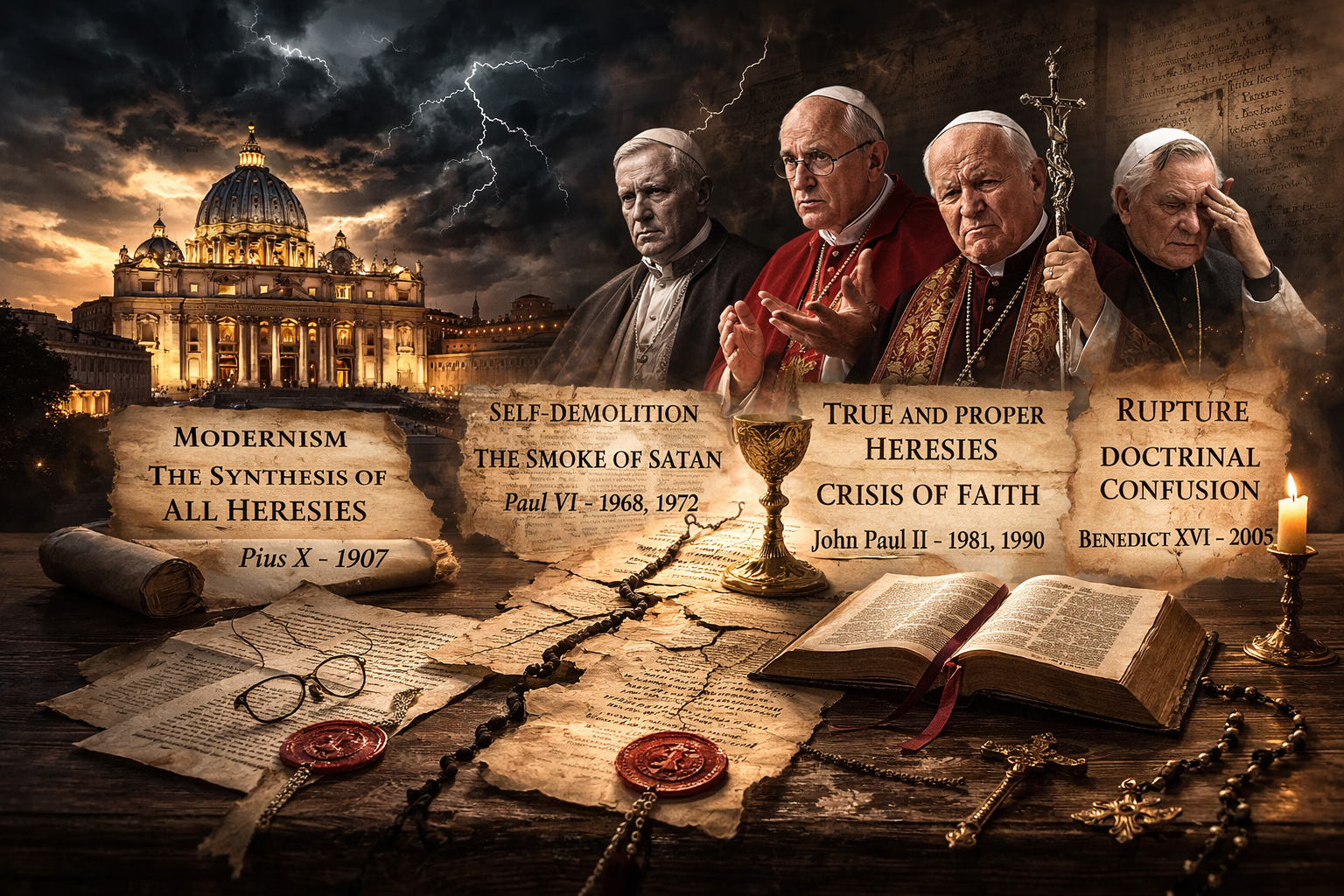
When Pope Pius X promulgated Pascendi Dominici Gregis on 8 September 1907, he described Modernism as “the synthesis of all heresies”⁴ and warned that its adherents were to be found “in her very bosom and heart.”⁵ He further stated that Modernists sought to “destroy the vital energy of the Church”⁶ and reduce dogma to mutable religious experience. This was not external opposition but internal doctrinal corrosion. The subsequent imposition of the Oath Against Modernism (Sacrorum Antistitum, 1 September 1910)⁷ demonstrates that the threat was judged systemic and grave.
In the immediate post-conciliar period, Pope Paul VI spoke of “self-demolition” within the Church⁸ and, on 29 June 1972, warned that “through some fissure the smoke of Satan has entered the temple of God.”⁹ In that same homily, he described doubt and uncertainty replacing confidence. The “temple of God” signifies the Church herself. The language denotes internal spiritual corruption, not minor reform.
Pope John Paul II declared on 6 February 1981:
“True and proper heresies have been disseminated in the dogmatic and moral field… even the liturgy has been tampered with.”¹⁰
The use of “true and proper heresies” is precise theological terminology. It indicates propositions objectively contrary to revealed doctrine. In Redemptoris Missio (7 December 1990), he added that the weakening of missionary zeal “is a sign of a crisis of faith.”¹¹ A crisis of faith strikes at the theological virtue by which believers adhere to divine revelation.
Pope Benedict XVI, in his Christmas Address to the Roman Curia (22 December 2005), identified a “hermeneutic of discontinuity and rupture” shaping interpretation of Vatican II¹². Rupture denotes fracture and breakage in doctrinal continuity. In his memoir Milestones, he lamented the phenomenon of liturgy appearing “fabricated” rather than organically developed¹³ — a comment reflecting concern over sacramental instability.
Even Pope Francis, addressing the Curia on 22 December 2014, catalogued fifteen “spiritual diseases” afflicting governance — including spiritual Alzheimer’s, rivalry, vainglory, and functionalism¹⁴ — employing clinical imagery to describe institutional pathology.
These statements meet classical criteria for grave ecclesial disturbance:
• Danger to the faith: “true and proper heresies,” “crisis of faith,” “synthesis of all heresies.”
• Sacramental disorder: “liturgy has been tampered with,” fabricated worship, rupture in continuity.
• Widespread doctrinal confusion: doubt, rebellion, hermeneutic of discontinuity.
Recognition of such conditions does not require formal declaration to exist objectively. Canonical tradition distinguishes between declarative and constitutive acts. A declaration acknowledges a reality already present; it does not create it. The absence of a decree naming a “state of necessity” does not negate the factual presence of grave disorder if the criteria are met.
This distinction addresses a recurring objection: that only the Pope or bishops in communion with him may “declare” necessity. Governance belongs to the hierarchy. Necessity itself is a condition rooted in fact. Authority may recognise it, interpret it, or respond to it inadequately; its existence depends on objective circumstances, not terminology.
Within this framework, bodies such as the Society of Saint Pius X, the Old Roman Apostolate, and the Servants of the Holy Family do not claim to invent crisis. They appeal to the documented language of the Roman Pontiffs. They argue that when successive Popes describe internal doctrinal confusion, liturgical tampering, and crisis of faith, the conditions correspond to the canonical markers of grave necessity.
Their prudential and juridical conclusions may be debated. The documentary foundation of their perception cannot be dismissed. They are responding to papal diagnosis, not constructing pathology.
The Church remains indefectible. The Creed endures. The sacraments remain valid. Yet the sustained and severe language employed by successive Popes corresponds to objective conditions that classical canonical theology recognises as grave disturbance affecting the salvation of souls. Whether those conditions warrant extraordinary measures is a matter for careful theological judgment. That they have been publicly described from the Chair of Peter is a matter of record.
- 1983 Code of Canon Law, can. 1323, 4°.
- 1983 Code of Canon Law, can. 1324 §1, 5°.
- 1983 Code of Canon Law, can. 1752.
- Pius X, Pascendi Dominici Gregis, 8 September 1907, §39.
- Ibid., §2.
- Ibid., §3.
- Pius X, Sacrorum Antistitum, 1 September 1910.
- Paul VI, Address to Lombard Seminarians, 7 December 1968.
- Paul VI, Homily for the Solemnity of Saints Peter and Paul, 29 June 1972.
- John Paul II, Address to Missionaries, 6 February 1981.
- John Paul II, Redemptoris Missio, 7 December 1990, §2.
- Benedict XVI, Christmas Address to the Roman Curia, 22 December 2005.
- Benedict XVI (Joseph Ratzinger), Milestones: Memoirs 1927–1977, Ignatius Press, 1998, pp. 148–149.
- Francis, Christmas Address to the Roman Curia, 22 December 2014.
RELATED ARTICLES


Latest ARTICLES
- Today’s Mass: September 05 Saint Lawrence JustinianSaint Lawrence Justinian, the first Patriarch of Venice, dedicated his life to the poor and the establishment of monasteries, rejecting noble marriage. Renowned for his humility and pastoral dedication, he emphasised the spiritual integrity of Venice’s safety. He was a precursor to the reforms of the Council of Trent, dying on 8 January 1455.
- 06.09.26 Nuntiatoria CXXII: NOMEN MANET, RES DEESTThis edition of Nuntiatoria explores the disconnect between the names of Catholic institutions and the realities they signify. Despite retaining their titles, many aspects of Catholicism—such as episcopal authority in China and religious practice in Poland—exhibit deteriorating substance. The piece cautions against superficial continuity, stressing the importance of genuine faith and practice over mere nomenclature.
- ORDO w/c 06.09.26The document outlines the liturgical schedule for the week of 6 to 13 September 2026, highlighting significant religious observances such as the Fifteenth Sunday after Pentecost and the Nativity of the Blessed Virgin Mary. It reflects on themes of compassion, holiness, fidelity, and humility, underscoring their importance in Christian life.
- The Fifteenth Sunday after Pentecost: When the Procession of Death Meets the Lord of LifeThe Fifteenth Sunday after Pentecost focuses on the transformative power of Christ, emphasising the supernatural life granted through grace. The liturgy highlights the Church’s role as a nurturing mother, mourning the spiritually dead while seeking their restoration. Christ’s compassion leads to resurrection, demonstrating that true life is found in dependence on Him.
- If Cecchin Is Right, Fatima Is WrongFr Stefano Cecchin, President of the Pontifical International Marian Academy, has declared opposition to apparitions that speak of divine punishment, suggesting they are false. This stance contradicts fundamental Catholic doctrine, including teachings from Scripture, the Catechism, and specifically the Message of Fatima, which warns of divine consequences for sin.


Leave a Reply