
The Return of Orders: Heralds of the Gospel, Roman Authority, and the Resolution of a Seven-Year Suspension
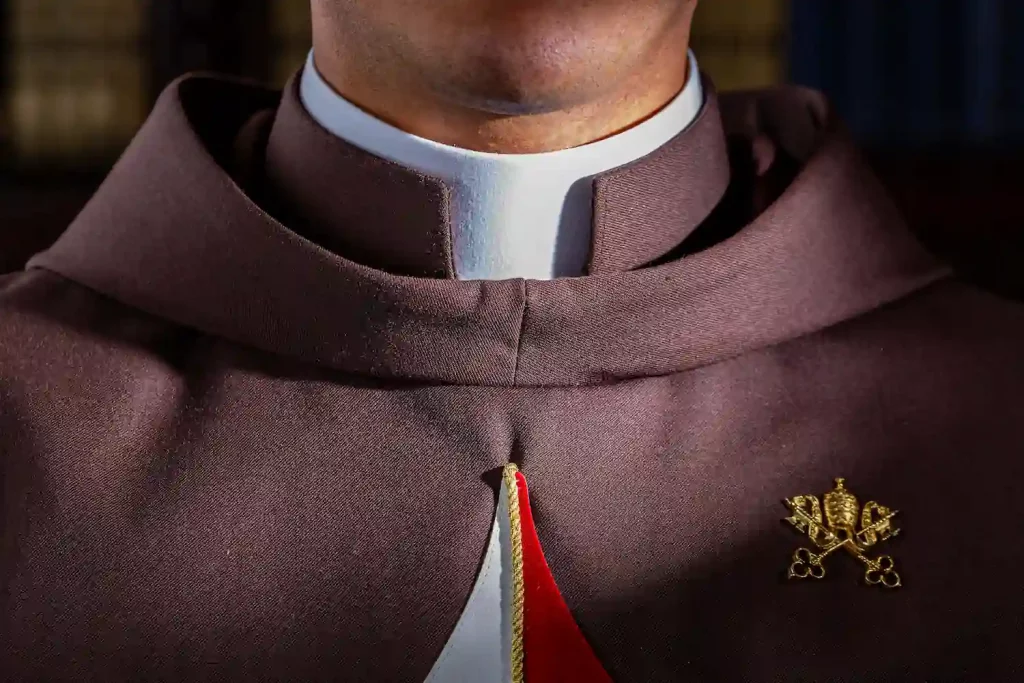
In the Paschal Octave of April 2026—specifically on 11–12 April at the Heralds’ principal house in Caieiras, São Paulo—the international Catholic association known as Heralds of the Gospel ordained 31 new deacons and 26 priests, bringing to an end a prolonged suspension of ordinations that had endured, in practical effect, since 2019.¹ The laying on of hands on the new transitional deacons was conferred by His Excellency. Revdma. Mons. Fernando José Monteiro Guimarães, archbishop emeritus of the Military Archbishopric of Brazil. On Divine Mercy Sunday, the celebration of the ordination of the new priests was presided over by His Eminence Most Reverend Don Raymundo Damasceno Assis, Archbishop Emeritus of Aparecida, Pontifical Commissioner.
The ceremonies were conducted under the authority of the pontifical commissioner appointed by the Holy See during the intervention into the movement, and with the necessary mandate of the Apostolic See. These ordinations do not constitute routine clerical progression. They mark a decisive moment in the relationship between Rome and a movement whose sacramental life had been, for years, administratively restrained. Permitted under the pontificate of Pope Leo XIV, they signal not merely a resumption, but the practical resolution of a prolonged ecclesial impasse.
A Movement Interrupted
Founded in Brazil in 1999 by Monsignor João Scognamiglio Clá Dias, the Heralds of the Gospel expanded rapidly across multiple continents, distinguished by solemn liturgical expression, Marian devotion, and a highly structured communal life. Their ethos drew from the intellectual and spiritual influence of Plinio Corrêa de Oliveira, whose vision of hierarchical Christian order and resistance to modernity helped shape the movement’s identity.²
From 2017, and with increasing intensity in 2019, the Vatican—principally through the Dicastery for the Doctrine of the Faith and associated dicasteries—initiated an apostolic visitation into the Heralds’ internal governance, formation practices, and communal structures.³ The result was a formal commissariate: leadership was displaced, a pontifical commissioner installed, and ordinations suspended.
Such a measure is not merely disciplinary. Within Catholic ecclesiology, the capacity to confer Holy Orders constitutes the generative principle of clerical life. To suspend ordinations is to interrupt continuity at its source.
The Nature and Experience of the Suspension
The Holy See did not publicly classify the suspension as a penal sanction, but rather as an administrative precaution within the context of restructuring.⁴ Its effects, however, were concrete and cumulative. Seminarians completed formation without ordination. Vocations accumulated without sacramental fulfilment. The internal life-cycle of priestly formation was effectively arrested.
The Heralds themselves have offered a markedly different internal interpretation. In a detailed account of the intervention, they describe the process as marked by “excessive and inexplicable prolongation,” alleging that accusations were not clearly disclosed and that procedural transparency was lacking.⁵ They further record the human cost: “numerous deacons… unable to see fulfilled their legitimate expectation of being ordained priests,” and “seven classes of seminarians” prevented from advancing.⁶
These claims, while not adjudicated in a public canonical forum, are essential to understanding the internal perception of the crisis. The suspension was experienced not simply as oversight, but as deprivation.
Civil Proceedings and the Question of Evidence
The juridical context is further clarified by developments in the civil forum. In July 2024, the Court of Justice of the State of São Paulo extinguished a public civil action brought against the Heralds of the Gospel concerning alleged abuses within their educational institutions. The court determined that the Public Defender’s Office lacked standing and that the evidentiary record did not substantiate the claims advanced.¹² The judgment further recognised that the families involved were not in a condition of vulnerability that would support the allegations made, and that the claims of systematic harm were not borne out by the available evidence.
This decision is not, in itself, determinative of the Church’s internal processes. Yet it is highly relevant. It demonstrates that accusations of a grave nature—such as might justify prolonged intervention—were subjected to judicial scrutiny and did not result in condemnation. When set alongside a continued suspension of sacramental life extending several years beyond such findings, the question of proportionality becomes unavoidable.
Ecclesial Justice and the Demand for Resolution
As previously argued in Nuntiatoria (November 2025), the case of the Heralds of the Gospel had already raised broader concerns regarding the administration of justice within the Church. The issue was not the legitimacy of intervention as such, but its execution. Canon law requires that administrative acts be grounded in objective norms, clearly communicated, and brought to resolution within a reasonable time.⁷ Yet the Heralds’ situation was marked precisely by what was lacking: duration without conclusion, supervision without articulated findings, and restriction without final determination.⁸
At that time, the governing principle was stated plainly: cases of this kind cannot remain suspended indefinitely.⁹ The events of April 2026 must therefore be read in light of that principle. The ordinations do not stand in isolation. They represent the concrete resolution—implicit, but unmistakable—of a condition that had already exceeded the bounds of proportionate ecclesial governance.
Resumption Under Roman Authority
The ordinations of April 2026 represent the first substantial release of accumulated vocational and institutional pressure. That they were carried out under the authority of the Holy See, and within the structure of the commissariate, is decisive.
No formal decree of rehabilitation has been promulgated. Yet the permission to proceed—particularly at this scale—constitutes a clear Roman determination that the impediments which previously justified the suspension no longer operate in a prohibitive manner. Contemporary reporting described the event as “the resumption of priestly ordinations after years of interference,” capturing both the opacity of the original intervention and the significance of its conclusion.¹⁰
Roman governance seldom announces reversals explicitly. It proceeds through restoration of faculties and the quiet resumption of sacramental acts. In this instance, the restoration is evident.
A Backlog Made Visible
The ordination of 31 deacons and 26 priests in a single cycle reflects not organic expansion, but delayed continuity. These candidates had completed formation over years in which ordination was not permitted. The result is a concentration—a sudden emergence of clergy that would ordinarily have been distributed across successive years.
This concentration is itself evidence. It demonstrates that the apparent stagnation of the Heralds’ clerical life was not due to a decline in vocations, but to administrative suspension. The vocations remained. Their sacramental consummation was deferred—and has now been granted.
The effect is both practical and symbolic: the restoration of ministerial capacity, and the visible confirmation that the interruption has ended.
Authority, Obedience, and Tension
A notable feature of this episode is the coexistence of critique and obedience. The Heralds have articulated serious concerns regarding the conduct and duration of the intervention. Yet they have remained within canonical obedience, accepting the authority of the pontifical commissioner and the Holy See throughout.
The ordinations themselves embody this tension. They are not acts of resistance, but acts of permission. The movement that protested has nevertheless submitted. The result is not rupture, but restoration—though not without unresolved questions.
Authority and the Postconciliar Pattern
The Heralds’ experience reflects a broader pattern in contemporary ecclesial governance. Movements characterised by strong internal discipline, hierarchical identity, and visible traditionalism have often been subject to extended oversight. Others, more closely aligned with prevailing pastoral trends, have not encountered comparable intervention.
This asymmetry raises substantive questions. What constitutes sufficient cause to suspend a movement’s sacramental life? How long may such a suspension endure? At what point does precaution become obstruction?
The duration of the Heralds’ suspension suggests an administrative model capable of prolongation without clear resolution. The resumption of ordinations suggests, in turn, a recognition that such a condition cannot be indefinitely sustained.
Theological Significance
At its deepest level, the episode concerns the nature of the Church herself. The Church is not merely a juridical institution, but a sacramental organism. The priesthood is not reducible to function; it is an ontological participation in the priesthood of Christ, conferred through Holy Orders for the sanctification of the faithful.¹¹
To suspend ordinations is therefore to interrupt the visible transmission of apostolic ministry. Such an interruption requires grave cause. Its cessation must likewise be understood as a serious act.
The April 2026 ordinations signify precisely this: the restoration of the Church’s generative function within this movement. Governance has yielded, in practice, to sacrament.
Conclusion: Resolution Without Proclamation
The ordination of 31 deacons by the Heralds of the Gospel is, in form, an event. In substance, it is a resolution. A movement once constrained has been permitted to act. A formation pipeline once obstructed has been reopened. A period of suspension has concluded—not through formal declaration, but through sacramental execution.
This is the grammar of Roman governance: not reversal by decree, but resolution by action.
For the Heralds, the moment carries an additional significance: the fulfilment of long-delayed vocations and, in their own account, the rectification of a prolonged injustice. Whether that judgment is universally shared remains an open question. What is not in question is the fact itself: the Church has resumed what she once withheld—and in doing so affirmed that the suspension of her own sacramental continuity cannot be indefinite.
- Edward Pentin, “Heralds of the Gospel Resume Priestly Ordinations After Years of Vatican Intervention,” Zenit, 8 April 2026.
- Roberto de Mattei, Plinio Corrêa de Oliveira: Prophet of the Reign of Mary (Leominster: Gracewing, 2015), 45–47.
- Vatican News, “Holy See appoints pontifical commissioner for Heralds of the Gospel,” 2019.
- Code of Canon Law (1983), c. 318 §1.
- The Commissariate of the Heralds of the Gospel (São Paulo, 2022), 12.
- Ibid., 18.
- Code of Canon Law (1983), cc. 50–51.
- “The Heralds of the Gospel and the Demands of Ecclesial Justice,” Nuntiatoria, 27 November 2025.
- Ibid.
- Pentin, Zenit, 8 April 2026.
- Catechism of the Catholic Church, §1582.
- “Tribunal de Justiça de São Paulo confirma extinção de processo contra os Arautos do Evangelho,” Heraldos.org.uy, 2024.
related articles


Latest articles
- Today’s Mass: September 09 Day II in the Octave of The Nativity of the Blessed Virgin MaryThe feast of Our Lady’s Nativity, of ancient Eastern origin and established at Rome by the time of Pope St Sergius I, celebrates Mary as the immaculate New Eve and the dawn of salvation, the chosen tabernacle from whom the Redeemer would take His flesh. Today the Church also commemorates St Gorgonius, an officer of the imperial household at Nicomedia who, with his companion Dorotheus, embraced the Faith and suffered martyrdom under Diocletian in A.D. 303; his relics were later translated to Rome.
- NOMEN MANET, RES DEEST ~ The Name Remains; the Reality Is Lacking: Spiritual Conference for Nuntiatoria CXXIIThe content emphasises the disconnect between the names associated with Catholicism and the actual practices of faith. It highlights the importance of embodying belief through genuine actions, urging self-examination rather than mere external observance. Ultimately, it advocates for a restoration of sincerity in faith, calling individuals to authentically reflect their beliefs through their lives and worship.
- Mary Is Co-Redemptrix: Cardinal Burke Reopens Rome’s Marian ControversyCardinal Raymond Leo Burke has declared the Virgin Mary as “Co-Redemptrix” amidst controversy over the Vatican’s restriction on this title. The debate revolves around the appropriateness of certain theological language and whether terminology historically used can still accurately express Marian cooperation in Redemption without compromising Christ’s unique role.
- When Politics Defines Doctrine: Edmund Waldstein, Integralism and the New Boundary at HeiligenkreuzThe ongoing exclusion of Father Edmund Waldstein from teaching at Heiligenkreuz has sparked debate on the limits of acceptable Catholic thought, particularly regarding integralism and its relationship to Church doctrine. Critics argue that Waldstein and similar positions challenge both Catholic teachings and democratic values, raising questions about the intersection of faith and politics.
- Christianity Is Right ~ Not Right WingThe article discusses the distinction between Catholic orthodoxy and modern political ideologies, particularly the Right and Christian nationalism. It argues that Catholic beliefs about family, morality, and authority predate contemporary political classifications and should not be conflated with right-wing politics. The ordo amoris framework is presented as a guiding principle for evaluating political alliances while maintaining a focus on the common good and the Social Kingship of Christ.



Leave a Reply