
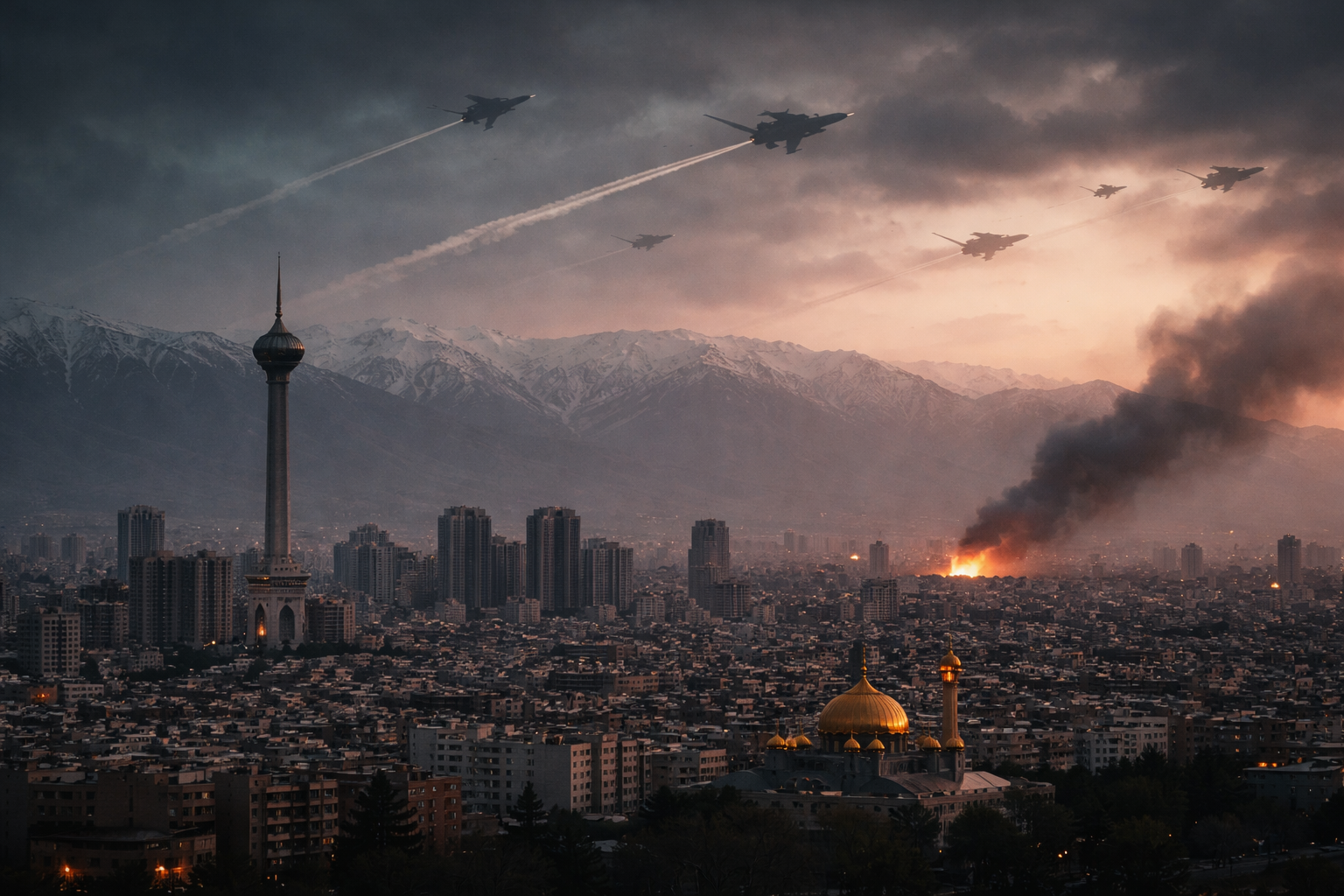
WAR, TYRANNY, AND THE CHRISTIAN CONSCIENCE: HOW CATHOLICS SHOULD VIEW THE IRAN CONFLICT
The recent escalation of war involving Iran and the death of the country’s Supreme Leader has provoked sharply divided reactions across the world. Some voices have greeted the event with jubilation, portraying it as the downfall of a tyrant. Others have responded with outrage, warning that the killing of a head of state by foreign military action represents a dangerous escalation in international conflict. For Catholics, however, the proper response must be more sober than either celebration or ideological condemnation. The Church’s moral tradition calls the faithful to judge political events through the lens of justice, prudence, and the dignity of the human person.
The death of a political leader—even one associated with repression—cannot be treated as a spectacle. Nor can war be viewed merely as a geopolitical game between rival powers. The Christian tradition instead insists that every human life is created in the image of God, that political authority must ultimately serve the common good, and that war, even when justified, is always a tragic consequence of human sin.
The conflict in context
The current crisis must be understood against the background of the Islamic Republic established in Iran in 1979. That revolution replaced the secular monarchy of Shah Mohammad Reza Pahlavi with a theocratic political system built upon the doctrine of velayat-e faqih—the rule of the Islamic jurist. Under this system the Supreme Leader holds ultimate authority over the state, armed forces, and key political institutions.¹
Ayatollah Ali Khamenei, who became Supreme Leader in 1989 following the death of Ayatollah Ruhollah Khomeini, presided over more than three decades of clerical rule. During this period Iran consolidated its influence across the Middle East through alliances with militant and political movements in Lebanon, Syria, Iraq, and Yemen.² At the same time, the regime developed an advanced nuclear programme that has long been viewed by Western governments and Israel as a strategic threat.³
Recent years have also revealed deep internal tensions within Iran. Economic hardship, corruption, and restrictions on political freedom have generated repeated waves of protest. Demonstrations in 2019 and again in 2022–2025 were met with severe repression by the Iranian security apparatus.⁴ The existence of such protests highlights an often overlooked reality: the Iranian people themselves are far from unified in support of the regime that governs them.
In this context, the death of the Supreme Leader during the present conflict has intensified an already unstable situation. While the state apparatus continues to function, the loss of a long-standing leader raises profound questions about succession and political legitimacy within the Islamic Republic.
Internal tensions within Iran
Western commentary frequently portrays Iran as a monolithic ideological state, yet the country contains diverse political and social forces. The ruling clerical establishment, supported by the Islamic Revolutionary Guard Corps, maintains tight control over political institutions. Yet large segments of the population—particularly younger Iranians—have expressed frustration with economic stagnation and restrictions on civil life.⁵
These tensions have occasionally erupted into mass demonstrations. The protests that followed the death of Mahsa Amini in 2022, for example, revealed widespread dissatisfaction with the regime’s moral policing and political authoritarianism.⁶ Such events suggest that the Islamic Republic faces not merely external pressure but also an ongoing internal crisis of legitimacy.
The death of a supreme leader during wartime therefore carries unpredictable consequences. It may consolidate the regime as factions unite against external threats, or it may deepen internal divisions that have long been present beneath the surface of Iranian political life.
The wider geopolitical stakes
Iran occupies a central position in the geopolitical architecture of the Middle East. Through alliances with groups such as Hezbollah and other regional actors, Tehran has developed a network of influence stretching from Lebanon to Yemen.⁷ This strategic posture has made Iran a major counterweight to Israel and to Western-aligned states in the region.
For decades the central concern among Western governments has been Iran’s nuclear ambitions. Diplomatic negotiations, sanctions regimes, and intelligence operations have all attempted to constrain Tehran’s nuclear development.⁸ The recent escalation of military confrontation represents the most serious rupture in that long diplomatic struggle.
Yet history suggests that leadership decapitation alone rarely resolves geopolitical conflicts. Political systems—especially those rooted in revolutionary ideology—often survive the loss of individual leaders. The broader strategic tensions that produced the conflict therefore remain unresolved.
The Catholic moral framework
In evaluating such events, Catholics must turn to the moral tradition of the Church rather than to the passions of political commentary.
The Church’s teaching on war is rooted in the just war tradition articulated by theologians such as St Augustine and St Thomas Aquinas. Augustine argued that war may sometimes be necessary to restrain injustice, yet it must always be ordered toward the restoration of peace rather than vengeance.⁹ Aquinas later developed the classical criteria for a just war: legitimate authority, just cause, and right intention.¹⁰
The modern magisterium has reaffirmed these principles while emphasising the tragic nature of war. The Second Vatican Council declared that even when war becomes unavoidable, its conduct must remain subject to moral law and directed toward the defence of human dignity.¹¹
In this framework the death of a tyrannical ruler cannot be celebrated as a good in itself. Catholic tradition recognises that resistance to tyranny may sometimes be morally legitimate, but it also insists that the deliberate taking of life carries grave moral weight.¹²
The Christian response therefore rejects both naïve pacifism and bloodthirsty triumphalism. Catholics may acknowledge the injustice of oppressive regimes while still mourning the human suffering caused by war.
Between justice and compassion
The present conflict illustrates a perennial tension in political life. Governments must sometimes confront aggressive regimes, yet the use of force inevitably harms innocent people. Civilians, not political leaders, usually bear the greatest cost of war.
For Catholics the appropriate attitude is therefore one of moral realism tempered by charity. Christians may recognise the dangers posed by authoritarian regimes, but they must also pray for peace and for the protection of the innocent. The Church calls the faithful not to hatred of enemies but to the conversion of hearts.
The death of a ruler and the turmoil of war are reminders of the fragility of political power. Empires rise and fall, governments change, and conflicts reshape the world’s political landscape. Yet the moral law remains constant. Every human person possesses an inherent dignity that no political ideology can erase.
In the midst of geopolitical upheaval, Catholics must therefore remain guided not by partisan passions but by the enduring principles of the Gospel: justice, prudence, and the hope of peace.
¹ Wilfried Buchta, Who Rules Iran? The Structure of Power in the Islamic Republic (Washington DC: Washington Institute for Near East Policy, 2000), 3–7.
² Ray Takeyh, Guardians of the Revolution: Iran and the World in the Age of the Ayatollahs (Oxford: Oxford University Press, 2009), 210–236.
³ International Atomic Energy Agency, Verification and Monitoring in Iran (IAEA reports, various years).
⁴ Amnesty International, Iran: Details of 2019 Crackdown on Protests (London: Amnesty International, 2020).
⁵ Suzanne Maloney, Iran’s Political Economy Since the Revolution (Cambridge: Cambridge University Press, 2015), 314–320.
⁶ Human Rights Watch, Iran: Violent Suppression of Mahsa Amini Protests (2022).
⁷ Augustus Richard Norton, Hezbollah: A Short History (Princeton: Princeton University Press, 2007), 94–118.
⁸ Kenneth Katzman, Iran’s Nuclear Program: Status and Policy Options (Congressional Research Service, various editions).
⁹ St Augustine, Contra Faustum, XXII.74.
¹⁰ St Thomas Aquinas, Summa Theologiae, II–II, q. 40, a. 1.
¹¹ Second Vatican Council, Gaudium et Spes, §79–80.
¹² John Finnis, Natural Law and Natural Rights (Oxford: Oxford University Press, 2011), 283–288.
RELATED ARTICLES


Latest ARTICLES
- Today’s Mass: October 09 St Dennis, Bishop with Rusticus & Eleutherius, MartyrsGregory of Tours states that Denis was bishop of the Parisii and was martyred by being beheaded by a sword. The earliest document giving an account of his life and martyrdom, the “Passio SS. Dionysii Rustici et Eleutherii” dates from c. 600, is mistakenly attributed to the poet Venantius Fortunatus, and is legendary.
- Today’s Mass: October 08 St Bridget of SwedenSaint Bridget of Sweden, born around 1302, was a noblewoman renowned for her piety and prophetic revelations. After marrying Prince Ulpho and raising eight children, she led a life of austerity and charity, founding the Order of the Holy Saviour. She died in Rome in 1373 and was canonised in 1391.
- Today’s Mass: October 07 Pope St Mark, ConfessorSt Mark’s brief pontificate teaches that God measures fidelity, not duration or worldly achievement. Christ alone possesses the everlasting priesthood; His servants are stewards of what they have received. With the commemorated martyrs, St Mark reminds us to persevere faithfully, so that when the Lord comes, He finds us “so doing.”
- Omnia autem probate: quod bonum est tenete ~ Prove all things; hold fast that which is good: Spiritual Conference for Nuntiatoria CXXVIThe conference reflects on St Paul’s assertion to “prove all things” in relation to self-judgement and the Church. It explores themes of synodality, ecumenism, and the importance of discernment, emphasising the need for humility in understanding truth and the challenge of maintaining genuine holiness in the midst of contemporary ecclesiastical crises.
- FROM PERMISSION TO PRESUMPTION: Fort Worth and the Chalice Vatican II never made the NormBishop Michael Olson has implemented strict limitations on the distribution of Communion under both species in the Diocese of Fort Worth, prompting a discussion on the historical evolution of liturgical practices following Vatican II. This decision aims to reaffirm the doctrine of the Eucharist, emphasising that Christ is fully present under either species, while addressing misconceptions surrounding modern practices.



Leave a Reply