
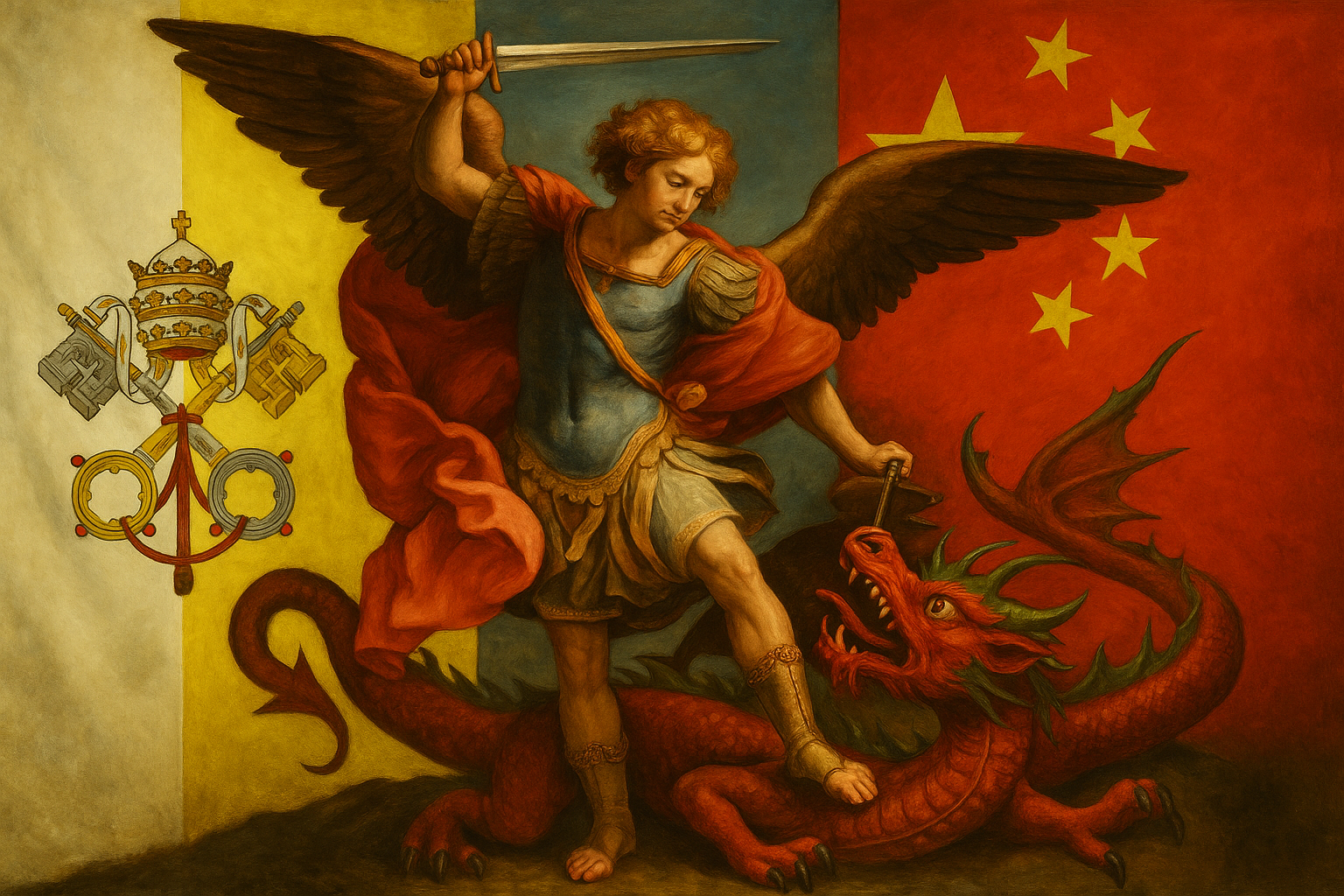
Beijing’s terms, Rome’s signature: the China deal and the cost of unity
The quiet absorption: how the China–Vatican agreement has reshaped the underground Church
The 2018 provisional agreement between the Holy See and the People’s Republic of China was presented as a diplomatic breakthrough: a cautious, even necessary, step toward unity in a fractured ecclesial landscape. Yet in the years since its signing, a growing body of evidence—documented by observers such as Human Rights Watch—suggests that the agreement has not secured the freedom of the Church, but rather facilitated a reconfiguration of pressure, shifting it onto those Catholics who had remained most faithful under persecution. The claim is not speculative but empirical: it is visible in names, in dioceses, in arrests, and in silences.
The unresolved fate of the underground episcopate
The case of Bishop James Su Zhimin of Baoding remains one of the most enduring indictments of the post-2018 settlement. Detained by state authorities in 1997, he has effectively disappeared from public view. Despite the Vatican’s rapprochement with Beijing, no credible update on his condition or status has been secured.¹ His continued detention underscores a fundamental point: the agreement has not been leveraged to secure justice for those who suffered most prior to its conclusion. Similarly illustrative is the treatment of Bishop Peter Shao Zhumin, repeatedly detained after 2018 for refusing compliance with state registration requirements.² His periodic disappearances—euphemistically framed as “study sessions” or “re-education”—demonstrate that the coercive apparatus remains intact, merely recalibrated to the new ecclesial framework.
The restructuring of episcopal legitimacy
The case of Bishop Vincent Guo Xijin is perhaps the most theologically revealing. Recognised by Rome as the legitimate underground bishop of Mindong, he was nevertheless asked to step aside in favour of a state-approved counterpart as part of the agreement’s implementation.³ This was not a peripheral concession but a reversal of the Church’s prior posture, in which underground fidelity had been affirmed as a witness to ecclesial integrity. In the aftermath, Bishop Guo reported sustained pressure, including eviction and harassment, before withdrawing from public ministry.⁴ This was not merely a concession; it was a signal. For the first time, the logic of the agreement appeared to require that fidelity under persecution give way to compliance under supervision. The underground bishop was not simply replaced—he was rendered ecclesiologically inconvenient. The symbolism is unmistakable: the underground bishop yields; the state-aligned structure consolidates.
Administrative coercion and the logic of registration
Across multiple provinces—Hebei, Zhejiang, and Fujian—priests have reported systematic efforts to compel their registration within the Chinese Patriotic Catholic Association.⁵ The terms frequently include affirmations of ecclesial “independence,” historically understood as implying practical severance from papal authority. Refusal leads to detention, surveillance, restriction of ministry, or removal from parish life.⁶ What has changed since 2018 is not the existence of pressure, but its justification. What had once been persecution now presents itself as regularisation; what had once been resistance is recast as disobedience. Compliance is framed as participation in a unified Church, implicitly endorsed by Rome. This is the critical shift identified by Human Rights Watch—coercion has become ecclesially mediated.
The dismantling of the underground parish structure
At the parish level, reports document the closure of unregistered chapels and the forced integration of their congregations into state-approved parishes.⁷ In some cases, churches have been demolished; in others, religious symbols have been removed or replaced in accordance with the state’s programme of “Sinicization.” This term, as deployed by the Chinese Communist Party, does not denote the organic inculturation long practised by the Church, but a political process by which religion is reshaped to conform to state ideology, national identity, and Party authority. It requires not merely cultural expression, but institutional alignment, doctrinal accommodation, and the effective subordination of ecclesial life to political oversight. The effect is cumulative: the underground Church is not eradicated in a single act, but gradually deprived of the conditions necessary for its survival.
The limits of the agreement
The installation of Bishop John Peng Weizhao in 2022 without clear Vatican approval exposed the agreement’s structural weakness.⁸ The Holy See issued a rare protest, demonstrating that the mechanisms governing episcopal appointments are neither transparent nor enforceable. The agreement does not constrain unilateral state action; it places Rome in a position of reactive diplomacy, responding to faits accomplis.
Moral responsibility without bad faith
To refrain from imputing bad faith to the Holy See is not to suspend moral judgment. The agreement is a prudential act and must be evaluated accordingly. If it foreseeably results in pressure on clergy, marginalisation of faithful bishops, and the dismantling of underground communities, then the question becomes one of proportionate reason. In classical moral theology, good intentions cannot justify disproportionate harm, nor can harmful effects become the means of achieving a desired good. The evidence suggests that the suffering of the underground Church is not incidental but structurally entangled with the agreement’s implementation.
This raises the further question of cooperation with coercive structures. The agreement does not endorse persecution, yet it may constitute material cooperation with a system that compels conscience and redefines ecclesial obedience in state terms. Such cooperation requires grave justification. Whether that justification exists remains deeply contested.
A witness from within: the warning of Cardinal Zen
The critique advanced here is not confined to external observers or Western advocacy groups. It has been articulated with particular urgency by Cardinal Joseph Zen, who has consistently warned that the agreement risks abandoning the underground Church to the very pressures it was meant to alleviate. In one of his most widely cited interventions, he described the policy as effectively encouraging the faithful to “enter a cage,” arguing that the state-recognised structures offer not freedom, but supervised compliance.¹⁰
Zen’s concern is not merely political, but ecclesiological. He has repeatedly argued that the distinction between the underground Church and the state-sanctioned system is not administrative but moral: it concerns the integrity of the Church’s witness under coercion. To collapse that distinction in the name of unity, he suggests, is to risk confusing prudence with concession.
His critique carries a particular weight because it proceeds not from abstraction, but from proximity. As a bishop who has long defended the rights of Chinese Catholics under pressure, his warnings reflect a pastoral judgment formed in the crucible of lived experience. When such a voice cautions that a policy may compromise the faithful it seeks to protect, that warning cannot be dismissed as ideological or external. It must be reckoned with as internal testimony.
Continuity and contrast: the vision of Pope Benedict XVI
A further point of reference sharpens the contrast. In his 2007 Letter to Chinese Catholics, Pope Benedict XVI affirmed both the desirability of reconciliation and the necessity of preserving the Church’s hierarchical constitution and freedom from undue state interference.¹¹ While acknowledging the complexity of the Chinese situation, he warned against solutions that would compromise the essential structures of ecclesial communion.
Set against that framework, the present agreement appears not as a simple continuation, but as a development marked by a greater willingness to accommodate state-defined conditions. The tension lies precisely here: between a vision of unity rooted in truth and one negotiated within constraint.
Conclusion: unity at the cost of witness
The cumulative evidence supports the conclusion advanced by Human Rights Watch: the agreement has enabled intensified pressure on underground Catholics, presenting compliance as both civic and ecclesial necessity.⁹ This does not require imputing bad faith; it requires recognising a failure of judgment at a level where judgment shapes the conditions of conscience and fidelity. For decades, the underground Church bore witness to the truth that communion with Rome may require suffering. If that witness is now diplomatically sidelined or institutionally absorbed, the signal sent is not unity but conditional fidelity.
The question, then, is no longer whether the agreement has achieved unity, but what kind of unity it has produced. If fidelity must yield in order for unity to be maintained, then what is preserved is not communion, but structure. And a structure that requires the quiet displacement of witness cannot long sustain the truth it claims to serve.
¹ U.S. Commission on International Religious Freedom, Annual Report (2019–2024), China sections.
² AsiaNews, reports on Bishop Shao Zhumin (2018–2023).
³ Vatican News, Mindong Diocese reporting (2018).
⁴ Union of Catholic Asian News, coverage of Bishop Guo Xijin (2020–2022).
⁵ Human Rights Watch, China: Revised Religious Regulations Tighten Control (2018).
⁶ Congressional-Executive Commission on China, reports (2019–2024).
⁷ ChinaAid, documentation (2018–2023).
⁸ Holy See Press Office, statement on Bishop Peng Weizhao (2022).
⁹ Human Rights Watch, statements (2020–2024).
¹⁰ Reuters; AsiaNews, interviews and reports on Cardinal Zen (2018–2023).
¹¹ Holy See, Letter of Pope Benedict XVI to the Catholics in China (2007).
RELATED ARTICLES


LATEST ARTICLES
- FRANCE BEFORE LEO XIV: THE NUMBERS ROME MUST FACEIn the week before Pope Leo XIV’s visit to France, alarming statistics underscore significant declines in French Catholicism: 68% fewer priests, 72% fewer parishes, 64% fewer baptisms, and 81% fewer marriages since 1980. Despite a rise in adult baptisms, the Church faces challenges in transmitting faith while navigating a diminished sacramental culture.
- A GOOD HABIT — BUT FOR WHOM?Blackfriars Oxford’s Good Habit café creatively meets community needs while providing revenue but lacks explicit support for the poor. Inspired by St Dominic’s legacy of charity, the café could incorporate pay-it-forward schemes to invite those in need to share the space, ensuring hospitality extends to all, not just paying customers.
- SLAVERY, REPARATIONS AND THE MISSING DEFENDANTSCaribbean governments are moving towards possible legal action against Britain over slavery. Britain’s responsibility is real, but so are African participation in supplying the Atlantic trade, Britain’s later international campaign to suppress it, the liberation of some 150,000 Africans by the Royal Navy and the deaths of approximately 2,000 British personnel during suppression. Any coherent doctrine of reparations must explain how historical liability is inherited and why the same principle applies to some successor states but not others.
- IVREA: WHEN SYNODALITY MEETS A CLOSED DOORIn the Diocese of Ivrea, disparate grievances have emerged among various communities regarding liturgical restrictions, clerical transfers, and financial transparency, leading to a crisis in confidence. The fundamental issue is whether Bishop ✠Salera’s authority translates into the listening and reconciliation he advocates, as congregations increasingly feel unheard and overlooked.
- Today’s homily: St Eustace & Co. Martyrs, XVII Post PentecostThe reflection on St Eustace and his family’s martyrdom highlights the profound commitment required of Christian households to love God entirely. Their example illustrates that true love for God often entails sacrifices, including comfort and earthly bonds, and that a family must priority spiritual unity over worldly concerns to cultivate faith and strive for eternal salvation.



Leave a Reply