
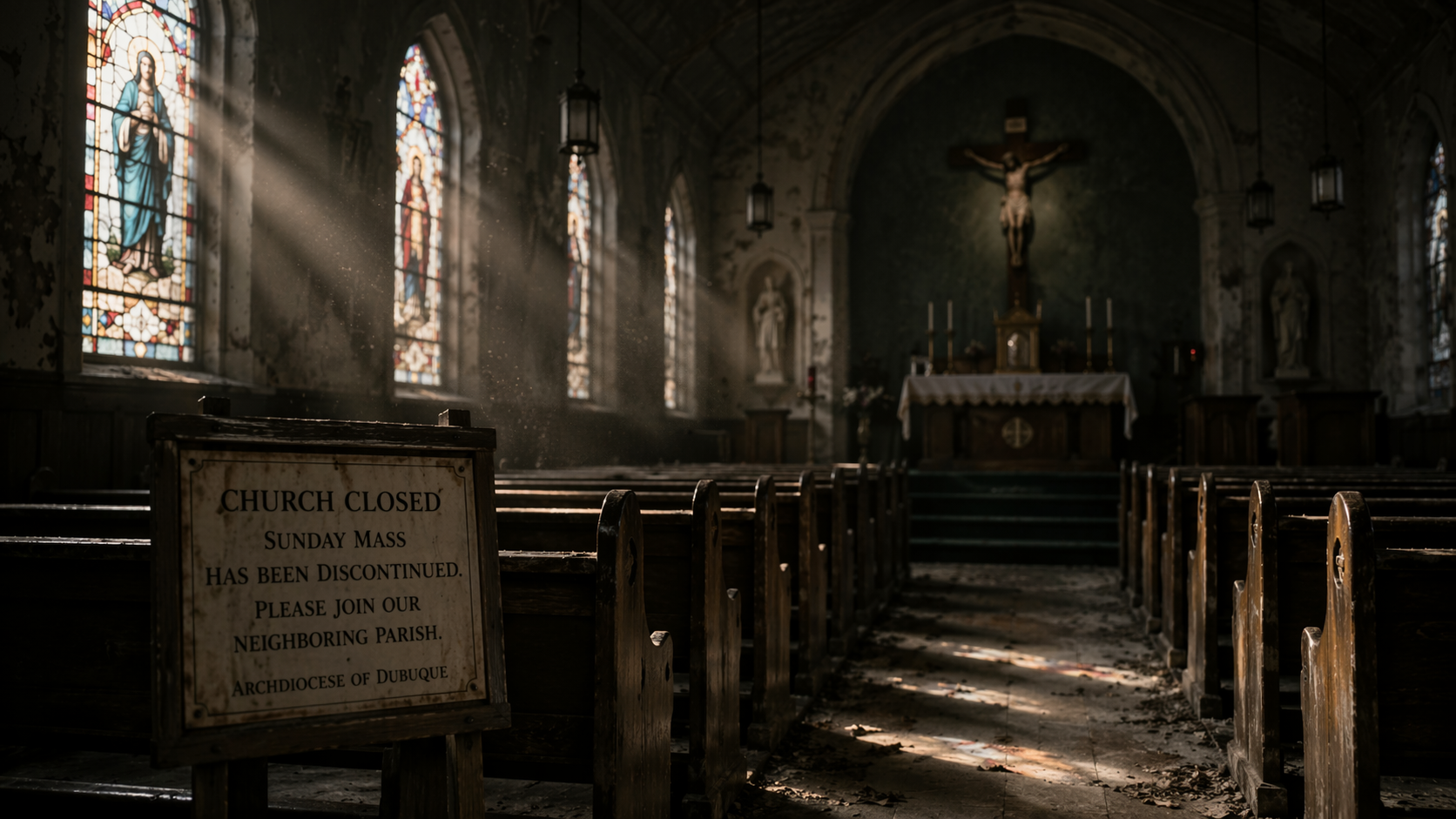
THE SILENT SUPPRESSION: 84 PARISHES, ONE SUNDAY, AND THE SHRINKING CHURCH
The Archdiocese of Dubuque has confirmed that Sunday Mass will cease in eighty-four parishes as part of a major diocesan restructuring initiative announced in early 2026 under the direction of Archbishop Thomas Zinkula.¹ The decision, framed as a pastoral response to declining attendance, reduced clergy numbers, and demographic contraction, represents one of the most significant local retrenchments of parish life in the United States in recent years. It is not, however, an isolated measure, but a local expression of a wider pattern observable across the Western Church.

A Crisis Measured in Absence
The official rationale is clear: fewer priests, fewer practising Catholics, and a parish infrastructure no longer proportionate to the faithful it serves. According to data from the Center for Applied Research in the Apostolate (CARA), the number of active diocesan priests in the United States has declined by over 40% since the late twentieth century, while weekly Mass attendance has fallen from approximately 55% of Catholics in the 1950s to under 25% in recent decades.² These figures are not abstract—they translate directly into empty pews, overextended clergy, and parishes unable to sustain regular sacramental life.
In announcing the restructuring, Archbishop Zinkula acknowledged these pressures directly, noting that “we cannot continue to maintain the current number of parish sites with the number of priests and the level of participation we now have.”³ Such admissions, once rare, are becoming increasingly common across Western dioceses.
Yet the cessation of Sunday Mass in a parish is not merely an administrative adjustment. It is, in effect, the suspension of the Church’s central act of worship in that locality. Where the altar is no longer regularly served, the parish ceases, in any meaningful theological sense, to exist as a Eucharistic community.
From Parish to Outpost
The practical consequence is a redefinition of parish identity. Communities once gathered weekly around the Sacrifice of the Mass are recast as satellites within larger “pastoral clusters,” served intermittently by itinerant clergy. This model, increasingly common in rural dioceses, replaces stability with rotation and presence with provision.
Historically, the parish has been territorial, stable, and sacramentally anchored. The Council of Trent insisted upon the resident pastor as the ordinary means by which souls are shepherded and the sacraments administered.⁴ The present shift away from that model marks not merely a logistical adaptation but an ecclesiological reconfiguration.
The risk is cumulative. As physical distance from the nearest Sunday Mass increases, participation declines further; as participation declines, consolidation accelerates. The cycle becomes self-reinforcing.
A Western Pattern, Not an Exception
What is occurring in Dubuque mirrors developments elsewhere. In Germany, official Church statistics record hundreds of parish mergers and closures annually, alongside a dramatic rise in formal defections (Kirchenaustritte), exceeding 500,000 in 2022 alone.⁵ In Ireland, diocesan reports indicate that the number of active priests has fallen by more than a third in some regions over the past two decades, necessitating widespread parish clustering.⁶ In the United Kingdom, Mass attendance has declined significantly since the late twentieth century, with diocesan restructuring plans consolidating parishes and reducing regular services in multiple regions.⁷
The consistency of these developments suggests that Dubuque is not an outlier but a representative case within a broader civilisational shift.
Secularisation or Self-Inflicted Decline?
The prevailing explanation attributes such contraction to secularisation: the erosion of religious belief and practice within modern Western societies. There is undeniable force in this argument. Yet it is insufficient on its own.
Periods of hostility toward the Church in earlier centuries did not produce comparable collapses in participation. The present decline is occurring not under persecution but under conditions of relative freedom. This raises a more difficult question: whether internal factors have amplified external pressures.
Critics point to doctrinal ambiguity, the fragmentation of liturgical life, and a pastoral strategy often perceived as accommodation rather than proclamation. Where the faith is presented indistinctly, it is seldom embraced with conviction. As Pope Benedict XVI observed, “the crisis of the Church in Europe is a crisis of faith.”⁸ The issue, therefore, is not merely sociological but theological.
The Theology of Contraction
The disappearance of Sunday Mass from eighty-four parishes is not simply a statistical event. The Eucharist is the “source and summit of the Christian life,”⁹ the act through which the Church is most fully herself. Its regular absence from a locality signifies not adaptation but diminishment.
The Fathers of the Church consistently emphasised the centrality of the Eucharistic assembly. St John Chrysostom warned that the weakening of sacramental life leads to the weakening of faith itself.¹⁰ The parish is not an administrative unit but a Eucharistic reality; without the latter, the former becomes nominal.
In this light, the restructuring in Dubuque is not merely organisational. It is sacramental in its implications.
A Church Managing Decline
What distinguishes the present moment is not simply contraction, but its normalisation. The language surrounding such decisions is managerial—efficiency, sustainability, allocation of resources—rather than missionary or penitential. Decline is treated as a problem to be administered rather than a crisis to be reversed.
This shift in posture is itself significant. A Church that plans for contraction risks habituating itself to diminished expectations. A Church that reduces its presence may, over time, cease to imagine expansion.
Conclusion: Retrenchment or Renewal?
The suppression of Sunday Mass in eighty-four parishes is not the end of the Church in Dubuque. But it is a sign—a visible, measurable indication of a deeper condition.
The question it poses is stark. Is the Church in the West engaged in a necessary retrenchment before renewal, or has it entered a phase of managed decline from which it no longer expects recovery?
History offers precedents for both outcomes. The difference has never been structural alone, but spiritual: clarity of doctrine, integrity of worship, and confidence in the truth proclaimed.
Where the altar disappears, the Church does not reorganise—it recedes.
¹ Archdiocese of Dubuque, pastoral restructuring initiative, announced 2026 under Archbishop Thomas Zinkula.
² Center for Applied Research in the Apostolate (CARA), Frequently Requested Church Statistics, Georgetown University, 2023.
³ Archbishop Thomas Zinkula, diocesan communication on parish restructuring, 2026.
⁴ Council of Trent, Session XXIII (1563), Decree on Reform, ch. 1–2.
⁵ German Bishops’ Conference, Kirchliche Statistik 2022, reporting 522,821 formal defections.
⁶ Irish Catholic Bishops’ Conference, vocations and parish restructuring data, 2000–2023.
⁷ Catholic Bishops’ Conference of England and Wales, statistical reports on Mass attendance and parish restructuring, 2010–2023.
⁸ Pope Benedict XVI, Address to the Bishops of Switzerland, 7 November 2006.
⁹ Lumen Gentium, §11.
¹⁰ St John Chrysostom, Homilies on the Acts of the Apostles, Homily 3.
RELATED ARTICLES


LATEST ARTICLES
- Today’s homily: Christ the KingThe homily reflects on Christ’s kingship as seen in the Gospel narrative. It contrasts earthly authority with divine truth, emphasising that true allegiance to God requires genuine obedience and transformation. Believers are called to examine their personal commitments and respond to Christ’s demands in everyday life, ultimately recognising their identity as bearers of God’s image.
- Sermon for Christ the KingToday marks the celebration of Christ the King and the Twenty Second Sunday after Pentecost, a feast asserting Christ’s sovereignty against totalitarianism. St. Paul emphasised Christ’s supremacy over power and principalities, challenging early Gnostic beliefs. The early Church’s victory over evil is affirmed in Christ’s resurrection, offering hope and unity amidst contemporary struggles.
- Today’s Mass: October 25 SOVEREIGNTY OF OUR LORD JESUS CHRIST, SUPREME KINGThe Feast of the Sovereignty of Our Lord Jesus Christ celebrates Christ’s dual kingship by birth and conquest. Established by Pius XI, it aims to deepen faith and counter anti-clericalism. The liturgical observance underscores His authority as King, advocating for societal recognition of His reign to bring peace and harmony.
- TRADITION BEHIND THE FENCEThe Vatican’s prohibition of the traditional Ad Petri Sedem pilgrimage to St Peter’s Basilica has sparked controversy, especially among traditional Catholics. While some cite scheduling conflicts, the broader issue lies in the restrictive policies of Traditionis custodes, which may confine traditional liturgical practices to specific enclaves, risking the transmission and recognition of Catholic Tradition within the wider Church.
- Today’s Mass: October 24 St Raphael the ArchangelThe Feast of Saint Raphael the Archangel highlights his healing powers as depicted in the Book of Tobit, where he aids Tobit and his son, Tobiah. Venerated as a protector of travellers and the blind, Raphael is celebrated for his miraculous interventions. His legacy includes support for nurses, matchmakers, and Catholic studies.





Leave a Reply