

Workplace Limbo After the Supreme Court: Ministers Retreat from Clarity on Single-Sex Spaces
The Government has confirmed that forthcoming statutory guidance from the Equality and Human Rights Commission (EHRC) on single-sex spaces will not apply to workplace regulations, leaving employers—particularly within the NHS—without updated, binding clarification following the 2025 ruling of the Supreme Court of the United Kingdom on the meaning of “sex” in the Equality Act 2010.
The Supreme Court held in April 2025 that “sex” under the Act refers to biological sex¹, clarifying the statutory framework governing single-sex provisions. The judgment was widely regarded as resolving a longstanding ambiguity in equality law. Yet subsequent ministerial statements indicate that while the EHRC’s revised Code of Practice for services and public functions is under review, it will not extend to employment regulations².
The result is a bifurcated compliance landscape: updated guidance for service providers, but no corresponding revision to the employment code, which has not been substantively updated since 2011³.
Services Covered—Employment Deferred
The EHRC submitted its revised Code of Practice for services, associations and public functions to ministers in September 2025⁴. The regulator has stated that this formed part of a two-year review process intended to reflect more than a decade of legislative development. However, it has also confirmed that revision of the employment Code of Practice will follow only “in due course”⁵.
In the interim, workplace guidance predating the Supreme Court ruling remains operative. That earlier framework reflects legal assumptions and policy interpretations formed before the Court’s clarification of the statutory meaning of sex.
Bridget Phillipson MP, Secretary of State for Education and Minister for Women and Equalities, has publicly confirmed that the revised Code “does not apply to workplace regulations,” indicating that employers must independently ensure compliance pending formal revision⁶.
This position leaves public bodies, including NHS trusts, responsible for reconciling existing employment guidance with the Supreme Court’s interpretation of the Equality Act—without centralised regulatory harmonisation.
The NHS and the Melle Case
The issue has assumed particular prominence in the NHS. In 2025, Health Secretary Wes Streeting pledged to introduce new NHS rules on single-sex spaces “within weeks” of the Supreme Court’s ruling⁷. At the time of writing, no such comprehensive update has been promulgated.
The controversy has been sharpened by the case of Jennifer Melle, a nurse at St Helier Hospital in Surrey, who in May 2024 declined to use female pronouns for a transgender prisoner, citing her Christian beliefs. She was suspended for nine months and referred to the Nursing and Midwifery Council under its professional conduct code⁸. Her employment tribunal claim against Epsom and St Helier Hospitals NHS Trust is scheduled for hearing in 2026.
Campaign organisations, including the Christian Legal Centre, have argued that the absence of updated employment guidance leaves healthcare workers vulnerable to disciplinary action in cases involving contested interpretations of equality law⁹.
Regulatory Fragmentation and Institutional Risk
The EHRC has emphasised that employers should not await formal publication of the revised Code before aligning policies with the law¹⁰. Yet in practice, numerous public institutions have indicated that they are awaiting ministerial approval and updated guidance before implementing significant policy changes.
This regulatory fragmentation—judicial clarification without synchronous administrative revision—risks producing inconsistent localised policies, increased litigation, and a climate of uncertainty for both employers and employees.
At stake are not merely procedural questions but competing legal duties: safeguarding, privacy, non-discrimination, and freedom of conscience. Where statutory interpretation has shifted, yet regulatory instruments lag, operational confusion is inevitable.
A Catholic Reflection: Truth, Law, and the Common Good
From a Catholic perspective, law is not merely procedural but teleological. As St Thomas Aquinas teaches, law is “an ordinance of reason for the common good, promulgated by one who has care of the community”¹¹. Clarity in law is therefore not a bureaucratic luxury but a moral necessity.
The Church’s anthropology affirms the unity of body and soul, recognising sex as a given of created reality rather than a subjective construct¹². At the same time, Catholic moral teaching insists upon the inherent dignity of every human person, including those experiencing gender dysphoria¹³. Justice requires both truth and charity: truth in the definition of reality, and charity in personal encounter.
Where civil authority fails to provide coherent guidance grounded in objective definitions, it risks undermining both justice and social peace. Ambiguity does not produce compassion; it produces conflict. Institutions charged with safeguarding the vulnerable and upholding professional integrity require clarity rooted in truth.
The Supreme Court has spoken. The question now is whether executive authority will align regulatory practice with judicial clarity—or whether ambiguity will continue to define the operational environment of Britain’s public institutions.
¹ Supreme Court of the United Kingdom, judgment clarifying the definition of “sex” under the Equality Act 2010, April 2025.
² Bridget Phillipson MP, public comments on scope of EHRC Code of Practice, 11 February 2026.
³ Equality and Human Rights Commission, Employment Statutory Code of Practice, 2011 (current edition in force).
⁴ Equality and Human Rights Commission, submission of revised Code of Practice for services, associations and public functions to ministers, September 2025.
⁵ EHRC spokesperson statement confirming future revision of employment code “in due course,” 2026.
⁶ Bridget Phillipson MP, remarks confirming workplace exclusion from revised Code, February 2026.
⁷ Wes Streeting MP, statement following Supreme Court ruling, 2025.
⁸ Nursing and Midwifery Council, The Code: Professional standards of practice and behaviour for nurses, midwives and nursing associates, 2018 (current edition).
⁹ Christian Legal Centre, public statement regarding Jennifer Melle case, 2026.
¹⁰ Equality and Human Rights Commission statement urging duty-bearers not to await publication before complying with the law, 2026.
¹¹ St Thomas Aquinas, Summa Theologiae, I–II, q.90, a.4.
¹² Catechism of the Catholic Church, §§369–373.
¹³ Catechism of the Catholic Church, §1700.
RELATED ARTICLES


Latest ARTICLES
- Today’s Mass: October 17 St Gall, Confessor;Saint Gall, born in Ireland in the sixth century, became a notable confessor after accompanying Saint Columban to France and later Switzerland, where he preached and converted idolaters. Despite his significant contributions, he humbly declined the position of bishop of Constance. He died in 646, leaving a lasting legacy.
- 18.10.26 Nuntiatoria CXXVIII: NON POTEST VERITAS SUBDI POTESTATIThis editorial asserts that truth should not be subjugated to authority, emphasising that legitimate power derives from truth rather than mandates it. It critiques contemporary tendencies in both ecclesiastical and societal contexts where authority prioritises institutional credibility over accountability. Ultimately, it calls for a return to truth as the foundation of authority, urging faithful adherence to moral principles.
- ORDO w/c 18.10.26The liturgical calendar from 18 to 25 October 2026 includes the feast of St Luke the Evangelist, commemorating essential themes of forgiveness and evangelisation. Subsequent days honour St Peter of Alcantara, St John Cantius, St Ursula and St Raphael, culminating in the celebration of Christ the King, affirming His universal sovereignty over all creation.
- THE DEBTOR AT HIS BROTHER’S THROAT: The Twenty-First Sunday after PentecostThe Twenty-First Sunday after Pentecost highlights the danger of receiving divine mercy and failing to extend the same to others, exemplified by the parable of the unforgiving servant. The Church emphasises the need for genuine charity, justice without vengeance, and the importance of faith in guiding interpersonal conduct amidst spiritual struggle.
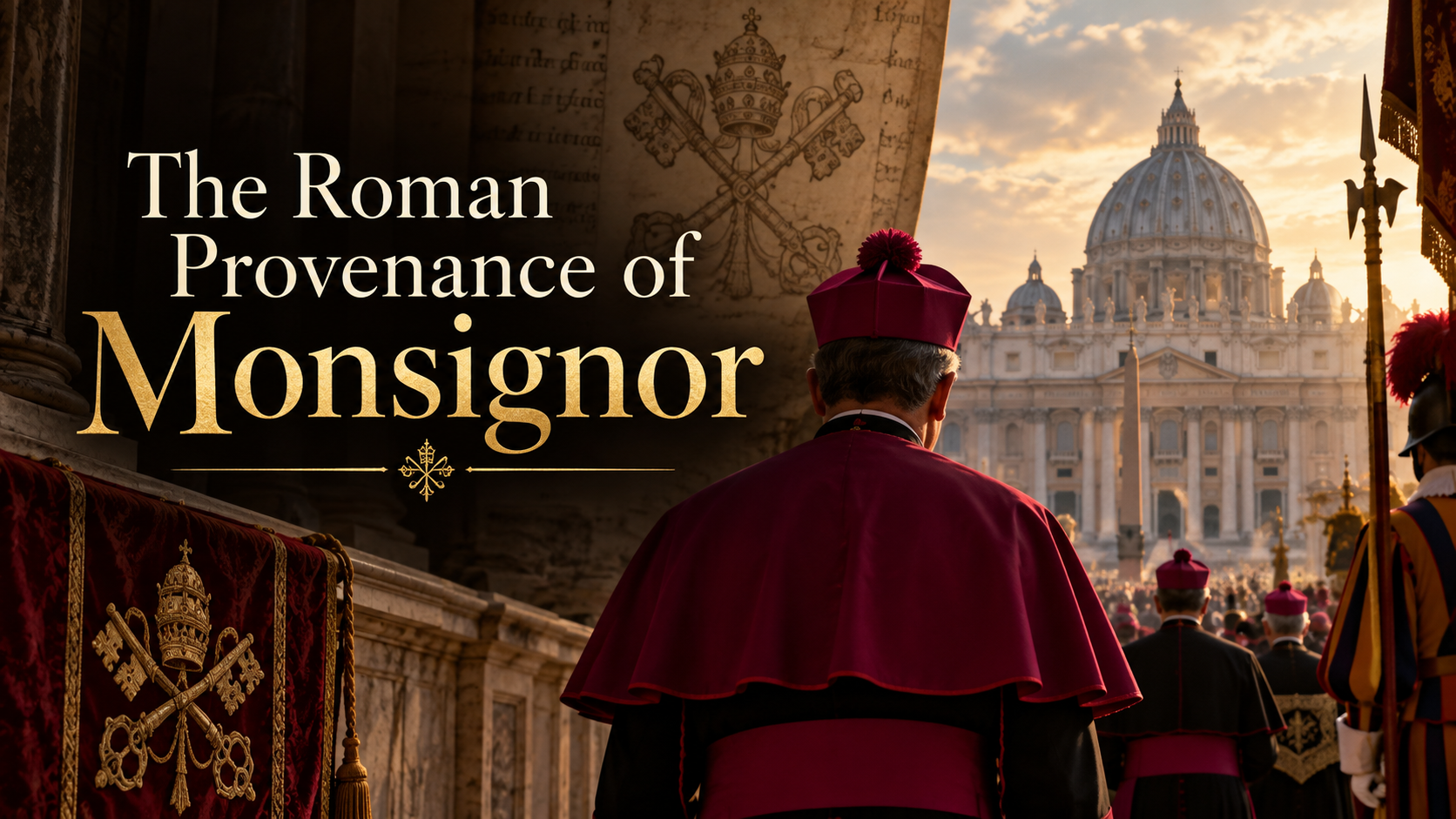
- The Roman Provenance of MonsignorThe title “Monsignor” is often misunderstood as an ecclesiastical rank or honour, whereas it is merely a style of address linked to specific ecclesiastical offices. The distinction between substantive dignity and its verbal expression is crucial. Various regulations historically defined these roles, ensuring accurate representation of ecclesiastical authority and honour.





Leave a Reply