
Saint Blaise, Bishop and Martyr: Witness, Healing, and the Liturgical Blessing of Throats (3 February)
Introduction
The Feast of Saint Blaise, kept on 3 February, stands at a quiet but theologically rich intersection of martyrdom, pastoral charity, and sacramental theology. The Church’s commemoration of Saint Blaise is inseparable from the Blessing of Throats, a venerable sacramental preserved in the Roman Rite not as folklore, but as a sober act of ecclesial prayer. To understand the liturgy is first to understand the man whose witness gave rise to it.

Hagiography: The Life and Martyrdom of Saint Blaise
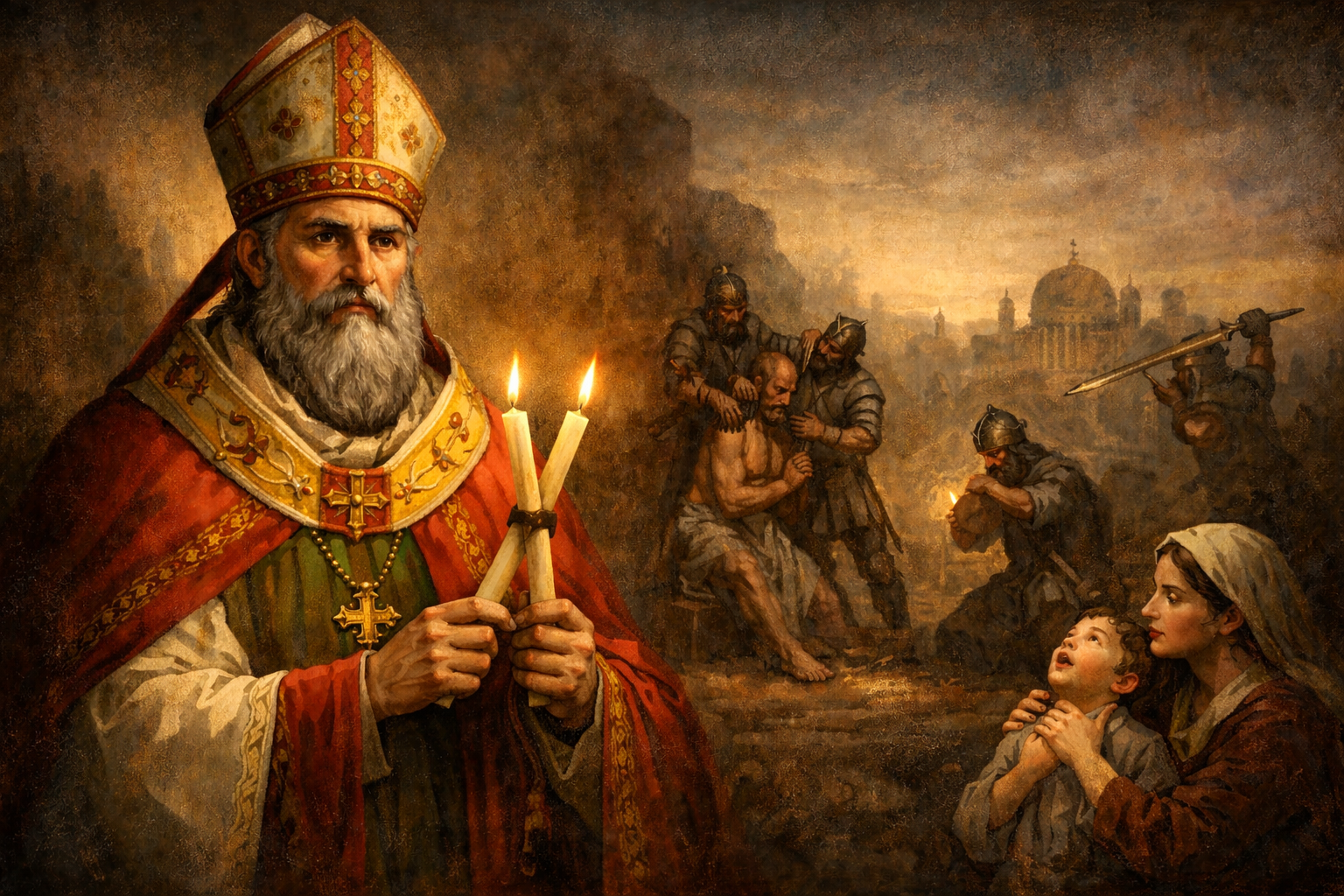
Saint Blaise lived at the turn of the third to fourth century, serving as bishop of Sebaste in Armenia during one of the most unstable periods of Roman religious policy. Christianity had emerged from obscurity but not yet into peace. Imperial attitudes varied sharply by region, and local governors exercised wide discretion in enforcement. In this climate, episcopal ministry demanded prudence, courage, and readiness for martyrdom.
Ancient sources describe Blaise as a man of learning, holiness, and ascetic discipline, chosen as bishop not merely for administrative competence but for evident sanctity. During periods of intensified persecution, he withdrew to a cave in the hills, living as a hermit while continuing discreet pastoral oversight. This withdrawal was not cowardice but continuity with early Christian patterns of eremitical retreat in times of danger, preserving the shepherd for the flock until witness could no longer be deferred.
It was during this period that Blaise’s reputation as a healer spread. The most enduring account tells of a mother who brought her child to the bishop as the boy lay dying, a fishbone lodged in his throat. Through prayer and blessing, Blaise delivered the child from imminent death. The episode is not incidental: it reveals the early Christian conviction that healing flows from sanctity, and that episcopal authority was understood as both doctrinal and pastoral in the fullest sense—concerned with body as well as soul.
Blaise was eventually arrested under the persecution associated with Licinius, whose policies in the East became increasingly hostile to Christians. He endured imprisonment and torture, most notably scourging with iron combs, instruments later iconographically associated with his martyrdom. Refusing to sacrifice to idols, he was finally beheaded, thus conforming his life wholly to the Cross he had preached.
His cult spread rapidly. By the early Middle Ages, Saint Blaise was venerated throughout Armenia, Byzantium, Rome, and Northern Europe, named among the Fourteen Holy Helpers in the West, invoked especially against illnesses of the throat and choking. His inclusion in the Roman Martyrology attests to the antiquity and universality of his veneration.
Theological Significance of Saint Blaise’s Witness
The Church venerates Saint Blaise not as a magician or wonder-worker, but as a martyr whose charity manifested the power of Christ. His healing of the child was not an isolated marvel but an extension of episcopal fatherhood. The miracle served faith; it did not replace it.
This distinction is critical. In Catholic theology, healing is always subordinated to salvation. Bodily cure is a sign, not an end. Saint Blaise’s cult therefore developed not around sensational claims, but around intercessory prayer, ordered, restrained, and ecclesial. This theological sobriety is reflected precisely in the Church’s liturgical discipline surrounding the Blessing of Throats.
The Blessing of Throats as a Sacramental
The Blessing of Throats is a sacramental, not a sacrament. As such, it does not confer grace by its own operation, but disposes the faithful to receive grace through prayer, faith, and trust in divine providence. Its efficacy lies not in mechanical performance, but in the Church’s supplication and the merits of Christ, invoked through the intercession of His martyr.
The Church’s retention of this blessing in her official ritual books underscores a central Catholic principle: the body matters because the Word became flesh. The throat, seat of breath and speech, is both physically vulnerable and morally significant. It is by the throat that man prays, confesses, sings, lies, curses, and proclaims truth. To bless it is to place both life and language under the Cross.
Liturgical History and Codification
By the High Middle Ages, the blessing associated with Saint Blaise had become widespread throughout the Latin Church. Following the Council of Trent, it was formally codified in the Roman Ritual (Rituale Romanum), where it remains with a fixed text and gesture. Its inclusion there confirms that this is not a paraliturgical curiosity, but a legitimate act of the Church’s public prayer.
Matter and Symbolism: The Crossed Candles
The rite employs two candles, ordinarily blessed on 2 February, the Feast of the Presentation of the Lord (Candlemas). They are held crossed and placed lightly at the throat of each of the faithful.
The symbolism is multilayered. Candles signify Christ the Light, who illumines the nations and dispels the darkness of sin and death. Their crossing forms the sign of the Cross, teaching that healing—whether physical or spiritual—comes only through participation in Christ’s Passion. The act is brief, restrained, and deeply catechetical.
Rubrics According to the Roman Ritual
The Roman Rite prescribes the blessing with notable precision.
The blessing is given by a priest, and traditionally also permitted to a deacon, though in classical usage it is ordinarily associated with priestly ministry. It may be imparted after Mass on 3 February, or outside Mass when pastoral circumstances require.
The faithful approach individually. The priest holds the crossed candles to the throat and pronounces the prescribed prayer, making the sign of the Cross over each person. The Latin formula reads:
Per intercessionem Sancti Blasii episcopi et martyris, liberet te Deus a malo gutturis et a quolibet alio malo. In nomine Patris, et Filii, ✠ et Spiritus Sancti.
The prayer is striking for its breadth. While explicitly naming “disease of the throat,” it petitions deliverance from every other evil, situating bodily ailment within the wider horizon of human fallenness and redemption.
No improvisation is envisaged. The sobriety of the rite guards the faithful from superstition and preserves the blessing as what it is: humble supplication, not promise of automatic cure.
Contemporary Relevance
In a culture marked by extraordinary medical capability and profound spiritual confusion, the Feast of Saint Blaise offers a quiet corrective. Modern man seeks mastery over illness but resists submission to meaning. The Church, by contrast, blesses the throat and prays—not presuming outcomes, but entrusting fragility to God.
Saint Blaise reminds the faithful that healing and holiness are not competitors. Medicine and prayer are not opposed, but ordered. The blessing teaches dependence, gratitude, restraint, and trust—virtues increasingly alien to a culture of control.
Conclusion
The Church preserves the Feast of Saint Blaise not as a relic of a credulous age, but as a liturgical confession of the Incarnation. Because the Word became flesh, flesh is not beneath blessing. Because Christ suffered, suffering may be sanctified. Whether God grants cure, endurance, or redemptive suffering, the Church continues to pray with Saint Blaise that her children may be delivered from evil and kept faithful unto life everlasting.
¹ Martyrologium Romanum, die 3 Februarii.
² Butler, Alban, Lives of the Saints, vol. II (February), entry on St Blaise.
³ Gregory of Tours, De Gloria Martyrum, ch. 101.
⁴ Rituale Romanum (Tit. IX, cap. X), Benedictio gutturis in festo S. Blasii.
⁵ Council of Trent, Session XXV, De invocatione, veneratione et reliquiis sanctorum.
⁶ Catechism of the Council of Trent, Part II, on sacramentals.
related articles


Latest articles
- Today’s Mass: October 24 St Raphael the ArchangelThe Feast of Saint Raphael the Archangel highlights his healing powers as depicted in the Book of Tobit, where he aids Tobit and his son, Tobiah. Venerated as a protector of travellers and the blind, Raphael is celebrated for his miraculous interventions. His legacy includes support for nurses, matchmakers, and Catholic studies.
- 25.10.26 Nuntiatoria CXXIX: CHRISTUS REXThe text discusses the relationship between Christ’s kingship and authority within the Church amidst contemporary challenges. It contrasts ecclesiastical power with genuine faith, emphasising that authority must protect divine truth rather than alter it. The witness of imprisoned priests illustrates the enduring significance of fidelity to Christ over institutional conformity.
- THE DOMESTIC CHURCH: 25 October – 2 November 2026 A Home with Room for Heaven: Preparing for All Saints and All SoulsThe content outlines a week’s plan for traditional Catholic families to prepare for the feasts of All Saints and All Souls. Emphasising daily prayers, remembrance of the deceased, and engagement with children’s activities, it aims to integrate Catholic customs into family life, enriching spiritual practices and fostering a shared faith experience.
- ORDO w/c 25.10.26The text outlines the liturgical calendar for the last week of October and the beginning of November, highlighting key celebrations. Notable events include the Feast of Christ the King, St Evaristus, the Vigil of Saints Simon and Jude, and the Feast of All Saints, emphasising themes of holiness, unity in faith, and the Church’s teachings.
- Christ the King: The Sovereignty of the Crucified RedeemerThe Mass of Christ the King articulates core Catholic beliefs about Jesus’ divine authority, redemptive sacrifice, and the essence of His Kingdom. It emphasises Christ as Prophet, Priest, and King, whose sovereignty is inseparable from His mission of reconciliation, calling the faithful to acknowledge His authority and embrace moral duties rooted in divine truth.





Leave a Reply