
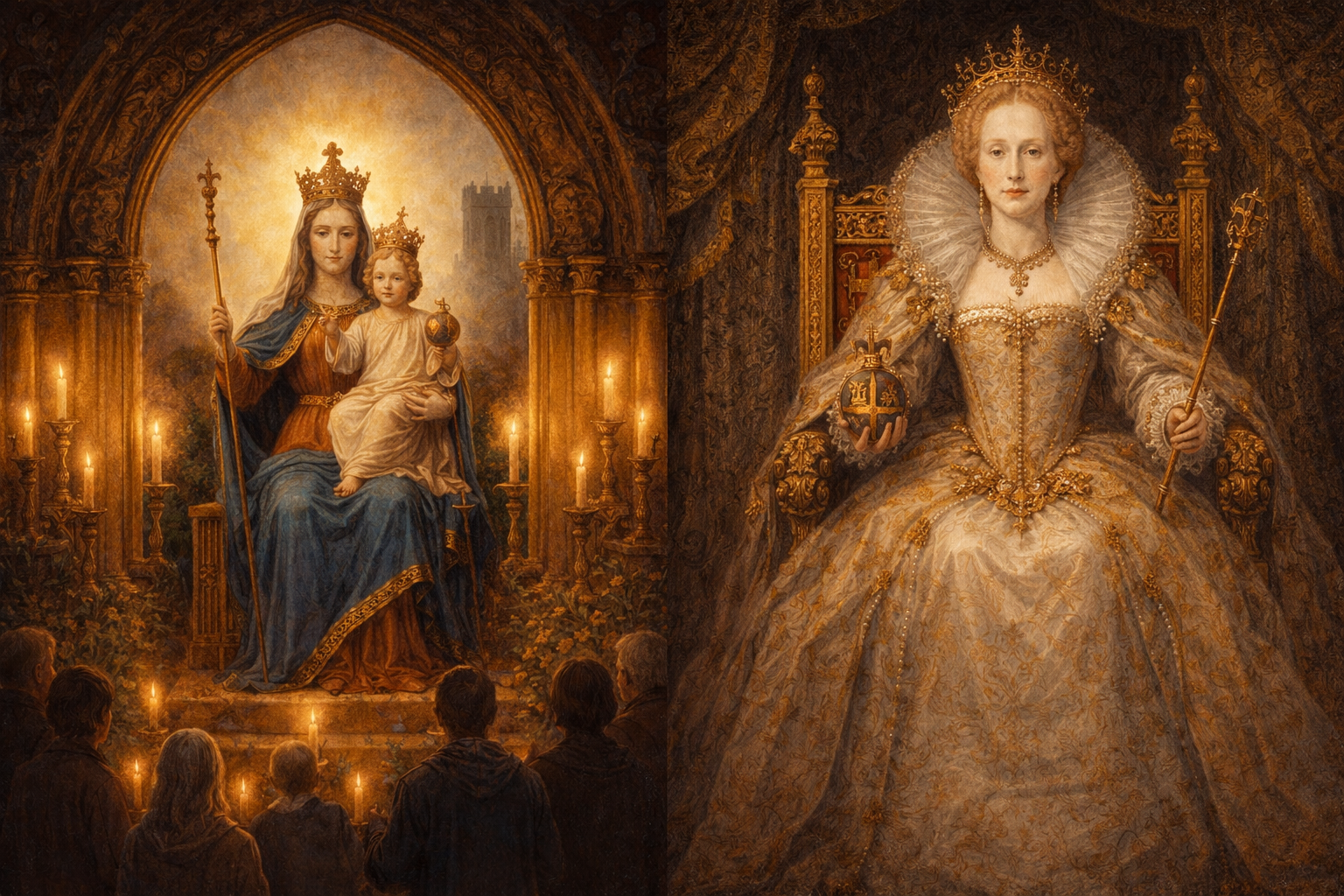
Reclaiming Our Lady’s Dowry: English Marian spirituality, symbolic displacement, and the work of reconversion
By the Titular Archbishop of Selsey
England was not called Our Lady’s Dowry as a pious flourish, but as a declaration of identity and allegiance. A dowry is not symbolic excess; it is a concrete act of entrustment. To name England in this way was to acknowledge publicly that the land, the people, and the ordering of life stood under the maternal patronage of the Mother of God. This title expressed a theological vision of nationhood: England understood herself not as autonomous, but as received—held, guarded, and oriented heavenward.
The contemporary crisis of England is therefore not merely political, economic, or moral. It is maternal. A nation that has forgotten its Mother has forgotten how to receive rather than seize, how to obey without servility, how to hope without illusion. The reconversion of England, if it is to be anything more than cultural nostalgia or managerial Christianity, must recover this lost grammar. It must begin again where England once began: at the feet of Our Lady.
The Marian Shape of England
From the earliest centuries of her Christian life, England’s faith bore a distinctly Marian contour. This was not the result of medieval exaggeration but the organic fruit of orthodox Christology. Where the Incarnation is believed with seriousness—where God truly takes flesh—Mary necessarily stands at the centre, not as rival to Christ, but as the one through whom He comes to us and through whom we learn how to receive Him.
Before the sixteenth century, Marian devotion permeated English religious life at every level. Churches, chapels, and guilds bore her name; her feasts ordered the calendar; her antiphons framed the Church’s nightly prayer. The great Marian antiphons—Alma Redemptoris Mater, Ave Regina Caelorum, Regina Caeli, and Salve Regina—were not rarefied liturgical texts but the emotional and theological backbone of English piety. In them, England learned to name herself as needy, exiled, and hopeful, crying out not to an abstraction but to a Mother.¹
Crucially, this Marian faith was not confined to Latin liturgy or clerical circles. It found voice in the vernacular, sung and memorised by ordinary people. One of the earliest Middle English Marian hymns opens with a confidence that assumes Mary’s queenship as an uncontroversial fact of life:
Of on that is so fayr and bright,
Velut maris stella,
Brighter than the day is light,
Parens et puella.²
Here Mary is hailed as Stella Maris, the Star of the Sea—a title of particular resonance for an island people whose lives were shaped by travel, danger, and dependence upon guidance beyond themselves. This was not imported devotion. It arose naturally from England’s experience of vulnerability and trust.
Another widely loved carol expresses the same certainty with lyrical economy:
Ther is no rose of swych vertu
As is the rose that bare Jesu;
Alleluia.³
Mary’s uniqueness is not argued, defended, or hedged. It is sung. Such texts reveal a Christianity at ease with its own theology, confident that love of the Mother neither diminishes the Son nor distracts from Him.

This devotion found its national heart in Our Lady of Walsingham, England’s Nazareth. The Holy House devotion expressed something characteristically English: the mystery of the Incarnation translated into domestic and local terms. God had taken flesh not only in Bethlehem long ago, but mystically among English fields and homes. Pilgrimage to Walsingham was therefore penitential and communal. England walked—literally walked—towards her Mother. King and peasant, scholar and labourer shared the same road, the same prayers, the same humility.⁴
The theological maturity of this Marian culture is evident even in its shortest devotional texts. A fifteenth-century lyric binds together Fall, Redemption, and Marian queenship with patristic clarity:
Ne hadde never our Lady
*A-been heavenè queen.*⁵
Mary’s queenship is here shown to flow not from sentiment but from salvation history itself. Such lines demonstrate that England’s Marian piety was neither naïve nor excessive; it was doctrinally literate, biblically grounded, and spiritually confident.
This Marian vision extended into England’s understanding of authority. The reign of Edward the Confessor embodied a conception of kingship as stewardship rather than domination. His Marian piety was inseparable from his restraint, justice, and reverence for divine order. England was not his possession; it was entrusted to him under God—and under Mary.⁶ Marian devotion thus acted as a quiet but real check on absolutism, reminding rulers and subjects alike that no earthly authority is ultimate.
The Reformation and the Violence of Forgetting
The English Reformation must be understood not merely as doctrinal realignment or political consolidation, but as an act of symbolic and imaginative violence. Shrines were destroyed, images defaced, pilgrimages forbidden. The removal of Our Lady was not accidental. Marian devotion represented a rival centre of loyalty—one that relativised royal power and reminded the nation that it lived under heaven rather than above it.⁷
What followed was not purification but truncation. The sacramental imagination narrowed. Intercession was recast as suspicion. Obedience became anxiety rather than trust. Christianity grew increasingly juridical, cerebral, and nationalised. Yet Marian memory did not vanish. It was wounded, suppressed, and caricatured, but not erased. Walsingham remained—a ruin that accused the present by its very existence, a silence louder than sermons.⁸

The Virgin Queen and the Marian Vacuum
Into this Marian vacuum stepped Elizabeth I—not only as monarch, but as symbolic substitute.
Elizabeth’s cultivation of the title Virgin Queen was not an incidental detail of biography. It was a deliberate act of symbolic reorientation. In a culture long formed by Marian categories, virginity, queenship, light, and protection were not neutral concepts. They were Marian. Elizabeth appropriated this grammar and redirected it to the Crown.
Elizabethan court poetry made this transfer explicit. In The Faerie Queene, Edmund Spenser presents Elizabeth through allegorical figures whose attributes closely mirror those once ascribed to Our Lady. As the virgin Belphoebe, she is praised in language unmistakably borrowed from sacred imagery:
“So pure and innocent, as that same lambe.”⁹
The lamb—long a Marian and Christological symbol in English devotion—is here detached from its theological home and attached to the monarch. Elsewhere, Spenser describes her as radiant with light, drawing directly upon iconographic rather than political vocabulary.¹⁰
Royal pageantry reinforced the same message. Elizabeth was hailed as light after darkness, virgin protectress, mother of the realm—roles that echo the Marian antiphons Ave Regina Caelorum and Salve Regina, but emptied of intercession and grace and refilled with national meaning.¹¹ England was not permitted to honour Mary. It was encouraged to adore Elizabeth.
This was not the abolition of devotion, but its redirection. The cult of the Virgin Queen replaced the cult of the Virgin Mother. What had once lifted loyalty beyond the state was absorbed into it. Authority was sacralised; devotion was politicised; the Crown accrued to itself a symbolic absolutism it had not previously possessed.
Even Elizabethan court music bears witness to what was lost. In John Dowland’s “Can she excuse my wrongs” (1597), devotion is transposed into melancholy longing: appeal without intercession, praise without mercy, virginity without motherhood. The beloved sovereign—widely understood within courtly convention as Elizabeth herself—is distant, judging, and emotionally absolute. There is no confidence of hearing, no expectation of advocacy, only anxious loyalty expressed through aestheticised suffering. Where England once sang to Our Lady as advocata nostra, confident that mercy would be given, Dowland’s courtly lover can only ask whether his wrongs might be excused. What had once been prayer becomes performance; what had once offered refuge becomes refined frustration. Mary was sung to because she could help. Elizabeth was sung about because she could not.

Mary and the Work of Reconversion
This history matters because symbols do not merely decorate belief; they form it. England’s long spiritual deformation did not begin with explicit unbelief, but with the misdirection of devotion. When Marian piety was removed, the human need for mediation, protection, and maternal authority did not vanish. It was absorbed elsewhere—into crown, nation, ideology, and later into the abstractions of progress and selfhood.
England will not be reconverted by argument alone. She has been argued with for five centuries and has learned to distrust every side. Nor will she be healed by political Christianity, which mistakes leverage for authority and influence for conversion. A faith that seeks primarily to manage outcomes rather than convert souls merely repeats, in ecclesial form, the same Elizabethan substitution it ought to resist.
What England lacks is not intelligence, policy, or activism. What she lacks is formation.
Marian devotion forms where argument exhausts itself. Mary does not reason England back to God; she teaches her how to receive Him. Her fiat corrects a culture intoxicated with autonomy. Her silence under the Cross rebukes a civilisation addicted to commentary. Her fidelity exposes the emptiness of a Christianity that seeks resurrection without sacrifice.
This is why Marian renewal is not optional or decorative. It is strategic in the deepest sense. Where Mary is honoured, Christ is received not as an idea but as a presence. Where Mary is restored, the Eucharist regains its gravity, sin regains its seriousness, and vocation regains its meaning. Marian devotion reorders affections before it reforms structures.
England does not need a louder Church. She needs a humbler one. And humility, in the Christian imagination, has always had a Marian face.
The Task of the Faithful
Reclaiming Our Lady’s Dowry will not be achieved by episcopal statements alone, however necessary such teaching may be. No nation has ever been converted by documents in isolation. Faith is transmitted by habit, memory, gesture, and love. If England is to recover her Marian soul, it must be lived into being—patiently, locally, and visibly—by the faithful themselves.
The work begins, necessarily, in the home. Before Marian devotion was public, it was domestic. England once learned to pray at Mary’s knee in the rhythms of ordinary life: morning and evening prayer, the Angelus sanctifying the day, the Rosary ordering time around the mysteries of Christ. In a culture fractured by noise and haste, Marian prayer restores rhythm, silence, and proportion. It teaches families once again how to receive life as gift rather than burden, and how to endure suffering without despair. A home that prays with Mary becomes a small Nazareth, capable of bearing Christ quietly into the world.
From the home, Marian devotion naturally overflows into the parish and the chapel. Here the task is not innovation, but confidence. Marian feasts must be celebrated without embarrassment or apology, as integral to the Church’s life rather than as optional sentiment. Processions, antiphons, votive Masses, and public acts of consecration teach the faithful that love for Mary is not a private eccentricity but a shared inheritance. Where Mary is honoured liturgically, reverence deepens, the sense of the sacred is restored, and the faithful learn again to kneel.
Pilgrimage occupies a central place in this recovery. England once walked to Mary. Pilgrimage is not tourism, nor is it nostalgia. It is penance enacted with the body. In an age dominated by abstraction, pilgrimage re-teaches the truth that conversion is not merely intellectual but physical. Feet learn what minds resist. Fatigue humbles. Distance purifies intention. Places like Walsingham remain potent precisely because they require effort, vulnerability, and persistence. Through pilgrimage, England remembers what it once knew instinctively: that faith is a journey undertaken together, not a theory privately maintained.
Catechesis must accompany this lived renewal. Mary must be taught not defensively, as though she were an embarrassment to be explained away, but confidently, as the Church has always taught her: Mother of God, model disciple, and Queen assumed into glory. Too often catechesis has surrendered to polemic, allowing Marian doctrine to be framed by Protestant objection or modern suspicion. This must be reversed. The faithful—especially the young—must be shown how Marian devotion flows directly from Scripture, from the Fathers, and from the logic of the Incarnation itself. To know Mary rightly is to know Christ more deeply, not less.
Above all, the faithful must recover the courage to appear Marian in a culture that prizes irony and distrusts reverence. Marian devotion will always look foolish to a world intoxicated with autonomy. But it is precisely this humility that once gave England spiritual strength. A people who can kneel together can stand together.
This work is not romanticism. It is recovery. It is the re-learning of a native spiritual language that England once spoke fluently and has not entirely forgotten. To reclaim Our Lady’s Dowry is not to import something foreign, but to come home—to the Mother who never ceased to watch, and who still waits to teach her children how to receive Christ again.
England’s Dowry Is Not Lost
Dowries are not annulled by neglect. They are not voided by amnesia or repudiated by rebellion. They remain, waiting to be recognised.
Mary has not ceased to be England’s Mother simply because England has ceased to acknowledge her. The title Our Lady’s Dowry names a reality, not a sentiment, and realities do not expire when they are denied. The medieval hymns and poems of England still testify that this land once loved Mary without embarrassment and trusted her without qualification. England once sang to her in her own tongue, prayed to her in her own idiom, and entrusted herself to her without fear of appearing weak.
The question is not whether England can recover Marian devotion. The question is whether England can be healed without it.
Every attempt at national renewal that bypasses Mary eventually collapses into ideology or sentimentality. Every vision of Christian restoration that refuses the maternal dimension of the faith ends either in authoritarianism or abstraction. Christ Himself did not come to England without a Mother; neither will England return to Him by pretending she can.
If England is to be Christian again, she must first be Marian again—not to displace Christ, but to receive Him rightly. Not to sentimentalise the past, but to recover the form of faith that once made England capable of repentance, endurance, and hope.
The old road has never been closed. It still leads to Walsingham.
And beyond Walsingham, it leads—always and only—back to Christ.
- Eamon Duffy, The Stripping of the Altars: Traditional Religion in England, 1400–1580, 2nd ed. (New Haven: Yale University Press, 2005), pp. 249–252.
- Carleton Brown, English Lyrics of the XIIIth Century (Oxford: Clarendon Press, 1932), pp. 48–49.
- Richard Greene (ed.), The Early English Carols (Oxford: Clarendon Press, 1977), pp. 88–89.
- J.C.H. Aveling, The Handle and the Axe: The Catholic Recusants in England from Reformation to Emancipation (London: Blond & Briggs, 1976), pp. 18–21.
- Douglas Gray, Themes and Images in the Medieval English Religious Lyric (London: Routledge, 1972), pp. 108–110.
- Frank Barlow, Edward the Confessor (Berkeley: University of California Press, 1970), pp. 57–63.
- Christopher Haigh, English Reformations: Religion, Politics, and Society under the Tudors (Oxford: Clarendon Press, 1993), pp. 150–182.
- Benedicta Ward, Miracles and the Medieval Mind (Philadelphia: University of Pennsylvania Press, 1982), pp. 113–134.
- Edmund Spenser, The Faerie Queene, Book II, Canto III, stanza 21, ed. A.C. Hamilton (London: Longman, 2001).
- Ibid., Book II, Canto III, stanza 23.
- Roy Strong, The Cult of Elizabeth: Elizabethan Portraiture and Pageantry (London: Thames & Hudson, 1977), pp. 15–38.
- John Saward, Redeemer in the Womb: Jesus Living in Mary (San Francisco: Ignatius Press, 1993), pp. 9–22.
related articles


Latest articles
- Today’s homily: Christ the KingThe homily reflects on Christ’s kingship as seen in the Gospel narrative. It contrasts earthly authority with divine truth, emphasising that true allegiance to God requires genuine obedience and transformation. Believers are called to examine their personal commitments and respond to Christ’s demands in everyday life, ultimately recognising their identity as bearers of God’s image.
- Sermon for Christ the KingToday marks the celebration of Christ the King and the Twenty Second Sunday after Pentecost, a feast asserting Christ’s sovereignty against totalitarianism. St. Paul emphasised Christ’s supremacy over power and principalities, challenging early Gnostic beliefs. The early Church’s victory over evil is affirmed in Christ’s resurrection, offering hope and unity amidst contemporary struggles.
- Today’s Mass: October 25 SOVEREIGNTY OF OUR LORD JESUS CHRIST, SUPREME KINGThe Feast of the Sovereignty of Our Lord Jesus Christ celebrates Christ’s dual kingship by birth and conquest. Established by Pius XI, it aims to deepen faith and counter anti-clericalism. The liturgical observance underscores His authority as King, advocating for societal recognition of His reign to bring peace and harmony.
- TRADITION BEHIND THE FENCEThe Vatican’s prohibition of the traditional Ad Petri Sedem pilgrimage to St Peter’s Basilica has sparked controversy, especially among traditional Catholics. While some cite scheduling conflicts, the broader issue lies in the restrictive policies of Traditionis custodes, which may confine traditional liturgical practices to specific enclaves, risking the transmission and recognition of Catholic Tradition within the wider Church.
- Today’s Mass: October 24 St Raphael the ArchangelThe Feast of Saint Raphael the Archangel highlights his healing powers as depicted in the Book of Tobit, where he aids Tobit and his son, Tobiah. Venerated as a protector of travellers and the blind, Raphael is celebrated for his miraculous interventions. His legacy includes support for nurses, matchmakers, and Catholic studies.





Leave a Reply