
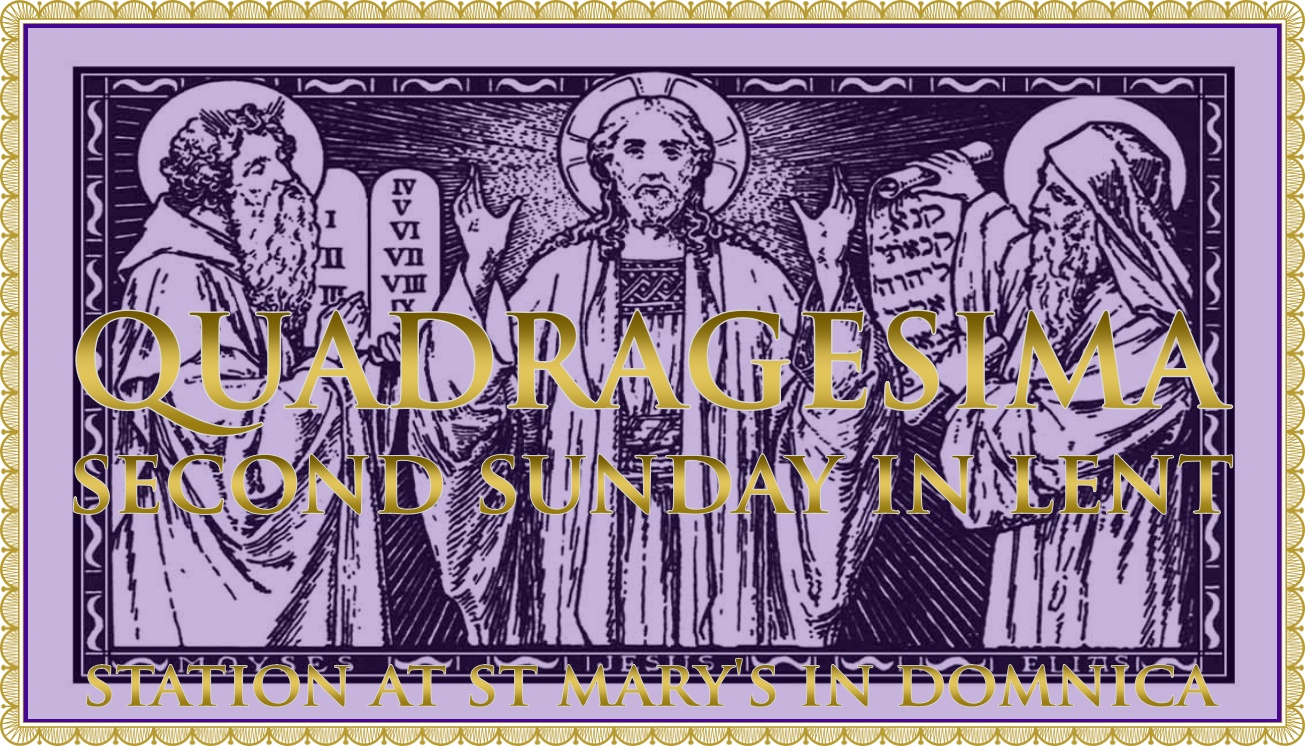
Quadragesima Sunday II: Tabor Before Calvary
The Second Sunday in Lent, in the Roman Rite as it stood prior to the mid-twentieth-century reforms, occupies a position of remarkable theological precision. The First Sunday confronts the faithful with the Temptation in the desert: Christ fasting, resisting, contending with the adversary. The Second Sunday leads them up a mountain. The Gospel is the Transfiguration (Matthew 17:1–9). The progression is deliberate and intelligible: Lent begins with combat and continues with revelation.
The Mass prepares this ascent with bracing realism. The Introit, Reminiscere miserationum tuarum, Domine, drawn from Psalm 24, pleads for divine mercy against encroaching enemies.¹ The Collect intensifies the anthropology: Deus, qui conspicis omni nos virtute destitui — “O God, who seest that we are deprived of all strength.”¹ The Roman liturgy presumes the wounded condition of fallen man and the necessity of interior strengthening by grace. This accords with the Augustinian account of nature healed and elevated by divine aid.² Lent begins not in optimism but in truth.
The Epistle from 1 Thessalonians (4:1–7) presses the faithful toward sanctification. Moral purification precedes contemplative elevation. The Church does not grant Tabor as sentiment; she grants it within discipline.
When the Gospel is proclaimed, the theological architecture becomes luminous. The Fathers are unanimous in reading the Transfiguration as preparation for the Passion. St Leo the Great declares that Christ revealed His glory to remove the scandal of the Cross from the disciples’ hearts.³ St John Chrysostom similarly explains that the manifestation of splendour prevented despair when humiliation would follow.⁴ Tabor is ordered to Calvary. The light is not ornamental; it is fortifying.
Moses and Elias stand beside Christ as representatives of the Law and the Prophets. St Jerome observes that their presence demonstrates the harmony of the Old Covenant with the Incarnation.⁵ Revelation converges upon the Son. The Father’s voice — ipsum audite — confirms both identity and authority. To behold Christ in glory is to be commanded to obey Him.
It is within this Christological centre that one must understand a detail of the older Roman lectionary: the same Gospel of the Transfiguration is proclaimed on the Ember Saturday of the First Week of Lent. Far from distracting from the Sunday’s focus, this repetition intensifies it.
The Ember Saturdays were not minor observances. From late antiquity onward they were associated with major ordinations in Rome. The Ordines Romani describe how Holy Orders were conferred during the extended vigil of Ember Saturday, after multiple prophetic readings and psalmody.⁶ By the time of the earliest lectionary witnesses, Matthew 17 already stands as the Gospel for that Ember Saturday as well as for the Second Sunday.⁷
The theological coherence is striking. Before men are sacramentally configured to Christ’s priesthood, the Church proclaims Christ unveiled in glory. Yet that glory is revealed precisely in order to prepare for suffering. The ordinand hears of Tabor immediately before being set apart for participation in the sacrificial ministry of the Cross. Revelation precedes immolation.
This pattern resonates deeply with the theology of Christ’s High Priesthood articulated in the Epistle to the Hebrews. Christ is presented there as the great High Priest who passes through the heavens (Hebrews 4:14), yet who is also perfected through suffering (Hebrews 2:10; 5:8–10). Glory and sacrifice are inseparable. The priesthood of Christ is not a triumph apart from the Cross but the very means by which the Cross becomes redemptive.
In Hebrews 8–10, Christ enters the heavenly sanctuary not with the blood of another but with His own. The Transfiguration may be read, in this light, as a momentary unveiling of the heavenly identity of the One who will soon offer Himself. The mountain anticipates the sanctuary. The radiant face foreshadows the exalted High Priest. Yet the path between them runs through Golgotha.
When the Ember Saturday candidates for ordination heard Matthew 17, they heard not merely a narrative of splendour but the pattern of their configuration: to act in persona Christi, as later scholastic theology would articulate, is to participate in a priesthood that unites glory and sacrifice.⁸ The priest stands at the altar as minister of a mystery in which divine majesty is hidden under sacramental veils. Tabor discloses what Calvary accomplishes.
When the same Gospel is proclaimed again on the Second Sunday, the Church extends this strengthening vision to the entire faithful. The laity, too, are called to share in Christ’s priestly self-offering, though in a distinct mode. The repetition thus reinforces, rather than shifts, the Christological centre of early Lent.
The Roman station for this Sunday at Santa Maria in Domnica on the Caelian Hill further anchors the ascent in sacred space. Within its golden apse mosaic, restored under Pope Paschal I, the visual language of radiance echoes the Gospel proclamation. The Marian dedication intensifies the Father’s command to “Hear Him,” for the Virgin embodies perfect receptivity to the Word. The faithful ascend liturgically and architecturally, only to descend strengthened for continued penance.
The structure of early Lent therefore emerges with remarkable coherence:
First Sunday: Temptation — Christ confronted.
Ember Week: Fasting intensified; clergy ordained.
Second Sunday: Transfiguration — Christ revealed.
Combat without vision would collapse into despair. Vision without combat would dissolve into illusion. The Roman Rite binds both together.
The Transfiguration stands at the threshold of Passiontide because the Church understands what the Epistle to the Hebrews proclaims: the High Priest who enters the heavenly sanctuary does so through suffering. The glory unveiled on the mountain is not an escape from the Cross but its interior meaning.
Thus the ancient Roman liturgy, in proclaiming Tabor twice within the first full week of Lent, insists upon a single truth: light precedes sacrifice, revelation fortifies obedience, and glory strengthens those who must walk toward Calvary.
¹ Missale Romanum, editio typica (Typis Polyglottis Vaticanis, 1920; reprint 1954), Dominica II in Quadragesima.
² St Augustine, De Natura et Gratia, PL 44:247–298.
³ St Leo the Great, Sermo 51 (De Transfiguratione Domini), PL 54:310–313.
⁴ St John Chrysostom, Homilia 56 in Matthaeum, PG 58:544–553.
⁵ St Jerome, Commentariorum in Matthaeum Libri IV, II.17, PL 26:116–120.
⁶ Michel Andrieu (ed.), Les Ordines Romani du haut moyen âge, vol. II (Louvain, 1931–1961), Ordo I and XXXIV.
⁷ Comes Wirceburgensis (7th century); Sacramentarium Gregorianum Hadrianum, ed. H. A. Wilson (Oxford, 1894).
⁸ St Thomas Aquinas, Summa Theologiae III, q. 82; cf. q. 45 (ed. Leonina, Rome, 1888–1906).
related articles


Latest articles
- Today’s Mass: September 19 St. Januarius, Bishop and Companion MartyrsSt. Januarius and companion martyrs were martyred during the persecution under Diocletian. St. Januarius, patron of the city of Naples and bishop of Beneventum, was beheaded with his deacons and some others.
- Sermon for St. Januarius and his CompanionsToday we celebrate the feast of St. Januarius and his companions. About St. Januarius little is known except that he was among the many martyrs during the great persecution under the Emperor Diocletian.
- 20.09.26 Nuntiatoria CXXIV: QUOD ACCEPIMUS, CUSTODIMUS ET TRADIMUSThe editorial emphasises the importance of understanding our inheritance as custodians rather than owners. It highlights the obligation to preserve and transmit the Christian Faith, sacraments, and traditions to future generations. Through gratitude and fidelity, those who receive must ensure that what has been entrusted does not end with them.
- ONE LORD, ONE FAITH, ONE BAPTISM: The Seventeenth Sunday after PentecostThe Seventeenth Sunday after Pentecost emphasises the love of God and neighbour, rooted in divine justice. The Mass articulates the necessity of one faith and baptism, ensuring charity is not sentimental but deeply theological. The Gospel challenges believers to recognise Christ’s dual nature as both David’s son and Lord, reinforcing true Christian charity.
- AN AWARD IS NOT A MEETINGLambeth Palace has withdrawn the Hubert Walter Award given to Hafiz Tahir Ashrafi for reconciliation, citing previously unknown controversial comments. This raised questions about the vetting process prior to the award. While Ashrafi has defended his record of protecting minority rights, the Palace must clarify why such issues were overlooked initially.



Leave a Reply