

Recusant Stone and Tudor Memory: Coughton Court and the Throckmorton Witness
The reopening of Coughton Court under renewed family stewardship is, at first glance, a matter of heritage administration. Yet Coughton is not simply another Tudor façade restored to visitor circulation. It is one of the most continuous recusant households in England — a house in which the memory of persecution was not theoretical but domestic.
Since 1946, the estate has been owned by the National Trust, following its gift by Lady Lilian Throckmorton.¹ The family, however, has lived at Coughton since 1409.² The present transfer of operational management back to the Throckmortons does not alter ownership, but it does restore visible continuity between place and lineage. That continuity matters, because recusancy was sustained not in abstract ecclesial debates but in houses like this one.
A House Through the Reformation
When Henry VIII severed England’s formal communion with Rome, many Catholic gentry initially accommodated the change in hope of stability. It was under Elizabeth I that recusancy hardened into a legal category.³ The Act of Uniformity (1559) mandated attendance at Anglican worship; by 1581, fines for absence reached £20 per lunar month.⁴ In contemporary economic terms, this was ruinous — designed not merely to penalise but to coerce conformity.
The Throckmortons chose the path of refusal.
Recusancy was not a single act of rebellion but a long obedience under suspicion. It meant keeping chaplains discreetly; it meant shielding travelling priests ordained on the Continent; it meant living under the shadow of informers. The 1585 statute declaring Jesuits and seminary priests traitors rendered the sacramental life itself a political offence.⁵
Coughton’s chapel and concealed spaces are therefore not curiosities. They are survival mechanisms.
Conspiracy and Suspicion
The Throckmorton name became synonymous with Catholic intrigue in the Elizabethan imagination. Sir Francis Throckmorton’s involvement in the 1583 conspiracy linked to Mary, Queen of Scots intensified scrutiny of the wider kinship network.⁶ Whether or not the principal Coughton line bore direct culpability, the association ensured that the family was watched.
Two decades later, the atmosphere darkened further. The Gunpowder Plot unfolded under James I in 1605. After the plot failed, several conspirators fled toward Warwickshire, a region dense with Catholic households.⁷ Coughton was connected to the planned Midland rising that was to accompany the explosion in London.⁸ Though the family itself avoided the executions that followed, the episode reinforced the state’s conflation of Catholicism with sedition.
The result was intensified enforcement and cultural marginalisation.
The Economics of Fidelity
The £20 monthly recusancy fine was not symbolic. It equalled the annual income of many modest households.⁴ Over years and decades, such penalties eroded estates and forced Catholic families into careful economic calculation. Some conformed outwardly to avoid financial ruin; others bore the burden.
Recusant survival required a network: marriage alliances among Catholic gentry; education abroad at institutions such as Douai; discreet travel routes for clergy; and a system of coded correspondence.⁹ It was not romantic heroism but disciplined endurance.
Historians have shown that by the early seventeenth century the Catholic community in England was smaller, more insular, and socially distinct — yet remarkably resilient.¹⁰ The gentry houses were its backbone.¹¹
From Persecution to Relief
The harshest penal provisions gradually softened in the eighteenth century. The Catholic Relief Acts of 1778 and 1791 dismantled some restrictions, though not without violent backlash, most notably the Gordon Riots.¹² Full civil emancipation came only with the Roman Catholic Relief Act of 1829, advanced through the parliamentary campaign of Daniel O’Connell.¹³
By then, the recusant era had receded into memory. Yet the architectural witnesses remained.
Coughton’s Tudor gatehouse does not narrate ideology; it embodies persistence. Its priest holes — concealed recesses cut into masonry and panelling — testify to a time when the celebration of Mass could lead to imprisonment or execution. Its chapel speaks of sacramental continuity guarded in secrecy.
Why This Matters Now
Modern visitors may encounter Coughton as an aesthetic experience: symmetry, gardens, heritage interpretation boards. Yet the deeper meaning of such houses lies in the moral vocabulary they represent.
Recusancy was the refusal to permit the state to redefine religious truth. It was a claim that conscience — properly formed — binds more deeply than statute. That conviction carried cost: financial depletion, political exclusion, public suspicion.
The reopening of Coughton under family stewardship does not recreate that world. But it reminds us that English Catholic survival was not secured by abstraction. It was secured by families who chose fidelity over convenience, and who preserved sacramental life in hidden rooms.
The Throckmortons’ residence at Coughton since 1409 is not merely genealogical trivia.² It is a thread that runs through Reformation rupture, penal severity, emancipation, and revival. The house stands as a material argument: that endurance, not visibility, preserved the faith.
The stones remain. The chapel remains. The memory remains.
Whether England remembers the cost of that refusal — and what it secured — remains an open question.
¹ National Trust, “Coughton Court: History,” official property history page (National Trust website).
² National Trust, “Coughton Court,” property overview and family history (National Trust website).
³ Act of Uniformity 1559 (1 Eliz. I c.2).
⁴ 23 Eliz. I c.1 (1581), “An Act to retain the Queen’s Majesty’s Subjects in their due Obedience.”
⁵ 27 Eliz. I c.2 (1585), “An Act against Jesuits, Seminary Priests and such other like disobedient persons.”
⁶ John Bossy, The English Catholic Community, 1570–1850 (London: Darton, Longman & Todd, 1975), pp. 36–38.
⁷ Antonia Fraser, The Gunpowder Plot: Terror and Faith in 1605 (London: Weidenfeld & Nicolson, 1996), pp. 210–235.
⁸ Mark Nicholls, Investigating Gunpowder Plot (Manchester: Manchester University Press, 1991), pp. 134–142.
⁹ Michael Questier, Catholicism and Community in Early Modern England (Cambridge: Cambridge University Press, 2006), pp. 89–103.
¹⁰ Eamon Duffy, The Stripping of the Altars (New Haven: Yale University Press, 1992), concluding chapters on Catholic survival.
¹¹ John Bossy, The English Catholic Community, pp. 158–176.
¹² Mark Knights, The Gordon Riots: Politics, Culture and Insurrection in Late Eighteenth-Century Britain (Oxford: Oxford University Press, 2010).
¹³ Roman Catholic Relief Act 1829 (10 Geo. IV c.7); see also Patrick M. Geoghegan, King Dan: The Rise of Daniel O’Connell (Dublin: Gill & Macmillan, 2008), pp. 312–345.
Related Articles


Latest Articles
- Today’s Mass: September 05 Saint Lawrence JustinianSaint Lawrence Justinian, the first Patriarch of Venice, dedicated his life to the poor and the establishment of monasteries, rejecting noble marriage. Renowned for his humility and pastoral dedication, he emphasised the spiritual integrity of Venice’s safety. He was a precursor to the reforms of the Council of Trent, dying on 8 January 1455.
- 06.09.26 Nuntiatoria CXXII: NOMEN MANET, RES DEESTThis edition of Nuntiatoria explores the disconnect between the names of Catholic institutions and the realities they signify. Despite retaining their titles, many aspects of Catholicism—such as episcopal authority in China and religious practice in Poland—exhibit deteriorating substance. The piece cautions against superficial continuity, stressing the importance of genuine faith and practice over mere nomenclature.
- ORDO w/c 06.09.26The document outlines the liturgical schedule for the week of 6 to 13 September 2026, highlighting significant religious observances such as the Fifteenth Sunday after Pentecost and the Nativity of the Blessed Virgin Mary. It reflects on themes of compassion, holiness, fidelity, and humility, underscoring their importance in Christian life.
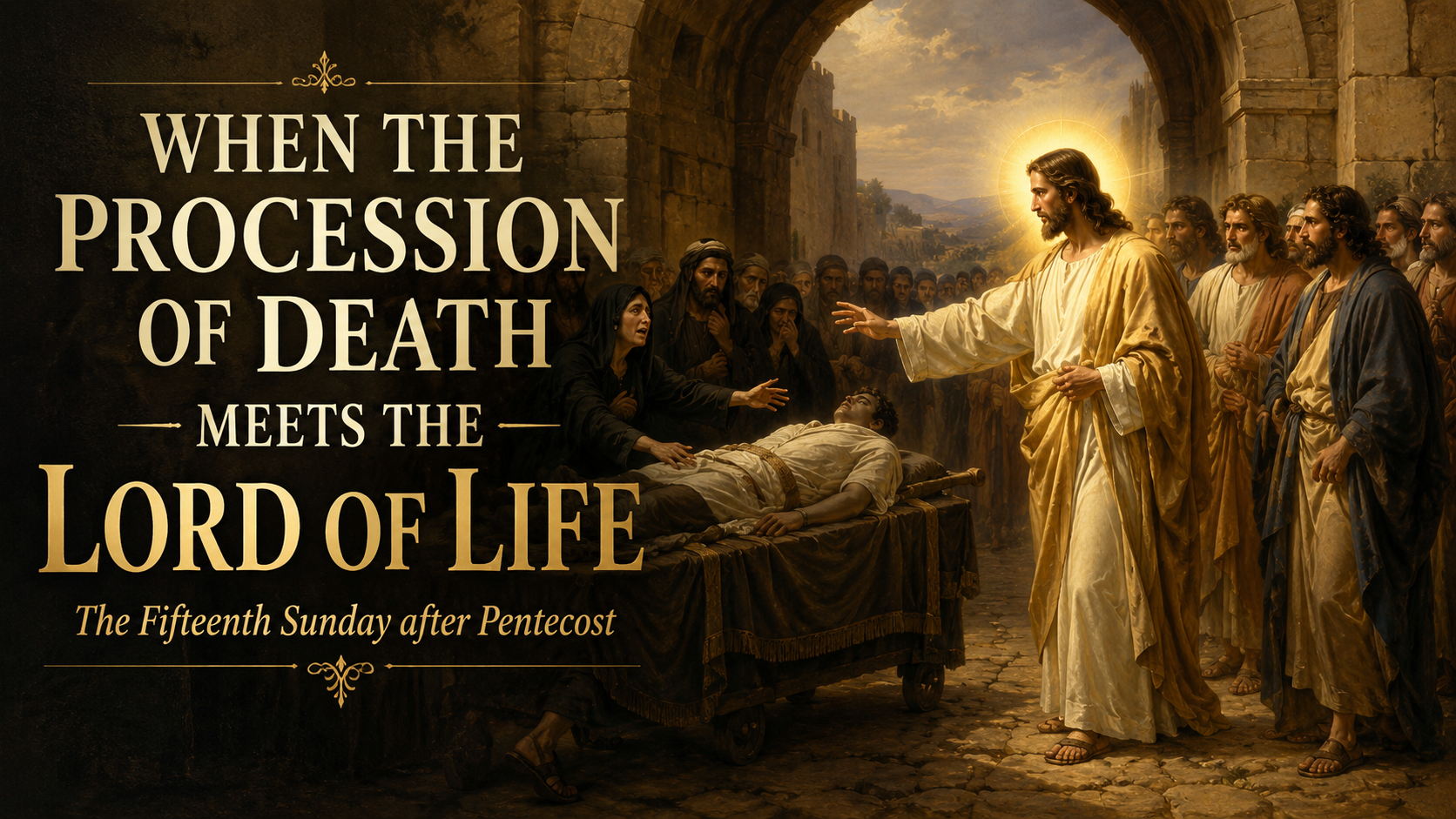
- The Fifteenth Sunday after Pentecost: When the Procession of Death Meets the Lord of LifeThe Fifteenth Sunday after Pentecost focuses on the transformative power of Christ, emphasising the supernatural life granted through grace. The liturgy highlights the Church’s role as a nurturing mother, mourning the spiritually dead while seeking their restoration. Christ’s compassion leads to resurrection, demonstrating that true life is found in dependence on Him.
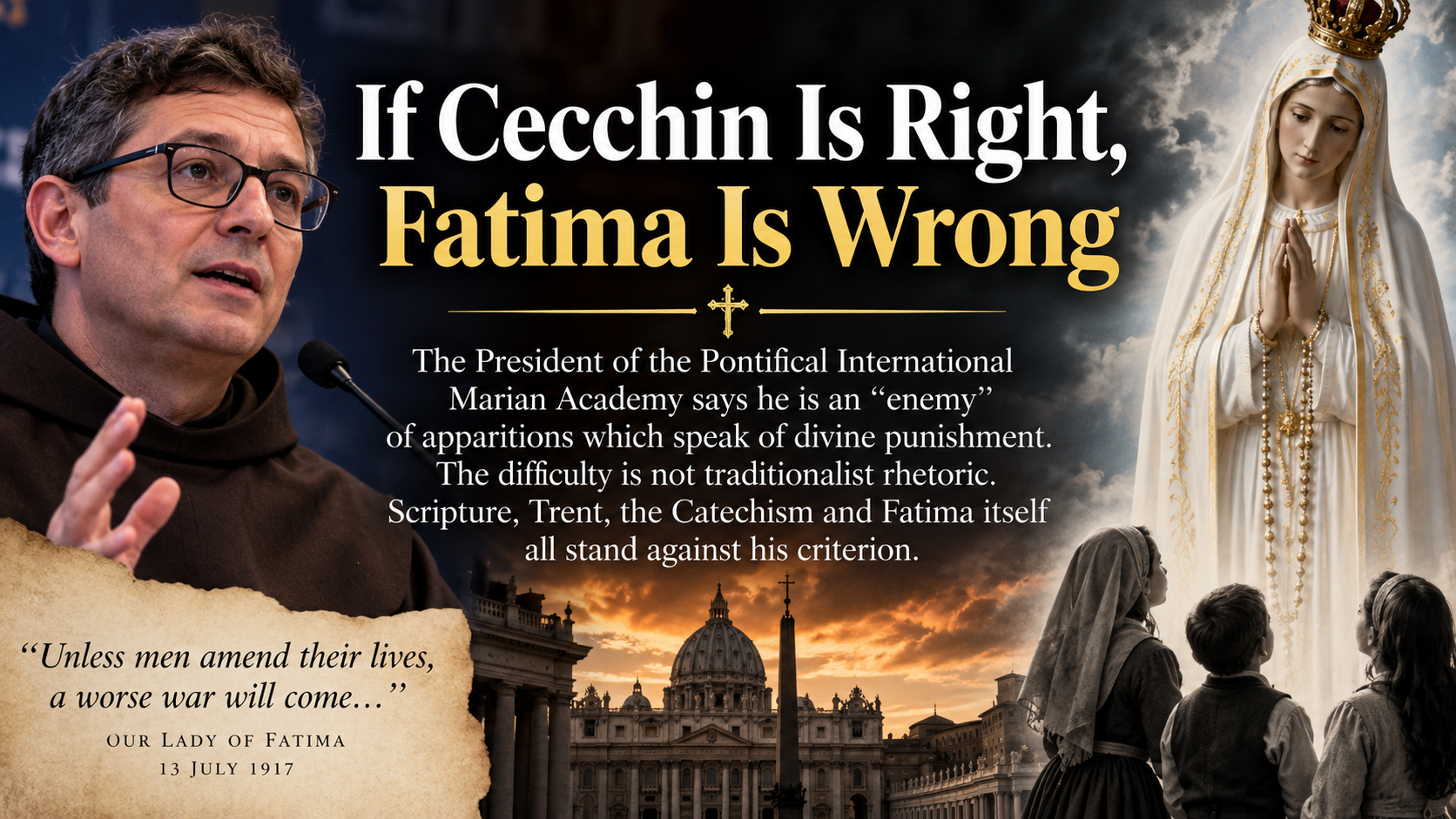
- If Cecchin Is Right, Fatima Is WrongFr Stefano Cecchin, President of the Pontifical International Marian Academy, has declared opposition to apparitions that speak of divine punishment, suggesting they are false. This stance contradicts fundamental Catholic doctrine, including teachings from Scripture, the Catechism, and specifically the Message of Fatima, which warns of divine consequences for sin.



Leave a Reply