
LEFEBVRIAN QUESTIONS – A catechism on the SSPX situation
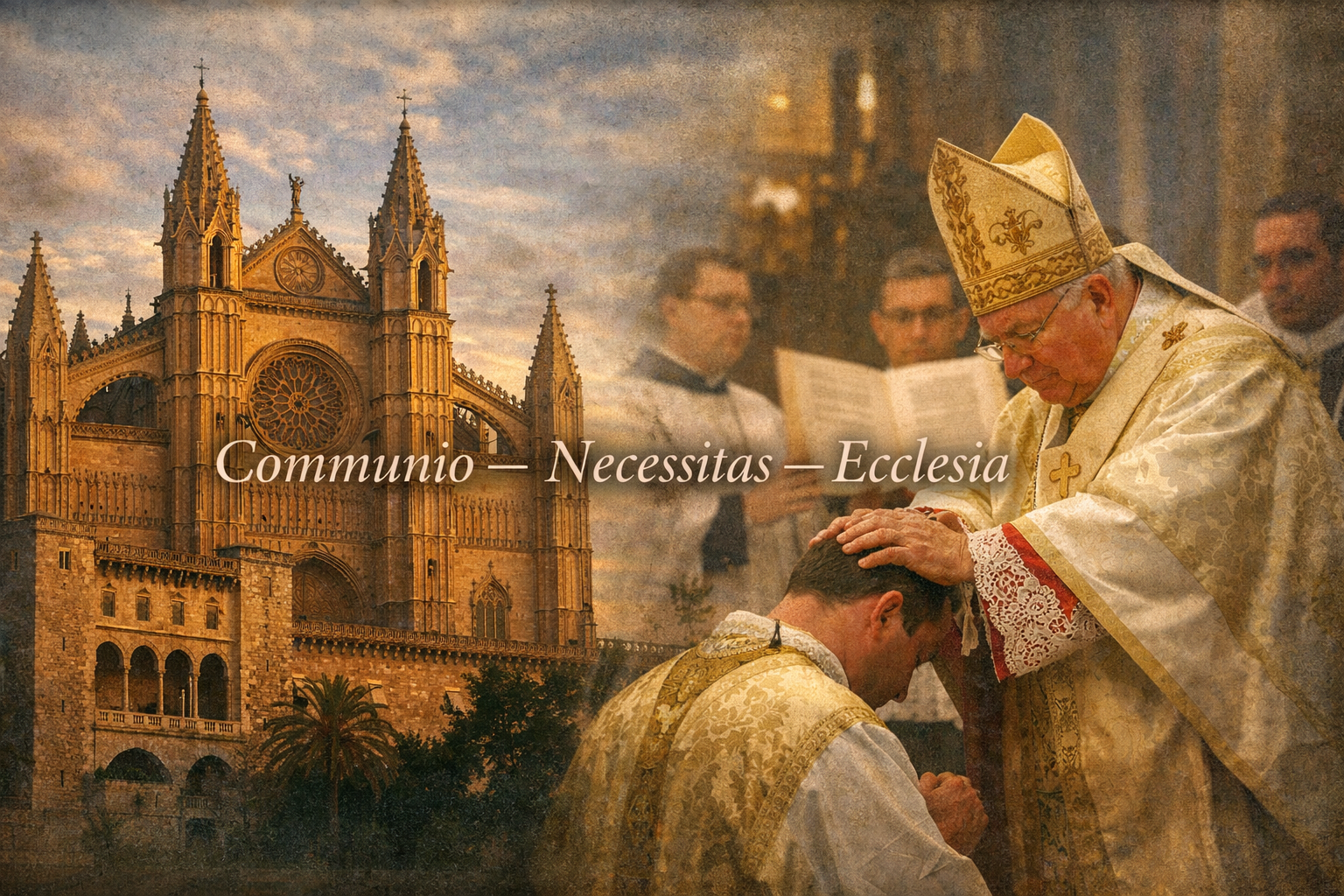
The following intervention has now become widely circulated across social media platforms and ecclesial discussion forums. Its author is not a member of the Priestly Fraternity of Saint Pius X, nor a cleric operating outside diocesan structures, but a priest of the Diocese of Mallorca: Fr Jaime Mercant Simó.
His widely shared Q&A on the forthcoming episcopal consecrations of the Priestly Fraternity of Saint Pius X has drawn attention precisely because it presents a structured canonical and theological defence of the Fraternity’s position from within diocesan clergy. Fr Mercant argues that the consecrations would not constitute formal schism, would not involve mortal sin, and that any automatic excommunication would lack its formal juridical foundation due to the absence of schismatic intent and the invocation of a state of necessity.
“Several of my readers have asked me about the upcoming episcopal consecrations of the Priestly Fraternity of Saint Pius X. Well, here is my position, expressed pedagogically in the form of questions and answers:
1. Will the Lefebvrists commit a mortal sin with these episcopal consecrations?
— No, not at all.
2. Is it not a schismatic act?
— No, formally it is not.
3. Why is it formally not a schism?
— Because, for a “perfect schism” to occur, there must be a clear intention to perform a schismatic act and to establish, with the new bishops, a hierarchical jurisdiction parallel to the one existing in the Roman Catholic Church. In this case, neither of these two things will occur.
4. Could it at least be an act of disobedience?
— Yes, indeed it is, at least materially, since Rome does not want these consecrations to take place.
5. Then, do they commit a mortal sin by disobedience?
— No, because in this case the intention of the authority of the SSPX, of the consecrators and of the future ordinands appears to be upright. They invoke the “state of necessity”, which would justify the “material disobedience”. In this regard, we have no objective reasons to doubt their conscience nor their upright intention, which is the good of the souls they assist.
6. But the “latae sententiae” excommunication will occur, that is, automatic and immediate, right?
— From a canonical perspective, yes, but, in my humble opinion, that excommunication will be null; I believe there are sufficient theological and philosophical-juridical reasons to conclude this, although I know that a large part of canonists will deny it from a purely legalistic point of view. However, I think that, in addition to the fundamental motive of the “state of necessity”, the “formal reason” why such a penalty should actually be incurred fails, since there is no objective intention of formal schism nor will a parallel jurisdiction be created, I repeat.
7. Did Msgr. Lefebvre receive the penalty of excommunication?
— Yes, as these bishops will surely receive it, but his excommunication was also null, since, on the supernatural level of the Mystical Body, that bishop never ceased to be in communion with the Church.
8. What do you mean by that?
— The essence of communion is threefold, namely: doctrinal, sacramental and hierarchical. I therefore consider that Bishop Lefebvre and, by extension, the SSPX, did not deny any of these three “essential dimensions” of ecclesial communion.
9. Is the SSPX in doctrinal communion?
— Of course, it has never ceased to teach what the Church has always believed.
10. But don’t the Lefebvrists constantly question the documents of the Second Vatican Council?
— They do not make a total amendment, as people commonly believe, considering that in its texts there are elements that form part of the “depositum fidei”, but they address, with a critical spirit, certain “delicate” issues in which theological discussion is legitimate.
11. How can you say such a barbarity?
— I can say it because the very “nature” of the Council allows me to do so.
12. What do you mean by that?
— I mean that Vatican II was a council of a “pastoral nature”, not dogmatic, and therefore did not enjoy the charism of infallibility, because at no time did it intend to define or condemn anything infallibly; that was the express decision of the majority of the Council Fathers. However, in the post-conciliar period, despite this “pastoral nature”, some have tried to turn that council into a “super-dogma”.
13. Super-dogma? This is disrespectful. Why are you using the Lefebvrian narrative?
— I am in fact using the very words of Joseph Ratzinger, who, during a visit to the bishops of Chile (1988), used these same terms.
14. On the other hand, is it true that the SSPX is in sacramental communion?
— Its sacraments are not only valid, but they are celebrated according to the traditional rites that the Church has used from time immemorial.
15. But it is obvious that the SSPX is not in hierarchical communion, right?
— Although, at the canonical level, its “institutional situation” is irregular and imperfect, the Fraternity does not cease to recognize the Pope of Rome as the supreme pastor of the universal Church. In fact, it also recognizes and respects the jurisdiction of all the bishops of the Catholic world.
16. Can you give me proof of what you are saying?
— In every Mass of the SSPX, without exception, the priests name, in the “canon missae”, the Pope and the local bishop.
17. Isn’t this a very weak argument?
— By God, it is not. The most formal and public manifestation of hierarchical recognition takes place precisely in the holy Mass, specifically in the canon.
18. Are you a Lefebvrist or a pro-Lefebvrist?
— Neither one nor the other, sir; I go my own way. I am simply Catholic and, as such, I have a critical spirit, that is, the good habit of using reason and the judgment of discernment.
19. But it seems that you agree with the SSPX on everything?
— No, I do not. In certain attitudes and issues I do not agree, but these, in my view, are secondary and accidental. In what is “essential”, I agree 100% with the Fraternity and therefore I will not contribute to its unjust and disproportionate public “demonization”.
20. Can you tell me what is essential?
— The “essential” is its “Catholicity”. Full stop.
21. But aren’t you worried about the “drift” of the Lefebvrists?
— I am much more concerned about the swarm of heterodox, blasphemous and sacrilegious people that exist everywhere, especially in Germany. I am also troubled by the double standard that seems to exist when it comes to applying penalties and censures by ecclesiastical authority.
22. So, what solution do you see to the current Lefebvrian problem?
— First of all, I believe that Rome should be benevolent and formally accept the consecration of these next bishops, while at the same time it should recognize the spiritual fruits of the apostolate of the SSPX. I think this would be a true gesture of mercy and intelligence; both things are not mutually exclusive.
23. Aren’t you afraid that you will be criticized for these opinions?
— No, because I am a priest of the Catholic Church, not the pastor of a sect, and therefore, with respect, I can and must exercise, in my life of faith, the true freedom of the children of God.”
Ordained in 2007, Fr Mercant combines active pastoral ministry with substantial academic credentials. He holds doctorates in Thomistic Studies and in Law and Social Sciences, together with advanced theological formation at the Institut Catholique de Toulouse and the Universitat Abat Oliba CEU. He serves as Director of the Diocesan Library of Mallorca and teaches at the Centre for Theological Studies of Mallorca.
That such arguments are being advanced not by SSPX clergy themselves but by a diocesan priest with formal academic formation in philosophy, law, and theology explains why the text has resonated so widely. It situates the current debate not at the level of polemic, but at the level of ecclesiology, canon law, and the interpretation of Vatican II.
RELATED ARTICLES


Latest
- Today’s Mass: September 04 Feria of Sunday XIV Post PentecostThe Fourteenth Sunday After Pentecost emphasises the importance of serving one master—God—over the flesh. It urges Christians to focus on spiritual over temporal concerns, warning against anxiety. The readings highlight the contrast between the fruit of the spirit and the works of the flesh, encouraging a pursuit of divine life.
- Today’s homily: St Pius X, PopeThe text reflects on the life and legacy of Pope St Pius X, who was chosen from humble beginnings to reform the Church. His pontificate focused on defending the Catholic Faith, restoring liturgical sanctity, and fostering deeper connections between believers and Christ. Pius X exemplified a balance of truth and pastoral charity.
- Today’s Mass: September 03 Pope St Pius X,Pope St Pius X, born Giuseppe Melchiorre Sarto, was a significant reformer who emphasised preserving the Catholic Faith against Modernism. His pontificate (1903-1914) featured reforms in liturgy, frequent Holy Communion, and seminaries, rooted in a pastoral desire to restore everything in Christ. He died in 1914 and was canonised in 1954.
- Today’s homily: St Stephen of HungaryThe homily reflects on the life of Saint Stephen of Hungary, illustrating his transition from a powerful ruler to a saint. He embraced the responsibilities of kingship guided by faith, understanding his authority as stewardship. His legacy teaches that true governance comes with surrender to God, ultimately placing his kingdom under the protection of the Blessed Virgin Mary.
- Today’s Mass: September 02 St. Stephen the GreatSt. Stephen the Great, King of Hungary (977-1038), was a significant Christian ruler who reinforced the faith throughout Hungary. Anointed king in 1000 by Pope Sylvester II, he fought against paganism and promoted the Church. He was canonised in 1083 and is the patron saint of Hungary, symbolising national identity.


Leave a Reply