
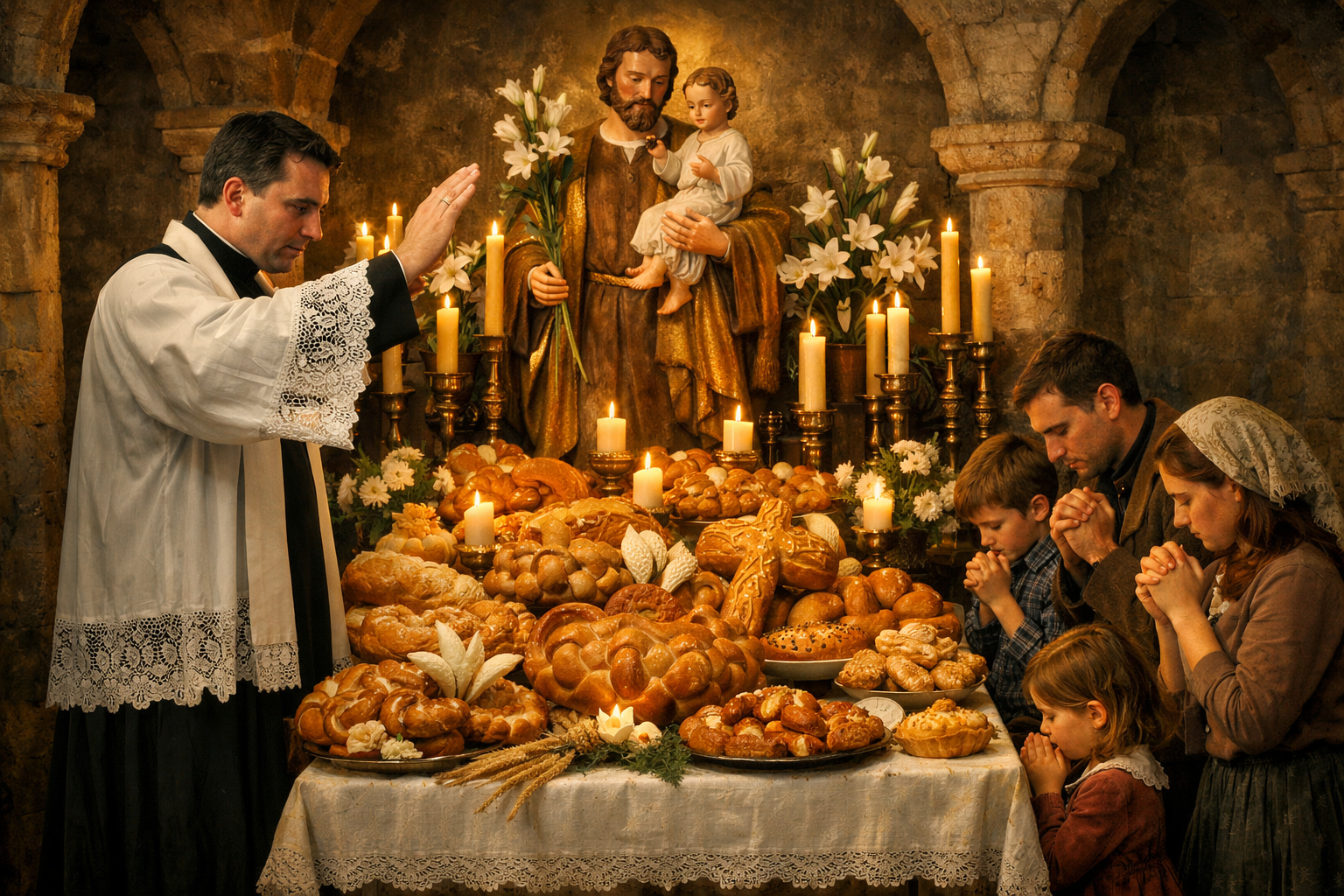
The Blessing of Bread on the Feast of St Joseph (19 March): Providence, Paternity, and the Domestic Altar
The annual blessing of bread on the Feast of St Joseph stands as one of the most theologically resonant expressions of Catholic popular devotion. Far from being a mere cultural ornament, it embodies in visible form the Church’s doctrine of divine providence, the sanctification of labour, and the mediation of grace through the domestic order. In an age increasingly detached from both sacrament and symbol, this custom retains a striking clarity: God feeds His people, and He does so through the hidden fidelity of the just.
Origins in Famine and Deliverance
The historical roots of the custom lie most prominently in Sicily, where a devastating medieval famine compelled the faithful to invoke the intercession of St Joseph. According to longstanding tradition, relief came through an unexpected abundance of crops—especially fava beans—prompting a solemn vow of thanksgiving.¹ The people prepared public tables laden with bread and food, distributing them especially to the poor in fulfilment of their promise. Thus emerged the tavola di San Giuseppe, a ritual blending liturgical blessing with corporal mercy.
Bread, as the most basic and universal staple, assumed a central symbolic role. It was shaped into forms recalling the saint himself—staffs, lilies, crosses, and carpenter’s tools—each element reinforcing the theological identity of Joseph as guardian, worker, and silent participant in the mystery of salvation.
Theological Structure of the Devotion
The blessing of bread on this feast is not accidental but deeply congruent with the Church’s understanding of St Joseph. The Fathers and later tradition consistently present him as nutritor Domini—the nourisher of the Lord.² Entrusted with the care of the Incarnate Word, he stands uniquely within salvation history as one who provided material sustenance to Him who is Himself the Bread of Life (John 6:51).
Three theological principles converge in this devotion.
First, divine providence operates through secondary causes. God feeds His people, yet ordinarily does so through human labour, social bonds, and the structures of family life.³ Joseph’s workshop becomes the instrument of divine care.
Second, labour is elevated, not negated, by grace. In Joseph, work is not merely economic necessity but participation in the sustaining activity of God Himself.⁴ The bread blessed on his feast therefore signifies not only provision received but labour sanctified.
Third, charity completes what blessing begins. The bread is not blessed for private consumption alone but for distribution. The tavola tradition insists that devotion without almsgiving is incomplete, echoing the perennial teaching of the Church that mercy is the proper fruit of grace.⁵
Thus, the custom forms a bridge between liturgy and life: what is consecrated in prayer is fulfilled in charity.
Liturgical Expression and Ritual Form
The Roman tradition provides for the blessing of bread within the broader framework of sacramentals. While no universal formula is exclusively assigned to St Joseph’s feast, the Rituale Romanum contains several benedictions of bread that may be adapted to his patronage.⁶
A form consonant with traditional theology for domestic use may be rendered as follows:
Benedic, Domine, hunc panem: ut sicut sanctum Joseph nutrire voluisti Filium tuum, ita nos tua gratia nutrias et conserves; et concede ut omnes ex hoc pane sumentes, per eius intercessionem, corporis et animae subsidium consequantur. Per Christum Dominum nostrum. Amen.
The structure is characteristic: invocation, anamnesis (recalling Joseph’s role), petition, and conclusion through Christ. The blessing situates natural sustenance within a supernatural horizon, making explicit that even daily bread is ordered toward eternal life.

The following may be used by a priest:
| Latin | English |
|---|---|
| V. Adjutorium nostrum in nomine Domini | V. Our help is in the name of the Lord |
| R. Qui fecit caelum et terram | R. Who made heaven and earth |
| V. Dominus vobiscum | V. The Lord be with you |
| R. Et cum spiritu tuo | R. And with thy spirit |
| Oremus; Domine, Jesu Christe, panis Angelorum, panis vivus, et aeternae vitae: benedicere + dignare panem istum, sicut benedixisti quinque panes in deserto: ut omnes ex eo digne gustantes, inde corporis et animae desiderabilem percipiant sanitatem: Qui vivis et regnas in saecula saecolorum. | Let us pray; O Lord Jesus Christ, Bread of Angels, living bread, and of eternal life: deign to bless + this bread, as Thou didst bless the five loaves in the desert: that all who worthily taste of it may thereby receive the desired health of body and soul: Who livest and reignest for ever and ever. |
| R. Amen | R. Amen |
After which the bread and pastries are sprinkled with holy water and the Litany to St Joseph recited:
| Latin | English |
|---|---|
| Kyrie, eleison. | Lord, have mercy. |
| Christe, eleison. | Christ, have mercy. |
| Kyrie, eleison. | Lord, have mercy. |
| Christe, audi nos. | Christ, hear us. |
| Christe, exaudi nos. | Christ, graciously hear us. |
| Pater de caelis, Deus, miserere nobis. | God the Father of Heaven, have mercy on us. |
| Fili, Redemptor mundi, Deus, miserere nobis. | God the Son, Redeemer of the world, have mercy on us. |
| Spiritus Sancte Deus, miserere nobis. | God the Holy Ghost, have mercy on us. |
| Sancta Trinitas, unus Deus, miserere nobis. | Holy Trinity, one God, have mercy on us. |
| Sancta Maria, ora pro nobis. | Holy Mary, pray for us. |
| Sancte Ioseph, ora pro nobis. | Saint Joseph, pray for us. |
| Proles David inclyta, ora pro nobis. | Illustrious offspring of David, pray for us. |
| Lumen Patriarcharum, ora pro nobis. | Light of Patriarchs, pray for us. |
| Dei Genetricis Sponse, ora pro nobis. | Spouse of the Mother of God, pray for us. |
| Custos pudicae Virginis, ora pro nobis. | Chaste guardian of the Virgin, pray for us. |
| Filii Dei nutricie, ora pro nobis. | Foster-father of the Son of God, pray for us. |
| Christi defensor sedule, ora pro nobis. | Diligent defender of Christ, pray for us. |
| Almae Familiae praeses, ora pro nobis. | Head of the Holy Family, pray for us. |
| Ioseph iustissime, ora pro nobis. | Joseph most just, pray for us. |
| Ioseph castissime, ora pro nobis. | Joseph most chaste, pray for us. |
| Ioseph prudentissime, ora pro nobis. | Joseph most prudent, pray for us. |
| Ioseph fortissime, ora pro nobis. | Joseph most strong, pray for us. |
| Ioseph oboedientissime, ora pro nobis. | Joseph most obedient, pray for us. |
| Ioseph fidelissime, ora pro nobis. | Joseph most faithful, pray for us. |
| Speculum patientiae, ora pro nobis. | Mirror of patience, pray for us. |
| Amator paupertatis, ora pro nobis. | Lover of poverty, pray for us. |
| Exemplar opificum, ora pro nobis. | Model of workmen, pray for us. |
| Domesticae vitae decus, ora pro nobis. | Glory of domestic life, pray for us. |
| Custos virginum, ora pro nobis. | Guardian of virgins, pray for us. |
| Familiarum columen, ora pro nobis. | Pillar of families, pray for us. |
| Solatium miserorum, ora pro nobis. | Comfort of the afflicted, pray for us. |
| Spes aegrotantium, ora pro nobis. | Hope of the sick, pray for us. |
| Patrone morientium, ora pro nobis. | Patron of the dying, pray for us. |
| Terror daemonum, ora pro nobis. | Terror of demons, pray for us. |
| Protector sanctae Ecclesiae, ora pro nobis. | Protector of the Holy Church, pray for us. |
| Agnus Dei, qui tollis peccata mundi, parce nobis, Domine. | Lamb of God, who takest away the sins of the world, spare us, O Lord. |
| Agnus Dei, qui tollis peccata mundi, exaudi nobis, Domine. | Lamb of God, who takest away the sins of the world, graciously hear us, O Lord. |
| Agnus Dei, qui tollis peccata mundi, miserere nobis. | Lamb of God, who takest away the sins of the world, have mercy on us. |
| Constituit eum dominum domus suae. | He made him lord of his house. |
| Et principem omnis possessionis suae. | And ruler of all his possessions. |
| Oremus. Deus, qui in ineffabili providentia beatum Ioseph sanctissimae Genetricis tuae Sponsum eligere dignatus es, praesta, quaesumus, ut quem protectorem veneramur in terris, intercessorem habere mereamur in caelis: Qui vivis et regnas in saecula saeculorum. | Let us pray. O God, who in Thine ineffable providence didst deign to choose blessed Joseph as spouse of Thy most holy Mother: grant, we beseech Thee, that we who venerate him as protector on earth may be worthy to have him as intercessor in heaven: Who livest and reignest for ever and ever. |
| Amen. | Amen. |
The Domestic Church and the Economy of Nazareth
Perhaps the most striking feature of this devotion is its inherently domestic character. Unlike many liturgical rites confined to the sanctuary, the St Joseph table extends the sacred into the household. It is, in a real sense, an extension of the altar into the home.
Here the figure of St Joseph assumes renewed significance. In a period marked by the fragmentation of paternal authority and the erosion of the family as a stable unit, his example stands in quiet but radical opposition. He governs not by assertion but by obedience; he provides not by domination but by sacrifice.
The blessed bread, placed upon the family table, becomes a sign that the home itself is ordered toward God. It recalls that the first economy of grace is not bureaucratic but familial; not abstract but incarnational.
Contemporary Relevance
Modern conditions render this devotion not antiquarian but urgent. Material insecurity, even within affluent societies, coexists with a deeper spiritual famine—a loss of meaning, purpose, and trust in providence. At the same time, the structures through which provision traditionally flowed—family, stable labour, local community—have been weakened or displaced.
Against this background, the blessing of bread on St Joseph’s feast speaks with renewed force. It reasserts that provision is not merely a function of systems but of persons; that authority is rooted in responsibility; and that what is received must be shared.
A society that forgets how to bless bread will eventually forget how to share it.
Conclusion
The devotion of blessed bread on the Feast of St Joseph is therefore not peripheral but paradigmatic. It encapsulates in a single act the relationship between grace and nature, labour and providence, blessing and charity.
St Joseph does not multiply loaves, nor does he proclaim himself the Bread of Life. Yet he stands at the threshold of that mystery, entrusted with its care. To participate in this devotion is to enter, however briefly, into the hidden life of Nazareth—where God provides, man cooperates, and all is ordered toward the quiet triumph of grace.
¹ Giuseppe Pitrè, Feste Patronali in Sicilia (Palermo: Pedone Lauriel, 1881), pp. 112–118.
² Pope Leo XIII, §3.
³ Pope Pius XI, §28.
⁴ Pope John Paul II, §25.
⁵ Catechism of the Catholic Church, §§2443–2447.
⁶ Rituale Romanum (Tit. VIII, Cap. IV), “De Benedictionibus Esculentorum.”
related articles


Latest articles
- Today’s Mass: October 30 The Blessed Martyrs of DouaiA group of 158 priests trained at the English College of Douai, in France. They were martyred in England and Wales during the century following the foundation of the famed college by Cardinal William Allen in 1568. All perished at the hands of English protestant authorities while labouring to reconvert the island. Simply being a Catholic priest was high treason in England at this time, with the penalty of hanging, drawing and quartering. Eighty alumni of Douai were beatified in 1929.
- THE PRAYER WAS IN THE LETTERNewly released Vatican correspondence contradicts claims regarding the refusal of Ad Petri Sedem pilgrims’ request to pray for Pope Leo XIV in St Peter’s Basilica. Bishop Athanasius Schneider’s homily at St Mary Major emphasised the Church as Mother of all Catholics and the importance of the traditional Roman liturgy, highlighting ongoing tensions surrounding ecclesiastical authority and traditional worship.
- Today’s homily: St Narcissus of JerusalemThe homily reflects on the role of St Narcissus as Bishop of Jerusalem, highlighting his dedication to preserving faith amidst adversity. By turning water into oil for the Paschal Vigil, he exemplifies the importance of stewardship in worship. It calls Christians to actively nurture their faith and responsibilities within their communities.
- Today’s Mass: October 29 St Narcissus, Bishop of JerusalemSaint Narcissus, Bishop of Jerusalem, was renowned for his piety and dedication to the church. Consecrated at an advanced age, he displayed unwavering vitality in governance. He presided over the Easter council, performed miracles, and faced wrongful accusations. Ultimately, he returned to serve until his death, exemplifying true Christian virtue.
- Today’s Mass: October 28 SS Simon & Jude, ApostlesToday, we honour Apostles Simon and Jude, believed to have been martyred together. Simon, known for his zeal, preached in various regions and is recognised as the patron saint of tanners. Jude, a relative of Jesus, authored an epistle urging faith and perseverance amidst challenges. Their joint feast is celebrated on October 28.



Leave a Reply