
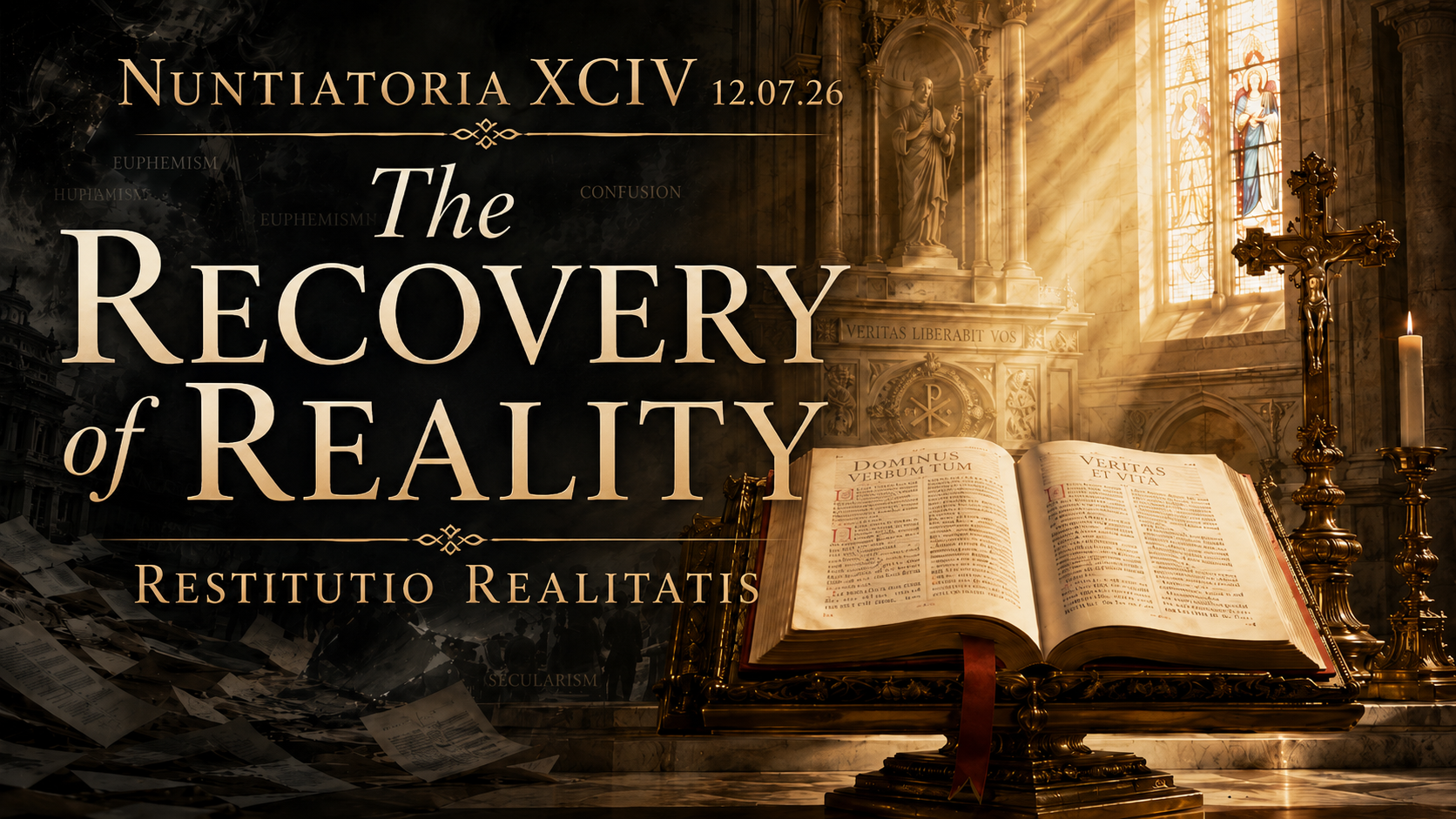
Editorial: The Recovery of Reality
Restitutio Realitatis
This edition of Nuntiatoria is concerned with the widening distance between words and things. Across theology, canon law, liturgy, medicine, education and war, reality is not always denied outright. More often it is veiled beneath euphemism, institutional language and moral abstraction until the obvious becomes controversial and the false appears respectable. Corruption is called reform, coercion is called safeguarding, injury is called care, indifferentism is called welcome, and war is called restraint.

The Gospel of the Seventh Sunday after Pentecost supplies the measure: “By their fruits you shall know them.” Our Lord does not tell us to judge merely by office, intention, reputation or language, but by what teaching and action actually produce. Saint John Gualbert, whose feast is also treated in this edition, provides the corresponding example of Catholic reform. He did not overcome corruption by softening its name. He recognised it, resisted it, and answered it with penance, discipline and fidelity. Before anything can be restored, it must first be seen truthfully.
That principle is central to the present controversy surrounding the Society of Saint Pius X. Disobedience to a pope is repeatedly described as though it were identical with schism, despite the Church’s own distinctions between refusing a command, resisting an abuse and repudiating papal authority or ecclesial communion. Those distinctions are not evasions. They are necessary if acts are to be judged according to their true moral and canonical character. Archbishop Jan Paweł Lenga’s criticism of the Vatican’s treatment of the Society therefore raises a question that cannot be settled merely by repeating the language of condemnation: does the accusation correspond to the reality?
The restriction of the traditional Roman liturgy within the Sovereign Military Order of Malta presents the same problem in another form. What appears as an administrative decision belongs to a wider transformation in which Catholic institutions retain their names and symbols while being progressively detached from the traditions that gave them identity. The Order’s difficulties are therefore not incidental. They are a miniature of the modern ecclesial crisis: continuity invoked in language, rupture imposed in practice.
By contrast, Bishop Antonio Suetta’s programme for the evangelisation of Muslims restores a truth that much contemporary Church discourse prefers to avoid. Christian hospitality is real, but incomplete if it withholds Christ. Food, shelter, welcome and legal protection are works of mercy; they are not substitutes for the Gospel. To offer every temporal good while concealing the necessity of conversion is not greater charity, but a diminished belief in the truth the Church was sent to proclaim.
The same loss of confidence appears in the treatment of the serpent in Eden published through the Vatican newspaper. The supernatural is not openly denied. It is dissolved into symbolism, cultural development and psychological interpretation. Satan becomes an idea, demonology an accretion, and the Fall a story stripped of personal evil. Yet once the devil is reduced to metaphor, sin itself soon becomes abstraction, and redemption loses its object. A Christianity embarrassed by the reality of Satan will not long preserve the reality of salvation.
The questioning of Saint Maria Goretti’s purity and martyrdom reveals a similar incapacity to speak plainly about virtue. Her witness is uncomfortable to a culture that sees chastity as repression and moral resistance as pathology. Yet she was not canonised because bodily integrity is worth more than life. She was canonised because she resisted grave sin, forgave her attacker and remained faithful to Christ under mortal assault. To obscure that reality is not sophistication. It is the failure to recognise sanctity when it takes a form modern sensibilities dislike.
The medical and safeguarding questions examined in this edition show the human consequences of such evasions. Severe incontinence, pelvic-floor damage and other lasting injuries do not cease to exist because surgery is described as affirming care. The Tavistock and WellBN controversies have already shown what happens when ideology outruns evidence and professional caution is treated as hostility. Children and vulnerable adults inhabit bodies, not theories. Safeguarding must therefore begin with material reality, informed consent, long-term risk and the freedom to question contested treatments.
The proposed prohibition of so-called conversion practices must be judged in that light. A law presented as protection may in practice silence exploratory counselling, pastoral care and parental concern. Once hesitation is equated with abuse and affirmation with safety, the law ceases to protect the vulnerable and begins to enforce an ideological conclusion. The language of compassion then becomes the instrument by which prudence is punished.
Oxford’s free-speech controversy exhibits the same inversion. Disruption is presented as protest, intimidation as safety, and the public identification of attendees as activism. A university does not preserve academic freedom merely by allowing a lecture technically to occur. Scholarship requires that arguments be heard without coercion, evidence be tested without fear, and those who attend be protected from organised denunciation. Without those conditions, academic freedom survives only as institutional rhetoric.
The renewed American strikes against Iran bring the issue into the sphere of life and death. Military escalation may be described as deterrence, strategic necessity or limited action, but vocabulary does not alter moral reality. War remains subject to the natural law, whether formally declared or not. Catholic politicians involved in such decisions cannot claim immunity from the moral standards applied to Catholic legislators in matters such as abortion. Public profession of the faith intensifies the obligation to act according to it.
The recent Old Romans Unscripted discussion following the Écône consecrations serves the same recovery of reality by insisting that terms such as schism, crisis, necessity and communion be defined rather than weaponised. A legal declaration is not a theological argument. A label is not a demonstration. The Church does not defend truth by discouraging distinctions, but by applying them honestly.
The contents of Nuntiatoria CXIV therefore reveal something deeper than a series of disputes. They disclose a crisis in the correspondence between language and reality. The natural order is treated as negotiable, supernatural truths as symbols, institutional rhetoric as proof, and moral consequences as inconveniences to be managed. Yet reality does not disappear when it is renamed. Falsehood remains false beneath an official masthead. Injury remains injury when given therapeutic language. Suppression remains suppression when justified as unity. War remains war when described as policy.
The recovery of reality begins with the restoration of truthful speech. Things must again be named according to what they are. Good must be called good, evil evil, error error, truth truth, and Christ Lord. Only then can reform be real, charity honest, obedience virtuous, safeguarding humane and peace something more than a diplomatic word.
“By their fruits you shall know them.” This edition asks its readers to look at those fruits without euphemism, fear or illusion.
IN THIS EDITION
- Resistance Without Rupture: Old Romans Unscripted on Papa Stronsay, Écône and the recovery of Catholic purposeThe latest episode of Old Romans Unscripted explores the challenges faced by traditional Catholics amid recent episcopal consecrations. The discussion centres on resisting ecclesiastical abuses without fostering division, emphasising that authority must be recognised while striving for communion. Both speakers stress that true restoration requires prioritising God and order within Catholic life.
- The Confessional Is Not the Cover-UpThe Church of England is reconsidering the seal of confession due to safeguarding concerns, arguing that mandatory reporting should take precedence over confessional confidentiality. Critics assert that the scandals originate from institutional failures rather than confession itself, warning that compromising the seal could misrepresent its purpose and impact child protection efforts.
- The Silver Confession: An Ancient Christian’s Challenge to Modern EuropeThe Church of England’s General Synod is being asked to “receive” Kairos II while, according to Canon Guy Wilkinson, its office declined to circulate the Board of Deputies’ response. Palestinian suffering must be heard, but the Church cannot commend a document that treats Zionism as inherently racist and proposes boycotting Zionist voices while claiming to respect British Jewish experience.
- Sermon for St. BonaventureToday marks the feast of St. Bonaventure, a Franciscan theologian who sought to integrate faith with scholarship, often seen as the order’s ‘second founder’. Unlike St. Thomas Aquinas, he emphasised divine illumination over sense experience. His works focused on the importance of prayer and contemplation in theology, advocating that true knowledge comes through God’s grace, not merely academic study.
- Beyond Écône: Returning Our Eyes to ChristHE ✠Jerome Lloyd’s conference shifted focus from the immediate controversies surrounding the episcopal consecrations at Écône to a deeper examination of the Church’s foundation in Christ. It emphasised the need for Catholics to look beyond current crises to maintain their faith in Jesus as the heart of the Church, rejecting both hyperpapalism and ecclesial independence.
- The Sword Laid Down Before the Cross: St John Gualbert, Abbot — Missa “Os justi meditábitur”Saint John Gualbert, celebrated on 12 July, embodies the essence of forgiveness and reform in Christianity. Once a knight seeking vengeance, he converted to a monastic life after choosing mercy over hatred. His actions emphasise that true strength lies in overcoming personal animosity and exemplifying divine charity, thus enabling ecclesiastical reform.
- Sermon for St. John Gualbert/Seventh Sunday after PentecostSaint John Gualbert’s life reveals the harmony of mercy and truth. He forgave his brother’s murderer for the sake of Christ, yet later resisted corruption within the Church with fearless firmness. His example teaches us to love our enemies without excusing error, to expose false prophets without hatred, and to defend Tradition without allowing zeal to become bitterness. True reform begins when the Cross conquers our own hearts: truth without charity becomes cruelty, while charity without truth becomes betrayal.
- Schism by Suggestion: How the Catholic Herald turns a clear canonical answer into an instrument of intimidationThe Catholic Herald’s response to a query about attending SSPX Masses contradicts itself by falsely implying that such attendance constitutes schism. Although it acknowledges occasional attendance does not equate to schism, it introduces ambiguity, suggesting fear about adherence to the SSPX, creating unnecessary anxiety instead of offering clear guidance.
- Invalid by Fiat? The DDF has announced sacramental invalidity without identifying the juridical act that produced itThe Dicastery for the Doctrine of the Faith has declared SSPX-administered sacraments invalid without clarifying the juridical basis for this decision. While some argue excommunication invalidates their authority, the explanatory note lacks precise mechanisms of revocation or clarity on the status of delegated faculties, leaving the validity of SSPX confessions and marriages uncertain.
- Before Synod Receives Kairos, It Must Hear British JewryThe Church of England’s General Synod is being asked to “receive” Kairos II while, according to Canon Guy Wilkinson, its office declined to circulate the Board of Deputies’ response. Palestinian suffering must be heard, but the Church cannot commend a document that treats Zionism as inherently racist and proposes boycotting Zionist voices while claiming to respect British Jewish experience.
- 12.07.26 Nuntiatoria CXIV: Restitutio RealitatisThis edition of Nuntiatoria examines the growing divide between language and reality across various sectors, including theology and medicine. It highlights the risks of euphemism and moral abstraction in discussing issues like corruption and safeguarding. Ultimately, it advocates for a truthful engagement with reality, urging clarity in language and actions to enable genuine reform and charity.
- By Their Fruits You Shall Know Them: The Seventh Sunday after Pentecost and the Catholic Measure of TruthThe Seventh Sunday after Pentecost focuses on the Christian life, emphasising that true faith must manifest in actions and sanctification. The liturgy contrasts the kingdom of God with worldly values, urging believers to discern true teachings. Ultimately, Christians are judged by their fruits, reflecting their alignment with God’s will and grace.
- ORDO w/c 12.07.26The content outlines the liturgical celebrations from 12 to 19 July, featuring saints such as St John Gualbert, St Anacletus, and St Vincent de Paul. Each day’s commemoration highlights significant aspects of their lives, teachings, and the corresponding Masses, focusing on themes of forgiveness, ecclesiastical reform, and service to the poor.
- Welcome Without Christ Is Not CharityBishop Antonio Suetta plans to enhance Church outreach to Muslims by combining charitable acts with Gospel proclamation, challenging the current trend of separating physical aid from spiritual invitation. He argues that failing to share Christ with migrants equates to negligence, emphasising that true charity includes inviting others to faith in Jesus.
- Oxford and the Licensed Heckler’s VetoOxford University’s management of protests against Dr Michael Foran’s lectures exposes a troubling mix-up between protest and obstruction. Activists disrupted his discussions, leading to cancellations, raising concerns about free speech. The situation tests the university’s commitment to academic freedom, highlighting its failure to clearly distinguish between lawful dissent and intimidation.
- The Gospel Is Not a Safeguarding RiskThe Church of England faced controversy over a fringe event concerning “sexual identity transformation” at the General Synod, highlighting fears of legislative censorship on Christian testimony and pastoral care. Despite affirming orthodox doctrine, the Church’s actions suggest an unwillingness to publicly support transformative Christian claims, raising concerns about freedom of expression and safeguarding encroachments on doctrine.
- When Safeguarding Becomes “Conversion”: Tavistock, WellBN and the legal intimidation of parentsThe proposed Conversion Practices Bill may deter parents, therapists, and educators from questioning gender identity in children, risking safeguarding failures similar to those at Tavistock and WellBN. The Bill’s broad definition of conversion practices could criminalise legitimate parental concerns, while existing evidence highlights the potential harms of medical transition.
- The Wolves Cite the Canons: Archbishop Jan Paweł Lenga’s denunciation of the SSPX decreeArchbishop Jan Paweł Lenga critiques the Vatican’s decree against the Society of Saint Pius X, arguing it demonstrates a departure from safeguarding Catholic doctrine. He highlights the Church’s selective enforcement of canon law, contrasting the severe penalties for traditionalists with leniency toward progressive views. His remarks illustrate a growing concern over the Church’s priorities and the integrity of faith.
- The Vatican Newspaper Finds No Devil—and No Sin—in EdenAn article in L’Osservatore Romano presents the Fall in Eden as a myth, asserting that there is no devil or sin. This controversial view, which praises Eva’s disobedience as courageous, challenges fundamental Christian doctrines of original sin and Redemption, sparking concern about undermining established theological teachings within the Church.
- After Écône: Old Romans Unscripted ReturnsThe return of “Old Romans Unscripted” on 8 July provided essential clarity for Catholics after the Écône consecrations, addressing fears and misunderstandings in ecclesiastical language. Hosted by HE ✠Jerome Lloyd and Fr Stanislaus, the episode emphasised the importance of precise distinctions in Catholic law, urging the faithful not to react emotionally but to think canonically.
- Against Papal Positivism: Obedience to Peter is not papalotryThe discussion highlights the distinction between papal obedience and papal positivism, arguing that the Pope’s authority is not absolute but serves to uphold the truth of faith. It challenges the notion that disobedience equates to schism, emphasising that obedience should align with divine law and the salvation of souls, not mere administrative compliance.
- Ann Widdecombe: She Believed, and Therefore She Spoke: A Catholic conscience in an age of political conformityAnn Widdecombe’s Catholicism was neither decorative nor private. Her conversion arose from the question of doctrinal authority, and her faith subsequently governed her defence of unborn life, marriage and Christian conscience. Though not every political judgement was beyond dispute, she possessed the increasingly rare integrity to believe publicly—and therefore to speak.
- Treated Like a Criminal: How Safeguarding Was Weaponised against Christian DissentThe Reverend Dr Bernard Randall was dismissed from his role at Trent College after preaching sermons encouraging students to engage with differing ideologies. Despite no substantiated safeguarding concerns identified after years of investigation, he faced prolonged exclusion due to institutional fears of his beliefs, highlighting a clash between doctrinal integrity and modern identity politics.
- Catholic Conscience in an Undeclared War: The War That Will Not Admit Its NameThe renewed American strikes on Iran are not only a geopolitical crisis but a Catholic test. Catholic office-holders who profess the faith must apply Catholic moral teaching to war, not quarantine conscience from power when bombs fall.
- The Order That Survived Everything Except ReformThe transformation of the Order of Malta reflects a broader shift within the Catholic Church, merging humanitarian efforts with altered identity. Traditional teachings have been overshadowed by institutional management, raising concerns about sovereignty and authentic Catholic practice. The Order’s identity, deeply rooted in faith and service, now faces challenges from modern reforms.
- The Martyrdom They Cannot NameThree German theologians have argued that St Maria Goretti should no longer be described as a “martyr of purity”. Their concern that victims of sexual violence must never be blamed is entirely just. Their conclusion is not. It rests upon the very confusion Catholic theology has always rejected: the confusion of bodily violation with moral consent.


Leave a Reply