
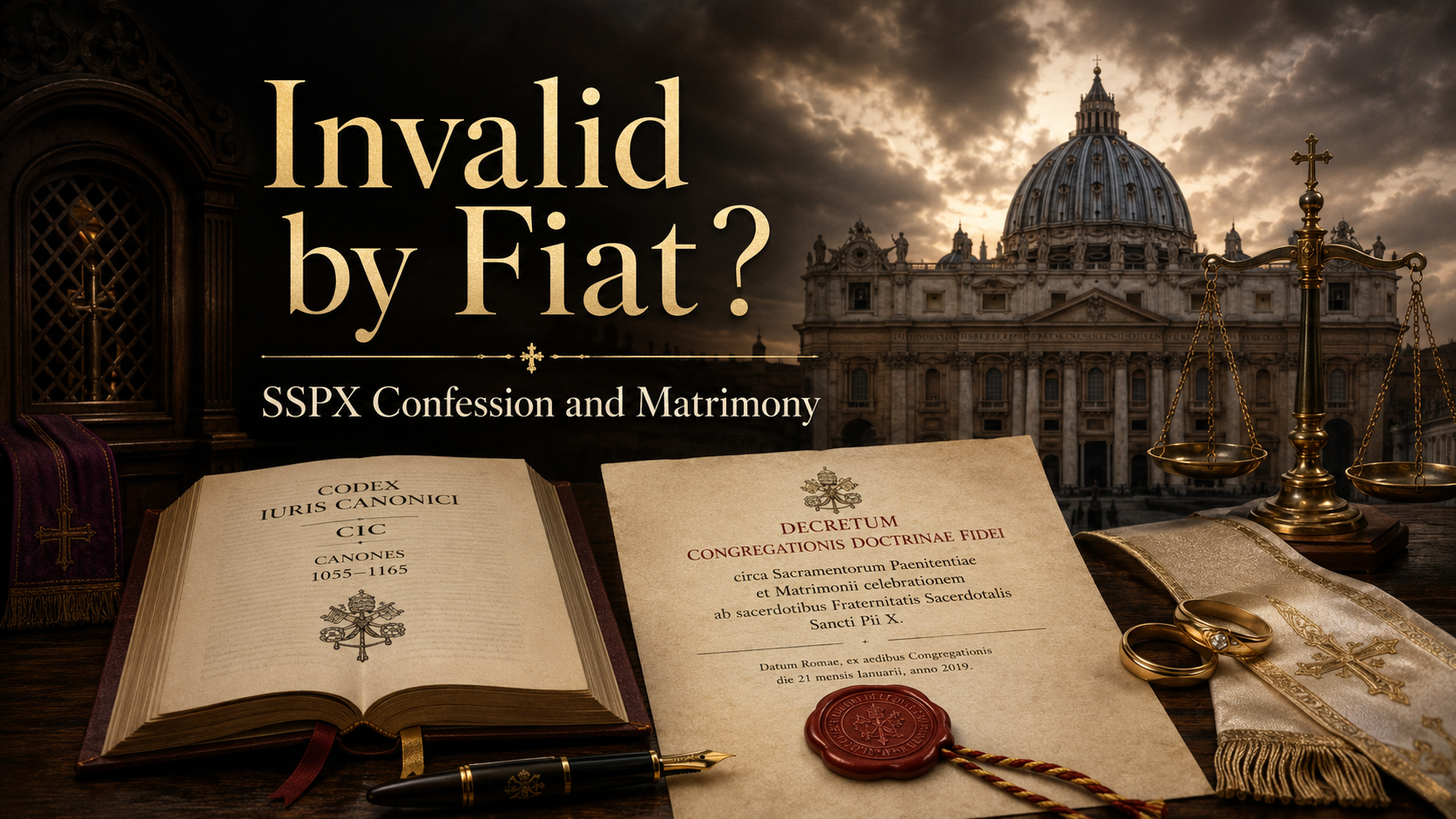
Invalid by Fiat? The DDF has announced sacramental invalidity without identifying the juridical act that produced it

The dispute over confessions heard and marriages assisted by priests of the Society of Saint Pius X is not fundamentally about whether the Church possesses authority over the sacraments. She plainly does. Nor is it disputed that valid priestly ordination is not, by itself, sufficient for every valid sacramental act. A priest requires a faculty to absolve validly; Catholics ordinarily must exchange matrimonial consent before the local ordinary, pastor, or a priest or deacon validly delegated by one of them.¹
The question is narrower: what precise juridical act withdrew, extinguished or rendered unusable the faculties and delegations previously possessed by SSPX priests?
The Dicastery for the Doctrine of the Faith has announced its conclusion. Its explanatory note of 2 July states that SSPX ministers administer the sacraments illicitly and that “the sacrament of Penance administered by them and the marriages assisted by them are invalid”.² What the note does not do is identify the canonical mechanism by which that universal invalidity has arisen.
Jonel Esto’s recent Epistles Online article, “Why SSPX Confession and Matrimony Are Invalid Now”, attempts to supply the missing reasoning. Esto writes candidly as a layman seeking to understand and obey the judgement of the Holy See, and that intention deserves respect. Yet his argument illustrates the precise canonical difficulty. He says that, “according to the Vatican’s 2026 explanatory note”, Pope Francis’s confessional concession and the matrimonial arrangement no longer apply. The note does not expressly revoke either provision. Esto’s conclusion is itself conditional: “if the Holy See judges that these faculties and delegations no longer exist”, invalidity follows. That is true—but whether, when and by what juridical act they ceased to exist is the very matter requiring proof.³
The case for the DDF should be stated in its strongest form. Canon 966 §1 requires a priest to possess both the power of Orders and the faculty to exercise it validly for the faithful whom he absolves. Canon 1108 ordinarily makes canonical form a condition for the validity of Catholic marriage. Canon 1331 prohibits an excommunicated person from celebrating the sacraments, exercising ecclesiastical ministries and performing acts of governance. Once a ferendae sententiae excommunication has been imposed, or a latae sententiae excommunication declared, acts of governance are invalidly exercised; the offender is also prohibited from benefiting from privileges previously granted.⁴
The DDF’s implied argument may therefore be reconstructed as follows. The Society has committed a formal act of schism. Its priests must consequently be considered schismatics subject to excommunication. Confessional faculties and matrimonial delegations possess a jurisdictional character. Once the censure has been declared, canon 1331 §2 either prevents the priests from benefiting from Pope Francis’s grant or invalidates their exercise of the ecclesiastical governance necessary for absolution and canonical assistance at marriage.
That is a substantial canonical argument. It may ultimately prove correct. It is not, however, the argument the DDF has actually set out.
The explanatory note does not say that Pope Francis’s confessional faculty constituted a privilege whose enjoyment has now been prohibited under canon 1331 §2, 3°. It does not say that sacramental absolution is being treated as an act of governance rendered invalid under canon 1331 §2, 2°. It does not say that the faculty itself has been revoked. It does not say that SSPX priests have been deprived of the faculty through an additional expiatory penalty.
These are not different expressions for the same juridical event. They are distinct canonical propositions with different foundations and effects.
Pope Francis’s original act was explicit. In Misericordia et misera, he recalled that during the Jubilee the faithful approaching SSPX priests had received absolution validly and licitly. He then declared that he had “personally decided” to extend the faculty beyond the Jubilee Year “until further provisions are made”.⁵
The grant was universal, directly papal and made without a fixed date of expiry. The words “until further provisions are made” plainly reserved the right of a future pope to alter or withdraw it. Pope Leo XIV undoubtedly possesses that authority. But the possession of authority is not identical with its juridically intelligible exercise.
The explanatory note may have been intended to constitute those “further provisions”. Yet it never says so. It does not cite Misericordia et misera. It does not state that Pope Francis’s grant is revoked. It does not identify whether revocation takes effect from the episcopal consecrations, from the decree, from the publication of the note or from its communication to the priests affected. It does not say whether the DDF is acting under delegated papal authority to revoke the grant or merely describing what it believes follows automatically from excommunication.
Those omissions matter because canon law distinguishes prohibition, incapacity, deprivation, revocation and invalidity. Canon 10 provides that laws are invalidating or incapacitating only when they expressly establish that an act is null or a person incapable of acting. Canon 18 requires strict interpretation of penal laws and laws restricting rights. Canon 21 provides that, in doubt, the revocation of an earlier law is not presumed. Canon 36 similarly requires strict interpretation of administrative acts that impose penalties, restrict rights or injure acquired rights.⁶
No one need argue that every one of these canons applies mechanically to the faculty contained in Misericordia et misera exactly as it would to an ordinary diocesan rescript. The concession was a universal papal provision contained in an apostolic letter. That makes express juridical treatment more necessary, not less. A direct papal grant should not be treated as silently extinguished by a curial explanatory note whose text neither names the grant nor identifies the manner of its cessation.
The distinction is confirmed by the Dicastery for Legislative Texts’ own Penal Sanctions in the Church: User Guide. In its commentary on canon 1336, the Guide distinguishes penal prohibitions from penal deprivations. It separately lists deprivation of the faculty to hear confessions and deprivation of delegated power of governance as expiatory penalties. It then explains that, where deprivation is inflicted, the sentence or decree must indicate concretely which rights have been removed and for how long.⁷
This does not prove that a priest under a declared excommunication can validly exercise an existing faculty. Canon 1331 §2 may invalidate the jurisdictional act while leaving the faculty itself formally in existence. The point is that the Church’s own penal commentary refuses to confuse the categories.
A priest may retain a faculty while being prohibited from using it. He may retain it while being incapable of exercising it validly because of a declared censure. The faculty may be expressly revoked by competent authority. Alternatively, he may be deprived of it through an expiatory penalty. To say simply that excommunication “removes faculties” conceals the question instead of answering it.
This is the weakness in Esto’s reliance upon Fr Davide Cito’s explanation. Cito is reported as saying that “a schismatic cannot validly hear confessions or validly witness a marriage” because these sacraments require canonical faculty or authorisation. But no one disputes that faculty or authorisation is necessary. The question is why a faculty directly granted by the Pope, or a delegation previously granted by a diocesan bishop, has ceased to exist or become incapable of valid exercise. Cito identifies the requirement; he does not demonstrate the juridical event by which that requirement ceased to be fulfilled.⁸
The anonymous DDF source cited by EWTN insisted that the explanatory note was published with Pope Leo’s approval and that there could be no doubt about his will. This establishes that the Dicastery was not acting contrary to the Pope’s intention. It does not necessarily establish the juridical form of his approval. Ordinary papal approval, approval in specific form, delegated executive authority and the Pope’s personal adoption of a document as his own legislative or administrative act are not interchangeable.
The distinction is not ceremonial. If Pope Leo personally revoked Pope Francis’s grant, the faithful should be told that he did so. If he approved a DDF judgement that canon 1331 already makes its exercise invalid, that reasoning should be stated. If the explanatory note is intended to possess the force of a universal decree, its legal character and operative provisions should be identified. Sacramental validity ought not to depend upon journalistic accounts of the intensity of the Pope’s intention.
The procedural difficulty is equally serious. Professor Jorge Miras, in his Practical Guide to Canonical Administrative Procedure in Penal Matters, explains that an extrajudicial penal decree must state, at least briefly, its reasons in law and fact and should follow a logical structure analogous to that of a judicial sentence. Before such a decree is issued, the authority must reach moral certainty concerning both the offence and its imputability. Canonical formalities are not obstacles to pastoral government. They are conditions of justice.⁹
The decree of 2 July declares the excommunication of the six bishops directly involved in the episcopal consecrations. It names them, identifies their acts and cites the canons under which they are judged to have incurred the penalties. It then warns clerics and lay faithful not to adhere to the Society’s schism, lest they themselves incur excommunication.
The accompanying explanatory note goes further. It states that the Society’s sacred ministers “are in schism” and must therefore be considered schismatics subject to the excommunication provided by law. It then declares their absolutions and matrimonial assistance invalid.¹⁰
Whether this wording constitutes a valid general declaration of the censure against every SSPX priest is precisely disputed. The decree itself declares the penal status of six identified bishops; in relation to other clergy it issues a warning against future or continuing adherence. The explanatory note then treats the whole body of priests as already schismatic and subject to the resulting sacramental consequences.
It does not identify the individual external act by which every priest committed the delict of schism. It does not distinguish those who participated in the consecrations from those who did not. It does not examine imputability, exemption or mitigation. It does not explain whether its wording constitutes the formal declaration of each priest’s latae sententiae excommunication required to activate all the additional effects of canon 1331 §2.
That distinction is decisive. Canon 1331 itself distinguishes the basic prohibitions of excommunication from the additional effects that arise once the censure has been imposed or declared. Canon 1335 §2 further provides that, where a latae sententiae censure has not been declared, the prohibition against celebrating a sacrament or performing an act of governance is suspended whenever one of the faithful requests it for any just reason.¹¹
If the priests’ censures have been validly declared, the DDF may invoke the stricter consequences of canon 1331 §2. If they have not been declared, canon 1335 §2 becomes directly relevant. The DDF cannot avoid that question by using language which sounds declaratory without specifying whether it is performing the juridical act of declaration.
Fr Gerald Murray has identified this defect with particular clarity. Although he accepts the declared excommunication of the six bishops, he argues that an explanatory note cannot add persons or penalties to the operative decree. “An explanatory note can explain what a decree contains,” he observed. “It can’t add to a decree.” Since the decree did not declare the priests excommunicated, he contends, the note cannot produce that result with legal effect. He applies the same reasoning to Pope Francis’s confessional grant: a DDF explanatory note cannot simply undo a formal papal act.¹²
Murray’s opinion does not constitute an authentic interpretation of the law. It does, however, expose the central distinction between the Holy See’s intention and the legal sufficiency of the instrument chosen to implement it. The DDF plainly intends the consequences to extend throughout the Society. The issue is whether that intention has been expressed through an act capable of producing those consequences.
The difficulty is greater still in relation to Matrimony.
Pope Francis did not give every SSPX priest an unrestricted universal faculty to assist at marriages. The 2017 arrangement authorised local ordinaries to make the necessary provision. Wherever possible, a diocesan or otherwise regular priest was to receive the parties’ consent, after which an SSPX priest could celebrate Mass. Where that arrangement was impossible, the local ordinary could delegate the SSPX priest himself to receive the consent.¹³
Consequently, an SSPX priest’s authority to assist at a particular marriage may derive from a special or general delegation issued by the competent local ordinary. The explanatory note does not state what has happened to those delegations.
Have they been revoked universally by Pope Leo? Have diocesan bishops been ordered to withdraw them? Do the delegations remain formally in existence but become incapable of valid exercise under canon 1331 §2? Are local ordinaries now prohibited from issuing new ones? What is the position of a special delegation already granted for a marriage arranged before 2 July but celebrated afterwards?
These are not peripheral questions. They determine whether particular marriages are valid.
Canon 1109 expressly provides that an excommunicated local ordinary or pastor does not validly assist at marriage by virtue of office once the penalty has been imposed or declared. The legislator therefore knew how to connect declared excommunication with invalid matrimonial assistance in the case of an office-holder. Canon 1111, governing priests and deacons who assist by delegation, contains no identical provision.¹⁴
That difference does not prove that an excommunicated delegate can validly assist. Canon 1331 §2 may still provide the invalidating mechanism. It does prove that the conclusion requires legal argument. The existence of an excommunication does not relieve the DDF of explaining how that censure interacts with a delegation already issued by competent authority.
Esto’s assertion that canon 1108 requires “lawful delegation” is also too broad. Canon 1114 expressly demonstrates that liceity and validity are not synonymous. A person possessing a general delegation acts illicitly if he has failed to ascertain the parties’ freedom to marry or, where possible, obtain the pastor’s permission. The canon does not declare the marriage invalid merely because the authorised witness acted unlawfully.
What validity ordinarily requires is valid canonical assistance. Not every illegality committed by a validly delegated priest destroys the matrimonial bond.
Marriage moreover enjoys the favour of law. Canon 1060 requires that, in doubt, its validity be upheld until the contrary is proved. A dicastery should therefore exercise particular precision before making a universal statement capable of causing spouses to doubt whether they are married. The canonical status of a family cannot safely be made to depend upon whether a sentence in an explanatory note silently extinguished a delegation previously granted by a diocesan bishop.
There are also express exceptions to any categorical statement that SSPX confessions and marriages are simply “invalid now”. Canon 976 permits any priest, even one lacking faculties, to absolve validly and licitly in danger of death. Canon 144 supplies executive power of governance in common error or positive and probable doubt of law or fact, and expressly extends that supply to the faculties governed by canons 966 and 1111. Canon 1116 permits marriage before witnesses alone where a competent assistant cannot be present or approached without grave inconvenience under the conditions established by law.¹⁵
These provisions do not establish the ordinary validity of SSPX sacramental ministry after 2 July. They do establish that neither the DDF’s statement nor Esto’s title can responsibly be converted into an exceptionless rule.
Nor can the objections be dismissed as arguments invented by defenders of the Society. Fr Murray condemns the episcopal consecrations and accepts the excommunication of the participating bishops. Cardinal Gerhard Müller has likewise urged Catholics not to seek sacraments from clergy separated from Roman communion. Nevertheless, Müller has stated that SSPX confessions are valid though illicit and has treated Matrimony as a more complex question, while maintaining that the spouses’ consent remains the efficient cause of the bond and that canonical form admits exceptions in law.¹⁶
Müller’s opinion is not legislation. His involvement is nonetheless contextually significant. As Prefect of the Congregation for the Doctrine of the Faith and President of the Pontifical Commission Ecclesia Dei, he signed the 2017 matrimonial arrangement whose present force is now disputed. At the very least, his intervention confirms that the canonical issue cannot be dismissed as ignorance of Roman policy or rebellion against papal authority.
Jonel Esto is therefore correct about one central proposition: if SSPX priests no longer possess the requisite faculties or delegations, and if the Church does not supply them in the particular case, ordinary absolutions and canonical assistance at marriage would be invalid. But his conditional premise is precisely what the DDF has not demonstrated. It cannot be supplied merely by trust in the Holy See’s intention, however sincere or commendable that trust may be.
The conclusion must consequently be exact.
It cannot presently be asserted with certainty that all ordinary SSPX confessions and marriages remain valid regardless of the declaration of 2 July. Canon 1331 §2 gives the DDF’s defenders a serious case: once excommunication is validly declared, the offender invalidly exercises acts of governance and is prohibited from benefiting from previously granted privileges. The requisite faculties for Penance and canonical assistance at marriage undeniably possess a jurisdictional dimension.
But neither can it responsibly be maintained that the explanatory note has demonstrated the universal invalidity it announces. It does not identify whether Pope Francis’s grant has been revoked, classified as a privilege which may no longer be enjoyed, or rendered incapable of valid exercise as an act of governance. It does not explain how existing matrimonial delegations have ceased. It does not establish with sufficient precision whether every SSPX priest’s censure has been juridically declared for the purposes of canon 1331 §2. It does not disclose the juridical form of the Pope’s approval. It does not set out the reasons of law by which its conclusion follows.
The question is not whether Pope Leo possesses authority to withdraw the faculties and delegations previously enjoyed by SSPX priests. He plainly does. The question is whether the instruments published on 2 July identify and effect that change with the juridical precision demanded when sacramental validity, penal incapacity and the marital status of the faithful are at stake.
Canon law is not an obstacle placed between the Pope and his subjects. It is one of the means by which papal authority becomes public, stable, intelligible and just. It protects penitents from uncertainty about absolution, spouses from uncertainty about their bond, priests from indeterminate penalties and the Holy See from the appearance of arbitrary government.
Pope Leo may expressly revoke the faculty granted by Pope Francis. He may determine that canon 1331 §2 makes its attempted exercise invalid. He may enact a prospective universal provision extinguishing existing matrimonial delegations or prohibiting their future grant. He may adopt the DDF’s conclusions as his own through a juridically explicit papal act.
The Pope can change ecclesiastical law. He cannot reasonably require the faithful to guess that he has changed it.
Nor can sacramental acts already completed under faculties and delegations validly possessed at the time be made retrospectively invalid by a later declaration. Law may regulate future acts; it cannot rewrite the sacramental reality of the past.
Penitents require moral certainty concerning absolution. Spouses require certainty concerning their bond. Bishops need to know whether delegations they granted remain in force. Priests need to know whether a faculty has been revoked, deprived, prohibited or rendered incapable of valid exercise.
An authoritative decision is not strengthened by leaving these matters obscure. It is weakened. Supreme authority does not become more authoritative by becoming less juridical.
Rome may possess the power to produce the result the DDF has announced. It must still identify the act that produced it.
¹ Code of Canon Law, cann. 966 §1, 1108 §1 and 1111.
² Dicastery for the Doctrine of the Faith, “Explanatory Note”, 2 July 2026.
³ Jonel Esto, “Why SSPX Confession and Matrimony Are Invalid Now”, Epistles Online, 8 July 2026.
⁴ Code of Canon Law, can. 1331 §§1–2.
⁵ Francis, Apostolic Letter Misericordia et misera, no. 12, 20 November 2016.
⁶ Code of Canon Law, cann. 10, 18, 21 and 36.
⁷ Dicastery for Legislative Texts, Penal Sanctions in the Church: User Guide (Vatican City, 2022), 60–64.
⁸ Victoria Cardiel, “Why Does the Vatican Recognize Orthodox Marriages but Not Those of the SSPX?”, EWTN Vatican, 10 July 2026.
⁹ Jorge Miras, Practical Guide to Canonical Administrative Procedure in Penal Matters, Ius Canonicum 57 (2017): 323–386, §7.6.3.
¹⁰ Dicastery for the Doctrine of the Faith, “Decree” and “Explanatory Note”, 2 July 2026.
¹¹ Code of Canon Law, cann. 1331 and 1335 §2.
¹² Myles Allman, “‘This Is a Canonical Mess’: Fr Murray Explains Why SSPX Priests, Laity Are Not Excommunicated”, Sign of the Cross Media, 8 July 2026; Gerald E. Murray, interview with Raymond Arroyo, EWTN, The World Over, July 2026.
¹³ Pontifical Commission Ecclesia Dei, Letter to the Ordinaries concerning marriages of faithful attached to the Society of Saint Pius X, 27 March 2017, published 4 April 2017.
¹⁴ Code of Canon Law, cann. 1108–1114.
¹⁵ Code of Canon Law, cann. 144, 976, 1060 and 1116.
¹⁶ “Cardinal Müller Says SSPX Sacraments Are Valid”, Catholic Herald, 9 July 2026; Pontifical Commission Ecclesia Dei, Letter to the Ordinaries, 27 March 2017.
RELATED ARTiCLES


LATEST ARTICLES
- Today’s Mass: October 16 St Hedwig of SilesiaHedwig of Silesia, a member of the Bavarian comital House of Andechs, was Duchess of Silesia from 1201 and of Greater Poland from 1231 as well as High Duchess consort of Poland from 1232 until 1238. She was canonized by the Catholic Church in 1267 by Pope Clement IV.
- Today’s Mass: October 15 St Teresa of AvilaSaint Teresa of Avila, born in 1515, was the reformer of the Carmelite Order and founded the Discalced Carmelites. Renowned for her mystical writings, she faced opposition while establishing numerous convents. Teresa’s deep spiritual insights and experiences led to her canonisation in 1622, and her feast is celebrated on 15 October.
- Today’s Mass: October 14 St Callistus, Bishop of Rome & MartyrCallistus was born to a Christian slave who had a Christian master in second-century Rome. He was placed in charge of a Christian bank which went broke. He fled the city, but was caught and sentenced to the treadmill, then later to the tin mines. He was later ransomed and returned to Rome…
- Sermon for St. WilfridToday marks the feast of St. Wilfrid, who was pivotal in establishing the Roman Christian tradition in England over the Irish. Born in 634 in Northumbria, he travelled to France and Italy, eventually becoming bishop of York. Despite conflicts with kings and church leaders, he successfully evangelised Sussex and laid foundations for future missions, showcasing both determination and a contentious spirit. St. Wilfrid passed away in 709, leaving a complex legacy of leadership and zeal for evangelism.
- THE GENERATION THAT WAS TOLD TO MOVE ON Is Rediscovering What the Church Left BehindArchbishop Salvatore Cordileone’s interview highlights the challenge of reconciling Catholic Tradition with contemporary practices, warning that restrictions like Traditionis custodes may deepen existing divisions. He notes younger Catholics are rediscovering traditional worship, which contrasts with the Church’s modern adjustments and emphasizes the need for reflective continuity in liturgical development.
CURRENT EDITION


Today’s Mass Propers
- Today’s Mass: October 16 St Hedwig of Silesia
 Hedwig of Silesia, a member of the Bavarian comital House of Andechs, was Duchess of Silesia from 1201 and of Greater Poland from 1231 as well as High Duchess consort of Poland from 1232 until 1238. She was canonized by the Catholic Church in 1267 by Pope Clement IV.

Leave a Reply