
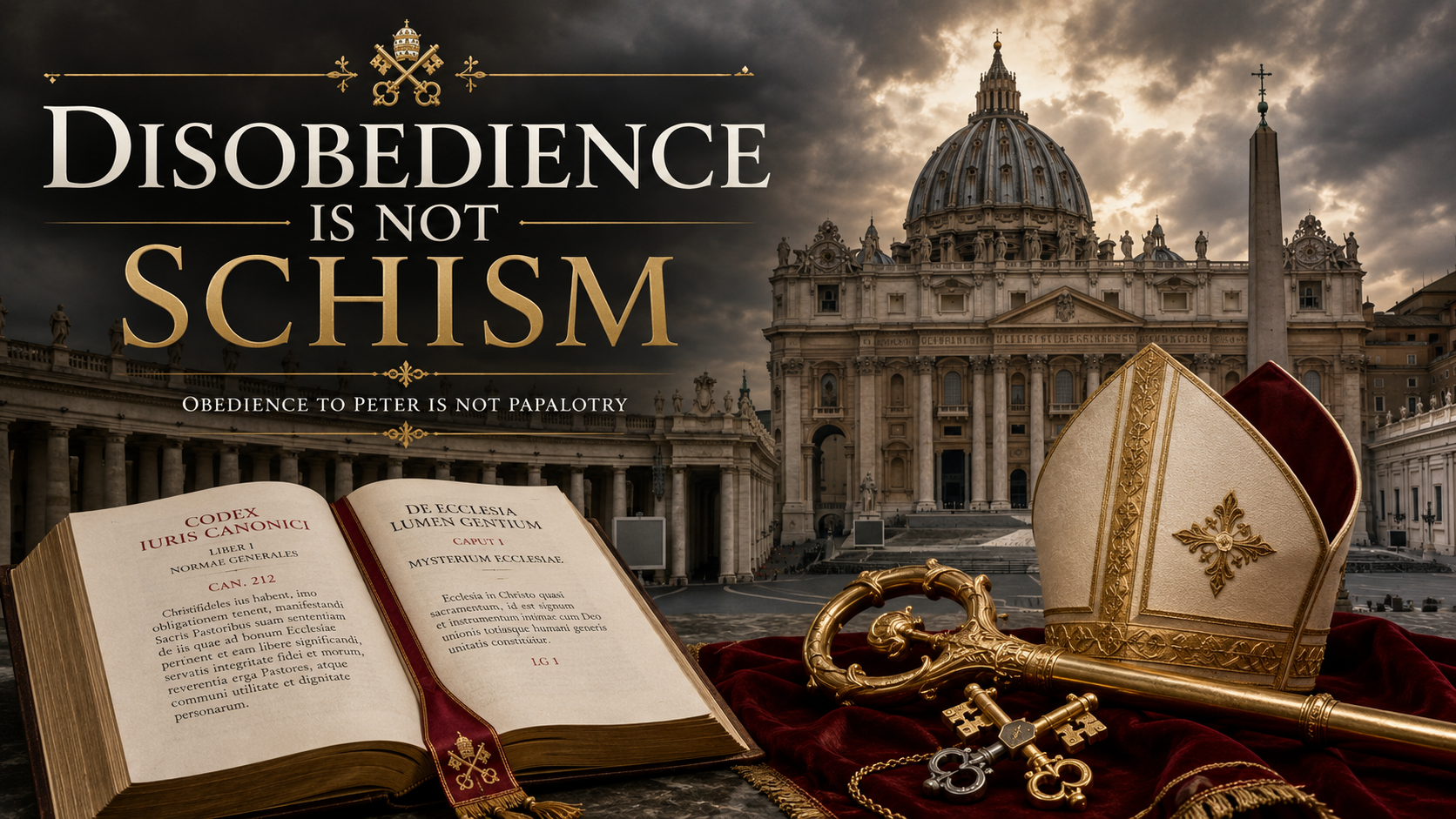
Against Papal Positivism: Obedience to Peter is not papalotry

The controversy surrounding the Society of Saint Pius X is being judged, above all, through the language of obedience. The argument is familiar: the Pope commands, the Catholic obeys, the Society refused, therefore the Society is disobedient; and because the refusal concerned episcopal consecrations without an apostolic mandate, the disobedience is said to be schismatic. The argument has the advantage of simplicity, but its simplicity is the problem. It compresses Catholic doctrine into an administrative slogan, as though the moral virtue of obedience, the nature of papal authority, the definition of schism, the imputability of canonical delicts, and the salvation of souls could all be settled by repeating that the Pope said no.
The difficulty is not merely canonical. It is theological. Many Catholics have quietly absorbed an idea of the papacy closer to potestas absoluta than to Catholic tradition: a “total Pope” whose will is imagined to settle theological difficulty by administrative command. On this view, the Pope does not merely judge within the faith; he becomes, in practice, the measure of the faith. Continuity is whatever the current authority says is continuous. Tradition is whatever the current authority permits to survive. Obedience is not service to truth, but submission to ecclesiastical power. That is papal positivism, and it must be rejected precisely because the papacy must be defended.
The Catholic answer cannot begin by minimising the papacy. It must begin by confessing it. The 1983 Code of Canon Law says of the Roman Pontiff that “he possesses supreme, full, immediate, and universal ordinary power in the Church,” and adds that “No appeal or recourse is permitted against a sentence or decree of the Roman Pontiff.”¹ These are not decorative phrases. They express the real jurisdictional primacy of Peter. The answer to papal positivism, therefore, cannot be Gallicanism, conciliarism, ecclesiastical parliamentarianism, or private judgement dressed in Roman vestments. The Catholic answer begins by accepting the primacy whole and entire.
But accepting the primacy whole and entire is precisely why papal positivism must be rejected. The Pope’s authority is not arbitrary. It is not personal sovereignty floating above revelation, tradition, divine law, natural law, or the constitution of the Church. The papacy is supreme within the Church; it is not supreme over God. It is supreme as an office of service to the faith, not as a power to refashion the faith. The Pope is the servant of the deposit of faith, not its proprietor.
The First Vatican Council itself supplies the first proof. Pastor Aeternus, the very constitution most often invoked by papal maximalists, teaches that the Holy Ghost was promised to Peter’s successors “not that they might disclose new doctrine, but that, by his assistance, they might religiously guard and faithfully expound the revelation or deposit of faith transmitted by the apostles.”² That is the solemn dogmatic structure of the papacy. It is not creative. It is custodial. It is not a licence for novelty. It is divine assistance for guarding and expounding revelation already given.
Vatican I’s Dei Filius gives the corresponding principle of doctrinal development. The Council teaches that the doctrine of faith is not a philosophical system “which can be perfected by human intelligence,” but a divine deposit committed to the Church; and it invokes the rule that growth must occur “in the same doctrine, the same sense, and the same understanding.”³ This is fatal to papal positivism. No papal command can turn rupture into continuity. No administrative demand can make contradiction into development. No appeal to the living Magisterium can require the faithful to treat a reversed proposition as though it were merely the organic unfolding of the same apostolic truth.
The authorised reception of Vatican I confirms this. When Bismarck and the German state treated papal infallibility as though Catholics had made the Pope an absolute ecclesiastical monarch, the German bishops rejected the interpretation. They explained that the Pope “cannot be called an absolute monarch,” that he is “subject to divine law,” and that the constitution of the Church is “not subject to human arbitrariness.” Pius IX, the Pope who promulgated Pastor Aeternus, approved that declaration as expressing the genuine Catholic sense of the Vatican decrees.⁴ This is decisive. The Pope of Vatican I did not understand Vatican I as papal absolutism. The bishops who defended Vatican I against Bismarck did not understand it as papal absolutism. The Catholic doctrine is not that the Pope is an ecclesiastical autocrat whose will becomes law because it is his will. The Catholic doctrine is that the Pope has supreme jurisdiction in the Church for the purpose of guarding, defining, defending, and applying the deposit of faith.
Saint Thomas Aquinas gives the moral principle. In the Summa Theologiae, he asks whether subjects must obey their superiors in all things, and answers by quoting Acts 5:29: “We ought to obey God rather than men.” He then gives the rule: “superiors are not to be obeyed in all things.” Saint Thomas does not make obedience meaningless; he places it within the hierarchy of divine and human authority. A subject is bound to obey “within the sphere of his authority,” but “inferiors are not subject to their superiors in all things.” He concludes by distinguishing true obedience from false excess: “Accordingly we may distinguish a threefold obedience; one, sufficient for salvation, and consisting in obeying when one is bound to obey: secondly, perfect obedience, which obeys in all things lawful: thirdly, indiscreet obedience, which obeys even in matters unlawful.”⁵
That is not Protestant private judgement. It is Catholic moral theology. Obedience is a virtue because it orders the will to legitimate authority for the sake of God. It ceases to be virtuous when it obeys where obedience itself becomes unlawful. A command is not made good by being commanded. A command binds according to the authority from which it comes, the matter to which it pertains, the end for which the authority exists, and the law of God to which every created authority remains subordinate.
Nor does reverence for prelates exclude correction when the faith is at stake. In the Summa, Saint Thomas writes: “It must be observed, however, that if the faith were endangered, a subject ought to rebuke his prelate even publicly.” He then explains the example: “Hence Paul, who was Peter’s subject, rebuked him in public, on account of the imminent danger of scandal concerning faith.”⁶ The first Pope himself is therefore the Scriptural and theological proof that resistance to a superior’s conduct is not necessarily rebellion against his office. The issue is not whether Peter has authority. He does. The issue is whether every concrete act of Peter, or of Peter’s successor, is beyond correction or resistance. Catholic tradition says no.
Saint Thomas also supplies the needed distinction concerning schism. In his treatment of schism, he says that “the schismatic intends to sever himself from that unity which is the effect of charity,” and that schismatics are “those who, wilfully and intentionally separate themselves from the unity of the Church.” He then specifies that the unity of the Church consists both in communion among members and in subordination to the one head, and concludes: “Wherefore schismatics are those who refuse to submit to the Sovereign Pontiff, and to hold communion with those members of the Church who acknowledge his supremacy.”⁷ Schism, therefore, is not every act of disobedience. It is not every refusal. It is not every external irregularity. It is a willed rupture from ecclesiastical unity, including refusal of submission to the Church’s head as such.
The post-Tridentine doctors do not teach papalotry either. Saint Robert Bellarmine, one of the greatest defenders of the Roman primacy, nevertheless writes in De Romano Pontifice: “Just as it is licit to resist the Pontiff that aggresses the body, it is also licit to resist the one who aggresses souls or who disturbs civil order, or, above all, who attempts to destroy the Church. I say that it is licit to resist him by not doing what he orders and by preventing his will from being executed; it is not licit, however, to judge, punish or depose him, since these acts are proper to a superior.”⁸ That is not Gallicanism. That is not sedevacantism. That is Catholic resistance: refusal of a harmful command without denial of the office.
Francisco Suárez gives the same doctrine. In De Fide, he writes: “If the Pope gives an order contrary to good customs, he should not be obeyed; if he attempts to do something manifestly opposed to justice and the common good, it will be licit to resist him; if he attacks by force, by force he can be repelled, with a moderation appropriate to a just defence.”⁹ Again, the point is not that papal authority is unreal. The point is that papal authority is not divine law itself. It is bound to divine law, to the common good of the Church, and to the end for which Christ instituted the office.
Leo XIII states the same hierarchy of obedience in Sapientiae Christianae. Speaking immediately of civil authority, but enunciating a principle rooted in divine law, he writes: “It is a high crime indeed to withdraw allegiance from God in order to please men, an act of consummate wickedness to break the laws of Jesus Christ, in order to yield obedience to earthly rulers, or, under pretext of keeping the civil law, to ignore the rights of the Church; ‘we ought to obey God rather than men.’” He continues still more forcefully: “But, if the laws of the State are manifestly at variance with the divine law, containing enactments hurtful to the Church, or conveying injunctions adverse to the duties imposed by religion, or if they violate in the person of the supreme Pontiff the authority of Jesus Christ, then, truly, to resist becomes a positive duty, to obey, a crime.”¹⁰ The principle is not that subjects may despise authority. The principle is that no created authority can oblige against God.
Newman, writing after Vatican I against Gladstone’s charge that Catholics had become slaves of the Pope, held the same Catholic balance. He acknowledged the Pope’s supreme claim upon Catholic obedience, but insisted that papal authority is “not ‘absolute’ even in religious matters.” His famous conclusion is not liberal subjectivism but Catholic moral order: “Certainly, if I am obliged to bring religion into after-dinner toasts, I shall drink—to the Pope, if you please,—still, to Conscience first, and to the Pope afterwards.” Newman does not dethrone the Pope. He dethrones papal positivism, because conscience, rightly understood, is not private preference but the echo of divine law in the soul.¹¹
This is the preconciliar Catholic doctrine. The Pope has supreme, immediate, universal jurisdiction. He is not an absolute monarch. He is judged by no earthly superior. He is bound by divine law. His office is for guarding the deposit, not inventing doctrine. His commands bind when they are lawful, ordered to the end of his office, and not contrary to faith, morals, divine law, or the salvation of souls. They do not bind when obedience would require sin, betrayal of the faith, or surrender to what a properly formed conscience judges contrary to divine law.
The same doctrine is repeated by later Roman authorities. Benedict XVI stated it with crystalline clarity in his 2005 homily for taking possession of the Chair of the Bishop of Rome: “The Pope is not an absolute monarch whose thoughts and desires are law. On the contrary: the Pope’s ministry is a guarantee of obedience to Christ and to his Word. He must not proclaim his own ideas.”¹² This is not a modern diminution of the papacy. It is the same doctrine in contemporary terms. The papal office is not the transfiguration of one man’s will into doctrine. It is a ministry bound to Christ and His Word.
The Congregation for the Doctrine of the Faith made the same point in its 1998 text The Primacy of the Successor of Peter in the Mystery of the Church, issued under Cardinal Joseph Ratzinger. It states: “The Roman Pontiff — like all the faithful — is subject to the Word of God, to the Catholic faith, and is the guarantor of the Church’s obedience; in this sense he is servus servorum Dei.” It continues: “He does not make arbitrary decisions, but is spokesman for the will of the Lord,” and adds that the primacy has “limits set by divine law and by the Church’s divine, inviolable constitution found in Revelation.”¹³ These are Roman words about Rome. They are not anti-papal. They are anti-papalotry.
The Catechism of the Catholic Church gives the theological principle underneath this. Paragraph 86 states: “Yet this Magisterium is not superior to the Word of God, but is its servant. It teaches only what has been handed on to it. At the divine command and with the help of the Holy Spirit, it listens to this devotedly, guards it with dedication and expounds it faithfully.”¹⁴ If the Magisterium teaches only what has been handed on, then no Catholic may be required to treat novelty, ambiguity, rupture, or contradiction as apostolic tradition merely because ecclesiastical authority demands submission.
This distinction matters because many Catholics now speak as though the Pope’s will were the rule of faith. It is not. The rule of faith is divine revelation, contained in Scripture and Tradition, authentically guarded and expounded by the Magisterium. The Pope is the visible principle of unity in that faith. He is not a substitute for it. Papal obedience is Catholic; papal positivism is not. Papal primacy is dogma; papalotry is distortion.
Canon law itself refuses the positivist reduction. Canon 212 certainly binds the faithful to Christian obedience toward sacred pastors, but the same canon recognises that the faithful have “the right and even at times the duty” to manifest their views on matters concerning the good of the Church. Canon 213 states that the faithful have the right to receive from pastors the Church’s spiritual goods, especially “the word of God and the sacraments.” Canon 1752 gives the interpretive key: “the salvation of souls, which must always be the supreme law in the Church.”¹⁵ The faithful are bound to obedience, but obedience is not the only juridical fact in the Church. The faithful also have rights. The Church has ends. The supreme law is not bureaucratic tidiness, but the salvation of souls.
This applies directly to the SSPX controversy. The question is not whether the Pope has authority. He does. The question is not whether canonical order matters. It does. The question is not whether an episcopal consecration without pontifical mandate is externally irregular. It is. The current Book VI of the Code states that “Both the Bishop who, without a pontifical mandate, consecrates a person a Bishop, and the one who receives the consecration from him, incur a latae sententiae excommunication reserved to the Apostolic See.”¹⁶ The ordinary canonical prohibition is real. The external irregularity is real. The disciplinary norm is real.
Nor is it irrelevant that Rome itself has framed such consecrations in explicitly schismatic language. In the recent decree reported by Vatican News, the episcopal consecration of four SSPX priests without pontifical mandate was described as “an act of a schismatic nature,” and the bishops involved were said to have incurred “ipso facto” the “latae sententiae” excommunication reserved to the Apostolic See.¹⁷ That is the charge. It must be taken seriously. But taking it seriously means asking whether the elements of schism have actually been established, not merely assuming that external illegality and formal schism are identical.
External irregularity does not automatically prove formal schism. Refusal of a particular papal command does not automatically prove culpable disobedience. The mere fact of an illegal consecration does not settle the moral, canonical, and theological case. Canon 751 defines schism as “the refusal of submission to the Supreme Pontiff or of communion with the members of the Church subject to him.”¹⁸ That definition is precise. It does not say that every illegal act, every act of resistance, every refusal of a command, or every consecration without mandate is schism by that fact alone.
The Code itself requires this grammar. Canon 1321 says that “Any person is considered innocent until the contrary is proved,” and that punishment requires an external violation “gravely imputable by reason of malice or of culpability.” Canon 1323 excludes liability for one who acted “by reason of necessity or grave inconvenience,” unless the act is intrinsically evil or harmful to souls. Canon 1324 adds that, in the relevant attenuating circumstances, the offender “is not bound by a latae sententiae penalty.”¹⁹ These canons do not automatically vindicate every SSPX claim. They do, however, prove that Catholic penal law does not permit a crude leap from external violation to culpable schism. The law asks about imputability. It asks about necessity. It asks whether the act is intrinsically evil or harmful to souls. It asks whether the penalty truly binds.
This is precisely where papal positivism becomes dangerous. It suppresses the questions canon law itself requires Catholics to ask. It moves too quickly from “without mandate” to “schism,” as though Catholic law and theology contained no intervening distinctions. But there are distinctions. There is external irregularity. There is canonical delict. There is subjective imputability. There is formal schismatic intent. There is necessity. There is the salvation of souls. These are not evasions. They are the grammar of Catholic judgement.
This is why the older recognise-and-resist formulation remains so important. Archbishop Marcel Lefebvre’s 1974 declaration did not reject Rome as such. It distinguished Catholic Rome from the postconciliar tendency that appeared to contradict Catholic Rome. “We hold fast, with all our heart and with all our soul, to Catholic Rome, Guardian of the Catholic Faith and of the traditions necessary to preserve this faith, to Eternal Rome, Mistress of wisdom and truth,” he wrote. He then added: “We refuse, on the other hand, and have always refused to follow the Rome of neo-Modernist and neo-Protestant tendencies which were clearly evident in the Second Vatican Council and, after the Council, in all the reforms which derived from it.”²⁰ That is the recognise-and-resist position in its most compressed form. It does not say there is no Pope. It does not say there is no Rome. It says that fidelity to Catholic Rome requires resistance to what appears to contradict Catholic Rome.
One may reject Lefebvre’s prudential conclusions. One may dispute whether the emergency he alleged justified the measures he took. One may argue about canonical facts, strategy, tone, or ecclesiology. But one may not honestly reduce that position to simple papal denial. Its inner logic is not sedevacantist. It is not a theory of private revelation against public authority. It is an appeal from contemporary ecclesiastical acts to the prior and permanent rule of Catholic Tradition. That appeal may be judged, but it cannot be dismissed by pretending that papal authority is potestas absoluta.
For decades, traditional Catholics have asked how Dignitatis Humanae on religious liberty is to be reconciled with Quanta Cura and the Syllabus of Errors; how postconciliar ecumenism is to be reconciled with Mortalium Animos; how collegiality is to be reconciled with Vatican I’s doctrine of papal primacy; how the reformed liturgy is to be judged in light of Trent, Quo Primum, and the organic development of the Roman rite; and how later claims concerning the death penalty, sacramental discipline for the divorced and remarried, conscience, and irregular unions can be squared with the previous Magisterium. Too often, the answer has not been clarification. It has been demand: accept the Council, accept the living Magisterium, accept the hermeneutic of continuity, accept that there is no contradiction because authority says there is no contradiction. That is not theological resolution. It is administrative closure.
Administrative closure cannot become the rule of faith. The irony is severe: many Catholics who would never dream of obeying the perennial moral doctrine of the Church with such exactitude suddenly become absolutists when the issue is obedience to the Pope. They tolerate dissent from Scripture, Trent, Humanae Vitae, natural law, and the traditional condemnation of religious indifferentism. They explain away liturgical abuse, doctrinal ambiguity, episcopal heterodoxy, and pastoral capitulation. Yet when the SSPX resists the postconciliar settlement, they discover an instant and uncompromising zeal for obedience.
That is not Catholic obedience. It is selective ultramontanism. Worse, it risks becoming papalotry: not reverence for Peter, but exaggeration of Peter; not loyalty to the office, but practical divinisation of the officeholder’s will; not obedience in faith, but obedience in place of faith. The papacy is weakened, not strengthened, by such exaggeration. The Pope is not made greater by being portrayed as an absolute monarch whose commands carry their own theological justification. He is made smaller, because his office is severed from its divine purpose. Peter was commanded to confirm his brethren in the faith. He was not commanded to make faith dependent upon administrative submission to every disputed postconciliar formulation.
None of this proves every prudential claim of the SSPX. It does not canonise every word, decision, or strategy. It does not make irregularity disappear. It does not make discipline optional. It does not give any Catholic permission to construct a private ecclesiology. But it does mean that the accusation of schism must be proved, not presumed. It means that disobedience must be judged morally, not merely administratively. It means that external irregularity does not automatically constitute formal rupture. It means that the papal office must be defended according to Catholic doctrine, not inflated into an ecclesiastical positivism that Vatican I itself does not teach.
Not every illegal consecration is schism. Not every refusal is rebellion. Not every act of resistance is a denial of authority. And not every papal command binds when its practical condition is surrender to doctrinal ambiguity or silence before error. The wound in the Church is real, but it will not be healed by papal positivism. It will not be healed by shouting “schism” at those who ask whether obedience can require acquiescence in unresolved contradiction. It will not be healed by making canonical peace conditional upon silence before the very errors that caused the crisis.
It will be healed when Peter’s authority is once again seen for what Catholic doctrine says it is: supreme, real, universal, and divinely instituted; but also ministerial, limited by divine law, subject to the Word of God, ordered to tradition, and given for the salvation of souls. That is the papacy of Vatican I. That is the papacy of Catholic tradition. And that is precisely why papalotry must be rejected.
¹ 1983 Code of Canon Law, canons 331 and 333 §3.
² First Vatican Council, Pastor Aeternus, ch. 4.
³ First Vatican Council, Dei Filius, ch. 4.
⁴ Collective Statement of the German Bishops, 1875; Pius IX, apostolic letter approving the German bishops’ explanation.
⁵ St Thomas Aquinas, Summa Theologiae, II-II, q. 104, a. 5.
⁶ St Thomas Aquinas, Summa Theologiae, II-II, q. 33, a. 4, ad 2.
⁷ St Thomas Aquinas, Summa Theologiae, II-II, q. 39, a. 1.
⁸ St Robert Bellarmine, De Romano Pontifice, lib. II, cap. 29.
⁹ Francisco Suárez, De Fide, disp. X, sect. VI, n. 16.
¹⁰ Leo XIII, Sapientiae Christianae, 10 January 1890, nn. 7–10.
¹¹ John Henry Newman, A Letter Addressed to His Grace the Duke of Norfolk on Occasion of Mr Gladstone’s Recent Expostulation.
¹² Benedict XVI, Homily for the Mass of Possession of the Chair of the Bishop of Rome, Basilica of St John Lateran, 7 May 2005.
¹³ Congregation for the Doctrine of the Faith, The Primacy of the Successor of Peter in the Mystery of the Church, 31 October 1998, nn. 7–10.
¹⁴ Catechism of the Catholic Church, 86.
¹⁵ 1983 Code of Canon Law, canons 212 §3, 213, and 1752.
¹⁶ 1983 Code of Canon Law, canon 1387, as revised in Book VI.
¹⁷ Vatican News, “Excommunication decreed for Lefebvrite episcopal consecrations,” 1 July 2026.
¹⁸ 1983 Code of Canon Law, canon 751.
¹⁹ 1983 Code of Canon Law, canons 1321–1324.
²⁰ Marcel Lefebvre, Declaration, 21 November 1974.
RELATED ARTiCLES


LATEST ARTICLES
- Today’s Mass: October 17 St Gall, Confessor;Saint Gall, born in Ireland in the sixth century, became a notable confessor after accompanying Saint Columban to France and later Switzerland, where he preached and converted idolaters. Despite his significant contributions, he humbly declined the position of bishop of Constance. He died in 646, leaving a lasting legacy.
- 18.10.26 Nuntiatoria CXXVIII: NON POTEST VERITAS SUBDI POTESTATIThis editorial asserts that truth should not be subjugated to authority, emphasising that legitimate power derives from truth rather than mandates it. It critiques contemporary tendencies in both ecclesiastical and societal contexts where authority prioritises institutional credibility over accountability. Ultimately, it calls for a return to truth as the foundation of authority, urging faithful adherence to moral principles.
- ORDO w/c 18.10.26The liturgical calendar from 18 to 25 October 2026 includes the feast of St Luke the Evangelist, commemorating essential themes of forgiveness and evangelisation. Subsequent days honour St Peter of Alcantara, St John Cantius, St Ursula and St Raphael, culminating in the celebration of Christ the King, affirming His universal sovereignty over all creation.
- THE DEBTOR AT HIS BROTHER’S THROAT: The Twenty-First Sunday after PentecostThe Twenty-First Sunday after Pentecost highlights the danger of receiving divine mercy and failing to extend the same to others, exemplified by the parable of the unforgiving servant. The Church emphasises the need for genuine charity, justice without vengeance, and the importance of faith in guiding interpersonal conduct amidst spiritual struggle.
- The Roman Provenance of MonsignorThe title “Monsignor” is often misunderstood as an ecclesiastical rank or honour, whereas it is merely a style of address linked to specific ecclesiastical offices. The distinction between substantive dignity and its verbal expression is crucial. Various regulations historically defined these roles, ensuring accurate representation of ecclesiastical authority and honour.
CURRENT EDITION


Today’s Mass Propers
- Today’s Mass: October 17 St Gall, Confessor;
 Saint Gall, born in Ireland in the sixth century, became a notable confessor after accompanying Saint Columban to France and later Switzerland, where he preached and converted idolaters. Despite his significant contributions, he humbly declined the position of bishop of Constance. He died in 646, leaving a lasting legacy.

Leave a Reply