
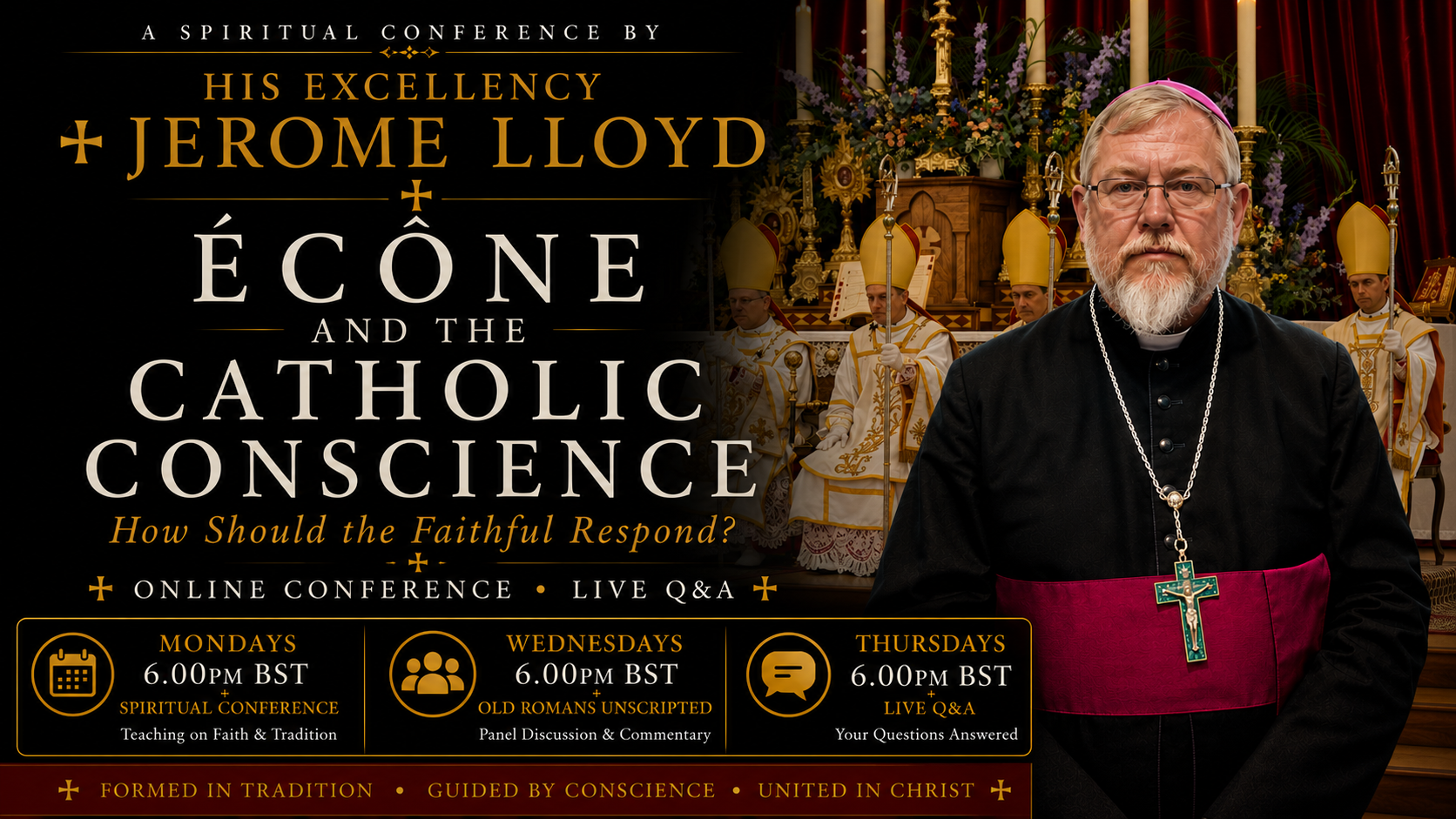
Beyond Écône: Returning Our Eyes to Christ
A Review of HE ✠Jerome Lloyd’s Spiritual Conference on Peter, the Papacy and the Present Crisis
The temptation in every ecclesiastical crisis is to mistake the immediate controversy for the deepest issue. Since the episcopal consecrations at Écône on 1 July, discussion has largely revolved around decrees, penalties, canonical arguments and competing interpretations of obedience. HE ✠Jerome Lloyd’s inaugural Spiritual Conference deliberately refused to remain there. Rather than beginning with Écône, he began where the Church herself begins: at Caesarea Philippi, with Our Lord’s question to His Apostles, “Whom do you say that I am?”
That decision determined the entire conference. The consecrations were treated not as the principal subject but as the occasion for reflecting upon a far more fundamental question: upon whom does the Church ultimately depend? In an age increasingly characterised by what the Archbishop described as “papal positivism”—the assumption that the Church derives her very existence from the reigning pontiff—he recalled listeners to the perennial Catholic doctrine that the Church is not the mystical body of the Pope but the Mystical Body of Christ. Peter’s office remains essential to the Church’s divine constitution, yet its authority is inseparable from Peter’s own confession: “Thou art Christ, the Son of the living God.”
From that foundation the conference addressed the present controversy with notable restraint. Rather than offering slogans or easy certainties, it carefully distinguished between established facts, disputed canonical questions and theological principles. The decree concerning the Écône consecrations was examined on its own terms, emphasising that the penalties presently concern the bishops named within it and that broader claims regarding clergy and faithful cannot simply be assumed from accompanying explanatory texts. The distinction between disobedience and schism, so often blurred in public discussion, was likewise explored with careful reference to Scripture, theology and the Church’s own canonical tradition.
One of the conference’s greatest strengths was its refusal to collapse complex ecclesiological questions into partisan rhetoric. Neither Rome nor the Society of Saint Pius X was romanticised. The Archbishop warned equally against reducing the Papacy to an absolute monarchy whose every disciplinary act constitutes theological reality, and against allowing prolonged resistance to become a permanent ecclesiology detached from the visible unity of the Church. In doing so he demonstrated that genuine fidelity requires Catholics to resist both hyperpapalism and practical ecclesial independence.
Perhaps the conference’s most memorable moment came not during its canonical analysis but in its closing meditation on St Peter walking upon the water. The image provided the theological key to everything that had preceded it. Peter remained above the waves only while his eyes were fixed upon Christ; the moment he looked instead at the storm, he began to sink. The application required little explanation. Catholics today are surrounded by storms: Rome, Écône, decrees, controversies, accusations and uncertainty. Yet none of these, however serious, constitutes the object of Christian faith. The Church’s strength is not this pontificate or that fraternity. It is Christ Himself, who remains Head of His Mystical Body even when His members wound one another.
That conclusion elevated the conference beyond current affairs. What might have become merely another contribution to the ongoing debate surrounding the Society instead became a meditation upon the nature of the Church herself. Listeners were reminded that Peter exists to confess Christ, that authority exists to serve the apostolic faith, and that the indefectibility of the Church rests not upon the prudence of any particular pontificate but upon the unfailing fidelity of her divine Head.
In an age when ecclesiastical discussion often oscillates between triumphalism and despair, this conference offered something rarer: theological precision joined to spiritual sobriety. It neither minimised the gravity of the present crisis nor allowed that crisis to eclipse the Lord of the Church. Its lasting contribution may prove to be its quiet insistence that the way through today’s divisions is neither panic nor partisanship, but a renewed fixation upon Christ Himself.
There will doubtless be continued disagreement over Écône, over canon law and over the future relationship between Rome and the Society of Saint Pius X. Those questions remain important and deserve serious treatment. Yet HE ✠Jerome Lloyd’s conference reminded its audience that they are not, in the end, the decisive question. The decisive question remains the one first asked at Caesarea Philippi and answered by Peter: “Whom do you say that I am?” Every controversy within the Church ultimately stands or falls upon that confession, for the Rock upon which Christ built His Church is Peter confessing Christ—and it is Christ, not the storm, who remains the hope of the Church until faith gives way to sight.
RELATED ARTiCLES


LATEST ARTICLES
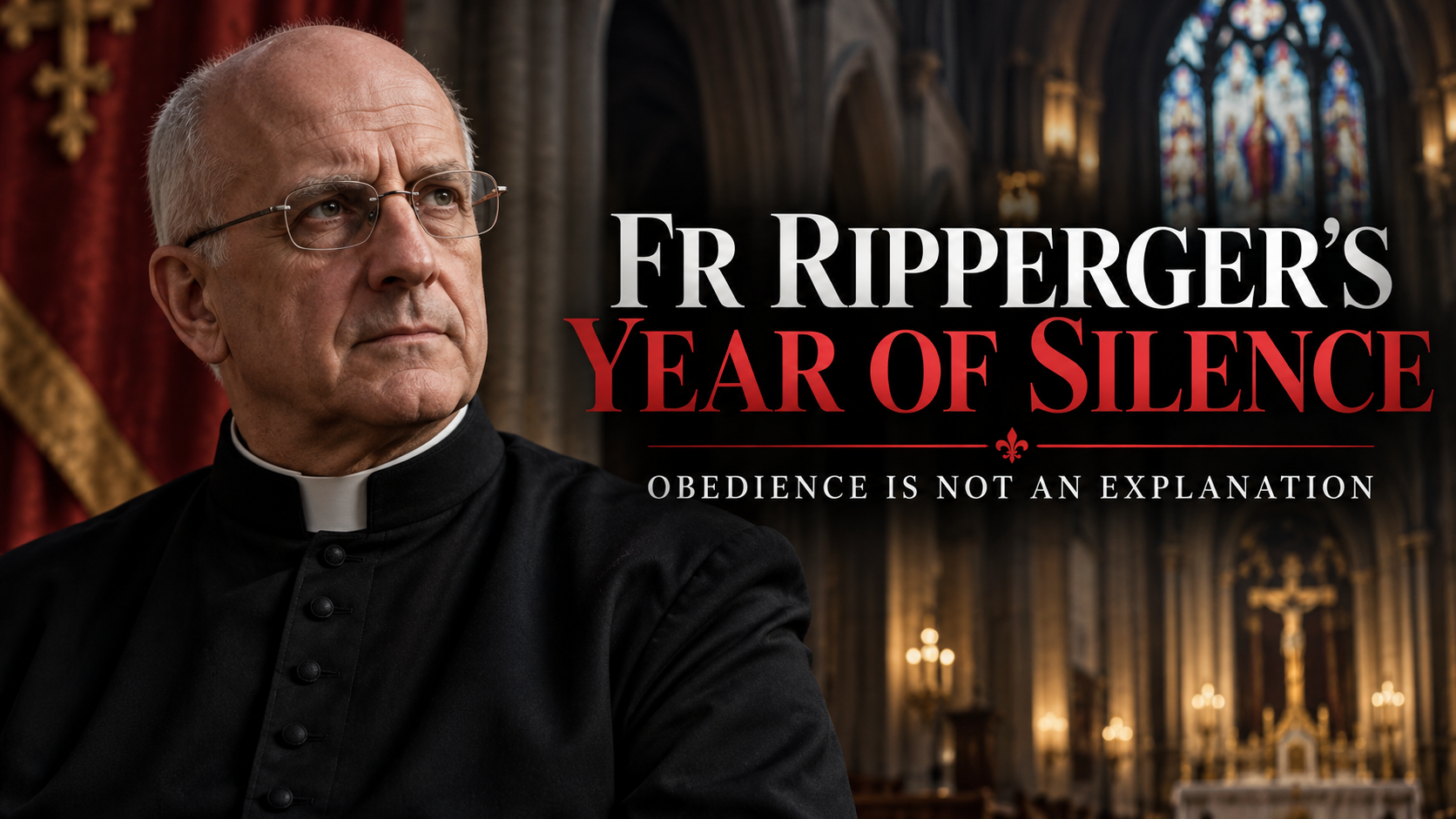
- FR RIPPERGER’S YEAR OF SILENCE: Obedience is not an explanationFr Chad Ripperger has accepted a year-long withdrawal from public speaking as requested by Archbishop Golka of Denver, aimed at focusing on his priestly community. This decision, following the removal of another exorcist, raises concerns about the Church’s balance between discretion and public witness regarding exorcism and supernatural matters.
- Today’s Mass: October 20 Octave Day of St Edward, King & ConfessorEdward the Confessor, England’s last Saxon king, ruled from 1042 until his death in 1066. Born in 1003, he fled to Normandy during Danish rule and returned to take the throne. His reign is debated, seen as both weak and a time of peace. Edward’s legacy includes the establishment of Westminster Abbey, where he is buried.
- SYNODALITY CANNOT SUBSTITUTE FOR GOOD BISHOPSCardinal José Cobo has highlighted the extensive process behind episcopal appointments, which includes numerous consultations and documentation, yet questions the effectiveness of this method in selecting suitable bishops. He stresses the need for reform in canon law and cautions against equating thorough procedures with genuine ecclesiastical wisdom and accountability.
- GAZA’S DEAD and the Claims Made in Their NameWestern politicians and media vilify Israel with double standards, while ignoring massacres of Christians across the Middle East. A century ago Christians were 20% of the region; now less than 4%, with persecution “close to genocide.” Yet Israel is the only state where Christians grow and worship freely. The Vatican mobilises diplomacy for Palestine, climate, and migration, but whispers for its own martyrs. Truth, then justice, then peace — anything less is counterfeit.
- PORTSMOUTH’S MISSING GENERATIONBishop Philip Egan has cautioned about the potential disappearance of Catholicism in England. Reports reveal an alarming trend where young people disengage after Confirmation and parents withdraw after baptismal preparation, despite some recovery in Mass attendance. Egan’s missionary programme must effectively transmit the Faith to future generations.
CURRENT EDITION


Today’s Mass Propers
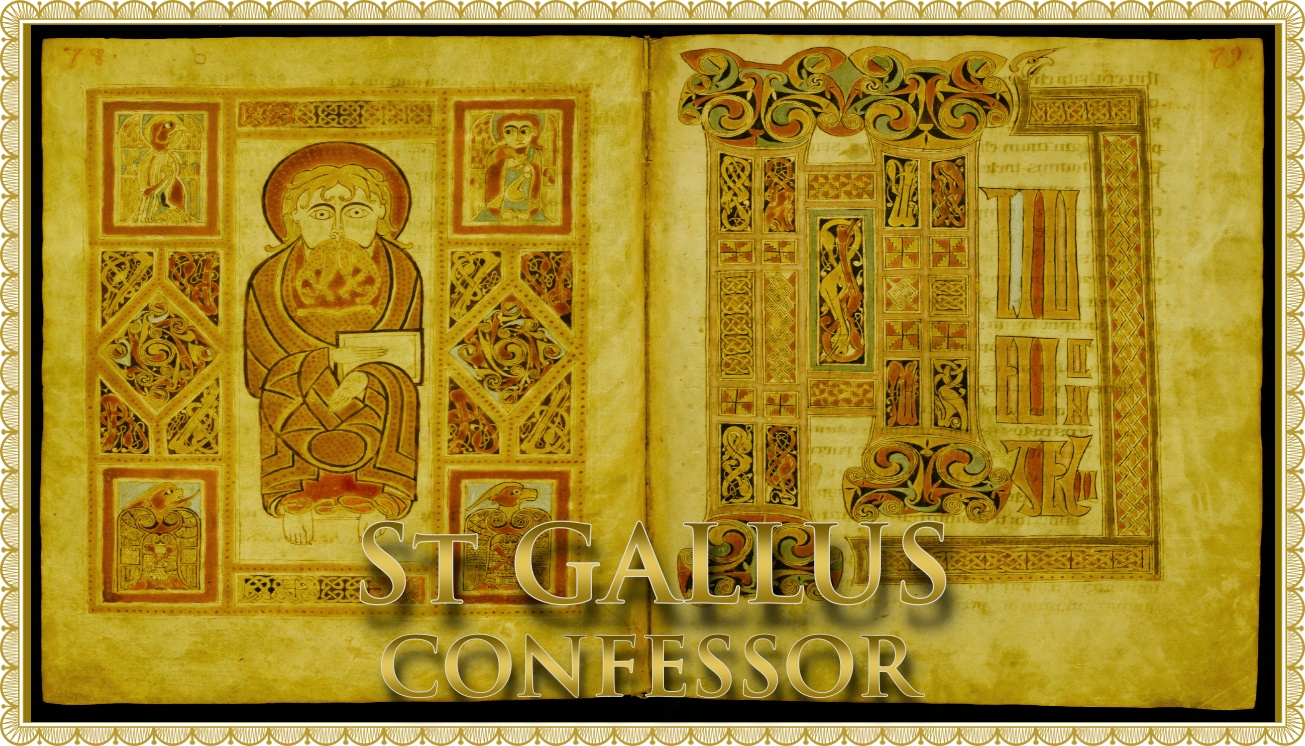
- Today’s Mass: October 20 Octave Day of St Edward, King & Confessor
 Edward the Confessor, England’s last Saxon king, ruled from 1042 until his death in 1066. Born in 1003, he fled to Normandy during Danish rule and returned to take the throne. His reign is debated, seen as both weak and a time of peace. Edward’s legacy includes the establishment of Westminster Abbey, where he is buried.


Leave a Reply