
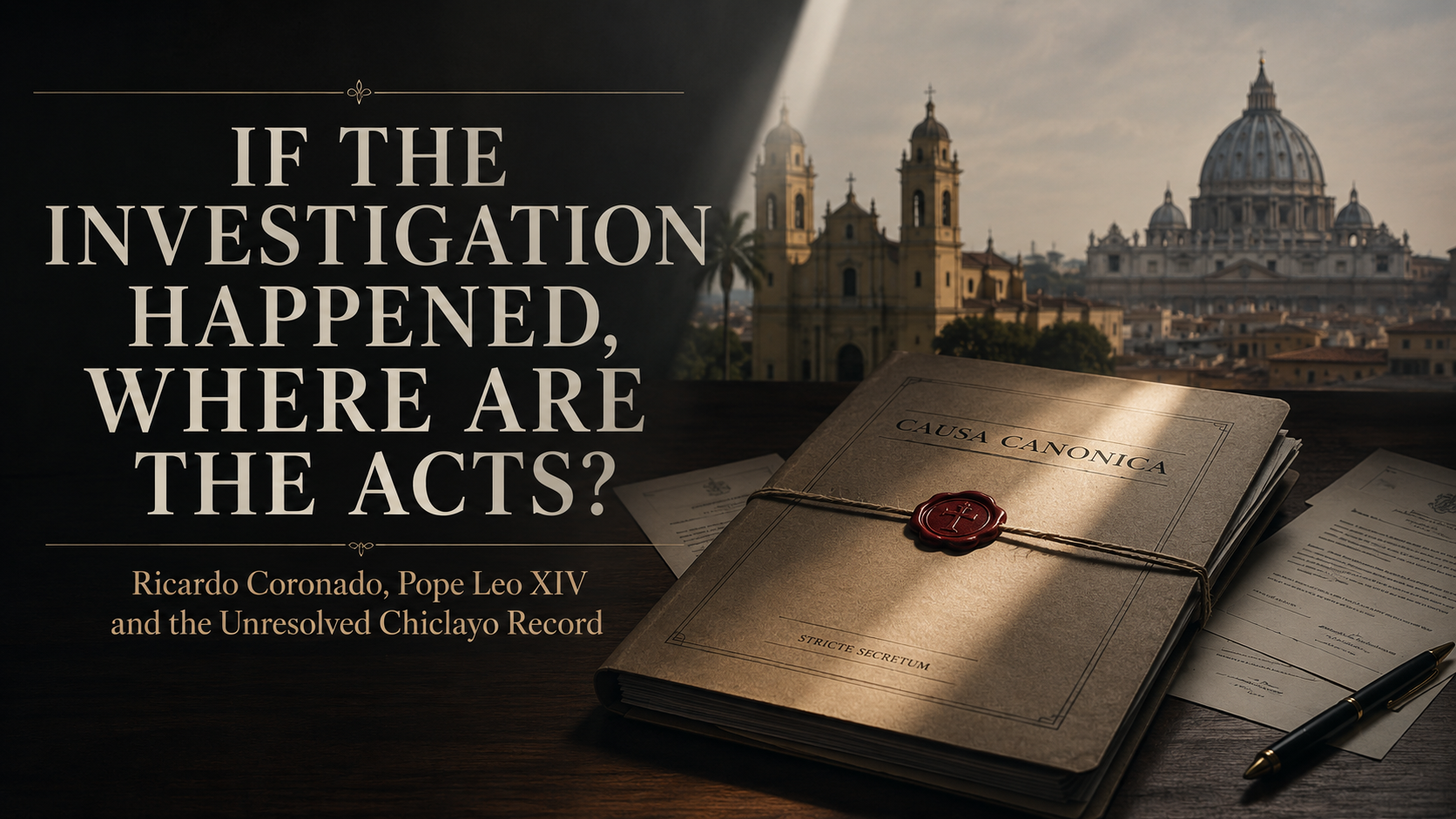
If the Investigation Happened, Where Are the Acts? Ricardo Coronado, Pope Leo XIV and the Unresolved Chiclayo Record
Ricardo Coronado Arrascue’s recent interview raises a legitimate question about the handling of clerical-abuse allegations while Robert Prevost was Bishop of Chiclayo. Yet that question is repeatedly obscured by canonical inaccuracies, hearsay and speculation presented as evidence. Neither Coronado’s damaged reliability nor the present Pope’s office settles the matter. If the diocesan account is correct, the canonical acts said to have been completed in 2022 must exist and must be capable of independent verification.

A recent interview with Ricardo Coronado Arrascue, a Peruvian canon lawyer and priest dismissed from the clerical state in December 2024, was presented as the disclosure of “the truth” about Robert Prevost’s conduct before his election as Pope Leo XIV. The presenter described reporting critical of Coronado as a coordinated smear and suggested that publications of otherwise conflicting ecclesiastical sympathies had united against him precisely because of what he was prepared to reveal. Before the evidence had been examined, the programme had largely supplied its conclusion.¹
That framing weakens rather than strengthens Coronado’s case. He raises one question of real gravity: whether allegations reported to Bishop Robert Prevost in Chiclayo in April 2022 received the preliminary canonical investigation required by the law of the Church. That question is sufficiently serious without being surrounded by theories concerning a prearranged papal succession, secret orders from Rome, fabricated accusations or the authorship of papal homilies.
Three women reported allegations concerning priests of the Diocese of Chiclayo in April 2022. The diocese acknowledges that Prevost received them. It says that precautionary measures were imposed, that Father Eleuterio Vásquez González was removed from his parish and prohibited from exercising public priestly ministry, that a preliminary investigation was undertaken, and that the resulting dossier was sent to the Dicastery for the Doctrine of the Faith on 21 July 2022. According to the diocesan account, the Dicastery archived the matter pro nunc on 10 August 2023, after which a further investigation was undertaken under the apostolic administrator, Bishop Guillermo Cornejo.²
The complainants have offered a directly contrary account. In a detailed response issued on 11 September 2024, they denied that any recognisable preliminary investigation had been conducted during Prevost’s tenure. They said that they had not been formally summoned to give evidence to an appointed investigator, had not been told the identity of any investigator and had seen no decree opening the investigation, no decree imposing precautionary measures, no investigative mandate, no decree concluding the investigation and no documentary proof that an authentic canonical file had been transmitted to Rome. They expressly requested production of the acts said to have been completed in 2022.³
The conflict is therefore not principally about whether Prevost received the women or listened to them. Both sides agree that he did. Ana María Quispe Díaz has since said that she first spoke to Prevost by telephone in 2020, that he told her he believed her, asked forgiveness in the name of the Church and encouraged her to make a formal report. She has also said that the April 2022 meeting was initially experienced positively and that Prevost encouraged recourse to the civil authorities. Her continuing complaint concerns what happened afterwards: delay, inadequate communication, uncertain support and the absence of a satisfactory canonical resolution.⁴
That later testimony materially complicates any simplistic allegation that Prevost dismissed or disbelieved the women from the outset. It does not establish that the subsequent canonical process was complete. The dispute concerns whether the sympathetic reception of the complainants was followed by a properly constituted canonical inquiry and whether the file sent to Rome contained the juridical acts and evidential material which the diocese says existed.
Coronado is correct about the governing principle. Canon 1717 provides that when an Ordinary receives information concerning a possible delict which possesses at least the appearance of truth, he is carefully to investigate the facts, circumstances and imputability, unless such an inquiry would be entirely superfluous. The DDF’s procedural Vademecum explains that a notitia de delicto need not arrive as a formal written complaint and should not be disregarded merely because the source is considered doubtful. A preliminary investigation should be undertaken whenever the allegation is at least plausible.⁵
The Vademecum describes the juridical record expected from such an investigation. The Ordinary is to issue a decree opening it, appoint the person who will conduct it where the task is delegated, ensure the authenticity of the acts, issue a decree concluding it, and transmit an authentic copy of the acts to the DDF together with his own reasoned assessment or votum. The originals are to remain in the secret archive of the curia, and the DDF ordinarily acknowledges receipt by assigning a protocol number.⁶
The preliminary investigation is not itself a trial and is not intended to determine guilt with moral certainty. Its purpose is to collect the information necessary to determine whether the accusation possesses a sufficient basis in law and fact to justify further canonical action. But precisely because it is a juridical procedure rather than an informal pastoral conversation, it leaves a documentary record.
Coronado therefore identifies the decisive question: did that record exist in July 2022?
He overstates his case, however, when he says that Prevost failed to follow Peruvian guidelines of which Prevost was himself “the author”. The revised safeguarding guidelines published by the Peruvian episcopate are dated 1 December 2022, months after the complaints were received and more than four months after the alleged transmission to Rome. They cannot simply be applied retrospectively as though their final wording governed every step taken in April 2022. Nor was Prevost their sole author. The document records that he and Bishop Reinaldo Nann devoted considerable work to updating and correcting the earlier 2016 guidelines.⁷
That correction does not remove the underlying question. Universal canon law was already in force, as was the DDF’s Vademecum of July 2020. Version 2.0 of the Vademecum was published on 5 June 2022, before the date upon which the diocese says the file was transmitted. The revised Peruvian guidelines did not invent the need for an opening decree, authenticated acts, an investigator’s report, a concluding decree and an episcopal votum. They reflected an existing canonical structure.
The pertinent question is therefore not whether Prevost complied word for word with a document published in December 2022. It is whether the acts required by canon law and Roman procedure existed when the Chiclayo dossier was reportedly sent to Rome in July.
The diocesan account encounters a further evidential difficulty. It says that Vásquez was prohibited from exercising public priestly ministry. The complainants’ response includes material which they identify as showing him participating in public Masses on 26 March, 2 April and 16 April 2023, as well as being publicly presented as a priest associated with La Inmaculada parish on 6 April.⁸
Those images do not establish that Prevost authorised the celebrations, knew that they would occur or had not modified the restrictions. Nor do they prove that no canonical precept had ever existed. They do, however, require an explanation. If a written precept prohibited public ministry, its terms, date, duration, communication and any subsequent modification should be ascertainable. The apparent public exercise of ministry is not proof of a cover-up, but neither is it an irrelevant detail.
Coronado’s reliability is weakened by several inaccurate or incomplete statements of canon law. He asserts that canon 1395 requires a priest accused of concubinage to be warned “at least twice” before penal proceedings can begin. The canon contains no such requirement. It provides that further penalties may be added progressively if, after a warning, the cleric persists in concubinage or another external offence against the sixth commandment which causes scandal. Other sexual offences, particularly those involving force, threats, abuse of authority or minors, are treated separately and may justify severe penalties, including dismissal from the clerical state.⁹
His account of a dispute with Bishop James Golka concerning the proposed marriage of a man who had undergone a vasectomy is similarly imprecise. Coronado argues that such a man could not validly marry because no bishop or pope could dispense him from the good of children. Canon law, however, expressly states that sterility neither prohibits nor invalidates marriage. A marriage may certainly be invalid if a party positively excludes offspring or another essential element of matrimonial consent, but the fact of vasectomy alone does not establish such an exclusion. The juridical question concerns the person’s act of consent, not sterility considered by itself.¹⁰
These corrections do not establish that the proceedings eventually taken against Coronado were just. They do demonstrate why his canonical conclusions cannot be accepted merely upon his own professional authority.
Coronado also presents the Peruvian Bishops’ Conference as having imposed an unlawful canonical penalty upon him despite lacking jurisdiction to judge an individual priest. The Conference’s official explanation was narrower. It said that it had not itself prohibited Coronado from acting as an advocate, but had recognised that, because he was undergoing penal canonical proceedings, he could not receive the approval required under canon 1483 and consequently could not continue to represent cases before ecclesiastical tribunals. Canon 1483 requires an advocate to be of good reputation, suitably qualified and approved by the competent bishop.¹¹
Whether the Conference’s public intervention was prudent, proportionate or sufficiently respectful of the presumption of innocence remains a legitimate question. A bishops’ conference is not itself a general penal tribunal for every priest within its territory. Coronado’s account nevertheless omits the juridical basis asserted by the Conference and represents the announcement as though it had created the underlying proceedings.
The chronology also complicates his claim that those proceedings were initiated in retaliation for his representation of the Chiclayo complainants. Reporting based upon diocesan documentation places the opening of an investigation into allegations against Coronado in March 2023, with a report sent to the Dicastery for the Clergy in September of that year. Coronado did not begin representing the three women until May 2024. The Dicastery issued the decree dismissing him from the clerical state on 19 December 2024.¹²
That chronology does not prove that the allegations were true, that the procedure was regular or that Coronado was given an adequate opportunity to defend himself. He says that he was denied meaningful access to the evidence and that repeated correspondence from his canonist went unanswered. Those claims deserve scrutiny. What the chronology does show is that the simplest retaliation theory—that the process was invented because he accepted the women’s case—cannot be maintained without considerably more evidence.
The interview’s most consequential allegations are also its least substantiated. Coronado says that a Peruvian priest told a mutual friend that an instruction had come “from higher up” to protect or “shield Prevost”. Coronado did not hear the alleged statement himself. The supposed speaker has not publicly confirmed it, and no document recording such an instruction is produced. The allegation is therefore second-hand hearsay transmitted through an intermediary, not evidence of an order issued by Rome.¹³
The programme then uses this allegation to advance the theory that Pope Francis had already marked Prevost as his intended successor. Coronado points to Prevost’s rapid elevation from cardinal deacon to cardinal bishop and his assignment to the suburbicarian Church of Albano on 6 February 2025. That promotion was real and plainly indicated exceptional papal confidence. It does not demonstrate that Francis had selected the next pope or arranged the result of a future conclave.¹⁴
Coronado is also mistaken in suggesting that a cardinal must ordinarily spend prescribed periods passing successively from cardinal deacon to cardinal priest and only then to cardinal bishop. Canon 350 permits the Roman Pontiff to assign a cardinal a suburbicarian title and thereby co-opt him directly into the episcopal order. Prevost’s promotion was unusual in its speed, but it was canonically possible. An unusual promotion may indicate influence, confidence or favour. It does not prove a secret succession plan.¹⁵
His assertions that Leo’s homilies must have been written by others, that the Pope possesses only a limited theological repertoire and that his public biography is fabricated are personal opinions rather than established facts. They reveal Coronado’s present judgement of Prevost but contribute nothing to determining whether the Chiclayo file was canonically complete.
Coronado’s reliability has been further complicated by Ana María Quispe, the most publicly prominent of the three complainants. She later accused him of instrumentalising the women and their case for purposes of his own. She said that their initial encounter with Prevost had been positive and that Coronado’s later intervention altered her understanding of his conduct.¹⁶
The Peruvian television programme Cuarto Poder had originally framed the allegations against Prevost in terms of “complicit silence” and reported the women’s accusation that he had failed to act adequately.¹⁷ Later reporting stated that, following Prevost’s election as Pope, the programme acknowledged that it had not possessed all the information concerning the diocesan handling of the case and questioned whether the complainants had been used by others for a different purpose.¹⁸
These developments weaken any attempt to present Coronado as the uncontested representative of the complainants. They do not eliminate the women’s continuing criticisms. Quispe has continued to complain about delay, inadequate communication, deficient psychological support and the absence of a satisfactory canonical resolution. She has also expressed concern that Vásquez’s request to leave the clerical state might bring the penal process to an end without an adjudication of the allegations.¹⁹
A compromised advocate does not erase the allegations he once represented. Criticism of his motives does not authenticate a disputed canonical file. One of the persistent failures surrounding abuse cases has been the temptation to transfer the controversy from the alleged institutional conduct to the character of the person demanding answers. Coronado’s weaknesses are relevant to the reliability of his broader narrative, but they do not make the underlying documentary question disappear.
The interview therefore does not prove that Robert Prevost covered up clerical abuse. Coronado repeatedly moves beyond what his evidence can bear. He treats hearsay as corroboration, unusual events as proof of concealed intention, disputed proceedings as demonstrated retaliation and personal assessments as factual revelations. His errors of canon law are especially damaging because his claimed authority as a canonist is central to the interview’s persuasive force.
Yet the weakness of Coronado’s larger narrative does not answer his strongest question. The Diocese of Chiclayo says that a preliminary investigation was completed and transmitted to Rome. The complainants say that the acts which would establish such an investigation have never been demonstrated. That conflict cannot be resolved by attacking Coronado, praising Prevost or appealing solely to the authority of the institutions whose conduct is disputed.
Nor does legitimate confidentiality prevent a resolution. The complainants and the public need not be given unrestricted access to confidential testimony or the identities of witnesses. The DDF could nevertheless commission an independent canonical audit confirming whether an opening decree was issued; who conducted the investigation; whether a notary was appointed; what categories of evidence were gathered; whether the accused priest was questioned; what precautionary restrictions were imposed; whether an investigator’s report and episcopal votum were produced; whether a decree concluded the investigation; what was transmitted on 21 July 2022; and what decision was communicated in August 2023.
A redacted chronology could then be published, confirming the existence and dates of the relevant acts while protecting legitimate confidentiality. If the diocesan account is accurate, such verification would answer the gravest allegation far more effectively than denunciations of critics. If the expected acts do not exist, or if what was transmitted amounted only to an informal report unsupported by a genuine investigation, the failure would be grave and would require acknowledgement and remedy.
Ricardo Coronado’s interview supplies neither a conviction nor an acquittal. It combines a legitimate demand for documentary accountability with allegations that range from the imprecise to the speculative. The answer is not to accept the whole because part may be true, nor to reject the whole because much is doubtful.
If the investigation happened as the Diocese of Chiclayo says it did, the corresponding decrees, acts and transmissions must exist. They must now be capable of independent verification.
¹ “Church and State”, interview with Ricardo Coronado Arrascue, YouTube video, accessed 4 July 2026. https://www.youtube.com/watch?v=UzRLHFVD2zQ&t=4s
² Diocese of Chiclayo, “Nota de Prensa OMCS-N.º 49”, 10 September 2024; “Así contesta la Iglesia las falsas acusaciones contra el cardenal Prevost”, Zenit, 12 September 2024. https://es.zenit.org/2024/09/12/asi-contesta-la-iglesia-las-falsas-acusaciones-contra-cardenal-prevost/
³ Ana María Quispe Díaz, Aura Teresa Quispe Díaz and Juana Mercedes Quispe Díaz, response to the Diocese of Chiclayo and América Televisión, 11 September 2024. https://lanuovabq.it/storage/docs/comunicato-risposta-vittime-11-9.pdf
⁴ Paola Nagovitch and Íñigo Domínguez, “Habla la víctima del caso de abusos en Perú usado contra el Papa”, El País, 1 October 2025. https://elpais.com/sociedad/2025-10-01/habla-la-victima-del-caso-de-abusos-en-peru-usado-contra-el-papa-y-confirma-que-su-abogado-la-utilizo-su-intencion-nunca-fue-ayudarnos.html
⁵ Code of Canon Law, canon 1717 §1; Dicastery for the Doctrine of the Faith, Vademecum on Certain Points of Procedure in Treating Cases of Sexual Abuse of Minors Committed by Clerics, version 2.0, nos. 9–33. https://www.vatican.va/archive/cod-iuris-canonici/eng/documents/cic_lib7-cann1717-1731_en.html https://www.vatican.va/roman_curia/congregations/cfaith/ddf/rc_ddf_doc_20220605_vademecum-casi-abuso-2.0_en.html
⁶ Dicastery for the Doctrine of the Faith, Vademecum on Certain Points of Procedure in Treating Cases of Sexual Abuse of Minors Committed by Clerics, version 2.0, nos. 39–41, 66–77. https://www.vatican.va/roman_curia/congregations/cfaith/ddf/rc_ddf_doc_20220605_vademecum-casi-abuso-2.0_en.html
⁷ Conferencia Episcopal Peruana, Nuevas líneas guía de intervención para el procedimiento a seguir por los obispos ante posibles casos de abuso sexual de menores y personas vulnerables por parte de clérigos, 1 December 2022. https://cepromelat.com/lineas-guia-peru/
⁸ Quispe Díaz, Quispe Díaz and Quispe Díaz, response to the Diocese of Chiclayo and América Televisión, 11 September 2024, pp. 5–7. https://lanuovabq.it/storage/docs/comunicato-risposta-vittime-11-9.pdf
⁹ Code of Canon Law, canon 1395 §§1–3. https://www.vatican.va/archive/cod-iuris-canonici/eng/documents/cic_lib6-cann1364-1399_en.html
¹⁰ Code of Canon Law, canon 1084 §3. https://www.vatican.va/archive/cod-iuris-canonici/eng/documents/cic_lib4-cann998-1165_en.html
¹¹ Permanent Council of the Peruvian Bishops’ Conference, communiqué concerning Ricardo Coronado Arrascue, 14 September 2024; Code of Canon Law, canon 1483. https://iglesia.org.pe/wp-content/uploads/2024/10/16-COMU-14SETBRE-2024-Cajamarca.pdf https://www.vatican.va/archive/cod-iuris-canonici/eng/documents/cic_lib7-cann1400-1500_en.html
¹² Aleja Hertzler-McCain, “Pope Leo Critic Now Says Her Lawyer Might Have Had a Secret Agenda”, National Catholic Reporter, 29 September 2025. https://www.ncronline.org/vatican/vatican-news/exclusive-pope-leo-critic-now-says-her-lawyer-might-have-had-secret-agenda
¹³ “Church and State”, interview with Ricardo Coronado Arrascue, YouTube video, accessed 4 July 2026. https://www.youtube.com/watch?v=UzRLHFVD2zQ&t=4s
¹⁴ Holy See Press Office, “Resignations and Appointments”, 6 February 2025. https://press.vatican.va/content/salastampa/en/bollettino/pubblico/2025/02/06/250206e.html ¹
⁵ Code of Canon Law, canon 350 §1. https://www.vatican.va/archive/cod-iuris-canonici/eng/documents/cic_lib2-cann330-367_en.html
¹⁶ Nagovitch and Domínguez, “Habla la víctima del caso de abusos en Perú usado contra el Papa”. https://elpais.com/sociedad/2025-10-01/habla-la-victima-del-caso-de-abusos-en-peru-usado-contra-el-papa-y-confirma-que-su-abogado-la-utilizo-su-intencion-nunca-fue-ayudarnos.html
¹⁷ América Televisión, Cuarto Poder, “Exobispo de Chiclayo mantuvo en silencio casos de abuso sexual”, 8 September 2024. https://www.americatv.com.pe/noticias/actualidad/exobispo-chiclayo-mantuvo-silencio-casos-abuso-sexual-n496492
¹⁸ Hertzler-McCain, “Pope Leo Critic Now Says Her Lawyer Might Have Had a Secret Agenda”. https://www.ncronline.org/vatican/vatican-news/exclusive-pope-leo-critic-now-says-her-lawyer-might-have-had-secret-agenda
¹⁹ Nagovitch and Domínguez, “Habla la víctima del caso de abusos en Perú usado contra el Papa”. https://elpais.com/sociedad/2025-10-01/habla-la-victima-del-caso-de-abusos-en-peru-usado-contra-el-papa-y-confirma-que-su-abogado-la-utilizo-su-intencion-nunca-fue-ayudarnos.html
RELATED ARTICLES


LATEST ARTICLES
- Today’s Mass: October 09 St Dennis, Bishop with Rusticus & Eleutherius, MartyrsGregory of Tours states that Denis was bishop of the Parisii and was martyred by being beheaded by a sword. The earliest document giving an account of his life and martyrdom, the “Passio SS. Dionysii Rustici et Eleutherii” dates from c. 600, is mistakenly attributed to the poet Venantius Fortunatus, and is legendary.
- Today’s Mass: October 08 St Bridget of SwedenSaint Bridget of Sweden, born around 1302, was a noblewoman renowned for her piety and prophetic revelations. After marrying Prince Ulpho and raising eight children, she led a life of austerity and charity, founding the Order of the Holy Saviour. She died in Rome in 1373 and was canonised in 1391.
- Today’s Mass: October 07 Pope St Mark, ConfessorSt Mark’s brief pontificate teaches that God measures fidelity, not duration or worldly achievement. Christ alone possesses the everlasting priesthood; His servants are stewards of what they have received. With the commemorated martyrs, St Mark reminds us to persevere faithfully, so that when the Lord comes, He finds us “so doing.”
- Omnia autem probate: quod bonum est tenete ~ Prove all things; hold fast that which is good: Spiritual Conference for Nuntiatoria CXXVIThe conference reflects on St Paul’s assertion to “prove all things” in relation to self-judgement and the Church. It explores themes of synodality, ecumenism, and the importance of discernment, emphasising the need for humility in understanding truth and the challenge of maintaining genuine holiness in the midst of contemporary ecclesiastical crises.
- FROM PERMISSION TO PRESUMPTION: Fort Worth and the Chalice Vatican II never made the NormBishop Michael Olson has implemented strict limitations on the distribution of Communion under both species in the Diocese of Fort Worth, prompting a discussion on the historical evolution of liturgical practices following Vatican II. This decision aims to reaffirm the doctrine of the Eucharist, emphasising that Christ is fully present under either species, while addressing misconceptions surrounding modern practices.




Leave a Reply