
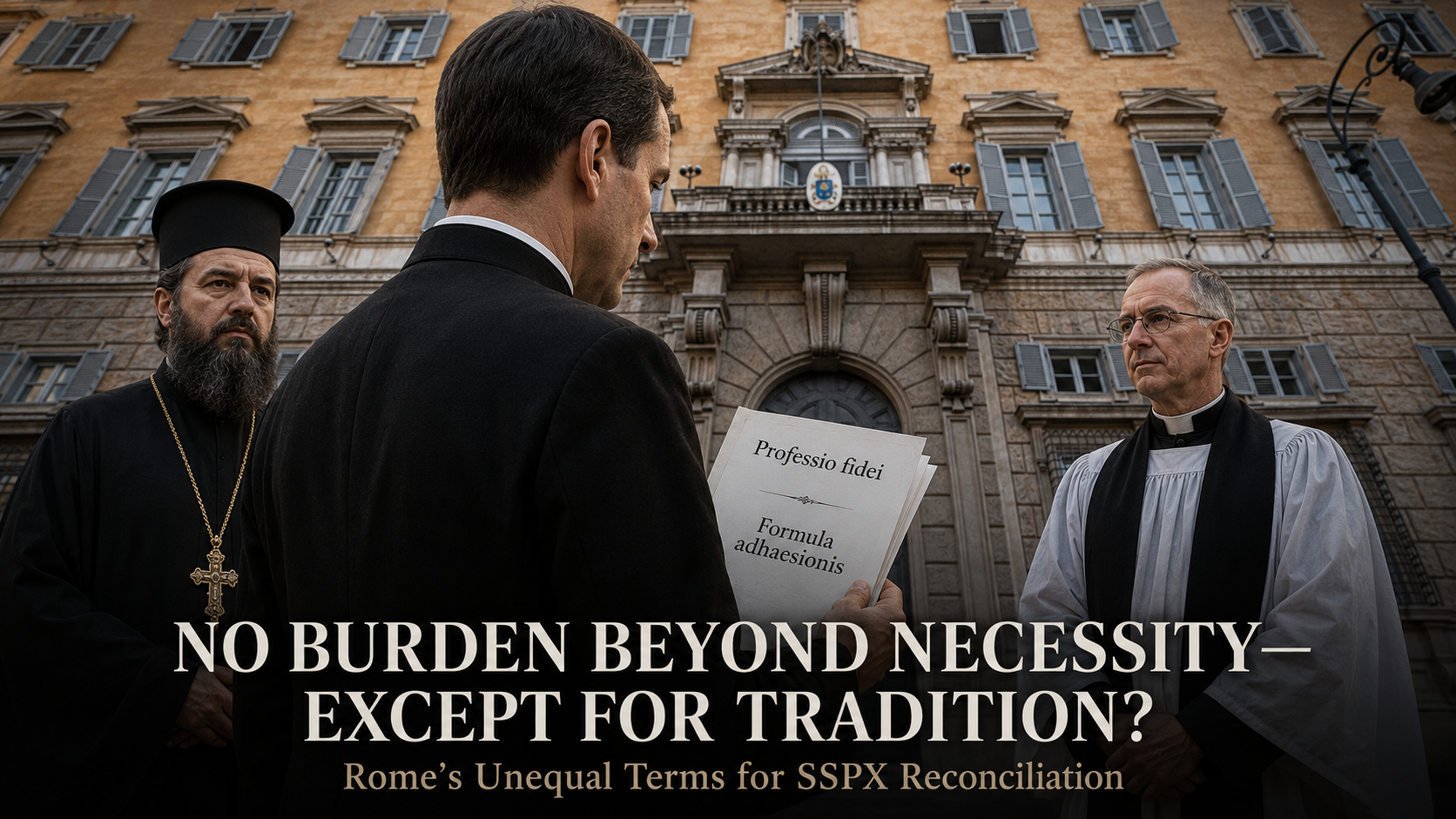
No Burden Beyond Necessity—Except for Tradition? Rome’s Unequal Terms for SSPX Reconciliation
An Orthodox priest may enter Catholic communion with his valid orders recognised. A former Anglican minister is received as a layman but may preserve his patrimony and seek Catholic ordination. An SSPX priest—already baptised and validly ordained within the Catholic sacramental order—must petition for remission of censure, accept Vatican II and the “legitimacy” of the Novus Ordo Missae, sign a special Formula of Adherence restricting his public criticism, and undergo as much as three years’ probation. The cases are not identical, but their differences do not justify ambiguity, collective culpability or demands extending beyond the Catholic profession of faith.

The Dicastery for the Doctrine of the Faith has followed its decree against the Society of Saint Pius X with an official worldwide procedure for priests and lay faithful seeking reconciliation with Rome. Issued following the episcopal consecrations conducted at Écône on 1 July 2026, the decree declares that Bishop Alfonso de Galarreta and the four newly consecrated bishops incurred latae sententiae excommunication under canons 1387 and 1364 §1. It also declares Bishop Bernard Fellay excommunicated for having participated as a co-consecrator and thereby publicly adhered to what the Dicastery describes as the schismatic act. Clerics and lay faithful are warned not to adhere to “the schism of the Priestly Fraternity of Saint Pius X”, lest they too incur excommunication.¹
The reconciliation requirements are not a journalistic reconstruction or an informal indication of what individual bishops might choose to demand. They appear in the Dicastery’s own official document, Prassi per la riconciliazione dei sacerdoti provenienti dalla Fraternità Sacerdotale San Pio X, published among the documents released by the DDF on 2 July. The text establishes the operative administrative practice governing remission of censures, probation and eventual incardination.²
The procedure begins by defining the priest eligible to use it as one who has decided to leave the Society and is disposed to accept “the Second Vatican Council and the legitimacy of the novus ordo Missae”, even while remaining attached to the usus antiquior. He must first find a diocesan bishop, major superior or other competent Ordinary willing to receive him ad experimentum. He must then write personally and by hand to the Pope, identify himself and request remission of the censures said to have been incurred because he received ordination from an excommunicated or irregular bishop, or because, having been validly and legitimately ordained, he subsequently entered the SSPX. He must supply his priestly ordination certificate and sign both the prescribed Professio fidei and the special Formula adhaesionis.²
The sponsoring Ordinary must forward the documents to the DDF and declare his willingness to receive the priest provisionally. The Dicastery will then issue a rescript remitting the censures and authorising a probationary period of at least one year and no more than three, after which incardination may proceed. If the probation fails, the Ordinary is to return the rescript to the Dicastery together with a report explaining why the priest was not incardinated.²
The appended Formula of Adherence is more consequential than any general description of “accepting Vatican II” might suggest. The signer promises fidelity to the Catholic Church and to the Roman Pontiff and undertakes to abstain from every public declaration adverse to the Pope’s person or Magisterium. He accepts the teaching of Lumen gentium 25 on the Church’s Magisterium and the assent owed to it. Where certain conciliar teachings, or subsequent reforms of the liturgy and canon law, appear difficult to reconcile with previous declarations of the Magisterium, he promises to follow a “positive line” of interpretation under Magisterial guidance, so that no doctrine is separated from the rest of the Church’s sacred doctrinal patrimony.²
The significance of the comparison with Orthodox and Anglican clergy is therefore unavoidable. It must nevertheless be made honestly. An Orthodox priest, an Anglican minister and an SSPX priest do not occupy the same sacramental, ecclesiological or penal position. A facile comparison based only upon how many documents each man must sign would conceal rather than clarify the issue.
An Orthodox priest belongs to a true particular Church separated from full communion with Rome but possessing valid apostolic succession, sacraments and Holy Orders. A former Anglican minister is a baptised Christian whose ministerial orders the Catholic Church does not recognise as sacramentally valid. An SSPX priest has already been baptised, confirmed and validly ordained within the Catholic sacramental order but is now regarded by Rome as belonging to a body in schism and as requiring remission of censure before the restoration of lawful ministry.
One is received with his priesthood recognised. One is received as a layman who may subsequently be admitted to Catholic ordination. One seeks canonical regularisation following what Rome has declared a rupture of communion.
That distinction provides Rome with its strongest defence. The Orthodox and Anglican procedures are principally processes of reception. The SSPX procedure is presented as a process of repentance, remission of penalty and restoration of canonical obedience. The Church may reasonably require evidence of repentance from someone said to have violated obligations already binding upon him which she would not demand from a person who had never been subject to Catholic clerical discipline.
The comparison does not therefore prove that every additional requirement placed upon an SSPX priest is unjust. It does require Rome to show that each additional requirement corresponds to an identifiable offence, a genuine obstacle to communion or a necessary safeguard of Catholic doctrine and ecclesiastical order. What cannot be required is submission to propositions whose content, theological authority and binding interpretation have not been identified.
The Orthodox priest: recognised orders and no unnecessary burden
The Code of Canons of the Eastern Churches establishes a deliberately restrained principle for baptised non-Catholics seeking full communion: nothing beyond what is necessary is to be imposed upon them. A member of a non-Catholic Eastern Church is received through the profession of the Catholic faith, following doctrinal and spiritual preparation appropriate to his condition. An Eastern non-Catholic cleric entering communion may exercise the sacred order he already possesses according to the norms established by competent Catholic authority.³
“Profession of faith alone” describes the juridical act by which he is received. It does not mean that an Orthodox priest may walk immediately from an Orthodox sanctuary into a Catholic parish and begin ministry without investigation. His baptism, chrismation, ordination, ecclesiastical history, moral character, marital condition and suitability must be verified. He must be placed under a competent Catholic hierarch, ascribed to the appropriate Eastern Catholic Church, canonically attached to an eparchy or other body capable of receiving clerics, and granted the faculties necessary for ministry.
Nevertheless, the sacramental principle is unmistakable. He is not baptised again, chrismated again or ordained again. The Catholic Church recognises that the separated Eastern Churches possess true sacraments, particularly through apostolic succession, the priesthood and the Eucharist.⁴
The Orthodox priest must accept the Catholic faith and full communion with the Roman Pontiff. He cannot retain a formal denial of Catholic dogma concerning papal primacy or the constitution of the Church. Yet Rome does not ordinarily require him to sign a detailed repudiation of every Orthodox objection to papal jurisdiction, denounce each act of his former hierarchy or confess that his previous priestly ministry constituted a canonical crime.
That approach does not minimise the gravity of separation. It recognises that the Orthodox priest did not minister as a Catholic cleric subject to Catholic penal discipline. His separation must be healed, but his former ministry cannot simply be punished as though he had possessed and then criminally repudiated a Catholic canonical mission.
The Eastern Code’s principle does not directly govern SSPX clergy, who are not Eastern non-Catholics seeking reception. It nevertheless articulates a recognisably Catholic principle of equity: reconciliation should require everything necessary for faith, communion and ecclesiastical order, but nothing superfluous, humiliating or doctrinally indeterminate.
The Anglican minister: his orders rejected, his patrimony preserved
The former Anglican minister faces a more radical sacramental judgement. His baptism will normally be recognised, but his Anglican ministry is not accepted as valid Catholic priesthood. He enters communion as a layman and cannot exercise Catholic priestly ministry unless he is subsequently accepted, formed and ordained by a Catholic bishop.
Under Anglicanorum coetibus, men who served as Anglican deacons, priests or bishops may be admitted as candidates for Catholic Holy Orders if they satisfy the requirements of canon law and are free from impediments. Acceptance is not automatic. They undergo doctrinal, spiritual, pastoral and personal scrutiny. Married former ministers require individual consideration and the necessary permission, while irregular marital circumstances may prevent admission to orders. Candidates must complete an approved programme of formation, and the competent ecclesiastical authorities must judge them suitable.⁵
Even a former Anglican bishop is not received as a Catholic bishop. If married, he may be ordained as a Catholic priest and appointed to govern an Ordinariate with ordinary jurisdiction, but sacramentally he remains a presbyter. The Catholic Church therefore passes a more radical judgement upon the sacramental reality of Anglican ministry than upon either Orthodox or SSPX orders.
Yet the treatment of Anglican converts is marked by a deliberate desire to identify, preserve and incorporate whatever is genuinely Catholic in their inheritance. Anglicanorum coetibus describes approved Anglican liturgical, spiritual and pastoral traditions as a “precious gift” and a “treasure to be shared”. The Ordinariates exist precisely so that entry into Catholic communion need not require the obliteration of every legitimate element of the tradition through which converts came to Rome.⁶
The accurate comparison is not that the Anglican minister faces an easier procedure overall. Sacramentally, he undergoes the most radical transition. His previous claim to priesthood is not recognised; Catholic ordination is not guaranteed; and he must receive Holy Orders before functioning as a Catholic priest.
The narrower and more revealing comparison concerns doctrinal reconciliation. The former Anglican professes the Catholic faith and is assessed according to identifiable standards of doctrine, morality, formation and pastoral suitability. He is not ordinarily required to sign a special anti-Anglican formula whose meaning extends beyond the ordinary Catholic profession.
Rome can reject his claim to existing priesthood while still honouring what was genuinely Catholic in his formation and patrimony. That makes the treatment of SSPX clergy more, rather than less, conspicuous.
The SSPX priest: neither convert nor candidate for reordination
An SSPX priest requires neither reception as a non-Catholic convert nor Catholic ordination. His baptism, confirmation and priesthood are already recognised. The DDF’s decree does not deny the validity of his Holy Orders or the Eucharist he celebrates. His predicament concerns alleged schism, canonical censure, lawful mission, faculties and incardination.
Rome may consequently require several things without injustice. It may require an unequivocal recognition of the Roman Pontiff’s primacy and jurisdiction. It may require the abandonment of any claim to exercise an autonomous ministry permanently without lawful ecclesiastical mission. It may demand acceptance of the Church’s canonical government, cessation of contumacious conduct and a sincere undertaking to preserve communion with the Pope and the bishops.
Rome may also demand recognition that sacramental rites promulgated by the Apostolic See are valid Catholic rites. A man cannot coherently seek lawful Catholic ministry while maintaining that an authorised sacramental rite of the Roman Church is intrinsically incapable of conferring the sacraments or formally heretical.
Where an individual priest has truly committed the canonical offence of schism, the Church may require repentance and the cessation of contumacy before remitting the corresponding censure. Penal reconciliation cannot be treated merely as an administrative transfer between priestly bodies.
But this is precisely why the offence and the censure must be stated accurately. The graver the penalty, the greater the obligation to identify its juridical foundation and establish the personal imputability of the accused.
Irregular ordination is not automatically excommunication
The official procedure directs a priest to request remission of censures incurred because he received ordination from an “excommunicated or irregular bishop”, or because, after valid and legitimate ordination, he subsequently joined the SSPX. This formulation conflates legally distinct possibilities.²
Canon 1387 imposes latae sententiae excommunication upon a bishop who consecrates another bishop without pontifical mandate and upon the man who receives that episcopal consecration. It does not impose the same excommunication upon every priest irregularly ordained.
Canon 1388 §1 concerns a bishop who ordains another bishop’s subject without lawful dimissorial letters. The bishop is prohibited from conferring orders for one year, while the man ordained is ipso facto suspended from the order received. The penalty specified for the ordinand is suspension, not excommunication. Other unlawful exercises of ministry may attract further penalties, but they must not be confused with the automatic excommunication attached to unauthorised episcopal consecration.⁷
An SSPX priest might instead be held to have incurred excommunication by committing schism under canon 1364. That is a distinct juridical title. Canon 751 defines schism as the refusal of submission to the Supreme Pontiff or of communion with the members of the Church subject to him. Schism cannot simply be equated with irregular priestly ordination, membership in a fraternity or celebration of Mass without ordinary faculties.
Those facts may constitute evidence in a particular case. Persistent public ministry in a body declared schismatic may provide strong evidence of formal adherence. Evidence is not, however, the canonical definition of the offence, and corporate membership does not remove the obligation to establish the external act and personal culpability required by penal law.
The DDF’s own procedure recognises this principle for laypeople. It states expressly that the imposition of a penalty upon SSPX-associated lay faithful cannot be presumed automatically but must be assessed case by case. It identifies Third Order membership and habitual participation accompanied by formal adherence to the Society’s doctrinal positions as possible evidence of imputability. Conversely, those who attended only for liturgical or spiritual reasons, or who remain conscious of tensions with Rome but do not reject the Magisterium or papal authority, are said not to be imputable.²
Clerical ministry may justify more exacting scrutiny than occasional lay attendance. It cannot abolish the personal character of penal responsibility. Canon 1321 requires an external violation that is gravely imputable. Canons 1323 and 1324 expressly address necessity, grave inconvenience, diminished culpability and erroneous beliefs concerning necessity. Under canon 1324 §3, a person acting in one of the attenuating circumstances listed in §1 is not bound by a latae sententiae penalty, although lesser penalties or penances may be imposed.⁸
The Society’s priests may fail to establish those excuses. Their belief in necessity may be judged erroneous, unreasonable or culpably formed. Catholic law nevertheless requires the question to be examined. It cannot simply be extinguished by classifying an entire clerical body as collectively guilty.
Rome must address the actual SSPX claim
The episcopal consecrations at Écône were not undertaken merely to secure the continued celebration of a preferred liturgical form. The SSPX maintains that a necessity exists for the preservation of the perennial Catholic Faith, the traditional priesthood, the received Roman liturgy and bishops capable of ordaining priests and confirming the faithful within that tradition.
One may dispute that judgement. One may conclude that the Society exaggerated the danger, acted prematurely or arrogated to itself a decision reserved to the Roman Pontiff. One may hold that no claimed necessity could justify episcopal consecration against an express papal prohibition.
Rome must nevertheless confront the claim actually made. The SSPX does not believe that it accepted the risk of excommunication simply to preserve Latin, lace or ceremonial preference. It believes that the integrity and transmission of the Faith itself are at stake. It would not otherwise have accepted the foreseeable canonical consequences.
That conviction does not automatically create canonical authority to consecrate bishops. It remains relevant because penal law distinguishes the objective violation from the offender’s imputability. The inquiry is not exhausted by proving that the Pope prohibited the act. It must also consider what the individual believed, whether his belief concerned necessity or grave harm to souls, whether the judgement was culpably formed and what effect those circumstances have upon an automatically incurred penalty.
A decree may reject the Society’s assessment of the crisis. It cannot thereby render canons 1321–1324 irrelevant.
“Accepting Vatican II” and the prescribed hermeneutic
The official procedure does not merely require the ordinary Profession of Faith. Its opening paragraph defines the qualifying priest as one disposed to accept the Second Vatican Council and the legitimacy of the Novus Ordo Missae. The appended Formula of Adherence then addresses directly those conciliar doctrines and subsequent liturgical or canonical reforms which may appear difficult to reconcile with earlier declarations of the Magisterium.²
The Formula is revealing because it concedes the existence of the precise difficulty repeatedly raised by the SSPX. It acknowledges that certain teachings of Vatican II and subsequent reforms may appear difficult to reconcile with prior Magisterial statements. It does not simply accuse the priest of inventing a contradiction where no difficulty could reasonably be perceived.
The priest is required to undertake to follow a “positive line” of doctrinal interpretation under the guidance of the Magisterium, so that no teaching is detached from the rest of the Church’s sacred doctrinal patrimony. Properly understood, this principle is unobjectionable. Catholic doctrine must be interpreted as an organic whole, and an apparent tension should initially be approached with the presumption that continuity is possible rather than with the assumption of rupture.
The difficulty is that the Formula does not identify what is required if the proposed reconciliation remains unpersuasive. It does not say whether a priest may continue to maintain, respectfully and with theological reasons, that a particular non-definitive formulation appears inconsistent with prior teaching. Nor does it distinguish between accepting an authoritative interpretation supplied by the Magisterium and being required to presume that a satisfactory interpretation must exist even where Rome has not provided one.
The ordinary Professio fidei, which the priest must also sign, already distinguishes the forms of assent owed to revealed dogma, doctrines definitively proposed, and authentic non-definitive teaching. The special Formula adds a prescribed interpretive disposition, but does not identify the disputed propositions, their theological notes or the authoritative interpretations by which the alleged difficulties are resolved.²
That omission is fundamental. Unless Rome identifies the specific propositions, their theological authority and their binding interpretation, it cannot legitimately transform “acceptance of Vatican II” into an obligation to accept an apparent contradiction. A Catholic may be required to approach the Magisterium with docility and a presumption of continuity. He cannot be required to profess that a difficulty has been resolved when the competent authority has not actually resolved it.
The Formula therefore moves beyond a profession of Catholic doctrine into a mandated hermeneutical posture. Such a posture may reasonably be required as evidence of good faith and willingness to remain in communion. It must not be interpreted as a prohibition upon identifying unresolved problems or asking the Magisterium to provide the reconciliation that the Formula itself does not supply.
The official discrepancy between legitimacy and validity
The official procedure employs two distinct formulations concerning the reformed liturgy.
Its opening paragraph requires the priest to accept the “legitimacy of the novus ordo Missae”. The Formula of Adherence, by contrast, requires acceptance of the validity of the Mass and sacraments celebrated with the intention of doing what the Church does and according to the typical editions promulgated by Paul VI and John Paul II. The discrepancy therefore appears within the DDF’s own official document and cannot be dismissed as journalistic shorthand.²
The Formula’s affirmation of validity is precise and theologically intelligible. It requires the priest to acknowledge that the reformed rites can truly confer the sacraments when the necessary sacramental conditions are present. No Catholic priest could legitimately maintain that universally promulgated sacramental rites of the Roman Church are intrinsically incapable of conferring grace.
The preliminary requirement of “legitimacy” is broader and undefined. It may mean that the rites were promulgated by competent authority and remain juridically authorised. It may mean that they are doctrinally orthodox and cannot be treated as intrinsically evil. Both propositions may reasonably be required.
“Legitimacy” could, however, also be construed as demanding approval of the reform’s prudence, pastoral wisdom, doctrinal expressiveness or historical implementation. Those are distinct questions. The Church’s possession of authority to promulgate liturgical rites does not make every exercise of that authority maximally prudent, pastorally fruitful or exempt from respectful criticism.
Four propositions must therefore remain distinct: sacramental validity; lawful promulgation; doctrinal orthodoxy; and prudential or pastoral merit. Rome may legitimately require acceptance of the first three. It cannot demand universal approval of the fourth.
Because the DDF’s own document moves from “legitimacy” in the governing introduction to “validity” in the signed Formula, a priest cannot know with certainty whether “legitimacy” adds something to the exact affirmation of validity and, if it does, what that additional obligation comprises. A procedure determining communion, remission of censure and future ministry should define the obligation precisely.
A prohibition upon every adverse public declaration
The official Formula does not merely ask the priest to avoid personal attacks upon the Pope. Its Latin text requires him to abstain from every public declaration adverse to the Roman Pontiff’s person or Magisterium. It cites canons 1373 and 1365.²
This is materially broader than an undertaking not to insult, calumniate or incite hatred against the Pope. An “adverse” declaration could include defamation or provocation of disobedience, but it could also be read to include carefully reasoned public criticism, an assertion that a papal act is imprudent, or a theological argument that a non-definitive teaching appears inconsistent with earlier Magisterium.
The cited canons do not straightforwardly establish an unrestricted prohibition upon every public statement adverse to papal teaching. Canon 1373 concerns the public incitement of animosity or hatred against the Apostolic See or an Ordinary because of an act of ecclesiastical office, or the provocation of disobedience. Canon 1365 concerns obstinate teaching or rejection of doctrines condemned or requiring the assent specified by the Code after warning by the Apostolic See or the Ordinary. Neither canon simply makes every critical public statement a canonical offence.
The Formula therefore uses language potentially broader than the penal provisions cited in its support. A promise to refrain from inciting hatred, animosity or disobedience would correspond intelligibly to canon 1373. A commitment not obstinately to teach condemned doctrine or reject authoritative teaching after canonical warning would correspond to canon 1365. An undertaking to abstain from every adverse public declaration may reach significantly further.
Canon 212 §3 recognises the right and sometimes the duty of the faithful to make their views concerning the good of the Church known to their pastors and to others, while preserving faith, morals, reverence and regard for the common good. Canon 218 recognises the just freedom of those engaged in sacred disciplines to inquire and express their opinions prudently, while observing the submission owed to the Magisterium.
Those rights do not authorise calumny, contempt or organised repudiation of legitimate authority. Neither are they extinguished because criticism is embarrassing or unwelcome.
The Formula must therefore be interpreted strictly and harmoniously with universal law. “Adverse” should be confined to conduct genuinely contrary to communion—such as calumny, incitement to hatred, rejection of papal office, obstinate doctrinal repudiation or provocation of disobedience—not every statement questioning a non-definitive teaching, disciplinary act or prudential decision.
Without that restrictive interpretation, the condition is not merely a profession of fidelity. It becomes a requirement of compulsory public silence extending beyond the offences identified by the canons it cites.
Probation must serve reconciliation, not humiliation
A probationary period of between one and three years is not inherently unreasonable. A bishop receiving a priest whom he does not know must assess his character, judgement, safeguarding history, pastoral competence, ability to work within a presbyterate and disposition towards legitimate authority. Comparable scrutiny accompanies the admission of an Orthodox priest to Catholic ministry and the preparation of a former Anglican minister for Catholic ordination.
Probation becomes objectionable if it ceases to assess genuine suitability and becomes instead a ritual of humiliation. An SSPX priest should not be required to prove reconciliation by abandoning every legitimate attachment to the traditional Roman liturgy, publicly denouncing former confrères or refusing to acknowledge grave problems within the contemporary Church.
The requirement that the priest first find an Ordinary willing to receive him creates an additional problem. A priest may accept every legitimate condition imposed by Rome and yet remain excluded because no bishop or superior wishes to assume responsibility for him. Reconciliation then depends not solely upon satisfaction of an objective canonical standard but upon success in securing episcopal patronage.
If Rome genuinely wishes to welcome priests leaving the Society, it should provide a stable authority or ecclesiastical structure capable of examining, supporting and incardinating them. Earlier Ecclesia Dei arrangements existed partly because dependence upon local discretion alone could not guarantee consistent treatment.
The present procedure risks combining centralised doctrinal demands with decentralised responsibility for the priest’s practical reception. Rome defines the terms, but the priest must find someone else willing to carry their pastoral and financial consequences.
The true disparity
The differences among the Orthodox, Anglican and SSPX procedures do not themselves prove injustice.
The Orthodox priest is treated most generously concerning sacramental continuity because his orders are valid. The Anglican minister faces the most radical sacramental judgement because his orders are not recognised. The SSPX priest faces a penal and disciplinary process because Rome alleges that he ruptured a communion and obedience to which he was already bound.
That distinction is coherent in principle.
The disparity becomes objectionable where the SSPX procedure moves beyond identifiable Catholic doctrine and proven canonical offence into collective culpability, undefined conciliar acceptance, uncertain liturgical terminology and a vague prohibition upon every public declaration “adverse” to the Pope or Magisterium.
An Anglican candidate may undergo extensive formation and still be refused ordination. An Orthodox priest may be received into communion but denied faculties if unsuitable. Those are serious requirements, but their purposes are intelligible: sacramental formation, moral fitness, canonical attachment and pastoral competence.
The additional conditions imposed upon an SSPX priest must be equally intelligible. He must be able to know which doctrine he is required to profess, which conduct he must renounce, which offence he committed, which censure he incurred and what evidence will establish restored communion.
Without that precision, the procedure appears less concerned with profession of the Catholic Faith than with unconditional acceptance of the entire post-conciliar settlement.
One Catholic faith should not require a fourth profession
Rome is entitled to demand the Catholic Faith from everyone entering or restoring full communion. It is entitled to require obedience to lawful authority, regulate priestly ministry, impose proportionate probation and refuse faculties to clergy who remain opposed to the hierarchical constitution of the Church.
But the Catholic profession of faith must remain the profession of Catholic faith. It cannot become one profession for an Orthodox convert, another for a former Anglican, and a more expansive and indeterminate profession for priests attached to Tradition.
A just procedure for an SSPX priest would require profession of the Catholic Faith; recognition of papal primacy and jurisdiction; acknowledgement of the validity, lawful promulgation and essential doctrinal orthodoxy of the Church’s sacramental rites; acceptance of canonical government; cessation of ministry exercised without lawful mission; individual examination of alleged offences and imputability; remission of any penalty actually incurred; and prudent provision for incardination, faculties and pastoral supervision.
It should not require an undefined acceptance of every proposition associated with Vatican II, approval of every post-conciliar reform, confession to a censure not canonically established in the individual case, or silence concerning matters that Catholic law permits the faithful to question respectfully.
The episcopal consecrations at Écône created a grave rupture. Rome possessed the right and duty to respond. Ecclesiastical penalties, however, are medicinal. Their purposes are the restoration of justice, the reform of the offender, the repair of scandal and ultimately the salvation of souls. They must not become instruments for securing an ambiguous ideological surrender.
If the Church can receive an Orthodox priest while recognising his priesthood and Eastern inheritance, and receive an Anglican minister while preserving what is Catholic within his patrimony, she can offer an SSPX priest a path which preserves what is Catholic in his formation, vocation and attachment to Tradition.
That path may rightly demand doctrinal integrity, canonical obedience and restoration of visible communion. It must not demand collective guilt, compulsory silence or assent to propositions Rome has declined to define.
The Eastern Code’s requirement that no burden beyond what is necessary be imposed does not juridically govern the SSPX case. Its wisdom should nevertheless govern the Church’s conscience.
Communion restored through truth, justice and charity is Catholic communion. Submission extracted through ambiguity is something less.
1. Dicastery for the Doctrine of the Faith, “Decreto”, 2 July 2026, Prot. N. 99/2009. The decree declares Bishop Alfonso de Galarreta, the four bishops consecrated on 1 July, and Bishop Bernard Fellay to have incurred latae sententiae excommunication, and warns clergy and lay faithful not to adhere to “the schism” of the SSPX.https://www.vatican.va/roman_curia/congregations/cfaith/documents/rc_ddf_doc_20260702_decreto-scomunica-fsspx_it.html
2. Dicastery for the Doctrine of the Faith, Prassi per la riconciliazione dei sacerdoti provenienti dalla Fraternità Sacerdotale San Pio X and Prassi per la riconciliazione di alcuni laici provenienti dalla Fraternità Sacerdotale San Pio X, 2 July 2026, with Annex A, Professio fidei, and Annex B, Formula adhaesionis. The document requires acceptance of Vatican II and the “legitimacy” of the Novus Ordo Missae, a handwritten petition to the Pope, proof of ordination, the prescribed declarations, and probation of between one and three years.https://www.doctrinafidei.va/content/dam/dottrinadellafede/documenti/2026-07-02-Prassi-riconciliazione.pdf
3. Codex Canonum Ecclesiarum Orientalium, cann. 896–899. Canon 896 directs that no burden beyond what is necessary be imposed; canon 897 provides for reception through the profession of Catholic faith after suitable preparation; and canon 899 concerns the exercise of sacred orders already possessed by an Eastern non-Catholic cleric.
4. Second Vatican Council, Decree Unitatis redintegratio, no. 15, recognising the true sacraments of the separated Eastern Churches, particularly through apostolic succession, the priesthood and the Eucharist.
5. Benedict XVI, Apostolic Constitution Anglicanorum coetibus, VI §§1–5; Dicastery for the Doctrine of the Faith, Complementary Norms, arts 6 and 10–12. Former Anglican ministers may be admitted as candidates for Catholic Holy Orders but remain subject to Catholic requirements concerning formation, marriage, impediments and suitability.
6. Anglicanorum coetibus, III, describing approved Anglican liturgical, spiritual and pastoral traditions as a precious gift and a treasure to be shared within Catholic communion.
7. Code of Canon Law, cann. 1387–1389. Canon 1387 concerns episcopal consecration without pontifical mandate. Canon 1388 §1 specifies ipso facto suspension for the recipient of priestly ordination conferred without lawful dimissorial letters, rather than the excommunication attached to illicit episcopal consecration.
8. Code of Canon Law, cann. 1321–1325. Canon 1323 addresses circumstances excluding liability; canon 1324 identifies mitigating circumstances and provides in §3 that one acting within those circumstances is not bound by a latae sententiae penalty.https://www.vatican.va/archive/cod-iuris-canonici/eng/documents/cic_lib6_en.pdf
9. Congregation for the Doctrine of the Faith, “Doctrinal Commentary on the Concluding Formula of the Professio fidei”, 1998, distinguishing truths requiring divine and Catholic faith, teachings definitively to be held, and authentic non-definitive teaching requiring religious submission.
10. Second Vatican Council, Dogmatic Constitution Lumen gentium, no. 25, concerning authentic Magisterial teaching, religious submission and the means by which the manifest mind and will of the teaching authority are identified.
11. Code of Canon Law, cann. 212 §3 and 218, recognising the faithful’s right and sometimes duty to express concerns for the good of the Church and the just freedom of theological inquiry exercised with due submission to the Magisterium.
12. Code of Canon Law, cann. 1365 and 1373. Canon 1365 concerns obstinate teaching or rejection of specified doctrines following warning; canon 1373 concerns public incitement of animosity or hatred against the Apostolic See or an Ordinary, or provocation of disobedience.
RELATED ARTiCLES


LATEST ARTICLES
- Saint Gertrude the Great: The Heart Made Ready for GodThe article explores St Gertrude the Great’s 15 November feast in the Traditional Roman Rite, explaining its liturgy, history and theological significance. It presents Gertrude’s Helfta spirituality as centred on Scripture, the Divine Office, Eucharistic devotion and the Sacred Heart. Her sanctity illustrates divine indwelling, persevering charity, intercession and readiness for eternal union with Christ.
- Today’s Mass: November 14 St Erconwald of LondonSt Erconwald, gentle monastic bishop of London, built the early English Church through holiness, prayer, and stability, strengthening St Paul’s and founding monasteries that shaped the land. St Josaphat, fiery Archbishop of Polotsk, defended unity with Rome and sealed it with his martyrdom. One built, the other bled—both faithful stewards of Christ’s flock.
- Sermon for St. ErconwaldSt Erconwald, seventh-century Bishop of London, founded monasteries and promoted peace during England’s divided, pagan age. His missionary work helped establish Christian and cultural unity before political unification. Remembered as London’s patron saint, his example of holiness, reconciliation and civilising influence offers hope and guidance amid modern tribalism and violence.
- 15.11.26 Nuntiatoria CXXXII: Depositum custodiThe editorial reflects on stewardship within the Church and society, inspired by Archbishop Héctor Aguer’s legacy of ordaining forty-nine priests. It defends fidelity to received doctrine and tradition while distinguishing legitimate authority from overreach. The author urges accountability, parental rights, safeguarding, and faithful domestic practice, reminding Catholics to preserve and transmit the Faith entrusted to them.
- ORDO w/c 05.11.26The week of 15–22 November 2026 concludes the ecclesiastical year with feasts of St Gertrude, the Apostles Peter and Paul, St Elizabeth of Hungary, St Felix of Valois, the Presentation of Mary and St Cecilia. It emphasises contemplation, apostolic unity, charity, redemption and preparation for judgement, while noting English calendar variations and Advent’s approaching beginning.
CURRENT EDITION


Today’s Mass Propers
- Saint Gertrude the Great: The Heart Made Ready for God
 The article explores St Gertrude the Great’s 15 November feast in the Traditional Roman Rite, explaining its liturgy, history and theological significance. It presents Gertrude’s Helfta spirituality as centred on Scripture, the Divine Office, Eucharistic devotion and the Sacred Heart. Her sanctity illustrates divine indwelling, persevering charity, intercession and readiness for eternal union with Christ.



Leave a Reply