
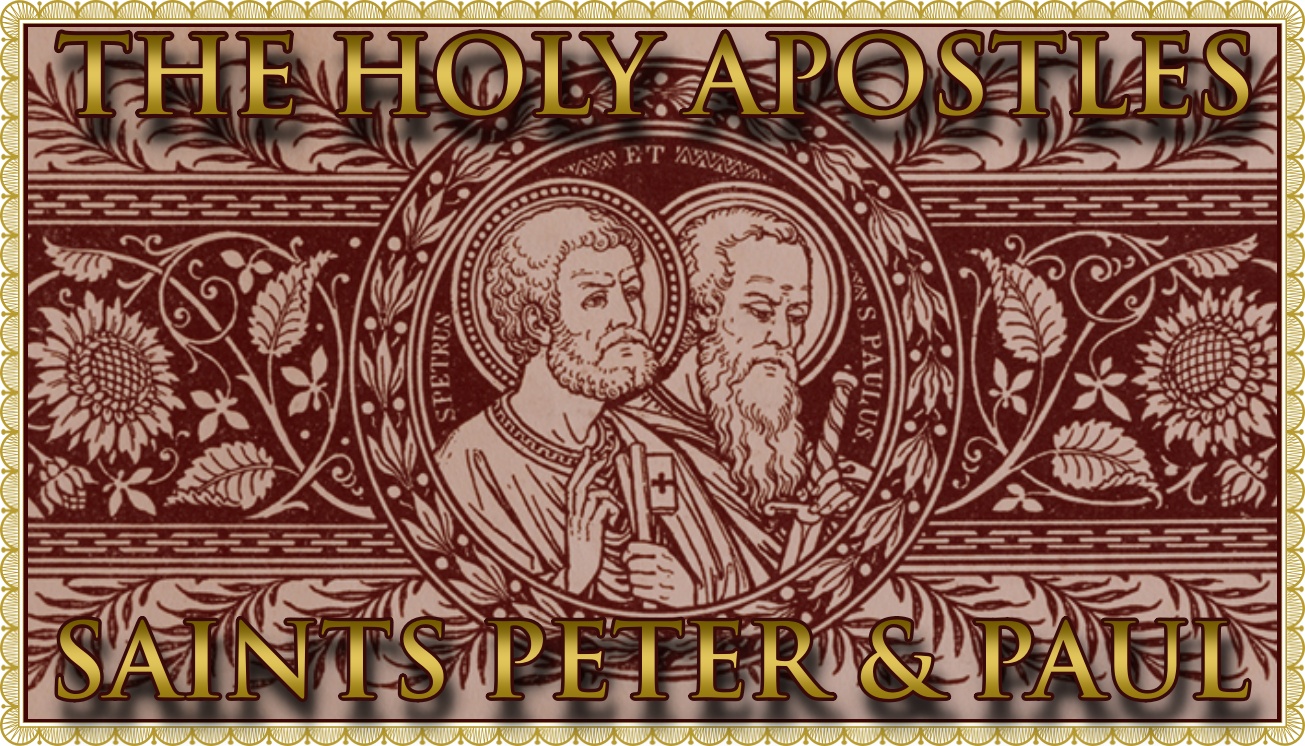
St. Peter and St. Paul
Today we celebrate the great feast of St. Peter and St. Paul. We mark the feast of these two saints together due to their martyrdom in Rome under the Emperor Nero. Today’s lections focus on St. Peter, while tomorrow’s commemorate St. Paul. Hence, today’s sermon will be about St. Peter.
Simon (later called Peter), along with his brother St. Andrew was a fisherman from Galilee. He was originally a disciple of St. John the Baptist, but was drawn into the following of the one whom John had said would be the Lamb of God who would take away the sins of the world, who would baptise with the Holy Spirit and with fire. His brother St. Andrew told Simon that he had found the one who would be the promised Messiah, the anointed liberator of Israel. Jesus said that though his name was Simon, he would be called Peter, meaning a rock (John 1). This was heavily ironic because St. Peter was a very unstable and impetuous character. After Jesus began his Galilean ministry, he was drawn (along with his brother St. Andrew and the two sons of Zebedee, St. James and St. John) to leave behind his fishing business and became a permanent follower of Jesus (Luke 5). When Jesus subsequently chose twelve disciples, symbolising the twelve tribes of Israel, Peter emerged as their leader. Despite his unstable temperament, he was clearly the dominant personality among Jesus’ followers and had great energy and commitment.
St. Peter saw, like the other followers of Jesus, that he was the one who would be the anointed liberator of Israel, in whom the prophecies of Isaiah about the age to come in which the eyes of the blind were opened and the ears of the deaf unstopped were being fulfilled. At the climax of his Galilean ministry, after the feeding of the Five Thousand, Jesus was compelled to take evasive action when the people tried to make him king by force (John 6). The world could not be won by the world’s own methods. Jesus subsequently withdrew from Galilee into the region of Caesarea Philippi. He asked his disciples about the nature of his person. They said that some thought that he was Elijah, some said John the Baptist, some said Jeremiah, or one of the prophets. But Jesus asked them who they thought he was. St. Peter, as their spokesman, said that he was the Christ, the anointed liberator of Israel. Jesus responded by blessing this great affirmation of faith. This had not been revealed to him by flesh and blood, but by the Father in heaven. He would be called Peter and upon this rock the Church (the faithful remnant of Israel) would be built. He would be given the keys of the kingdom and whatever he bound on earth would be bound in heaven and whatever he loosed on earth would be loosed in heaven (Matthew 16). The power to bind and loose was later given to the other apostles (John 20), but it was given to St. Peter first as their leader and chief spokesman.
But Jesus discerned that St. Peter and the other disciples had not penetrated into the deeper meaning of his person and ministry. He began to teach them that his messianic destiny, enthronement and rule would paradoxically come about through his own reversal, repudiation, suffering and death. He would be the suffering servant of Isaiah, who would follow the path of non-violence. He would be despised and rejected by men, a man of sorrows and acquainted with grief. St. Peter understandably found this message difficult to accept. He had indeed recognised Jesus as the agent of God’s final deliverance of his people, but he had been hoping for another king David, a warrior and a conqueror who would defeat the pagan enemies of Israel and restore the temple. But Jesus recognised in this the same satanic temptation that he had fought against in the wilderness (Matthew 4), and said that Peter spoke not of the things of God, but of men. The world could not be won by the world’s own methods. Later when St. James and St. John argued about who would have first place in the kingdom, Jesus rebuked them, as he had rebuked St. Peter, by saying that the way of worldly power was pagan, for the kings of the Gentiles exercise authority by force and violence. By contrast, the Son of Man came not to be served, but to serve and to give his life as a ransom for many (Mark 10).
It was not only the crowds who brought palm branches and acclaimed him king at his triumphal entry into Jerusalem who misunderstood the deeper meaning of Jesus’ message, but also Jesus’ most intimate disciples, St. Peter, St. James and St. John. St. Peter protested when Jesus washed his disciples feet on the night on which he was betrayed (John 13) and used violence against the servant of the high priest (whose name was Malchus) at Jesus’ arrest in the Garden of Gethsemane (John 18). But Jesus repudiated the way of violence, and did not resist his arrest, for all they that draw the sword shall die by the sword (Matthew 26). Most famously of all Peter denied knowledge and association with Jesus when confronted during Jesus’ trial, though his Galilean accent gave him away as a follower.
In the end Jesus’ disciples all forsook him and fled, even St. Peter, who had professed his undying loyalty. The time had now come when Jesus no longer taught, but acted and suffered. In turning the other cheek and in going the second mile, he offered himself for the sins of the nation.
But the good news of the gospel is that it does not end there. When St. Peter and St. John went to the tomb on the first Easter morning (John 20), they found the tomb empty. Subsequently, Jesus appeared to his disciples in his risen and glorified body, both in Jerusalem and then later in Galilee. It was on an occasion when the disciples had returned to Galilee and were fishing on the lake that Jesus again appeared to them. St. Peter was reinstated as the leader of the disciples, despite his betrayal and commanded to feed the flock (John 21).
It seems that St. Peter had finally grasped the secret of Jesus’ message about non-violence, and he emerges as the leading spokesman of the followers of Jesus from the day of Pentecost (Acts 2) onwards. His early speeches are recorded in the Acts of the Apostles, and they speak of how the Saviour had fulfilled his vocation, not as a warrior and a conqueror, but as a suffering servant. Herod later persecuted the Church, killing St. James and imprisoning St. Peter. But St. Peter miraculously escaped imprisonment (Acts 12). He now no longer resided in Jerusalem, where the leadership of the Church passed to Jesus’ brother St. James, but travelled preaching the Gospel. His ministry was especially associated with Rome (it is usually thought that he first travelled to Rome after escaping his imprisonment in Jerusalem) and Antioch. Hence, the Church has later celebrated feasts of St. Peter’s Chair, for Antioch as well as Rome.
After the great fire of Rome in 64, the Emperor Nero sought to put the blame on the Christians as the scapegoat for what had happened (popular opinion more reasonably supposed that Nero had started the fire himself as a pretext for rebuilding the city). It seems that the fear that the persecution in Rome could spread to the provinces led St. Peter to dispatch a letter to Asia Minor. In this he emphasised the message that his own experience had most impressed upon him, that the way of the Saviour was not one of violence. When he was reviled, he had not reviled again, but had entrusted himself to the one who judged justly. Christian leadership was not about being lords over God’s heritage, but rather about following the example of the Good Shepherd (1 Peter 5). He had given his life for the sheep, and had died not only as a sacrifice for sin, but also to give an example to his followers of the way of non-violence.
It was probably not long after this letter was dispatched that St. Peter himself was martyred in Rome. The word martyr means witness, and he, for all his earlier unfaithfulness and backsliding, had eventually be found faithful.
The way of non-violence was difficult to accept then, as it is now. Let us pray for grace to strengthen us in our weakness and that, like St. Peter, we will eventually be found faithful at the last.
by the Revd Dr Robert Wilson PhD (Cantab), Old Roman Apostolate UK



Leave a Reply