
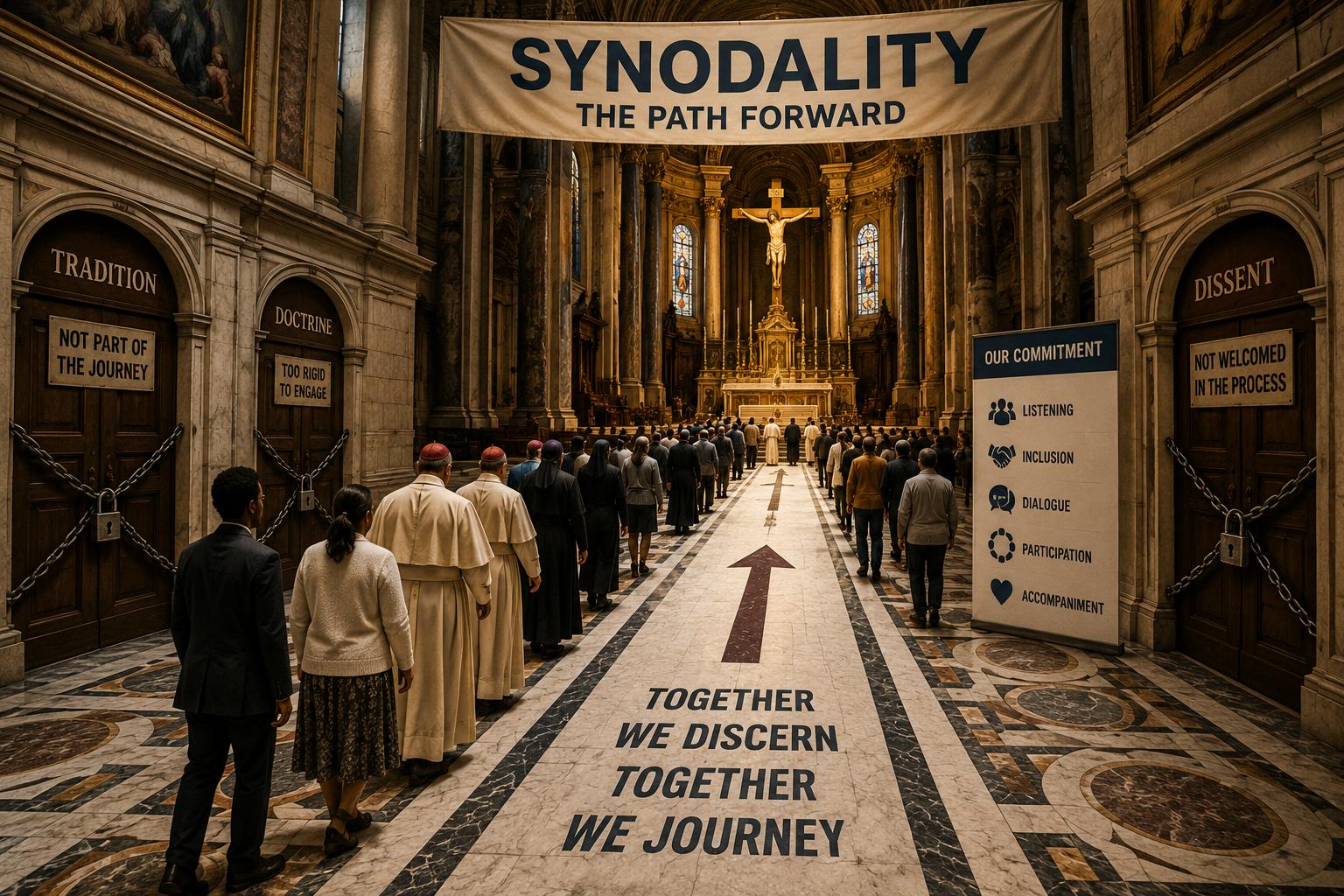
Victims Until Victorious: The Fascistic Reflex of Catholic Progressivism
Catholic progressivism presents itself as the advocate of the excluded, the wounded and the unheard. Yet once it acquires institutional power, its language of liberation too often conceals an authoritarian method: doctrine is destabilised, dissent is selectively punished, and revolutionary change is imposed through structures the faithful cannot remove by voting.

The most revealing thing about Catholic progressivism is not what it says when it is weak, but what it does when it becomes strong.
While seeking influence, it speaks almost exclusively in the language of compassion. It claims to represent the excluded woman, the marginalised sexual minority, the remarried Catholic, the disaffected young person, the migrant, the indigenous community, the clerical-abuse survivor and everyone said to have been denied a voice by an oppressive institution. Its proposals acquire moral authority less from their coherence with Catholic doctrine than from the suffering of those in whose name they are advanced.
Once the progressive movement acquires power, however, the language of liberation remains while the methods change. Those who demanded dialogue begin deciding what may be discussed. Those who denounced exclusion determine who must now be excluded. Those who attacked ecclesiastical authority as clerical and oppressive invoke that same authority against their opponents. Those who demanded diversity impose conformity.
They remain victims in their own account of themselves, even after they have become governors, officials, professors, bishops, commissioners and advisers. Their continuing claim to victimhood absolves them from recognising the power they now exercise.
They are victims until victorious. Thereafter, they become commissars.
This does not mean that every Catholic who describes himself as progressive is secretly a communist, or that communism, socialism and fascism are interchangeable political systems. Fascism is a historically specific ideology and should not be reduced to a synonym for authoritarian behaviour. There is, nevertheless, a recognisably fascistic reflex wherever a movement claims exclusive moral legitimacy, identifies dissenters as dangerous rather than merely mistaken, captures institutions, controls permissible language and employs concentrated authority to impose an ideological transformation.
It is this reflex, rather than a precise historical identity, that contemporary Catholic progressivism increasingly displays.
The method has obvious secular precedents. Classical Marxism divided society principally according to economic class. Later radical theory extended the conflict into culture, race, sex, family, education, language and personal identity. Society was reimagined as a contest between oppressor and oppressed, with moral authority belonging almost automatically to whichever group had been assigned the status of victim.
Herbert Marcuse gave the principle unusually candid expression. His “liberating tolerance” would require “intolerance against movements from the Right and toleration of movements from the Left.”¹ Equal treatment was itself redefined as oppressive because it failed to distinguish between those advancing liberation and those allegedly defending structures of domination.
Once that premise is accepted, coercion becomes compatible with compassion. Conservative opinions may be censored because speech itself is classified as violence. Progressive disruption may be excused because it is interpreted as resistance. Institutional neutrality becomes suspect, since neutrality between the alleged oppressor and victim is said to perpetuate oppression.
Much of Catholic progressivism has absorbed this political grammar almost intact. The categories are adjusted, but the mechanism remains. The hierarchy becomes a privileged class. Doctrine becomes structural oppression. Traditional morality becomes exclusion. The sacramental priesthood becomes clerical power. The reservation of priestly ordination to men becomes discrimination. Catholic teaching on sexuality becomes violence. Liturgical tradition becomes an ideological threat.
The person designated a victim is then granted a kind of doctrinal authority. His suffering deserves compassion, justice and pastoral care; but it is also treated as evidence that the Church’s teaching must be wrong. Experience becomes revelation. Hurt becomes hermeneutics. The accusation of exclusion becomes an argument for changing what the Church has received.
This is not how Catholic truth is known. The sufferings of men and women may reveal failures of charity, prudence, governance or pastoral practice. They may expose hypocrisy, cruelty or the abuse of power. They cannot establish that adultery has ceased to be sinful, that homosexual acts have acquired a moral character they did not previously possess, or that the Church has received authority to alter the substance of a sacrament.
Authentic pastoral care begins by loving the person in truth. It does not manipulate suffering as political capital, nor tell the wounded that healing requires the surrender of doctrine. Christ received sinners with mercy, but He did not flatter sin. The Gospel does not liberate man by confirming every identity he has constructed. It liberates him by giving him a new identity in Christ.
The central obstacle confronting Catholic progressivism is that the Catholic Church claims to have received a divine revelation which she is obliged to preserve. She cannot reinvent the constitution of the sacraments, reverse the natural moral law or contradict doctrines definitively taught by the ordinary and universal Magisterium.
A political party may revise its manifesto. A legislature may repeal a statute. An electorate may reverse the decisions of the previous government. The Church cannot announce that what was intrinsically immoral yesterday has become virtuous today, or that a sacrament instituted by Christ may be reconstructed according to contemporary theories of representation and equality.
Progressive change must therefore occur without being admitted as change.
The vocabulary is carefully chosen. Doctrine remains unchanged, but its “pastoral application” develops. The teaching is reaffirmed, but its practical consequences are suspended. A settled question is “reopened for discernment.” A prohibition becomes an invitation to dialogue. A novelty is presented as the recovery of a neglected tradition. A contradiction becomes a creative tension. Ambiguity becomes a sacred space in which the Holy Ghost is presumed to be at work.
This method changes the life of the Church while preserving the verbal formula that nothing doctrinal has changed. Practice is detached from doctrine, as though repeated public practice did not itself teach. Yet what the Church habitually blesses, celebrates, permits, funds and honours will inevitably be understood by the faithful as legitimate. The pastoral exception becomes an expectation; the expectation becomes a local norm; and the local norm becomes evidence that universal recognition is overdue.
Fiducia supplicans supplied a particularly clear example. The declaration affirmed the traditional doctrine of marriage and prohibited anything resembling a liturgical blessing of a same-sex union. It simultaneously authorised spontaneous blessings of same-sex “couples” and described its own proposal as a “real development” and an “innovative contribution” to the pastoral understanding of blessings.²
The doctrinal formula remained in place while the pastoral boundary moved. The document insisted that the relationship was not being validated, even as the couple presenting itself through that relationship was blessed as a couple. The ensuing confusion was not accidental to the method. It was the foreseeable result of attempting to alter ecclesial practice while denying that the alteration carried doctrinal meaning.
The same technique appears in the continuing campaign for the ordination of women. Pope John Paul II declared that the Church had “no authority whatsoever” to confer priestly ordination upon women and that this judgment must be definitively held. The Congregation for the Doctrine of the Faith subsequently confirmed that the teaching belongs to the deposit of faith and has been infallibly taught by the ordinary and universal Magisterium.³
Yet progressive Catholic institutions continue to speak of keeping the question open, extending discernment, hearing women’s experiences and overcoming exclusion. A teaching concerned with the divine constitution of the sacrament is treated as though it were an unresolved employment policy awaiting a sufficiently representative committee.
The Church is said to be listening, but the permitted conclusion of the listening exercise is already apparent. Testimony supporting change is classified as the voice of experience. Testimony supporting tradition is diagnosed as fear, internalised oppression or resistance.
The German Synodal Way made the programme more explicit. Its adopted texts included proposals concerning the separation of powers in the Church, the re-evaluation of homosexuality in the Magisterium, gender diversity, women in sacramental ministries, lay participation in episcopal appointments and the creation of permanent synodal governing structures.⁴
The initiative was repeatedly presented through the language of participation, accountability and overcoming clerical power. Yet the Holy See found it necessary to state that the German process possessed no authority to compel bishops or faithful to adopt new forms of government or new approaches to doctrine and morals. It warned that new structures or doctrines imposed before agreement at the level of the universal Church would wound ecclesial communion.⁵
The contradiction was instructive. A movement ostensibly organised to resist the abuse of ecclesiastical power sought structures through which its own ideological programme could acquire permanent and binding force.
The same ambiguity lies within much contemporary discussion of synodality. Consultation can be genuinely valuable. Pastors should know their people, hear their concerns and receive prudent counsel. The faithful possess not only the right but sometimes the duty to make their concerns known to their pastors. The Church has always possessed synods, councils, chapters and consultative bodies.
Consultation, however, is not revelation. Nor is a managed consultation necessarily the voice of the Holy Ghost.
Who chooses the questions determines the direction of the discussion. Who selects the participants shapes the range of answers. Who appoints the facilitators controls the atmosphere. Who drafts the synthesis decides which voices will be amplified, softened or omitted. Who interprets the conclusions possesses the real power.
A process may therefore be described as listening while functioning as ratification. The faithful are invited to speak, but only certain experiences become “synodal themes.” Catholics may ask repeatedly for doctrinal clarity, reverent worship, strong catechesis and freedom for the traditional liturgy, yet their concerns are reinterpreted as nostalgia, rigidity or fear of change. Meanwhile, demands associated for decades with Western theological progressivism reappear in synodal reports as though they had arisen spontaneously from the entire People of God.
Pope Leo XIV’s opening address to the Extraordinary Consistory of 26 June 2026 supplied a striking example of the problem. He acknowledged that structured group work was not the usual way of conducting a Consistory and assured the cardinals that there would be room for personal contributions. He asked them for freedom, frankness and sincere counsel. Those qualifications should be recognised.
Yet he also told them that the unfamiliar method was “part of the journey along which the Lord is leading us,” adding that the cardinals would “learn synodality by practising it.”⁶
The expression is revealing. A contested method of ecclesiastical government was not presented merely as the Pope’s prudential choice, to be assessed according to its usefulness and results. It was placed within a journey attributed to divine guidance. The programme was given a theological canopy.
The problem is not that Leo XIV explicitly forbade criticism; in the same address he invited frank counsel. The problem is that sacralising language can outlive procedural assurances. Once a particular administrative method is described as the path along which the Lord is leading the Church, resistance to that method may readily be interpreted as resistance not merely to the judgment of churchmen, but to God.
This resembles the invocation of “the spirit of the Council.” The phrase acquired its power precisely because it could not be confined to any particular conciliar text. Innovations neither commanded nor contemplated by the Council could be represented as expressions of its deeper momentum. The text might be silent; the “spirit” nevertheless required movement in the approved direction.
“Synodality” risks becoming the successor to that phrase: not a clearly delimited canonical principle, but an ever-advancing providential journey whose destination is interpreted by those already directing it. The programme becomes self-validating. Its advocates define the process, administer it, interpret its outcome and identify opposition as resistance, rigidity or failure to listen.
No Catholic need deny that Providence guides the Church or that the Holy Ghost assists her legitimate pastors. Divine assistance, however, does not canonise every administrative method, strategic preference or institutional experiment. Prudential decisions remain prudential. They must be judged by their conformity to revelation, the constitution of the Church and the fruits they produce.
To invoke divine guidance in favour of a disputed programme before that programme has demonstrated its fidelity is not discernment. It risks using theological language to place ecclesiastical policy beyond ordinary criticism.
The selective character of progressive tolerance is especially visible in the treatment of the traditional Roman liturgy. Catholic progressives have spent decades praising diversity, local adaptation, inculturation, pastoral sensitivity and the need to accompany communities where they are. Yet Traditionis custodes declared the post-conciliar liturgical books to be the “unique expression” of the Roman Rite’s lex orandi and imposed an increasingly restrictive system of permissions upon the older liturgy.⁷
Experimentation is celebrated when it moves in a progressive direction. Diversity becomes dangerous when it preserves inherited tradition. Pastoral accommodation may be extended to those seeking reconciliation with the sexual revolution, but denied to families seeking worship according to rites sanctified by centuries of Catholic use.
The operative principle is not pluralism but directional pluralism. Almost everything may be discussed provided that the discussion moves towards the approved destination. Every identity must be respected except the traditional Catholic identity. Every wound deserves accompaniment except the wound caused by liturgical dispossession. Every form of alienation must be studied except the alienation of Catholics who no longer recognise the worship, language or moral confidence of the Church in which they were raised.
Marcuse’s asymmetrical tolerance has acquired an ecclesiastical form: openness towards movements from the progressive Left and restriction towards movements associated with tradition.
The danger is intensified by the constitutional character of the Church. In a secular democracy, ideological capture can theoretically be reversed through elections. Governments fall. Ministers are removed. Legislatures change hands. Policies are repealed and public officials may be investigated or dismissed.
The Catholic Church is not a democracy. Strictly speaking, she is not a democracy even during a conclave. A conclave is a restricted canonical election in which designated cardinals elect the Bishop of Rome; it is not an exercise of popular sovereignty. The faithful do not elect the Pope, vote diocesan bishops out of office or replace chancery officials at the next local ballot.
The Roman Pontiff possesses supreme, full, immediate and universal ordinary power. Diocesan bishops possess legislative, executive and judicial authority within their particular Churches. The College of Cardinals principally assists the Pope and elects his successor. Synods ordinarily advise unless deliberative power is specifically granted and their decisions ratified by the competent authority.⁸
This constitution exists because ecclesiastical authority is apostolic and sacramental, not delegated upwards from an electorate. It protects the Church from government by opinion poll. Yet when ecclesiastical authority is captured by an ideological faction, it also makes resistance exceptionally difficult.
A progressive bishop can shape appointments, seminaries, schools, commissions, tribunals, liturgical policy, clerical advancement and access to church property for many years. The faithful cannot remove him at an election. A priest who resists may be isolated, transferred, deprived of office or subjected to an indefinite investigation. A lay employee may discover that dialogue ends precisely where criticism of the institution’s ideological assumptions begins.
This is why progressive capture within the Church is more consequential than ordinary political fashion. It can employ a divinely established structure to advance ideas contrary to the purpose for which that structure was given. Authority intended to guard the deposit of faith becomes the machinery by which the deposit is obscured. Obedience intended to unite Catholics in truth is invoked to secure compliance with novelty.
The faithful then face an inversion. Those defending what the Church has consistently taught are described as disobedient, while those advocating what the Church has repeatedly rejected are praised as prophetic.
The exercise of control rarely sounds authoritarian because it employs therapeutic rather than juridical language. Opponents are not condemned; they are diagnosed. The traditional Catholic is rigid, fearful, nostalgic, wounded, ideologically trapped or incapable of embracing complexity. His arguments need not be answered because his supposed psychological condition has already explained them.
This is an unusually effective method of neutralisation. A man accused of doctrinal error can defend his orthodoxy. A man accused of rigidity finds his defence interpreted as further evidence of the condition. The more clearly he argues, the more deeply attached he is said to be. The more earnestly he appeals to tradition, the more urgently he is thought to require conversion to the new paradigm.
Political disagreement is thus transformed into moral pathology. Progressive conclusions become evidence of maturity, openness and compassion. Traditional conclusions become symptoms of fear and exclusion. The ideology places itself beyond falsification because opposition to it proves the opponent’s defect.
That is not accompaniment. It is domination wearing the expression of pastoral concern.
The answer is not to democratise the Church, replace progressive identity politics with a rival politics of resentment, or deny genuine injustice. Victims of clerical abuse must be heard. Corruption and cruelty must be exposed. Bishops must be accountable to law, justice and the purpose of their office. The laity possess real rights, responsibilities and charisms.
The answer is to recover the Catholic meaning of authority.
The Pope is not the proprietor of revelation. Bishops are not managers of a religious organisation whose identity may be revised to suit the prevailing culture. Priests are not ideological compliance officers. The laity are not passive consumers of ecclesiastical fashion. Authority exists to preserve and hand on what has been received, sanctify the faithful through the sacraments and govern the Church according to truth and justice.
Canon law recognises the right and sometimes the duty of the faithful to make their concerns known, their right to worship according to approved rites, their right to defend their ecclesiastical rights and their right not to be punished except according to law.⁹ Bishops are obliged to teach the truths of faith, protect their integrity and prevent abuses from entering ecclesiastical discipline.¹⁰
Respectful correction, canonical recourse, serious theological scholarship, independent Catholic journalism and solidarity with priests and laypeople subjected to ideological coercion are not acts of rebellion. Properly exercised, they are forms of ecclesial fidelity.
Catholics must also recover the distinction between the divine constitution of the Church and the prudential decisions of those who govern her. A legitimate superior may choose badly without ceasing to be legitimate. A papal policy is not thereby a revealed doctrine. An administrative method does not become the will of God merely because devotional language is attached to it. The Holy Ghost protects the Church according to Christ’s promises; He does not guarantee the wisdom of every appointment, commission, questionnaire, synthesis or small-group exercise.
Catholic progressivism gains much of its power by obscuring these distinctions. It presents its political aspirations as pastoral necessities, its preferred methods as movements of the Spirit, and its institutional victories as irreversible developments of the Church’s self-understanding.
Its authoritarian character becomes visible whenever the faithful decline to move in the prescribed direction. The appeal to openness is then replaced by restriction, accompaniment by discipline, diversity by enforced uniformity and dialogue by a demand for submission.
Every revolutionary movement describes itself as liberation while power remains beyond its grasp. Its true character emerges in its treatment of those who will not conform once power has been obtained.
The question is not whether the Church must move through history. She always has. The question is whether she moves as a pilgrim obedient to the revelation entrusted to her, or as an institution carrying a political project and calling its chosen direction Providence.
¹ Herbert Marcuse, “Repressive Tolerance,” in Robert Paul Wolff, Barrington Moore Jr and Herbert Marcuse, A Critique of Pure Tolerance (Boston: Beacon Press, 1965; expanded edition, 1969).
² Dicastery for the Doctrine of the Faith, Declaration Fiducia supplicans: On the Pastoral Meaning of Blessings, 18 December 2023, presentation and nos. 31–41.
³ John Paul II, Apostolic Letter Ordinatio sacerdotalis, 22 May 1994, no. 4; Congregation for the Doctrine of the Faith, Responsum ad propositum dubium concerning the teaching contained in Ordinatio sacerdotalis, 28 October 1995.
⁴ The Synodal Way of the Catholic Church in Germany, official collection of decisions, including “Power and Separation of Powers in the Church,” “A Re-evaluation of Homosexuality in the Magisterium,” “Sustainable Strengthening of Synodality,” “Dealing with Gender Diversity” and “Women in Sacramental Ministries,” 2022–2023.
⁵ Holy See Press Office, “Holy See Statement,” 21 July 2022.
⁶ Leo XIV, “Opening Address to the Extraordinary Consistory,” 26 June 2026; Holy See Press Office, “Extraordinary Consistory, 26–27 June 2026: Programme of Proceedings,” 22 June 2026.
⁷ Francis, Apostolic Letter Traditionis custodes, 16 July 2021, arts. 1–5; Congregation for Divine Worship and the Discipline of the Sacraments, Responsa ad dubia on certain provisions of Traditionis custodes, 4 December 2021; Rescript concerning Traditionis custodes, 20 February 2023.
⁸ Code of Canon Law, canons 331–343, 349, 353 and 391.
⁹ Code of Canon Law, canons 212 §§2–3, 214 and 221.
¹⁰ Code of Canon Law, canons 386 and 392.
RELATED ARTiCLES


LATEST ARTICLES
- Today’s Mass: October 03 St Thomas [de Cantilupe] of HerefordSt Thomas de Cantilupe was an influential figure, born into nobility around 1218. Educated in canon law, he supported the baronial party during the Barons’ War and served as Chancellor of England and Bishop of Hereford. Known for his piety and charity, he was canonised in 1320, with his relics drawing pilgrims to Hereford Cathedral.
- 04.10.26 Nuntiatoria CXXVI: OMNIA AUTEM PROBATE: QUOD BONUM EST TENETEThis editorial highlights the importance of discernment in faith, urging Christians to test teachings and hold onto what is good. It critiques contemporary issues, such as compulsory inclusivity at universities, government information security, and interfaith dialogues, emphasizing that a responsible faith must involve critical examination and recognition of true values.
- ORDO w/c 04.10.26The week begins with the Eighteenth Sunday after Pentecost, honouring various saints, culminating in the feast of St Francis of Assisi. Key celebrations include St Wenceslaus, St Michael the Archangel, St Jerome, and St Thérèse of the Child Jesus. The period highlights the call to surrender worldly attachments in devotion to God.
- THE WEDDING GARMENT: The Nineteenth Sunday after PentecostThe Nineteenth Sunday after Pentecost joins St Paul’s command to “put on the new man” with Christ’s parable of the wedding garment. The warning is directed especially towards those already within the household of Faith: Catholic identity, orthodoxy and traditional practice cannot substitute for sanctifying grace and personal conversion. Grace does not merely bring us into the feast; it must make us fit for the presence of the King.
- Blue Labour discovers the Common GoodJonathan Hinder criticises “hyper-liberalism” for prioritising individual autonomy over community values. His emphasis on family and societal duties echoes Christian teachings often overlooked in modern politics. Although Hinder promotes aspects of Blue Labour as solutions to social issues, he underscores the necessity of returning to deeper truths about human nature and moral authority for genuine societal cohesion.
CURRENT EDITION


Today’s Mass Propers
- Today’s Mass: October 03 St Thomas [de Cantilupe] of Hereford
 St Thomas de Cantilupe was an influential figure, born into nobility around 1218. Educated in canon law, he supported the baronial party during the Barons’ War and served as Chancellor of England and Bishop of Hereford. Known for his piety and charity, he was canonised in 1320, with his relics drawing pilgrims to Hereford Cathedral.
![Today’s Mass: October 03 St Thomas [de Cantilupe] of Hereford](https://nuntiatoria.org/wp-content/uploads/2026/10/thomascantilupemasstitle.jpg)



Leave a Reply