
Everything Has Changed—and Nothing Has Changed
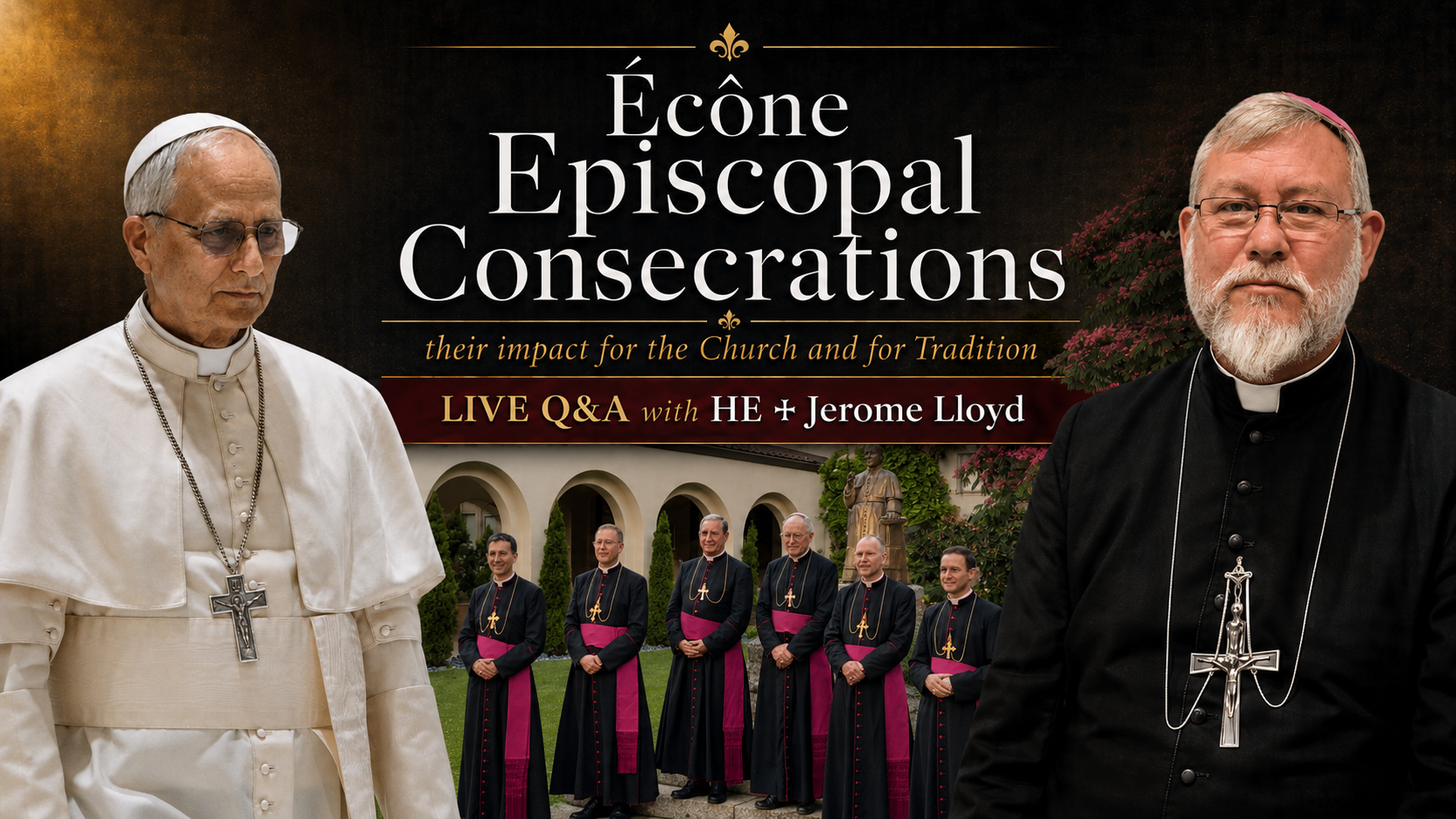
In a live question-and-answer broadcast on the crisis surrounding the Society of St Pius X, HE ✠Jerome Lloyd examined the Écône consecrations, Rome’s declaration of excommunication, the canonical position of SSPX priests and faithful, and the deeper failure of pastoral government which permitted the confrontation to reach its present point. His Excellency’s central conclusion was stark: six bishops had been named and censured, but the attempt to treat an entire priestly society and its faithful as collectively excommunicated exceeded what the decree itself could juridically accomplish.
The live Q&A given by HE ✠Jerome Lloyd on the Society of St Pius X began where any Catholic consideration of the Écône consecrations ought to begin: not with triumph, recrimination or partisan excitement, but with prayer and sorrow. Episcopal consecration is ordinarily an occasion of joy. The consecration of four bishops against the expressed will of the Roman Pontiff, followed immediately by declarations of excommunication and schism, cannot be celebrated as though it represented an uncomplicated victory. It is evidence of a wound within the Church.
Much of the commentary surrounding the events had been confused, exaggerated and frequently vitriolic. His Excellency therefore sought to distinguish what had actually occurred in law from what commentators, on all sides, had claimed. His summary was deliberately paradoxical: “Everything has changed and nothing has changed.”
Something has plainly changed. The Dicastery for the Doctrine of the Faith has issued a decree naming Bishop Alfonso de Galarreta, Bishop Bernard Fellay and the four newly consecrated bishops. It declared that the penalties prescribed for unauthorised episcopal consecration and schism had been incurred. Its accompanying explanatory note went further, describing the Society’s sacred ministers as schismatic, warning of the excommunication of lay faithful who formally adhere to the schism, and asserting grave consequences for the validity and liceity of certain sacraments.¹
Yet the documents did not accomplish everything that their public presentation appeared to suggest. The decree named six bishops. It did not name more than seven hundred priests. It did not identify individual seminarians, religious or lay faithful. It did not examine the knowledge, intention, circumstances or culpability of each person associated with the Society. Nor could it abolish the distinction between sacramental validity and canonical liceity.
That distinction between the six named bishops and the wider Society is essential. Canon law permits a penalty to be incurred by any person who individually commits the relevant offence under the conditions established by law. It does not permit an ecclesiastical body to be treated as though all its members possessed one undifferentiated mind, intention and degree of guilt. Membership, association or attendance may be evidence in a particular case; it cannot substitute for proof of the offence and imputability of the individual.
The decree itself demonstrates that unauthorised episcopal consecration and schism are not identical offences. Canon 1387 imposes an automatic excommunication upon a bishop who consecrates another bishop without pontifical mandate and upon the man who receives such consecration.² Schism is governed separately by canon 1364 and defined in canon 751 as “the refusal of submission to the Supreme Pontiff or of communion with the members of the Church subject to him”.³
The law therefore distinguishes the prohibited act of episcopal consecration without mandate from the more comprehensive rupture implied by schism. Disobedience may be grave. It may be deliberate, public and scandalous. It may even provide evidence of a schismatic disposition. It is not, however, automatically identical to the refusal of papal authority as such.
✠Jerome expressed this in straightforward terms. A person may refuse a particular command while continuing to recognise the authority of the person who issued it. “I cannot obey this command” is not the same proposition as “you possess no authority over me.” The first may be culpable disobedience; the second is a denial of authority.
The Society continues publicly to profess the Roman Primacy, recognise the reigning Pontiff, name the Pope and local ordinary in the Canon of the Mass, and deny that it has established a separate Church. These facts do not make schism logically impossible. Words may be contradicted by actions, and a consistent pattern of practical independence may eventually disclose a refusal of submission. They do mean, however, that schism cannot simply be presumed from a single act without proving that the act manifested the refusal required by canon 751.
The DDF followed the reasoning employed by John Paul II after the 1988 consecrations: that consecrating bishops against the Pope’s will constitutes disobedience which implies a practical rejection of the Roman Primacy.⁴ Yet the disputed point lies precisely in that implication. The act of disobedience is undeniable. Whether it amounts to a wholesale refusal of submission is the conclusion requiring demonstration.
This is especially relevant in the case of Bishop Fellay. He was not the principal consecrator and did not receive episcopal consecration in 2026. His declared penalty was attached to the alleged crime of schism. The separate treatment of his case confirms that the law does not automatically equate every form of participation in an unauthorised consecration with the specific offence described in canon 1387.
The explanatory note then moved beyond the six bishops and asserted that all SSPX sacred ministers are in schism and subject to the excommunication prescribed by canon 1364. It further stated that lay faithful formally adhering to the Society’s schism are also schismatic and excommunicated. But a general assertion concerning canonical status cannot dispense with the elements required for individual penal responsibility.
Canon 1321 provides that every person is considered innocent until the contrary is proved and that no one may be punished unless an external violation is gravely imputable through malice or culpability.⁵ Canon 18 requires laws imposing penalties or restricting rights to be interpreted strictly.⁶ These principles exist precisely to prevent condemnation by inference or association.
A priest cannot be declared schismatic merely because he belongs to the Society unless his conduct and intention establish that he has refused submission to the Pope or communion with those subject to him. A lay Catholic cannot be declared schismatic merely because he attends Mass in an SSPX chapel. The canonical offence must be established in the person concerned.
The DDF’s own reliance upon the 1996 note of the Pontifical Council for Legislative Texts confirms this. That document stated that formal adherence required both an interior and an exterior element. Internally, the person must knowingly and freely share the substance of the alleged schism, placing attachment to the Lefebvrist movement above obedience to the Pope. Externally, that choice must be manifested through conduct.⁷
The same note expressly recognised that attendance at SSPX worship is not an unequivocal sign of schismatic adherence. A person may attend its liturgy without sharing a schismatic spirit. In the case of the laity, intention must be examined and circumstances judged individually. Occasional participation is insufficient. Even habitual attendance does not by itself reveal why the person attends or what he believes concerning the papacy and the Church.
This is the clearest answer to the anxiety of ordinary faithful. Attendance is not schism. A Catholic does not cease to be Catholic by entering an SSPX chapel, hearing Mass there, receiving Holy Communion, contributing to its upkeep or preferring its preaching and devotional life. None of these acts necessarily constitutes a refusal of submission to the Roman Pontiff.
A person may attend because he seeks the traditional Roman liturgy, doctrinally reliable preaching, a disciplined sacramental life or a stable Catholic environment for his family. Those motives are not identical to rejecting papal authority. They must not be treated as though they were.
A layman could, in principle, incur the automatic penalty attached to schism if he knowingly and freely repudiated papal submission or ecclesial communion and externally manifested that choice. That possibility exists under the universal law for every Catholic. It is not proof that every person associated with an SSPX chapel has committed the offence.
The same need for individual judgment applies to the Society’s clergy. The DDF may regard continued ministry within the Society as strong evidence of adherence. Yet evidence is not the same as an individual judgment. The priests were not named in the decree, separately accused, presented with evidence, heard in defence or individually judged through reasoned decisions.
Canon 1717 requires an inquiry into the facts, circumstances and imputability of an alleged offence. Canon 1341 directs authority to begin a penal process only when pastoral care, correction, warning or rebuke cannot sufficiently restore justice, reform the offender and repair scandal. Where an extrajudicial procedure is employed, canon 1720 requires the accused to be informed of the accusation and evidence, given an opportunity to defend himself, and judged through a decree stating the reasons in law and fact.⁸
A single explanatory note cannot perform these acts for hundreds of unnamed priests and an undefined number of faithful. It may announce the DDF’s interpretation and warn of the consequences of formal adherence. It cannot simultaneously become hundreds or thousands of individual penal judgments.
The Code also requires consideration of circumstances which may exclude or diminish liability. Canons 1323 and 1324 address ignorance, grave fear, necessity, grave inconvenience and the mistaken belief that such circumstances exist. In some cases no penalty is incurred; in others liability is diminished, and an automatic penalty does not bind.⁹
This does not prove that the Society’s claim of necessity is objectively correct. It does prove that the claim is canonically relevant. The Society has repeatedly said that it acted because it believed the preservation of the perennial Faith, priesthood and sacramental life required additional bishops. Rome rejects that assessment, but it cannot remove necessity from the Code merely by denying that necessity exists.
A proper canonical examination would ask why the bishops believed the situation constituted an emergency, what alternatives they pursued, what responses they received from Rome, what provision was offered for the continuation of their work, and why they considered that provision inadequate. Only then could authority assess whether their conviction was sincere, reasonable, culpably mistaken or fabricated.
The haste of the final confrontation makes this failure of process more serious. The Society announced its intention months before the consecrations. Father Davide Pagliarani corresponded with Cardinal Fernández, sought a personal audience with the Pope, presented the Society’s profession of faith and publicly explained the claimed necessity. The Pope’s personal intervention came only on the eve of the ceremonies.
His Excellency acknowledged that the Society might have responded by postponing the consecrations and seeking an immediate meeting. Such a gesture could have demonstrated deference to the Pope and created one final opportunity for reconciliation. Yet responsibility for ecclesial unity rests in a particular way upon the Roman Pontiff. He is not merely another party to a dispute but the visible principle of unity and the chief shepherd of the Church.
A personal audience would not have diminished the papal office. It would have manifested it. The Good Shepherd does not merely issue a warning to the sheep at the edge of the flock. He goes after it. A Pope who personally summoned the Superior General, listened to the Society’s fears and proposed a concrete provision for its future would have acted with precisely the paternal solicitude invoked in the papal appeal.
Even after the consecrations, the Pope possessed other options. He could have acknowledged the penalties attached to the act while offering their remission upon condition of a personal meeting, doctrinal discussions and agreed steps towards regularisation. Such a response would have defended papal authority while keeping reconciliation visibly open.
Instead, the DDF documents created the impression that an entire priestly society and its faithful had been placed outside the Church in a single stroke. That impression is difficult to reconcile with the law’s insistence upon personal imputability and individual judgment.
The distinction between an incurred and a declared penalty is also important. The six bishops were named in a decree declaring their censures. The Society’s priests were not individually named. Canon 1335 §2 provides that when an automatic censure has not been declared, the prohibition against celebrating sacraments, sacramentals or acts of governance is suspended whenever a member of the faithful requests them; any just reason makes such a request lawful.¹⁰
This does not regularise the Society or erase every canonical restriction. It demonstrates that the law itself distinguishes an alleged automatic censure from one formally declared against an identifiable person. The explanatory note did not suddenly become an individual declaration against every SSPX priest.
The sacramental questions must likewise be approached through distinctions rather than slogans. Masses celebrated by validly ordained SSPX priests remain valid. Excommunication or suspension does not remove the sacramental power of Holy Orders. Confirmations and ordinations performed by validly consecrated bishops remain sacramentally valid, however illicit Rome judges their exercise to be.
Confession and marriage require additional consideration because their validity ordinarily depends upon faculty, jurisdiction or delegation.
Pope Francis granted SSPX priests the faculty to absolve the faithful validly and licitly and extended that provision beyond the Jubilee “until further provisions are made”.¹¹ The 2026 explanatory note asserts that SSPX confessions are invalid but does not expressly identify or formally revoke that papal concession.
The intention of the DDF appears clear: it wishes the former provision to be regarded as no longer operative. The juridical mechanism is much less clear. Canon 21 states that the revocation of an earlier law is not presumed in doubt and that earlier and later provisions should be harmonised as far as possible.¹² If a universal faculty personally extended by the Pope was to cease, the faithful and clergy were entitled to a clear statement identifying the faculty and the act by which it was withdrawn.
✠Jerome was therefore justified in saying that the withdrawal appeared to be implied rather than expressly enacted. That does not settle every question in favour of the Society. It exposes the imprecision of a document purporting to determine the validity of innumerable confessions without directly addressing the papal concession upon which their validity had rested.
The 2017 provisions concerning marriage were more limited. They authorised local ordinaries to delegate a diocesan or fully regular priest to receive matrimonial consent or, where this was not possible, to delegate the SSPX priest himself.¹³ Marriages celebrated under validly granted delegation cannot simply be declared retrospectively invalid unless the delegation had ceased or was lawfully withdrawn.
Canon 144 may also supply jurisdiction or delegation in cases of common error or positive and probable doubt of law or fact. It expressly applies to the faculties and delegation required for confession and marriage.¹⁴ Its application must be judged in the circumstances of each case, but decades of contradictory statements, exceptional concessions and uncertain canonical classifications make it impossible to dismiss the existence of probable doubt without argument.
His Excellency’s pastoral conclusion was therefore measured rather than reckless. The faithful should not be told that every SSPX sacrament has suddenly become invalid. Mass and the sacraments dependent upon the power of orders remain valid. Confession and marriage present disputed jurisdictional questions which the DDF note has not resolved with the clarity demanded by the seriousness of the matter.
Behind the canonical controversy lies the more fundamental question raised throughout the broadcast: why did the Society believe these actions necessary?
The dispute is not merely about a preference for Latin, incense or older ceremonial. The traditional Mass is central because the law of prayer forms the law of belief and the law of Christian life: lex orandi, lex credendi, lex vivendi. Yet the Society’s criticism extends to religious liberty, ecumenism, the interpretation of the Second Vatican Council, the doctrinal content of the reformed liturgy, moral teaching, the last things and the practical collapse of Catholic belief and observance.
✠Jerome rejected the claim that the existence of other traditional communities resolves these concerns. The Fraternity of St Peter, the Institute of Christ the King and similar bodies provide the traditional liturgy within regular canonical structures, but the Society’s contention is not simply that the old Mass must survive. It is that disputed postconciliar teachings and practices require doctrinal clarification and correction.
His Excellency therefore commended proposals for an authoritative clarification of conciliar passages which appear difficult to reconcile with the earlier Magisterium. The hermeneutic of continuity asserts that Vatican II must be interpreted consistently with Tradition. Yet asserting continuity is not always the same as demonstrating it. Where Catholics perceive contradiction, authority should identify the precise teaching, its theological weight and its reconciliation with what preceded it.
The final question concerning the Novus Ordo Missae allowed His Excellency to correct another common caricature. The Society does not maintain that every celebration of the new Mass is invalid. Its criticism concerns the comparative diminution of sacrificial language, the replacement of the ancient Offertory, the ambiguity introduced by multiple options, the widespread practice of celebration facing the people, and the liturgical and catechetical environment in which the rite is frequently celebrated.
A reverent new Mass may be valid and celebrated with genuine devotion. That does not prove that it expresses the propitiatory sacrifice, ministerial priesthood and Real Presence with the same fullness and precision as the traditional Roman Rite. The older liturgy’s prayers, gestures, silence, orientation and ceremonial form a coherent theological whole directed towards the sacrifice of Calvary.
The live Q&A was therefore neither a simplistic defence of everything done at Écône nor an acceptance of Rome’s sweeping interpretation. It was an appeal for the distinctions demanded by the Church’s own law: between disobedience and schism, validity and liceity, an automatic penalty and a declared censure, association and formal adherence, corporate description and personal culpability, papal authority and papal positivism.
His Excellency closed by asking viewers to pray for Pope Leo XIV, the Society of St Pius X, traditional Catholics and all Catholics throughout the world. That conclusion expressed the true character of the broadcast. The crisis is not an opportunity to rejoice in the defeat of opponents. It is a wound in the Church.
Everything has changed because Rome has adopted a more severe public and juridical position towards the Society and has declared censures against six bishops. Nothing has changed because the decree did not individually excommunicate every SSPX priest or faithful, attendance at its chapels remains insufficient to prove schism, valid orders remain valid, and personal culpability cannot be replaced by collective condemnation.
The solution will not be found in ambiguous decrees, rhetorical escalation or the pretence that no crisis exists. It will require theological clarity, juridical precision, pastoral courage and an exercise of papal authority modelled upon the Good Shepherd, who does not abandon the wandering sheep but goes out to bring it home.
Watch the live Q&A with HE ✠Jerome Lloyd
- HE ✠Jerome Lloyd, “Live Q&A: Écône Episcopal Consecrations and the SSPX Situation”, July 2026.
https://www.youtube.com/live/ZqKKdxN0R4s - Dicastery for the Doctrine of the Faith, Decree and Explanatory Note concerning the Society of St Pius X, 2 July 2026.
https://www.vatican.va/roman_curia/congregations/cfaith/ - Code of Canon Law, can. 1387.
https://www.vatican.va/archive/cod-iuris-canonici/eng/documents/cic_lib6-cann1364-1399_en.html - Code of Canon Law, can. 751.
https://www.vatican.va/archive/cod-iuris-canonici/eng/documents/cic_lib3-cann747-755_en.html - John Paul II, Apostolic Letter Ecclesia Dei Adflicta, 2 July 1988, n. 3.
https://www.vatican.va/content/john-paul-ii/en/motu_proprio/documents/hf_jp-ii_motu-proprio_02071988_ecclesia-dei.html - Code of Canon Law, can. 1321.
https://www.vatican.va/archive/cod-iuris-canonici/eng/documents/cic_lib6-cann1311-1363_en.html - Code of Canon Law, can. 18.
https://www.vatican.va/archive/cod-iuris-canonici/eng/documents/cic_lib1-cann7-22_en.html - Pontifical Council for Legislative Texts, Explanatory Note concerning adherence to the movement of Archbishop Marcel Lefebvre, 24 August 1996.
https://www.vatican.va/roman_curia/pontifical_councils/intrptxt/documents/rc_pc_intrptxt_doc_19960824_vescovo-lefebvre_it.html - Code of Canon Law, cann. 1717, 1341–1342 and 1720.
https://www.vatican.va/archive/cod-iuris-canonici/eng/documents/cic_lib7-cann1717-1731_en.html - Code of Canon Law, cann. 1323–1324. ht
tps://www.vatican.va/archive/cod-iuris-canonici/eng/documents/cic_lib6-cann1311-1363_en.html - Code of Canon Law, can. 1335 §2.
https://www.vatican.va/archive/cod-iuris-canonici/eng/documents/cic_lib6-cann1311-1363_en.html - Francis, Apostolic Letter Misericordia et Misera, 20 November 2016, n. 12.
https://www.vatican.va/content/francesco/en/apost_letters/documents/papa-francesco-lettera-ap_20161120_misericordia-et-misera.html - Code of Canon Law, can. 21.
https://www.vatican.va/archive/cod-iuris-canonici/eng/documents/cic_lib1-cann7-22_en.html - Pontifical Commission Ecclesia Dei, Letter to the Ordinaries concerning marriages of SSPX faithful, 27 March 2017.
https://press.vatican.va/content/salastampa/en/bollettino/pubblico/2017/04/04/170404d.html - Code of Canon Law, can. 144.
https://www.vatican.va/archive/cod-iuris-canonici/eng/documents/cic_lib1-cann129-144_en.html
RELATED ARTiCLES


LATEST ARTICLES
- Today’s Mass: October 08 St Bridget of SwedenSaint Bridget of Sweden, born around 1302, was a noblewoman renowned for her piety and prophetic revelations. After marrying Prince Ulpho and raising eight children, she led a life of austerity and charity, founding the Order of the Holy Saviour. She died in Rome in 1373 and was canonised in 1391.
- Today’s Mass: October 07 Pope St Mark, ConfessorSt Mark’s brief pontificate teaches that God measures fidelity, not duration or worldly achievement. Christ alone possesses the everlasting priesthood; His servants are stewards of what they have received. With the commemorated martyrs, St Mark reminds us to persevere faithfully, so that when the Lord comes, He finds us “so doing.”
- Omnia autem probate: quod bonum est tenete ~ Prove all things; hold fast that which is good: Spiritual Conference for Nuntiatoria CXXVIThe conference reflects on St Paul’s assertion to “prove all things” in relation to self-judgement and the Church. It explores themes of synodality, ecumenism, and the importance of discernment, emphasising the need for humility in understanding truth and the challenge of maintaining genuine holiness in the midst of contemporary ecclesiastical crises.
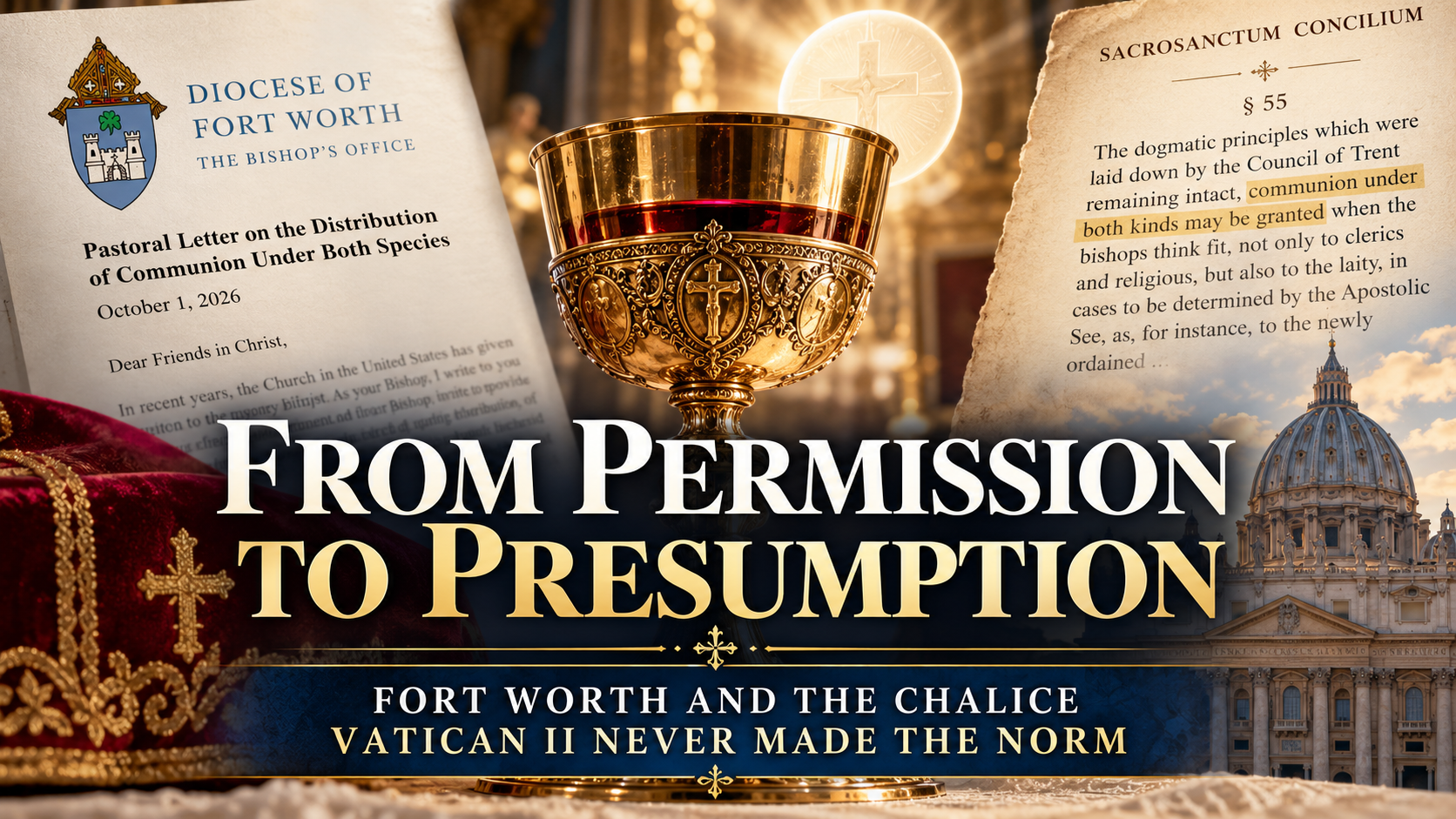
- FROM PERMISSION TO PRESUMPTION: Fort Worth and the Chalice Vatican II never made the NormBishop Michael Olson has implemented strict limitations on the distribution of Communion under both species in the Diocese of Fort Worth, prompting a discussion on the historical evolution of liturgical practices following Vatican II. This decision aims to reaffirm the doctrine of the Eucharist, emphasising that Christ is fully present under either species, while addressing misconceptions surrounding modern practices.
- AUGSBURG 2030: Can Rome commemorate a Confession it once confuted?Pope Leo XIV aims to revitalise the ecumenical spirit of the Augsburg Confession for its 2030 anniversary. However, historical responses from Rome highlight significant doctrinal differences between Catholics and Lutherans. True reconciliation must acknowledge these unresolved issues, as merely celebrating commonality risks glossing over critical theological distinctions that led to the Reformation.
CURRENT EDITION


Today’s Mass Propers
- Today’s Mass: October 08 St Bridget of Sweden
 Saint Bridget of Sweden, born around 1302, was a noblewoman renowned for her piety and prophetic revelations. After marrying Prince Ulpho and raising eight children, she led a life of austerity and charity, founding the Order of the Holy Saviour. She died in Rome in 1373 and was canonised in 1391.

Leave a Reply